4/7InkzHVUEQeEdU9vpc1tikzEhChrKmPfvXI-FSDBrBQ

Ambassadors Report

Ambassadors Visit St. Mark’s, Clifton Heights

st. mark clifton heights
It’s Mothers Day! The Ambassadors had some business in Upper Darby, so we chose to visit the early service at St. Mark’s in nearby Clifton Heights. This way we’d have most of the day to spend with family.

One of our Ambassadors is from a church which merged with St. Mark’s. He is a bit upset that they have dropped the name. It is officially St. Mark’s Temple, he told us.

St. Mark’s is one of those back door churches. Most people seem to enter from the back door into the narthex. We didn’t see the expansive front of the church until we left.

The narthex was full of tables with various offerings. The sanctuary is long and narrow. We Ambassadors usually sit in the back. The back in this case is quite far from the front. Our new Ambassador, who is familiar with the church, chose a seat close to the front.

The early service is listed as the Praise service and they used the Praise hymnal. These modern hymns are not particularly meaty and most have just one verse. They are meant to be chanted or repeated multiple times, building emotion. Lutherans have a hard time repeating more than twice, so that leaves hymn-lovers a bit wanting. Short on theology and emotion.

It was a bare-bones liturgy with the words projected on a screen. The screen tends to replace the altar as the focal point.

The people were friendly and some recognized our Ambassador whose family has a long history at Temple. He asked about some of the historic portraiture. Apparently, they have already archived the Temple side of the merger.

The organist and her daughter did an interesting anthem that combined the Shaker Hymn, ’Tis A Gift to Be Simple, with Pachelbel’s Canon in D. Two voices managed at times to sound like more!

The congregation is in the interim pastor process. It’s been nearly a year and a half. Interminable interims! The congregation seems to have a pretty strong sense of identity and purpose. Their statistics, at least as presented on their web site, seem to be growing. We wonder why they have endured such a long interim period.

Pastor Arlene Greenwald followed the congregational custom of gathering the entire congregation at the altar for the Eucharist. There were about 30 present. As a visitor, I find it to be a bit awkward—communing with people who represent the church that has worked so hard to destroy our congregation and attacked me personally in court. So I usually sit out communion. I actually enjoy the quiet time.

We have been made very unwelcome within the church of our heritage. There has never been any attempt to reconcile with us, which makes the offering of communion seem disingenuous.  All of the congregations we visit have it within their power to make a difference. All seem content to do nothing. Year after year. Weekly communion seems to be a pacifier to the communal Lutheran conscience—along with empty offerings of prayer that substitute for action.

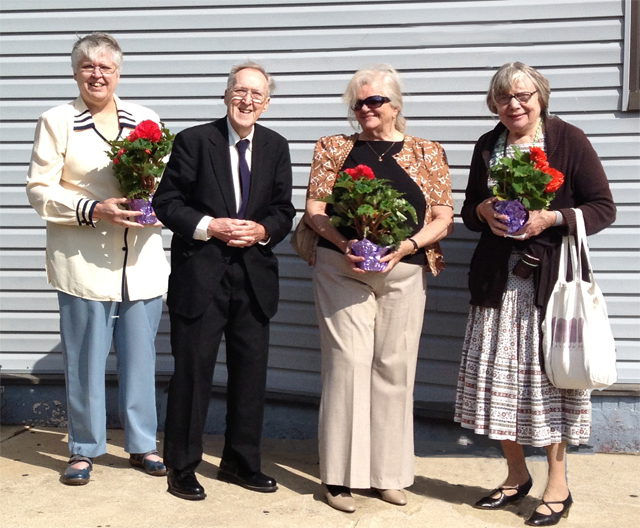
Potted posies were given as gifts to the mothers. So nice. Our pastor wanted one to put on his mother’s grave.

One of our Ambassadors asked for a detour on the way home to view some sculpture. It was worth the drive.

We had a Mothers Day Breakfast together.

Of course, at Redeemer, we all remember Mothers Day 2009, when SEPA Synod representatives visited our church and attempted to commandeer our worship service.

Measuring Diversity in the Church

“We Are Diverse”

One of the more frequent exclamations coming from SEPA Synod Assembly is the boast, “We are diverse.”

Just keep saying it and people might believe it.

Diversity in SEPA Synod is an illusion. Cloaks and mirrors.

The Synod Assembly is rigged to display diversity. Congregations are given extra votes and representation if they can prove diversity. A small church with darker skinned members can have more votes than small pale congregations.

Ecclesiastic gerrymandering also distorts gender and age. Most churches have a predominance of women in attendance, but congregations are required to send one female and one male member . . . creating the illusion of gender equality.

From the number of youth present at the Assembly, you’d think our churches were filled with energetic and engaged young people. They are not.

Diversity Within Diversity

When addressing diversity, the Church tends to fixate on skin color. Skin color alone, is broader than black and white and diversity is so much more than skin color. Skin color is easy to see and count  . . . and so we do!

Redeemer’s Ambassadors have visited more than 60 of SEPA’s 160 congregations, We began our visits in the city where racial diversity is likely to be more prevalent than in the suburbs. As we continue our visits, reaching into the suburbs, we doubt we’ll see more diversity than we already have. So far, we haven’t seen much!

We see many white congregations with a few assorted “others” and a few black congregations with a few assorted “others.” Of all the congregations we have visited we can count only about five that have a substantial representation of people from different racial or ethnic backgrounds. Each of these was a smaller congregation.

This includes Redeemer — who SEPA has excluded from Lutheran fellowship for five years. Redeemer had grown to be very diverse. We were diverse racially, culturally, linguistically, ethnically, economically, philosophically, and in gender and age. 

Our diversity didn’t earn us extra votes. In fact, we were denied any voice or vote in the Southeastern Pennsylvania Synod of the Evangelical Lutheran Church in America (SEPA ELCA) by decree of the bishop—a flagrant denial of congregational constitutional rights.

SEPA attempted to divide our congregation along racial lines. SEPA reported only our white members in reports to Synod Assembly. They further decided for our black members where they ought to go when they claimed our property—as if our black members were somehow too feeble to determine for themselves where they’d like to worship. It was OK if white Redeemer just disappeared. In fact, that was the plan.

“White Redeemer must be allowed to die. Black Redeemer . . . we can put them anywhere,” Bishop Burkat said in 2007.

Truth be told, there was great diversity among both our black and white memberships. We had African Americans, East Africans and West Africans. The Africans spoke many languages—French, Swahili and various tribal languages. We had white members born in England, Germany, Asia and America. We had regular visitors from India, France and South America and students from East Falls’ three universities. 

We don’t count.

Do Some Research

You don’t have to visit as we have to get a true picture of diversity. Just add the numbers in the parish reports available on the ELCA Trend site. The demographics of Lutheranism are very white and very aging.

Our visits reveal that most worship services are typically attended by women over 65.

More often than not, there are no children present in the sanctuary for worship. Children’s choirs, a rarity, tend to be very small and very young.

Youth are scarce. It will be 20 years (if ever) before the few young people will come to be of an age to support the church financially in the manner of previous generations. They will be saddled with college debt.

Leadership has a hard time recognizing reality when they look across the Synod Assembly and see the hand-picked representation that gathers to decide the future of the church.

SEPA has often chosen to let congregations die, providing minimal services for as long as 10 years rather than help congregations when a little help might have made a big difference.

This should be a serious concern to SEPA. Two decades could decimate dozens of congregations. It may be too late and far more costly than if this had been addressed 20 years ago.

Some Parting Questions and A Plan

Should diversity in the Church be measured at all if there is no way of recognizing it?

Is diversity so important that we create false impressions? What is to be gained?

We are one in the Lord.

The fact is diversity will soon be the new norm in most neighborhoods. We are ill-equipped to serve the changing population.

Lest you think we criticize without venturing solutions, check out vbsaid.com. It outlines a plan which 2×2 would love to sponsor and pioneer. It could help the many small, aging churches reconnect with their neighborhoods.

We dont want to see any more Lutheran property in the city, provided by the sacrifices of dedicated lay members, permanently sacrificed to plug short-sighted budget holes.

The plan requires cooperation within the church and between various expressions of the church, but we think it is worth the effort and will benefit all. Right now, all these expressions are struggling in isolation.

We know the perfect hub to implement this program. Midvale and Conrad in East Falls.

Networking in the Digital Age

martins

Missionaries to Sweden Visit with 2×2

2×2 has an unusually broad reach for a very small congregation. Our blog has made amazing things happen.

A local reader introduced friends of hers who are missionaries in the far north of Sweden to 2×2. They became regular readers and contributors.

They have been back in the states for a few months and asked to meet us.

The four of us had a lovely afternoon sharing mission stories.

Sweden is a traditionally Lutheran nation that has over the years become somewhat secular. Religion is respected, the churches are open, but large sanctuaries are far from filled.

Sound familiar?

Their mission centers on house churches. Many denominations use this concept in America with success. The church we visited with the largest attendance was a Presbyterian Church in the Fairmount neighborhood of Philadelphia. There were well over 200 at worship. We noticed in their bulletin that they had invitations to several house church meetings during the week. Two of them were in our neighborhood!

There is something attractive in the concept. Large gatherings can feel overwhelming. People lose the intimacy so important to faith-nurturing.

Lutherans have never been particularly strong on this idea, stressing the corporate nature of church even as their numbers steadily fail. It might be worth considering.

2×2 has some experience. We met in our homes for the first year and a half after being evicted from our property by the Southeastern Synod of the Evangelical Lutheran Church in America. We enjoyed the experience but it was difficultt to have any outreach or influence. We felt isolated from Christian community—which was the whole idea behind locking our doors. In isolation, we were expected to disappear.

We took to the idea of visiting churches with enthusiasm and our Ambassadors enjoy our visits.

So much of Lutheran attention centers on property and there are advantages. A church property is like a large billboard—a visual presence in the community. But if anything good is to happen inside that property, it is up to the people to nurture it—and that often happens best in small community. A dichotomy!

So it was interesting to talk with people who use the house church concept to reach individuals and thereby begin building Christian community.

So far, 2×2 has concentrated on building community with its web presence. That, too, is an interesting experimental mission — uncharted territory, really. We’ll take all the ideas we encounter to see what might be most effective for today’s faithful.

Blessed Are the Peacemakers

Redeemer’s First Sunday of the Month Worship

Once a month Redeemer worships in East Falls. Our Ambassadors were happy to be home this week. One of our Ambassadors had just returned from a trip to St. Augustine, Florida, and was brimming with news of her visit to a Missouri Lutheran Church there.

She had been invited to attend a Catholic church with some of her travel companions, but she was determined to visit a Lutheran Church in this old and historic city.

We did the research in advance and found there were only two—one ELCA and one Missouri. Both were quite a distance from the hotel where she was staying.

She talked of her $10 taxi ride to find the church with the taxi driver looking at a map with a magnifying glass as she hunted for the address. 
She found a small church of 55 members. They were celebrating ten new members, nearly 20% growth! (Redeemer had 82 members when SEPA took us to court to force our closure. We were growing, too.)

Two members took her under their wings, invited her to the new member reception, and drove her back to her hotel.

The church gave her a gift of a cross with Luther’s Seal. They had fashioned the nice medallion to sell to raise money for property renovation. They are encouraging others to emulate their successful fundraiser. We are all for congregational entrepreneurship!

Another Ambassador had brought a painting an artist in a previous congregation had given as a gift many years ago. The artist, now deceased, had become quite famous and has works in the Philadelphia Museum of Art. Our Ambassador had rich provenance from his personal relationship with this artist and shared many stories. It happened that another Ambassador was planning to attend a social that very afternoon featuring an appraiser from PBS’s Antiques Roadshow. We convinced him to take his “Lutheran” painting for appraisal.

We began worship sharing our week’s activities but soon settled down to hear the message of peace that was the lectionary theme for the day. Peace — that elusive, misunderstood, but welcome Christian concept.

We long for peace that doesn’t dehumanize us. Peace with passion, perhaps. Peace that doesn’t discern victors and victims.

Which brought our Ambassadors to talking about the signs that have gone up around Redeemer this week. The patronizing signs chastise local dog owners who let their pets run freely on the vacant property. I listened for a while as the Ambassadors talked about the desecration of sacred property. I thought they were talking about the dogs desecrating the property, but I soon realized that they considered the heavy-handed signs revealing an attitude of superiority to be the desecration.

Blessed are the peacemakers. Anyone know any peacemakers?

Or is peace one of those concepts Lutherans believe in theory only?

Ambassadors Visit Peace, Ben Salem

peace-bensalemFour Redeemer Ambassadors traveled to NE Philadelphia to visit Peace Lutheran Church in Ben Salem. We encountered a friendly, small congregation very much like Redeemer. There were about 30 in worship at their second service.

We were greeted by a very friendly woman who asked where we were from and sat with us for a short chat. She didn’t know where East Falls was and confessed to knowing little about Philadelphia. We suspect there are many in SEPA who don’t know much about East Falls or urban ministry but are less willing to admit it.

The sanctuary is small and comfortable. 100 people would fill it pretty well. There was a strong age representation.

A woman made an announcement that 198 meals had been prepared that week and announced other plans for their women’s group.

Someone offered to train anyone interested in handling church finances. The laity seemed to be showing leadership initiative—a very good thing.

A five-member choir sang new seasonal words to a Christmas tune — Rise Up Shepherds and Follow. The organist/choir director led hymns with an understated organ. Very nice. The hymns were favorites which made for comfortable worship.

Pastor Harold Evans strayed from the lectionary for the first time in more than a decade, he said, to address the age-old question, Where is God when bad things happen? He concluded with a quote: “He is in the same place He was when His Son was dying on the cross.” The message was an appropriate follow-up to a week accented by violence.There was also a prayer call to the altar.

We like the way they distributed communion. We see so many take and dunk “fast food” communion presentations where people file by stations. The purpose seems to be to get the ritual over with. Redeemer always took the time to gather together at the altar. So did Peace.

We enjoyed singing The Lord’s Prayer, even with that high F—or was it a G—at the end!

We spoke with several members after church and they seemed to be most congenial and good-humored.

Pastor Evans approached us after church and asked a few questions. He referred to the letters one of our Ambassadors sends from time to time. We had a nice conversation.

One of our Ambassadors will be looking up a Lutheran church in St. Augustine, Fla., next week. Who knows where the rest of us will go!?

Ambassadors Return to Prince of Peace, Plymouth Meeting

We had a new ambassador with us today so we wanted to make sure he had a good experience. We returned to the first church we visited two years ago, Prince of Peace, Plymouth Meeting, Pa.

We found the church celebrating a happy day—the baptism of a nine-year-old boy. We were greeted by people who remembered our last visit. We were delighted to find their worship population had doubled from our last visit.

Prince of Peace is celebrating their 50th anniversary. As the service began, an announcement was made. They were looking for names of people previously involved in their church. The woman making the announcement mentioned two people specifically. One was a prominent member of Redeemer! The other had worked with one of our ambassadors. We were happy to tell them what we knew about them.

Prince of Peace’s pastor, Rev. John Jorgenson, has been working to launch a program that centers on the strength of the family. He has a particular passion for families living with autism. He has been working with neighborhood groups and church agencies and his program, No Family Left Behind, launches in May.

We had a lovely morning, including a nice fellowship reception for their new young member.


Thank you for your words of support

elca mock logo
Anonymous Lutheran Addresses Redeemer Situation

I received an anonymous letter from a member of a SEPA congregation this week. The writer added a note that she was sending the letter to ELCA Presiding Bishop Hanson and several other church leaders including our local bishop.

She noted that she doubted letters make any difference. True, anonymous letters give the recipient an excuse to blow off any point the writer makes no matter how valid.

We understand the need for anonymity. We live in a Synod that is funding its ministry with seizures of property and lawsuits against laity.

Clergy have no room to criticize. Their universal silence on these issues is a form of anonymity.

We at Redeemer have written many signed letters almost all of which have been ignored. The single exception was the first letter we wrote to Bishop Hanson, probably early 2008. The Bishop glibly dismissed our very serious issues. Lots of God words, no God actions. His attitude trickles down to his staff and clergy. The ELCA legal offices, funded with parishioner offerings, responded to a Redeemer member’s letter with a note that they feel no obligation to get involved. Bishop Burkat has never responded to any of our letters. The people we pay to be there to make sure the congregations are protected spend our offerings protecting themselves.

We are going to reprint this anonymous letter because it has value. This writer took the time to understand the issues — something SEPA clergy, the Synod Council and Synod Assembly and the courts have failed to do. This writer nails the issues. Write on!

Here’s the letter (with minor spelling/grammar edits):

Dear Bishop Hanson,

I belong to Peace Lutheran Church in Bensalem, Pa., which is part of SEPA Synod. I recently attended a charity event in Philadelphia and met a woman from a church in Lansford, Pa. We got into a conversation about Redeemer Lutheran Church and Bishop Claire Burkat and how sad that their church was taken from them and how their valiant fight to regain their spiritual home was knocked down by the Pa Supreme Court, citing “church vs. state.” The woman I sat with told me that her church belongs to the Slovak-Zion Synod and that their Bishop (Rev. Wilma S. Kucharek) was investigated by the authorities for making improper withdrawals from a congregation’s accounts, causing the downfall of a church in New Jersey. She locked them out of their own church, like Burkat, and then sold their properties for a huge sum of money, forcing the congregation to now worship in a rented facility when they already had a mortgage-free church and parsonage of their own. She heard this from some people she knows that had attended a Synod Assembly cruise. Are you even aware of this in Chicago?

What kind of organization allows the taking of church properties that were built and paid for by the members of these congregations without any help from their synods. Just because you have hidden clauses in your constitutions that allow Synod Bishops to abscond with properties does NOT make it morally right. It is actually criminal to take by force another’s possessions for your own profit or gain. These clauses do not appear in the congregation’s constitution (I checked) but appear in the Synod’s constitution. How sneaky. Why didn’t you put this language in the congregations’  constitutions and spell it out more clearly so the average parishioner can understand the language? “That the Synod Bishop may close, at his/her discretion, the congregation’s church, seize their property, sell it, and then distribute the funds as he/she sees fit.” Wouldn’t that be more befitting to a religious organization to be honest and more forthcoming with the followers. You should also point out to the congregation to NOT come to you with their problems because you are an “interdependent” organization.

I am ashamed of how the ELCA has disgraced the Lutheran religion by ignoring Martin Luther’s principles of fair play for all. He would never condone abusing the weak by taking their possessions to further enhance one’s already lofty standing. Greed is a terrible sin. God knows who these bishops are. They can’t fool him with their empty prayers and their false justifications that they are doing this for the overall good of the Synod. These thefts of properties will be seen for what they are by the Lord.

Bishop Hanson, I’m sorry to say, the ELCA is now being run by bureaucrats and lawyers who don’t know what it’s like to honor the Lord by doing what is right in the Lord’s eyes and not the courts. There can be a happy medium but right now there isn’t. By the interdependent nature of the ELCA, you’ve divorced yourselves from your followers (the mass that supports the organization) by taking away their right to a fair an unbiased hearing regarding the closing of their churches. They can’t go to the courts because of the “separation between the church and state.” The Synod assemblies are a joke. The people who sit on these assemblies have no training in judicial matters in order to make proper judgments. They are just parishioners of local churches who volunteer to attend a yearly gathering and are clueless as to what’s going on. They are heavily influenced by the bishops, plus I don’t think that the bishops even need their approval to close a church.

It’s just so wrong that just one person can decide the fate of so many. At least the Catholics can go the Vatican Council in Rome where they have already overturned church closings in places like Cleveland, Ohio, by over-ruling local Bishops. The Lutherans have no such recourse.

Claire Burkat may have sued some members of Redeemer for standing up to her abuses, but she will not be able to sue me.

Signed, Disgusted

Here are a Few More Supporting Points

This writer describes the problems fairly accurately. The interdependent constitutions leave parishioners vulnerable to various self-serving interpretations, putting anyone who raises an issue at risk. Parishioners are the most vulnerable.

The writer also does not mention the founding Articles of Incorporation of ELCA Synods. These foundational documents forbid bishops from taking property and limit the power of the Synod Assembly. The writer is dead right that Synod Assemblies don’t know enough about church law to make decisions. Also, about a third of the Synod Assembly (the clergy) have a built-in bias. They owe their next call to their relationship with the bishop.

The clauses in the Synod constitutions have been altered over the years. The original model Synod Constitution calls for synodical administration to be temporary in nature and with the consent of the congregation. It was intended to help struggling congregations. Tweaks here and there presented to unsuspecting Synod Assemblies have reversed the intent of the constitution and violate the Articles of Incorporation—which was further compromised by Judge Lynn’s order regarding Redeemer, issued without hearing the case. Saint Paul knew what he was talking about when he advised church people to stay out of court!

Consequently, a clause intended to help congregations find their way through difficult times is now used to seize assets and help the synod through troubling times.

In Redeemer’s case, Redeemer appealed the issue of Synodical Administration to the Synod Assembly. The Synod Assembly never voted on the issue we appealed. Synod officials used our appeal to present a question allowing them to take our property (which we had not addressed in our appeal). Like lemmings the Synod Assembly voted on an entirely different issue—and an issue over which they have no constitutional authority. All SEPA Lutherans were victims of bait and switch.

Because of Synod Assemblies unquestioning decision, no Lutheran congregation really owns its own property anymore. A long-standing Lutheran tradition is gone. Your bishop needs only to make a claim on your property and your congregation is toast. There are no standards to be met. If Bishop Burkat needs your property to meet her budget (including her salary) she can claim it.

Back when Redeemer’s money was taken (1998) we were told the money would go to a Mission Fund. It was later reported that Mission Fund money is tapped by the Synod to fill deficits. When our Ambassadors visited Holy Spirit in NE Philadelphia, the week before they closed, their pastor explained that their money would go the the Bishop’s Discretionary Fund. At least that’s more transparent if not nobler. We suspect there is even less control over that fund than the misnamed Mission Fund.

We hope there are more letters written and we encourage you to sign them. Send them our way. As long as they are factually accurate, we will consider publishing them. At least you’ll know your letter has a chance of being read. Right now, the ELCA’s circular files are wide and deep!

The best people to put an end to the travesties of SEPA Synod are SEPA Lutherans. Ask your Synod Assembly to revisit the issues with Redeemer. We are still alive and well. We have grown a base of support during our years of exile and are ready to resume our ministry with our property— if SEPA Lutherans can ever manage to deal with the issues for which they have accepted responsibility.

It should be obvious to SEPA Lutherans that the sad story of Redeemer’s lack of viability was always a crock. Redeemer, even with many of its members in hiding, is stronger today than ever. We reach more people each week than any church in SEPA. We are positioned to restore our endowment to its 1990s high point—before SEPA cast its line over our waters (and they weren’t fishing for men).

There is more economic potential in open churches than in closed churches.


The Squandering of a Small Congregation’s Reputation

clrgyglassesChurch Vision: A Study in Black and White

Congregations and clergy, including regional leaders, are often strangers to one another.

Regional leaders can know very little about the congregations they serve or the people who support them with their offerings.

It is not likely that they visit often with lay leaders. Even if they did, lay leadership shifts every couple of years or so.

Regional leaders have only two sources of information.

  1. Annual parish reports (completed and submitted by clergy) 
  2. Pastors’ firsthand accounts which can not help but be delivered with self-interest.   

Regional leaders are likely to come into contact with congregations at pivotal times in a congregation’s history.

  1. When they need to call a new pastor for any number of reasons.
  2. When there is some form of conflict, which often involves a pastor.

Consequently, regional leaders are likely to have a very biased view of a congregation.

When they don’t know what’s going on they fall back on numbers — not seriously considering what the numbers represent.

They might send someone to visit a church and report their findings. That visitor reports there are only 14 in worship. They have no way of knowing that 50 usual attendees are really upset about something that might involve the pastor. They are not going to hear about this from the pastor! They come to the conclusion that the church cannot survive. They never deal with the problems. When the regional body is hungry for assets, it is easy to reach this lazy conclusion.

The congregation then has a reputation among clergy. The memory for this reputation is quite long. Clergy might comment: “Wasn’t there trouble in 1960?” The congregation has no idea what they are talking about!

Lay people are often unaware of the power of the clergy gossip mill. They are unlikely to be part of the conversation that can spin out of control with no way to correct misunderstandings.

Clergy are sometimes so self-absorbed that they even come up with trendy slang. Years ago, pastors talked among themselves about alligators. “Who is the alligator in your church?” they might ask one another. An alligator in clergyspeak is a lay person who lurks in the congregational water ready (in this clergy person’s mind) to snap its jaws on a pastor’s throat. Paranoia? Perhaps! It reflects neither love nor respect for their flock. It does untold damage to a congregation within the Church—all the less fortunate when it voids the congregation’s reputation outside of ecclesiastic circles.

Every congregation has a reputation in its community. Clergy can influence it or they can exist totally unaware of it.

This reputation spans longer periods of time—generations—and takes in the community’s knowledge of the congregation’s participation and response to community needs and the lives they have touched that may not be part of the congregation’s membership or collected statistics.

The community measures churches with a different yardstick.

  • They work together on community projects.
  • Their children attend schools and programs sponsored by the church.
  • The community can count on the congregation to share their facilities generously.
  • The community remembers a congregation’s response to a local disaster.
  • They may have acquaintances and family members whose lives were touched in some small but significant way.
  • The community knows nothing and cares less about denominational involvement or reputation. They only know what they see and that’s the local congregation and its members.

A regional body has no way of measuring this, except as filtered through the clergy. Too bad. This reputation is an asset to the entire denomination. It is far more powerful than slogans or logos or even press releases.

The challenge to the Church is to know a congregation’s reputation and protect and nurture it. It must learn to separate the truth from the gossip. This becomes difficult when the regional body’s interests are limited to placing pastors and accumulating assets.

2×2 published a parable about this division between clergy and lay leaders and how it impacts the small church and the mission of the church. It is based on our 60 visits to local congregations—most of them quite small. It is meant to spark discussion on how clergy and laity can work together and advance mission with the limited resources (both human and financial) which define today’s church.

LandingPageWidgetRead Undercover Bishop. Share its short chapters weekly with your congregation. Ask if they see themselves anywhere in the story. Study questions are included at the end of the book.

UndercoverBishop

Easter 2013: Four Years Locked Out of Our Church

RedeemerEaster2013lrCan No One Roll the Stone Away?

Redeemer members gathered this Easter on the sidewalks of our forbidden house of worship. Our pastor led us in a song. We took turns singing verses of I Know That My Redeemer Lives. Redeemer still is a church full of soloists.

We then went to a member’s home for Easter Fellowship. Ham and kielbasa. Delicious.

We had changed our Easter time to accommodate the plans of our members. So when two carloads passed by the church at the normal time for Redeemer worship (10 am) they found an empty church (as opposed to an empty tomb).

We caught up with them later and took a second photo.

Fortunately, we can resurrect our sign which our bishop was so intent on destroying. It’s looking better than the church!

Take away the name. Take away the heritage. Destroy the church. Control the wealth.

SEPA, let the people who love a church, care for it. That’s the Lutheran way.

RedeemerEasterBaptism

Ambassadors Visit Reformation, Media, Pa.

Palm Sunday in Media

reformation:mediaRedeemer Ambassadors decided not to miss Palm Sunday. We hopped on the Blue Route and were in Media in less than 30 minutes.

Reformation, Media is the 57th SEPA congregation we visited.

We attended the second service and found a packed sanctuary. Empty seats were few. There were probably around 200 in attendance. As seems to be common these days there was a lot of moving around in the back of the church.

First Communion for six young people and the tradition of Palm Sunday brought people out.

We spoke with two people and found we had something in common with both. The first woman we spoke with told us about her mother’s work in a mission hospital in Madras, India, in the late 1920s and 1930s. One of our Ambassadors was born in the southern India mission fields at the same time. His parents were missionaries there for 25 years. The second woman we spoke to was introduced as being from the western part of Pennsylvania. Two Ambassadors have roots in the same town. She knew the pastor of our church. In fact, we lived in the same house as her friends!

Try as they do, SEPA cannot disconnect Redeemer from our heritage.

The adult choir was strong and led the traditional singing of The Palms. It’s our tradition, too. Our organist always balked at playing it. He considered it unsingable. One of our former leaders, not known for her voice, finally told him, “If I can sing it, you can play it.” He played it.

Their music director chose excellent music for two choirs. Their adult choir did a dramatic anthem —almost theatrical.

A five-member children’s choir — all girls — did a nice Natalie Sleeth number. We used a lot of Natalie Sleeth anthems as hymns at Redeemer. She was a great church musician.

Reformation did an abbreviated version of the Passion Story but left out the Psalm and Epistle. The voice of Isaiah was heard, though.

They used three Palm Sunday hymns. The version of Ride On, Ride On in Majesty in the new Lutheran hymnal is deadly and the congregation sat it out along with us!

It was explained to us afterward that some elements of the service are traditional for them and were not included in the bulletin. We understand the importance of tradition and miss our own.

Reformation has a “bridge” pastor, the Rev. Arden Krych. We encounter interim pastors, mission pastors, and bridge pastors. Bridge pastors, it seems, are post-interim pastors — a second stage of “interimness.” We continue to believe that the interim minister process is a symptom of a growing clergy body seeking flexibility in their careers. Their needs are in contrast to the needs of congregations who are encouraged to seek “settled” relationships with pastors.

Redeemer was not part of any such process. Not our choice. Bishop Almquist broke the contract we had with an interim pastor in 1997. We were left on our own for most of the next decade. We found our own “between calls” pastors.

We know now that this neglect was intentional. A step toward closing our congregation. It is actually a stated policy of Bishop Burkat who advises church leaders to not waste time and resources on congregations that will close in TEN years. Ten years of neglect will close a lot of churches!

We hope Reformation has better luck with “the process.”

Reformation owns a nice tract of land. They acquired adjacent property and cleared some old homes.

We liked the flexible seating—chairs, not pews. We also liked that name tags were available for members and a good number were wearing them.

Someone introduced us as from a closed church. We corrected them. Redeemer is not closed; we are locked out of God’s House by SEPA Synod. It’s time for SEPA Synod to revisit their thinking in regards to Redeemer and our community as we have continued to grow even under oppression.

Locked out and shunned by SEPA, we took our ministry online. We are experiencing exponential growth. We doubled and then tripled our growth over the last six weeks. Redeemer now has a greater reach than any SEPA congregation. We now have almost 1400 visits to our website every week (nearly twice the average weekly attendance of SEPA’s largest church). We continue to grow — just as we were in 2008 when SEPA coveted our property.

There is more economic potential in open churches than in closed churches. (Click to Tweet)

If there were ever any questions about our ability to survive (and this was never discussed with US), they are now debunked. Had SEPA worked with us (as they have falsely claimed) we’d have money to share and a new model for ministry that might help other congregations.

A lot of churches talk about transformation. We have done it!

SEPA’s actions in East Falls and Roxborough have resulted in almost no Lutheran presence in the largest geographic neighborhood in Philadelphia. In addition, they leave a horrendous legacy for future Lutherans to overcome.

Reconciliation is the only answer, but reconciliation takes dialog. There has been no dialog with our congregation since 2007.

Now would be a good time to resume.

And so we continue to visit all the congregations who voted (against their own governing rules) to take our property. We meet a lot of good people who are generally unaware of their churches actions. That’s a shame.