Rev. Carlton Rodgers led worship punctuated by music from many genres, with a fine seven-member choir, which the congregation often joined in song. Pastor Rodgers has been serving Tabernacle for nine years.
The pianist, Peter Charalambidis, was excellent and moved effortlessly from liturgy to gospel song to praise hymn to mainstream hymn. A deacon, Samuel Barham, led much of the service and singing with a resonating voice.
The pastor referenced hardship with no specifics. One member told us they had recovered from two fires. We saw on their website that one had occurred in 1969 and destroyed their large stone structure. Redeemer had also recovered from a devastating fire so we know something about recovery. We rebuilt our sanctuary without any outside help and went on to build an education building a few decades later, also with no synodical help.
Tabernacle is a “transformation” church which means they are receiving some special attention in reviving their neighborhood ministry. Our congregation had undergone a transformation that synod refused to recognize, probably because it was largely lay led, but we had begun to attract many new members with dedicated work of our membership.
The people of Tabernacle made a special effort to greet us. The passing of the peace was not part of the service but we were passed the Peace of the Lord by almost everyone we passed as we left the sanctuary.
Attendance was about 30 although we made no effort to count. There were about five children and youth.
The congregation led prayer with a number of people leading lengthy and heartfelt prayer requests. A book we are about to review, Scattering Seeds, points to the ability of lay members to lead unscripted prayer as a sign of congregational vitality. Tabernacle has that.
The congregation seemed to enjoy each other’s company and many plans for congregational events were discussed.
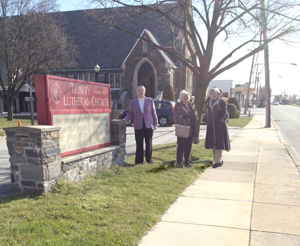
Three Redeemer Ambassadors visited this active church on West Chester Pike near City Line Avenue this morning. The congregation has been of interest to us for some time since one of our members, a retired Lutheran minister, remembers serving his internship year with this congregation 60 years ago. Unfortunately, he wasn’t with us this morning, but we took photos to share with him!
The 10:45 service had about 60 in attendance, including a nine-member choir and piano accompanist for all worship. A lovely solo, Panis Angelicus, began the service. The sermon was about keeping the first commandment — giving your all for Lord. The message rang clear to our Ambassadors as our people have sacrificed greatly for our church, laying much on the line as individuals. Our devotion has been ridiculed and taken advantage of by denominational leaders. But the pastor, Dr. Dolores Littleton, admitted in her sermon that it is a difficult commandment to honor.
Members were quite friendly. Several went out of their way to talk with us and we had several good conversations.
The congregation seemed to be pulling together on many projects including an upcoming mission trip to West Virginia. It was older adults bragging to us about their youth’s activities. Their youth had just participated in a youth retreat in New Jersey and slides from that event were on display in the fellowship room.
One member talked to us about a ministry meeting in their building called Oromo. We had seen this listed in directories but could learn nothing about it. He described it as a ministry exclusive to those from an area of Ethiopia. We discussed our East African outreach with him and how we had grown into a multicultural congregation.
The pastor expressed a sentiment that she wished Redeemer members could move on and forget all the anger. Anger is a rightful byproduct of injustice.
No one suggesting we should move on — including our bishop — ever presents any realistic options. Law suits filed against our church and individual church members left no choice but to defend.
Which church near us (all which voted to take our property) would be willing to welcome us? We’ve visited almost all of them. They are very much like Redeemer in size and joining one of them is likely to find us being treated the same way all over again in a few years, just as our nearest neighbors — Grace and Epiphany, Roxborough, were before us. We care about our church and neighborhoods and are bound by faith to minister in our own community.
Redeemer is dedicated to finding answers to urban ministry challenges — not shuffling people, their faith and properties like playing cards.
Last Sunday four Redeemer Ambassadors visited the suburban congregation Christ’s Lutheran Church in Oreland, Pa. This was our 40th congregational visit.
We arrived to find a nearly full parking lot. The front door was hard to find from where we parked. We followed signs for the church office and ended up entering the busy sanctuary from the front of the church. This may have been the largest congregation we’ve encountered and was particularly impressive that it was the first Sunday in Lent, not a popular holiday. The other large congregations we visited on Reformation Sunday and Palm Sunday.
We were interested in Christ’s because one of our former pastors had come to us from this congregation back in the 1980s. We were happy to see that the service was very well attended with a healthy mix of ages. The organist was away but the substitute pianist did a great job with a beautiful prelude rendition of “When I Survey the Wondrous Cross.” Her hymn choices during communion were also very nice.
A children’s choir sang. This was only about the third children’s choir we have encountered. The adult choir nearly filled the chancel area. It was the largest choir we have encountered so far and had a well-balanced blend.
Rev. Kay Braun led a lovely service. She is listed as senior pastor but apparently she is the only pastor.
We left the service through the same door we arrived and did not talk to anyone. The side door opened to an area surrounded on three sides by brick walls and the sound reverberated, reminding us of Redeemer’s plans to someday build an outside worship area using the hill and church wall to amplify sound.
The bulletin announced a number of fun ideas, including a “Guess Who Is Coming to Dinner” event where participants sign up to either host or attend dinner in someone’s home . . . only who will go to which host’s home is not announced until just before the appointed time. Sounds like a fun mixer!
A long announcement period before the service talked of many mission projects.
Our own events, weather and other commitments grounded the Redeemer Ambassadors over the holidays but we returned in good force this week with a visit to St. Paul’s, Ardmore. This was our 39th visit.
St. Paul’s has two services with fellowship in between. We entered their fellowship area and were met at an Official Visitor’s Center. St. Paul’s has been working on its outreach to visitors. We had a long talk with several members before the service began. Several members made a point of greeting us away from the greeting station. Pastor McDowell greeted us after the service as well. It is always noticeable when congregations are consciously practicing welcoming hospitality.
One of the greeters said she was a fairly new member but explained that the visitor’s greeting desk was begun about five years ago. They present a visitor with a gift mug filled with goodies as they leave. If you are in the neighborhood, they offer to bring the gift along when making a follow-up visit. We noticed in their newsletter that they accepted about ten members last quarter.
The 10:30 service had about 60 in attendance, including 17 serving at the altar and in the choir. The music offerings were glorious and included a violin solo, which we missed because we entered the sanctuary during the announcements, after the prelude, and an ambitious anthem set to the tune of the “Let All Mortal Flesh Keep Silence.”
The congregation is on its fourth building and has been at its present site since the 1940s. The colorful stained glass windows were saved from previous buildings and incorporated into a colorful sanctuary. The color seemed to leap from the windows’ traditional depictions from the life of Christ to the exposed beams arching across the sanctuary. The color throughout the sanctuary complemented a more reserved chancel area, accented by a small, circular depiction of Christ at prayer. All in all . . . beautiful.
While there were children in the fellowship area, we saw none at this second worship service.
Their bulletin flier was filled with projects and service opportunities.
One of our ambassadors commented that while she misses our own church she really enjoys our church visits. The Ambassadors have begun to look forward to our Sunday morning excursions and fellowship during and after our church visits. We share breakfast together and plan church activities for the week.
Redeemer is not closed; we are locked out of God’s House by SEPA Synod.
As a people, Americans have become suspicious and xenophobic. We live in a world that recommends background checks and fosters credit checks for simplest of reasons. These attitutudes are bound to manifest in church life.
But church life should be different. We should be welcoming the people with spotty backgrounds. Christ died for them! The least we can do is welcome them into His church!
Most churches describe themselves as friendly. Some church web sites describe themselves as “truly friendly.” Many churches post a generic sign “All Welcome.”
Friendliness, however, is a beauty that can only be measured by the eye of the beholder. If visitors to your church leave feeling they were wallflowers, observers of friendliness, it is not hospitality.
Redeemer Ambassadors visited 38 churches in the last 18 months. We have experience as recipients of church hospitality. We think this is an area of church life that needs to be addressed.
Hospitality, once part of the fabric of American life, no longer seems to come naturally. It may have to be taught and nurtured. Even pastors, whom we presume received training in evangelism, seem to be awkward in greeting church visitors.
Some churches have assigned “greeters.” But the gauntlet of greeters characteristically do little more than hand you a bulletin. We suspect that visitors are rare in some congregations and that leads to a bit of rustiness.
In several of the churches we visited, the pastor disappeared after the service and did not greet people at the door. At times the pastor was present in the fellowship area but stood along the wall and waited for people to come to him/her.
While some pastors pointed us to guest books to sign, most never introduced themselves to us or asked our names. After 38 visits, only one pastor followed up with a phone call after our visit. Another returned a call when one of our ambassadors called him.
Some churches seemed to have fellowship going on somewhere else in the building. The congregation disappeared quickly after worship, failing to invite us to join. In many cases, people walked by in the narthex and never made eye contact. In one instance, when we approached them and asked a simple question such as the location of a restroom, they responded, “Oh, we thought you knew someone here” or “We thought you were here for the baptism.” Assumptions block hospitality.
The number of churches/pastors who exhibited true hospitality are so few as to be memorable to us. We suspect that if others were greeted the way we were in these churches that they would return. Here are a few efforts we remember and appreciated as visitors:
When a pastor personally invited us to fellowship, accompanied us and introduced us to a few people (one church visit).
When a pastor asked if he could meet with us sometime during the week (one church visit).
When a member took the time to give us a tour of their church and told us something of their history (three church visits).
When a lay member sent us a handwritten thank you note for our visit (one church visit).
When a member sat next to us and pointed things out in the bulletin (one church visit).
When we left knowing at least one member’s name (a few times).
When members of a church offered to help us (more than just pray) and followed through (three church visits).
When a member engaged us in extensive conversation that was about us as much as about them (six visits).
When congregation members prompted the worship leader to introduce visitors (two visits).
When a pastor asked us to join their congregation (one church visit).
Here are four easy resolutions your church can make in 2012 to become a more welcoming, hospitable church:
Make sure each visitor knows the name of at least one church member before they leave.
Make sure each visitor is addressed by name before they leave.
Make sure each visitor receives a direct and specific invitation to a church activity. It can be next week’s worship or some other event. Most people report that they became involved in a congregation because someone invited them!
Contact your visitor within five days of their visit with a phone call or greeting card. Make it as personal as possible.
The Redeemer Ambassadors have now visited just shy of one fourth of the churches in SEPA Synod.
As we enter the 2012, we have some observations to share.
Attendance is challenged across the board. We attended many services with fewer people than Redeemer.
The Lutheran Church is aging. There are few children attending church and even fewer tweens and teens. A typical service at Redeemer had half the congregation under 18.
Hospitality is a challenge. Most congregations are friendly and say hello but generally few make any attempt to introduce themselves or engage visitors. This includes clergy.
There are many churches in interim, bridge or mission redevelopment ministries, which means that their ministries are monitored by the Synod to some extent. SEPA broke its interim ministry contract with Redeemer.
Worship style and communion practices differ from congregation to congregation.
Most congregations do not use hymnals but print comprehensive bulletins. Redeemer does too.
Racial and ethnic diversity is rare. Less than 10% of the congregations we visited had broad diversity. Redeemer is mixed both racially and culturally.
Languages other than English are rare as well. Redeemer is multilingual and our worship reflects this.
People love their congregations and are proud of who they are. So does Redeemer.
People feel little connection with the greater church. There is a sense that they are alone in ministry and that they cannot expect constructive help from their denomination. Synod had almost no contact with Redeemer for a decade. We feel the same way. Interesting aside: Several church consulting groups across the nation have published statistics that indicate that 75% of church members disapprove of their denominational leadership — with an additional 10-15% weighing in with “not sure” responses. This should be a cause of concern!
Most congregations need more leadership than they can afford the old-fashioned way. If congregations are to grow, the denomination needs to help them find creative and affordable solutions to leadership challenges. As it is, some congregations are doing this successfully on their own with impressive commitment from their lay leaders. Unfortunately, they sense that asking for help might bring the same kind of actions from Synod that Redeemer experienced.
Most churches have very little knowledge of their nearest neighboring Lutheran congregations and even less of those farther away. Redeemer was much like everyone else until we started our Ambassador’s program!
“Let the little children come to me, and do not hinder them, for the kingdom of God belongs to such as these.” Mark 10:13-15
Our Ambassador visits reveal a remarkable variety of approaches to what seems to be the simple task of welcoming. Some assign the task to official greeters; others let the pastor handle it. Some ask visitors to introduce themselves; some point you to the guest book. Some church members wear name tags. Some offer coffee and sweets; others offer a meal.
There is a sense that this can be a challenge to congregations, especially when visitors have been rare for a while. While our Ambassadors cannot claim that they ever have been made to feel unwelcome, there are some churches who have honed their greeting skills a bit more than others.
We suspect one of the congregations we visited was conscious that this might be a weak point in their ministry. The bulletin included a prayer petition that their congregation “may learn the hospitality of Scripture and welcome our friends, family and guests with it.” Interestingly, while the congregation was entirely pleasant in passing the peace and saying hello, not a soul introduced themselves–not even the pastor. In contrast, on another visit to a church where the pastor was away, we were greeted first on the sidewalk and by virtually every person who walked into the sanctuary. We were even offered a tour after the service. We knew the names of several members before worship began. Their liturgy included a moment early in the service for welcoming. Hospitality clearly had been modeled and engrained in this community for some time.
As in much of church work there is a temptation to create a program for encouraging hospitality. It should be as simple as modeling good habits. Start with the children!
Redeemer Lutheran in the East Falls neighborhood of Philadelphia, had a strong ministry to East African immigrants. Upon entering the home of one of our immigrant families, every family member comes to the door and shakes your hand. It was not surprising to see even the youngest children practicing this skill in church. It gave them a confidence that grew and soon translated into other skills.
This custom, brought to us from a foreign land, flies in the face of America’s best parenting practices.
We teach our children “don’t talk to strangers.” Adults tend to model what they teach their children. Our children can grow into adults who are afraid to reach out to shake hands and say the simplest words of introduction, “Hello. Welcome to our church. I am Tom. What is your name?”
This simple script is a recipe for teaching the fundamentals of hospitality. Begin to teach your congregation welcoming skills by teaching this script to your children.
Give a children’s sermon on “welcoming.” There are many scriptures to use as a foundation, including the “Suffer the little children” passage quoted above from the NIV translation.
As an exercise, ask the children to shake one another’s hands and follow the script. Allow enough time for them to get over the awkward giggles.
When they have greeted every child. Ask them to walk down the aisle and practice it with adults. Ask older children to walk beside them to help them.
Ask the adults to turn to the person next to them and practice.
Repeat as needed.
Give the congregation the assignment of doing this every week with every visitor. Make sure they see church leaders practicing what they preach! If visitors are rare, practice on the people you know. Be ready to greet the first new face!
We’ve been traveling far lately but we decided to make our 36th church visit a bit closer to home. St. Paul’s is in the neighborhood of Lansdowne midway between two of our other recent visits– Upper Darby and Drexel Hill. Despite proximity, the three churches are very different, revealing the profound changes between neighboring communities. Attendance at St. Paul’s was similar to Upper Darby in number, but the smaller sanctuary felt fuller.
St. Paul’s web site noted that worship is led twice each month by a contemporary band, Covenant. We were fortunate to encounter one of these weeks. The band varied in size and participation throughout the service but had an accomplished pianist at its hub with drums, percussion, two clarinets, and a guitar, at least. There were about eight instrumental and voice leaders. They used mostly contemporary hymns. The well-known Advent hymn, O Come, O Come Emmanuel, was starkly beautiful as the band held back and the congregation’s voices carried the tune.
In general, the atmosphere of worship was well regulated to follow the drama of the worship readings and liturgy.
Twelve or more members stepped forward to sing an anthem in the Klezmer tradition. When Will Messiah Come? was well accompanied by the band’s clarinets. This is the largest choir we encountered in a small congregation and may have been as large as the choirs in the biggest congregations we have visited.
There was no fellowship time so there was little opportunity to interact with anyone. We nevertheless enjoyed our 36th congregational visit.
Our Ambassadors study web sites as we prepare for visits. A few have snappy web sites or adequate, static sites. Some have barely functioning web sites. A surprising number have no internet presence whatsoever.
Now and then we come across a web site that features a Pastor’s Blog. This raises our interest. Blogging is a passion of 2×2’s. We have come to expect disappointment. The blogs are often no more than a few posts, months apart, and the most recent post is often years old. The blog posts tend to be personal musings aimed at the congregation’s existing community. No wonder they ran out of steam!
Ministry opportunity is being lost! Pastors should blog. Congregations should blog. Here’s why:
Blogging is team work. Maintaining and growing a blog is work that should be shared. Working together on developing a good congregational blog will help your members and leaders bond, build community, and find ministry and mission opportunities.
Blogging provides direction. Blogging is a tool to help your congregation stay connected with the people you serve. Posting content several times a week is good lubrication to keep your ministry from getting rusty. You will be looking constantly for issues to address. You will meet new people and organizations. Who knows how this could impact your ministry?
Blogging builds trust. Bloggers wear their hearts on their sleeves. Publishing daily in a forum where your thinking can be challenged as easily as applauded keeps your thinking grounded. Readers will notice, respect and trust that you have others’ interests at heart.
Blogging helps you reach out.Blogs help seekers find you. This won’t happen with four posts a year though! You need to treat your blog with the same importance you treat the preparation of a sermon or worship service. It is likely that it will be read by many times the number of people who attend worship! (2×2 started our blog nine months ago. We now have 100-150 new readers every week!)
Blogging expands your point of view. Blogs allow for interaction. Your readers can comment on the ideas you present. Commenters influence the dialogue. They may applaud your efforts; they may point you in a different direction. Good bloggers listen and respond to all legitimate comments whether they agree or not.
Blogging returns us to Christ’s approach to outreach. Congregations often exist with a fairly narrow focus on the world, fashioning ministries around tradition and doctrine. Outreach efforts often focus on trying to find people who fit into the community culture as it already exists, with thinking that mirrors their own. In contrast, Christ’s approach was to build upon encounters with the least likely prospects. With disciples grumbling in the background, Christ approached lepers, the possessed, children, women, criminals, rulers, church authorities and outcasts.
There is power and momentum in blogging. It takes work, but it is work that can bear fruit and multiply.
Second time’s the charm. Last week we set out to visit St. Michael, Unionville, and ran into multiple detours and road blocks. We returned this week and experienced no problems.
St. Michael’s appears to be a thriving congregation that relocated to a 7-acre rural lot about 25 years ago and has undergone some major expansion projects since. We entered an unusual sanctuary, much wider than long. Attendance on this Thanksgiving weekend was probably a little over 100, although we didn’t tally.
Their worship was traditional with an LBW liturgy. A hostess explained after the service that the choir had a week off in preparation for the busy holiday season to come. Two members sang a beautiful duet. They introduced one new Advent hymn and used several other more traditional Advent hymns.
Their new associate pastor gave a nice sermon and children’s sermon and blessed the work of their knitters and crocheters who had made prayer shawls. They seemed to be in the midst of a stewardship drive — seems to be that time of year!
We also heard a talk from a son of the congregation involved in mission work in Mexico. He talked about taking an ethnocentric approach to spreading the Gospel and noted that their were 8000 ethnic groups or “nations” waiting to hear the Good News. He claimed that the Gospel is often best shared in setting geared to individual ethnic traditions. We talked with him extensively after the service and shared our multicultural approach.
We talked to several members after church and learned a good deal about their ministry experiences.
We inquired about their new web site project which we had reviewed before attending.
We had a delightful visit and enjoyed sharing our story and learning from theirs.
Join Bishop Ruby Kinisa as she visits small churches "under cover" to learn what people would never share if they knew they were talking to their bishop.
Undercover Bishop will always be available in PDF form on 2x2virtualchurch.com for FREE.
Print or Kindle copies are available on Amazon.com.
For bulk copies, please contact 2x2: creation@dca.net.
MISSION INSPIRATION OFFER
A visual and biblical guide to help congregations define their missions.
Contact Info
You can reach
Judy Gotwald,
the moderator of 2x2,
at
creation@dca.net
or 215 605 8774
Redeemer’s Prayer
We were all once strangers, the weakest, the outcasts, until someone came to our defense, included us, empowered us, reconciled us (1 Cor. 2; Eph. 2).
Be calm. Wait. Wait. Commit your cause to God. He will make it succeed. Look for Him a little at a time. Wait. Wait. But since this waiting seems long to the flesh and appears like death, the flesh always wavers. But keep faith. Patience will overcome wickedness.
—Martin Luther



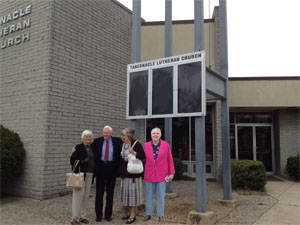 The Redeemer visited Tabernacle on 58th and Spruce in West Philadelphia for a spirited two-hour worship.