4/7InkzHVUEQeEdU9vpc1tikzEhChrKmPfvXI-FSDBrBQ

Commentary

The Beleaguered Life of the Laity

It isn’t easy being a lay person in the church.

Sometimes we come to the church by birth and tradition. Sometimes we buy into the message having had little church background. Ultimately, it’s a life we choose. It doesn’t matter how we got here. Neither door warns us of what is in store. 

  • We will be relied upon to do much of the work with little recognition and no compensation.
  • We are expected to adapt to every changing leader, shelving our lay talents if necessary.
  • All our work and passion can be dashed at any moment by political forces in the church that consider neither the contributions of nor the consequences to the laity.
  • Our beliefs, fostered by passion, can be sorely tested.
  • At worst, we risk family, friends, social standing, profession and earthly possessions—while clergy carefully watch their compensation plans.

It’s exactly the life Jesus foretells in next Sunday’s scripture (Luke 14:25-33), but it isn’t what today’s church is selling.

There are few enough people in church today. Best to preach the happy life. Church membership is a rabbit’s foot.

In our Ambassadors 71 visits, we have spoken with countless lay people. They often share the same aura—a sense of  futility. They are stuck believing in a message that their leaders don’t really believe anymore. They continue to work and sacrifice and see little benefit to the communities they love. They are taken for granted. They face a very real and ugly possibility. Church leaders may be waiting for them to fail.

In one of our recent Ambassador visits, I spoke with a woman who admitted she was one of the old guard. She was genuinely happy to see some new life in their church but seemed resigned in her new role as bystander. She was clearly worn down. There was a sense that the new people, welcome as they were, mattered. She and her friends were has-beens.

As we left, I told her that we had visited dozens of churches and her church was as good as any of them. I was surprised at the look of gratitude that swept across her face. A cloud lifted—the cloud of living under a judging eye. She suddenly seemed happy and enthusiastic.

A little validation goes a long way.

Why don’t we work a bit harder at pumping up the real rank and file—not just the ones who gain status by attending church-wide functions but the ones who stay home and teach the Sunday School and sing in the choir and sweep the floors and fold the bulletins—the ones who live with the problems church leadership would sweep away.

The annual rallying cries at Synod Assemblies fail to recognize the basic problems most congregations are facing.

  • There are very few people in church under 40. Therefore, probably half our congregations will be facing serious problems of survival within 20 years.
  • The modern cost of living has outpaced many churches’ sources of income.
  • Most congregations can afford ministry but they cannot afford benevolence.
  • There is no infrastructure to welcome the diversity we seek.
  • The pool of pastors who are willing to commit to neighborhood ministry is very shallow.
  • Church life is slow to embrace or connect with the fast-changing world that lay people face every day.

The Church’s survival depends upon the lay people.

Jesus’ message—it was for us!
Transforming Trends in the Church-5

longtailTREND 5
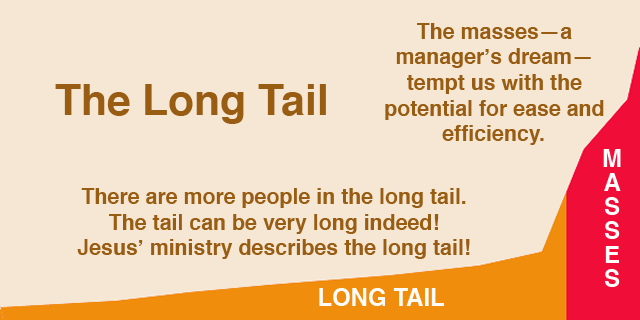
The Long Tail

Huh? What’s the Long Tail?

This is a term familiar to marketers. It refers to niche marketing. Major retailers are generally interested in selling lots of just a few products. The emphasis is on creating products that will appeal to everyone.

This traditional business model is why it was hard to get a book published. Publishers wanted to make sure it was worth printing 100,000 copies minimally. If your interest was canoeing in Nepal or the life-cycle of spiders, you were out of luck!

The internet has made it possible for products that appeal to smaller audiences to be profitable, too. In fact, there is great potential in recognizing the people who go against the mainstream. It is a numbers game. There are an awful lot of people in the world!

The result in the publishing world, with which I am most familiar, has been an exciting explosion of new titles.

What does this mean for Church?

Actually, the Church is the original long-tail marketer. They’ve just forgotten it! Click to Tweet.

Jesus’ approach to ministry describes the long tail. Seek and serve the marginal members of society—everyone from the rich man and educated Nicodemus—to the dead, infirm, and dying—to the women and children with no status—to the foreigners.

As the Church grew, every neighborhood was a “niche.” But today, the Church is abandoning its strength, hoping for economic strength in size.

This may be a long-term disaster.

Large churches are not filling the gap of the abandoned small faith communities. A few are growing slowly but most are in decline. People like to worship with people they know. Being part of a crowd may be fiscally desirable, but faith doesn’t work that way. Most churches will continue with memberships hovering between 100 and 300 ( a third of them active) until the Church abandons them. That’s the way it’s always been and it follows the findings of sociology that it’s the way it will always be.

We already know the small church works well—perhaps even best. The challenge to the Church is to keep small churches viable and in keeping with their expectations. This requires entrepreneurial thinking which is not prevalent in the Church.

Churches like to do things the same way (while preaching transformation). They have an expensive infrastructure that resists change and requires size.

The concept can even be seen in their approach to mission.

Redeemer’s membership was always an immigrant population. Early members were western European. The immigrants of recent years represented five continents. Many from East Africa found their way to our door. We welcomed them and they were part of a truly transforming ministry.

The Synod, on the other hand, had a different vision for us. The older immigrants and their descendants had to die. (They waited eight years for this to happen at one point in our history—2000-2008). But new members came along. Their plan was not working.

Their pronouncement: White Redeemer must be allowed to die. Black Redeemer . . . we can put them anywhere.

Actually, SEPA had a vision for a Pan-African church. Something big. Something to boast about. Something that could exist without bothering white Lutherans.

africa-truesizeA Pan-African Church! When you realize the size of Africa, the concept is ridiculous. Africa is a BIG place, with varied customs and cultures. Our African members were amused at the idea. “They don’t speak our language in Zimbabwe!”

This is nothing new. Chestnut Hill, Mt. Airy, Germantown, Roxborough, Manayunk and East Falls look so close on the map. The managerial temptation is to try to unite them for efficiency and cost-savings. Four church closings in this area have not bolstered the memberships of the other churches. (Advent in Mt. Airy, Grace and Epiphany in Roxborough and the seizing of land in East Falls). (Shh! The doors may be locked, but we are still open!)

Urban people know their neighborhoods are distinct. So, too, are their ministries.

With size and managerial motives (among others, we suspect), SEPA Synod orchestrated the closing of our growing viable community congregation. Their plan (never discussed with our leaders) was to set our white members free to fend for ourselves (excommunicate us) and assign our black members to another site. Result: 82 Lutherans locked out. A squandering of new blood!)

Unfortunately, when you close churches in the neighborhoods where immigrants live, you take the resources that would serve them. Everyone in the neighborhood loses and the takers of the property get only a short-term advantage as they quickly spend the assets the communities developed over a century.

The future of the Church may be in rediscovering its past. The trick will be finding a way to make Long Tail Evangelism fiscally viable. The more active and inviting the ministry, the more realistic this will be.

Redeemer was well on our way to implementing a plan which would be supporting the congregation today with ample dollars to spare.  We saw ourselves serving several niches and felt uniquely qualified for this type of ministry.

If the Church is to be successful in recognizing the benefits of Long Tail Evangelism, they must help congregations explore the use of their assets for ministry, not seize them for their own financial fix.

The result is long-term loss to faith, community and potential.

Perhaps it is time we return to Jesus’ approach. Love that long tail.


Transforming Trends in the Church-4

watch of old, pocketwatchTREND 4
Extremely short attention spans due to clutter.

Oh, my! This is a challenge for the modern church.

  • Five, two-hour sessions constitute today’s Bible School as opposed to two weeks, including weekend events.
  • Praise songs that repeat one simple theological concept. Let’s not think too hard when we are singing!
  • Fast food-style Eucharists (Take and dunk.).
  • Every event interrupted with snack breaks and coffee breaks.

All of these things are enjoyable but take something away from the experiences we once valued. No wonder today’s Christians don’t know the Bible as well as their ancestors. They also have less understanding of “church.”

Attention span was a challenge at Redeemer as a multicultural church. Our American culture often clashed with the more laid-back ways of our immigrant members. When we planned events we started with two extremes. “White Redeemer” (the Synod’s term, not ours) would advocate for a two-hour event. Our African members didn’t mind planning for the whole day. We managed to compromise. Events were planned for two hours, would last closer to three, and the social afterwards would last just as long for those who chose to stay. Most did.

The challenge to the western Church is to recognize that their members’ attention is demanded by many more sources than in yesteryear—professionally, socially and as family members.

We can keep offering the same sorts of educational events. The people who show up may never really connect.

This is where online ministry can shine. A simple thought presented daily will have far more impact than an hour-long Bible study. You may find that when members get together on Sunday that they are talking about the short messages they read during the week. (That’s been our experience.)

The Church can also be a slowing agent, a social retardant, a respite from the hectic pace of the Information Age. Try going against the norm now and then. Ask people to slow down and take time for God. Weave this into your more fast-paced ministry.

  • Study a four- or more-verse hymn together—something with some theologic substance like The Church’s One Foundation. Mix the hand-clapping mantras with something that may one day be of more comfort and guidance.
  • Change up the worship service. Add an object lesson. Divide the sermon into three with a comment on each of the major scripture readings. Illustrate the sermon with slides. (People who watch worship on TV are used to this!) None of this abandons the sacred order of liturgy. That would bring the roof down!
  • Change venues. Short attention spans might be lengthened if the surroundings change. Meet in different places (maybe even for the same event!). Move from the sanctuary to the fellowship hall to the outside. Take advantage of your church camps. Meet in homes. Small churches can meet in local restaurants. (We do!)

The short attention span is likely here to stay. Let’s work with it.

A pondering:

Many of the churches we visit have “fast food” Eucharist, (people file past quickly with just a nibble of a foretaste of the feast to come). This can be a shock to the senses of those who were raised kneeling together with family at the altar. A few provide an option. The communicants who filed through the line were invited, if they wished, to retire to the altar. Several did.

What would happen if everyone did—and they stayed there in prayer for ten minutes, instead of sixty seconds?

photo credit: Berenice Decados via photopin cc

Transforming Trends in the Modern World-3

medium_32325828TREND 3
The need for an authentic story as the number of sources increases.

Here’s where a Church hierarchy can still play an important role.

Since the beginning of the Church there were offshoots of Christianity to deal with. Separate groups of followers had a different story to tell. Much of early Church history is about deciding exactly which group is telling the most authentic story.

Early leaders looked for sources with the most direct connections with Christ. They sought to verify connections. That’s how we arrived at today’s approved Bible, which isn’t about to change soon. Nevertheless, scholars with the help of archeologists still find new texts to add to our knowledge of the early Church.

For example, most Protestant churches teach very little from the Apocrypha. Roman Catholic and Orthodox traditions include these books.

The challenge for today’s Church is that the Church is accustomed to dictating what the true story is. They will now have to live in a world that challenges their authority.

That’s most easily done in an atmosphere of open dialog. Dialog is easy in today’s world, but the Church needs to be where the people are—and it’s not in church on Sunday morning.

The Church is inexperienced at open dialog. How much dialog really happens at Synod Assemblies or Church-wide Assemblies? They are pretty well orchestrated to limit dialog.

Frequently, dialog is open in the Church only on approved topics and only up to a point. The cast of players is hand-chosen and properly vetted.

The parameters of the dialog are likely to be narrow and the results are likely to be predictable. Their discussions may be published, but few will read them. The people in the pew know their input is not particularly welcome. Why bother? The dialog was taking place so that we could all be told what to think and believe.

Yet it was never more important. The Scriptures can be easily distorted for selfish purposes. Every 10-year-old holds in his or her hands tools more powerful than ever before in history.

The telling of the story is often a tool of charismatic people who crave control, power or are following any number of dangerous urges. This is how cults gain traction. Cults can be big movements. They can exist in little congregations. They can be led by outsiders. They can be led by church leaders.

The Church won’t be able to check this if they aren’t part of the dialog. When they abandon churches—waiting for them to die, they open the door to all kinds of potential bad teaching.

It may seem insignificant. After all, they are waiting for churches to die. What does it matter?

But the damage can be devastating—even life-threatening. The stories of loving parents following the lead of faith healers right until their child (or children) die regularly make the news. So, too, the stories of innocent youth lured into inappropriate situations.

The Church needs to address this on every level. The story must be told nationally and internationally, regionally and in every neighborhood congregation. Every congregation must (and can) be part of the ongoing dialog of faith.

Faith is a delicate thing. Handle carefully.

photo credit: mnadi via photopin cc

Transforming Trends in the Modern World-2

We are exploring Seth Godin’s prophecies from eight years ago to determine how they relate to the modern church.

TREND 2

Amplification of the voice of the consumer and independent authorities

small_2610625869The voice of the individual is far more powerful today. There is no way to hush it. There will be attempts to try. Old habits die hard.

In the past the great silencers would banish a dissenter. A train ticket to Siberia is cost-effective! Disconnect them from the rest of the world. Problem solved.

There is no longer anywhere to send them.

A less drastic technique of the great silencers is to isolate them socially. They would sully their reputation, limit their opportunities for advancement, threaten their livelihoods or break their kneecaps—anything that could be done legally or without getting caught. This would often be done under the guise of beneficence. We are doing the world a favor.

Today, they can be called out by anyone with a smartphone and a backbone.

The Church is slow to discover this. Church structure takes comfort in acceptance. The clergy have a pulpit. They have an audience. They don’t use their voice with much effectiveness. They crave acceptance.

Someday they will find their voices. It will only take a few little successes and a refreshing power will be released.

But it won’t be easy. For example:

One retired pastor—a member of Redeemer—uses his voice. He writes letters, mostly to clergy, protesting the actions of the Southeastern Pennsylvania Synod in our neighborhood of East Falls and pointing out the violations of the governing rules.

The reaction: Synod Council voted to ask a neighboring bishop to censor him. They wrote a letter. Most, if not all, signed it. It didn’t work. The neighboring bishop knows this pastor to be a good man. And so they are left to take another course — just dismiss him as a malcontent.

Time will tell whether or not he was right.

Interestingly, the people who signed the letter have found no other way to use their voice on the issues. They follow the crowd.

While the whole world is exploring new ways to right wrongs and make the world a better place, the Church is still seeking ways to keep people towing their line (even when their line violates their own governing rules).

Where this will go for the Church is hard to say. It is a new force that wise church leaders should recognize and begin to work with in more enlightened ways.

Reverting to the Middle Ages is not likely to work.

The Creation and Amplification
of the Voice of Independent Authorities

This is something that the Church really needs to explore.

It can be dangerous in the world of religion, eclipsing any possible good. But it might also be good, if nurtured.

It has never been more possible to create a cult. Cults prey on the insecurities of the faithful.

It has always been a problem in the Church. Some ordained pastors practice cult leadership. They find ways to make themselves the center of the religion—making obedience and compliance indispensable to salvation or participation. The major tool is charm. They tend to be likable people. Do some good things that attract admiration and attention. They soon have a growing following—that will disappear as soon as the cult leader disappears (often with the money or a harem).

Sometimes they are called out but rarely before serious damage has been done.

The road is difficult and divisive for all—those who get caught up in it and those who try to battle it.

You can be certain it is happening in today’s church—in little pockets and in broader territories—perhaps entire denominations. A few years of damaging leadership can create long-term strife.

And so, the Church (that means everyone in the Church) must be vigilant. Most important they must be knowledgable in their faith. A strong knowledge of faith is the best weapon in fighting potential cult leaders.

Sadly, Christian education tends to stop at age 10 these days. When these Christian children grow up and begin to face the complexities of faith, they are ill-prepared to cope. Easier to opt out.

But it’s not all bad!

New leaders with good faith foundations may emerge outside of the “system.” They may have something important to say and add to the mainline expression of faith. They will see things that have been camouflaged by ritual and tradition.

Will there be room for them?

Or will they be silenced?

photo credit: StephenMcleod – International Man of Mystery via photopin cc

Follow Your Conscience or Follow the Rules

Moses and The Ten CommandmentsTransforming Trends in the Modern World

Eight years ago, a leading entrepreneur in the marketing world published a list of 14 trends he foresaw as revolutionizing the business environment. Today Seth Godin wrote a post updating his prophecy.

We’re going to look at them one at a time to consider whether or not they apply to Church.

TREND ONE

1. Direct communication and commerce between produces and consumers.

This is so prevalent that it is today’s expectation.

Several times recently I’ve witnessed customers getting rough treatment from a salesperson. They are incredulous. So are the onlookers. They are mumbling to their companions.

What gives? Haven’t they heard of customer service?

There are still a few that haven’t. Sadly, they will always be with us. For the most part, corporate leaders know that they can’t simply ask employees to cite “policy” as a way to dismiss a disgruntled customer. The disgruntled have new power. Their story will be told around the world before nightfall.

The ability of everyone to tell their story to a vast audience has changed the business world. It’s made the business world a better place, I think!

What about Church?

Church relies on storytelling. It always has! Today, the storyteller is truly powerful. The filters are gone.

Church publications were once controlled by the people who could pay the enormous expenses for printing and broadcasting. No one outside an elite circle had a chance at being heard.

The costs are negligible today. That changes the nature of storytelling.

There is tremendous power in storytelling—whether the story is benevolent or critical. The Church can no longer rely on unhappy parishioners going home to sulk unnoticed.

That puts the same burden on Church leaders as business leaders carry.

We MUST deal with the problems and sensitivities that are raised among our members.

small_48098811The Church has very little practice at this!

The standard reaction from the structured Church is to cite rules (which can be fickle) and expect the faithful to obey. End of story.

One of the strongest and most traditional hierarchies in the world is having trouble with this. Roman Catholic religious leaders are beginning to respond to world problems with their own sense of right. They are pledging their obedience to God more than to man. They have the attention of national media.

Hierarchical pronouncements carry far less weight and there is really no way in the modern world to stop it. But the Church will keep trying. They’ve been in this business a very long time!

They will be slower to realize what business is already recognizing.

The average church member increasingly expects his or her voice to be heard. Christians will be far less likely to accept “Because I’m the Father” reasoning when they start to weigh important decisions.

By the way, this is the topic of next Sunday’s Gospel. Read Luke 13:10-17. Compare Jesus reaction to the Church leaders who cited rules in response to his Sunday ministry.

This very same dialog is going on in today’s Church. And that’s a good thing. A godly thing.

More to the Story

There’s more to this story however. Denominations used to put a lot of money and effort into providing resources for their member churches. They expected their constituency to buy their publications and curriculums without question.

Congregations now have easy access to publications and services from an endless array of sources—many of them FREE!

Denominations will have to compete for market share. They will have to see their constituency as reaching beyond the faithful—who may be more faithful than loyal!.

Could be daunting!

Could be fun!

MOSES: photo credit: wallyg via photopin cc
SIGN: photo credit: njhdiver via photopin cc

Ministering Where No One Cares

medium_4282010665

Being A Small Church in a Big World

In today’s world we don’t quite know what to do with small. There is the temptation to crave the huge. Bigger buildings. Bigger numbers.

Big translates as accomplishment. Leaders need to see growth. When church leaders aren’t racking up statistics in their own denomination, they begin to stress ecumenical dialog. They have to achieve something somewhere even if their years of work don’t mean a thing.

The ELCA worked at this long and hard with the Episcopal Church. We finally achieved “full communion.”

This achievement means absolutely nothing to lay people. Nothing. But lay people footed the bill for all the meetings, talk and time spent by our leaders.

The achievement is a symptom of desperation. With this little shot in the arm, church leaders now have more potential pulpits to fill and a broader field from which to recruit candidates to fill our seminaries.

Even that doesn’t seem to be working very well.

We’ve sacrificed our autonomy for very little indeed. Why would anyone interested in Lutheran ministry care or want to submit their credentials to the Episcopal Church for approval?

All of this created an illusion of influence.

While all this dialog was going on, small churches in both denominations were struggling to find their way in the world of big. They were doing it pretty much alone.

Increasingly, no pastors wanted to serve them. The work was too hard. The professional recognition wasn’t what they sought.

This is frustrating to dedicated small church pastors. They often adopt a “just leave me alone to do my ministry” attitude. They don’t have much to worry about. The regional body is likely to leave them alone until they need the small congregation’s assets.

Most churches — a healthy majority, something like 80% — are small communities. Only about one or two percent are mega churches. Not many more are corporate churches. Regional bodies, who rely on congregational support for their existence, are happy when congregations can report memberships in the thousands. It means more for them!

But the body of churches who created these hierarchies consisted mostly of congregations with a few hundred members. They created these governing bodies to support them, not ignore them.

It’s funny how quickly our priorities shifted. Large churches simply didn’t exist a century ago. This modern phenomenon was a result of post-war America population boom and affluence. So much of our lives began to revolve around the car and parking lot.

It’s too soon to tell, but the large church’s role in the timeline of church history might be a cameo. Large churches are struggling, too. The last ten years have seen many of them decline by a third or half. It’s too soon to say they won’t revive, but the downward trend is a decade old now.

We are all struggling and so the attention tends to go to the larger churches. Large church ministries are applauded and noticed. They are successful at doing the same things smaller churches have always done but in plusher surroundings and with less struggles to pay the basic bills of life and with more professional services available.

Even with all this going for them, they are not cauldrons of innovation.

Meanwhile, small churches get the scraps of hierarchical attention. That’s a mistake.

The greatest potential for innovation is in the small churches. They are beehives of activity. Small churches will experiment and brainstorm our way into the future. Because we know we have to.

We are likely to do this without being noticed and with little more than condescending support from the church bodies.

Keep at it small churches. Share your ideas. Talk about your successes and don’t forget to share your failures. Failure in an important ingredient in the recipe for success.

We are going to have to support and inspire one another.

This, of course, would be made all the easier if regional bodies did not interpret incremental failures amid broader success as justifying land and asset grabs.

Fortunately, the ELCA forbids this. 🙂

photo credit: Stéfan via photopin cc

On Being “Church” in a Cookie-Cutter World

cookie2Conformity May Be What Makes the Cookie Crumble

Today, as we Redeemer Ambassadors head out on our 69th church visit, I came across this. I suspect I found this at this link in my snippet folder where I cut and paste things for some unknown future use.

Thomas E. Frank, a seasoned observer of church life, writes about turning to ethnographic practices of listening as a way to escape what he perceived to be market-driven perspectives prevalent in church-improvement literature. He found most of that writing to be largely prescriptive, tending to depict a congregation “as a franchise in a service industry, completely missing the remarkable imaginative life of a community of persons who stay together over time, practicing a faithful way of life together.” As an alternative approach, he favors a disposition toward ethnography that “honors this particular congregation, the one right in front of me, the one I am serving.”

Ethnography is a descriptive act that is not for the sake of sharing best practices of exemplary congregations alone, but, more significantly, to help readers see their own context from a new angle. “The soul thrives on contemplating difference,” Frank writes, “for if I see your place and symbols clearly, I can see my own more distinctively as well.” In addition, he says, “Imagination is sparked by the juxtaposition of opposites, the collision of difference.” Laying distinct worlds side by side can sometimes allow an unexpected view to emerge.

Our visits reveal remarkable similarity from church to church. The similarity is often in the leadership. The personality in the congregation is often revealed in interactions with the people.

That’s also where most churches come into conflict.

Deep down inside most pastors want to have successful ministries that fit some sort of imagined ideal. The people will love their sermons and eagerly volunteer to do whatever leadership determines needs to be done. Parents will bring their children to church-sponsored programs and events. Church council leaders will listen to a pastoral report with waiting accolades. The neighborhood will want to come and join this wonderful community that centers on their leadership. Who wouldn’t!

Lay people populate this imaginary world. But they are real, live people—not gingerbread men. They have their own sense of what an ideal church would be. Some of their ideas are shaped by long association with Church. Increasingly, the church serves a world that is unfamiliar with its teachings and customs.

The temptation is to take these groups of people called congregations and tell them what’s what. Mold them. Whip them into congregational shape—all the easier for the next pastor, any pastor, to work with.

Result: conformity.

This is a market-driven approach. Create a product (church) and sell it.

What happens with this approach in the market? All IPods are the same. You might have a choice of black or white! What an IPod can do will soon be copied by every other manufacturer of similar products.

And so churches become rather cookie-cutter in nature. It doesn’t matter where you go to church. You’ll be limited in your expression of faith by the structure of conformity.

More’s the pity. When things are all the same, only people who are comfortable with “same” fit in. That excludes a host of people.

Continuing the quote:

Even though you may be a leader in your congregation, you should learn to occasionally practice being an observer, listening closely to the people in your congregation, at times withholding your immediate response in order to slowly and carefully tease out a full description of another person’s way of seeing things. As Frank says, “Paying attention is . . . a spiritual discipline that not only centers one’s life but opens the way to entirely unanticipated dimensions of experience.”

Perhaps you will find yourself stepping back for a moment to really pay attention to a person who typically drives you crazy. Instead of retreating to a time-honored response, you may just pause, listen, and turn to wonder about the story that lies beneath a strongly held belief about the salary of the youth pastor or the designated parking space for ushers. You may even go poking around to see if you can unearth the story. In given a listening ear, the story may release its power into a form more accessible to being used by God’s Spirit.

Remember the story of St. Lawrence. (See the Martyrdom section at this link.)

The people of the church are your treasure.

Fashion ministry around them and in keeping with the Word — which doesn’t require conformity, just belief.

Conformity is mostly our idea. God made each of us different for good reasons.

photo credit: arsheffield via photopin cc

Why Congregations Should Own Their Buildings: Part 1

Why Congregations Must Own
Their Ministries
(and that includes property).

quote-8713Part 1

A long time ago there was a church that had lost its way. It had many members. Almost every person in every city and hamlet belonged.

Each town had its own monument to God. These monuments were built by the people. The land was likely part of a tract of land provided by a local baron, who might have received his land as a reward for a winning role in a crusade.

The people built the resulting church or cathedral. Some laid the foundations and built the walls, some designed windows of rainbow beauty. Others made the hardware that hung the doors and secured the roof. Others carved the pews and illustrated the stories of their faith on the wall. Still others waited until the roof was complete to install the musical instruments for their best musicians to play.

And then there were the women who kept the homes going, the workers fed, the linens woven and held the hands of the many children they brought through its doors. It took several generations to make these splendid monuments to God.

These monuments became extensions of their homes. They were nurtured at their altars in their youth, strengthened through the years, and comforted in their old age.

They loved the buildings and what they meant to them, but they did not own them.

Absentee Landlords

Their churches were owned and controlled by leaders, far away on the other side of formidable mountains.

Church officials did not trust the people to own their own buildings. Their work was acceptable to God, but it was owned and controlled by hierarchy which tended to appoint and elect people who would comply and obey.

What was presented to the glory of God was used to glorify Man.

This system worked very well as long as everyone agreed on everything and there were enough people willing to enter lives of total compliance to sustain the structure. For centuries most people’s choices in life were made for them by the station of their birth. Change was seldom seen and challenges came from outside the faith.

Things Started to Change

Suddenly, the challenges of this lifestyle came not from infidels but from the faithful. How would the Church handle its own dissenters?

The knowledgeable religious began to see that sole ownership of the church by a corporate office in Rome was abusing the faithful. The Church had become a vehicle for personal advancement. Expensive lifestyles were sustained with the sacrifices of much poorer people. They were being gouged— charged even for prayer.

People wanted to believe that the Church they loved had their best interests in mind. They relied on trust—most messages from their leaders were delivered in a foreign tongue.

Then came Martin Luther and Gutenberg (among others).

He told them what was going on in their own language.

His printed message spread across Europe, uncensored by the Church for the first time.

Many of the faithful were kicked out.

Lucky! For the first time, they had some place to go!

The Church in a New Land

Many traveled to a New Land where immeasurable property was newly available. For the first time the people could actually own the property they donated and the buildings they raised. They could affiliate with a Church later.

The old system still exists today. It is failing fast. The Roman Catholic Church and the Episcopal Church still own all church property. Both bodies are closing churches at a record pace. The Episcopal Church is fighting many court battles over property. The Roman Catholic is being eaten alive in our area by the clergy sexual abuse scandals.

Some of this is because of the failing support and lawsuits. Some is control of their people. Disagree with the Church. We will take the property you built and paid for.

The Lutheran Church and other Protestant Churches, grounded more firmly in the spirit of the Reformation and growing in a new land, did not attempt to accumulate property for the benefit of a corporate church. There would be no grand collections of art and treasuries to collect the sacrificial offerings of the faithful for the benefit of clergy. We had left that thinking behind.

Protestant Churches of many sects prospered under this new system.

Early Lutherans in the New World forbade church hierarchy from owning property. They wanted to ensure that the officials of the church existed to serve not accumulate wealth.

But today the church is in trouble again. The Lutherans spent a good part of recent decades trying to unite with the Episcopal Church. They are now proudly in Full Communion (minus the long list of exceptions and disclaimers that follow the documents that most people don’t read). Full communion, sort of.

One reason today’s Lutheran bishops are comfortable claiming congregational property is this new association with Episcopal Church. In doing so, they are reverting to pre-Reformation thinking—the thrilling days of yesteryear when hierarchy controlled more than they led.

We’ll look at what this means for today’s Lutherans in an upcoming post.

Take It to the People

What If?

In yesterday’s post we talked about Bishop Claire Burkat’s tactic of bypassing clergy and church council leadership and taking issues dear to her heart directly to the congregation, who under the circumstances would be voting having witnessed the horrific treatment of their leaders.

Although this is always presented as democratic, it is a violation of church structure and a form of bullying. Sue the leaders; then ask others, whose collective knowledge of church procedure is likely to be low, to do the voting. (And if that doesn’t work, just issue an edict.)

It’s an irritating problem for church leaders. When pride and power reign and the possibility that you won’t make payroll looms on the horizon, it’s worth a try—constitutional or not. Bishop Almquist had tried it before at Redeemer (and failed).

This first Sunday of the month, as Redeemer heads out to worship in our own community, passing our locked church building (now equipped for the first time in its history with a security system), on our way to meet in the upper room of a local theater, we can’t help but wonder:

What would happen if SEPA bypassed the bishop, Synod Council and Synod Assembly and took the issue of Redeemer directly to the people of SEPA Synod?

Same strategy. Who knows what the results would be?

No worries.

It will never happen. Bishop Burkat would never stand for such a violation of church procedure. 😉