4/7InkzHVUEQeEdU9vpc1tikzEhChrKmPfvXI-FSDBrBQ

Object Lessons for Adults

Adult Object Lesson: November 4, 2012

Hearing, Obedience and the Commandments

Adult Object Lesson: Deuteronomy 6:1-9Psalm 119:1-8Hebrews 9:11-14Mark 12:28-34

Today’s scriptures have a common theme. They are about listening and obeying. In fact, in today’s gospel, Jesus takes and passes a test!

Today’s object lesson is about following directions. Your congregation will take a test.

 “Hear, O Israel! The LORD our God, the LORD is one! You shall love the LORD your God with all your heart, and with all your soul, and with all your might” (Deuteronomy 6:4-5).

The Old Testament Lesson is called The Shema, the Hebrew word for Hear. It is the key Bible text in the Christian/Judaic scriptures.

The Psalm reassures us that there is happiness in following God’s ordinances.

The Epistle and the Gospel dance around the established authorities of scripture—the priests, scribes and Jesus.

Today’s Gospel follows a number of exchanges between various religious leaders who challenge Jesus. There seems to be some confusion among Jesus’ followers. In comes a scribe, a fellow who is used to being the “go to” guy when such questions arise.

Scribes were respected teachers, entrusted to copy and interpret scripture.

So, in this exchange, we have “dueling teachers.”

As we read today, we might be waiting for this scribe to get his comeuppance from Jesus, the great teacher.

That’s not what happens!

The tables are turned. This time Jesus is quizzed.

The question: What is the most important commandment?

We can be amused that Jesus passes the scribe’s test, but Jesus took him seriously. He could have answered, “How dare YOU question ME!” But Jesus embraced the moment. He enjoyed the exchange just as any good teacher might enjoy debating a worthy colleague.

Jesus’ answer assures the scribe that He has not departed from the traditional Jewish teachings. And so the scribe, who clearly knows his stuff, is neither embarrassed nor intimidated.

The following exercise is adapted from a “listening” exercise used with school children. There is no trick. It’s just seeing if you can follow directions. Educators claim that despite the simplicity, it is, in fact, a challenge. The only suggestion from teachers is to tell them you will not repeat a direction more than once. They have to LISTEN if they are to OBEY!

You might interweave this with your actual sermon.

Make sure there is a blank piece of paper and a pencil handed out to each worshiper before the sermon or with the bulletin.
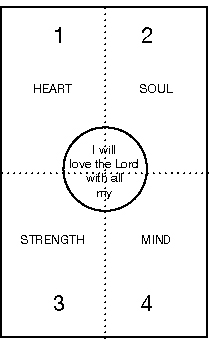
Before the sermon. Instruct the congregation to fold their piece of paper in half lengthwise. Then ask them to open the folded piece of paper and fold it a second time crosswise. Again, have them unfold the paper. They should have a piece of paper that is neatly divided into four sections. Have them number the sections. 1, 2, 3, and 4.

Have them draw a roughly two-inch circle in the center where the folds cross.

Have them write inside the circle, ” I will love the Lord with all my”

Tell them to listen carefully in the sermon for further directions.

Interspersed in your sermon give the following directions.

In section 1, write HEART

In section 2, write SOUL

In section 3, write STRENGTH

In section 4, write MIND

Congratulate them for following your directions. Challenge them to follow the directions of the commandment.

Bonus question: What is the second most important commandment. (See if they were really listening!)

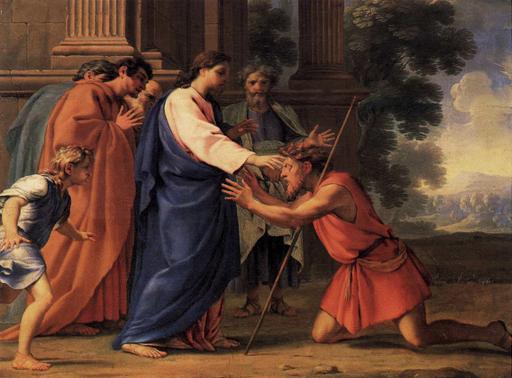
Adult Object Lesson: Mark 10:46-52

Save Us!

So Jesus is walking along the countryside, minding His own business, doing his teaching thing, when some bystander dares to interrupt, “Save me!”

You’ll need an accomplice for this, but that should be easy to find.

Choose an object that will create a distracting annoyance.

You might have someone honk a horn or rattle a noisemaker. You can ask the organist to hit a foot pedal, seemingly by accident, but repeatedly.

If you have a self-assured 10-year-old in your congregation, he or she could play this role perfectly. Your accomplice can sit in his or her usual spot, but on cue create some kind of disruption. Your congregation is bound to react with a corrective frown the first time before they catch on. All the better to make your point.

Blind Bartimaeus wants to be noticed and isn’t about to be turned away by the well-meaning disciples or crowds. They just want him to shut and slip into the background where he has likely spent most of his life.

“Save me,” was his cry.

We’ve heard that cry before in this Gospel and in some of the Old Testament companion texts, especially the passages from Job and the Psalms. The cry is heard in steadily crescendoing tones. We will hear the cry again as Jesus enters Jerusalem. All propriety will be set aside. The crowds will shout together, “Hosanna!” Please, please, save us!

And then . .. Jesus will!

End your object lesson with one last sounding of the annoying noise or have your congregation shout “Hosanna!”

Adult Object Lesson: Mark 10:35-45

What Hat Do You Wear in the Kingdom of God?

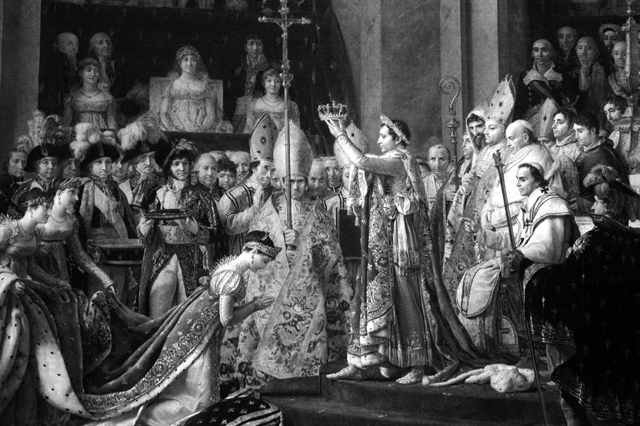
Today’s object can be the photo of this historic painting of Napoleon crowning Josephine or it can be a crown of your own manufacture (a Burger King crown is fine!) and a fashioned crown of thorns or an image of crown of thorns. See below!

You might find room in your bulletin for these photos.

Today’s Gospel talks about hierarchy. Where it doesn’t exist, mankind has a way of creating it!

You can point to this painting of Napoleon. Everything that concerned James and John in this week’s lesson is depicted here. Focus on the hats. You have crowns, mitres, skull caps, plumes and feathers, jewels and finery. Hats were really important in that day. They announced your standing in society. Crowns and mitres make you appear that much taller than everyone else. Jewels make you more valuable. And look at the gals in the viewing box in the upper left. They have seats of honor almost among the clergy and royalty. One woman sits on a throne and is flanked on the left and right by people in somewhat smaller seats. You’d have to do some research to figure out who they are today, but back then everyone knew!

People like to feel important.

James and John were seeking similar status. They were young and ambitious. After all, they had dropped everything to follow Jesus. They were loyal and hard-working. They deserved some compensation for their sacrifices. And Jesus had this troubling way of approaching all kinds of people, any one of whom might take their place in Jesus’ affection, if they let their guard down. Best to claim a reservation now!

Jesus tries to realign the disciples’ priorities. It’s not his first attempt! Maybe it will “take” this time as he talks more and more of the coming passion. Talk about this for a while.

Then turn to the headware worn by Jesus—the crown of thorns. This humiliation awaits Jesus and the disciples. The only place of honor they can expect is the honor of service and sacrifice. The lowest shall achieve the greatest reward in the Kingdom of Heaven.

It’s a concept that we still wrestle with today. Church leaders talk in terms of service, politicians talk in terms of public service. But they, too, face the temptation to elevate their status above that of those they serve.

Look again at the Napoleon painting. Does anyone see anyone in this painting that is accepting a servant role? Josephine kneels—but only to accept the crown. Two gals are arranging her train, but they don’t appear to be particularly lowly. The clergy aren’t out in full force as a show of humility! They are flaunting their status with their symbolic staffs, jewelry and finery.

It’s not in our nature to humble ourselves. But it is required. The sooner we, like the disciples, learn this the better.

Here are the above image in grayscale and an image of Jesus wearing His crown. Use the credit below for the Napoleon photo, please. You can find a higher resolution version of this by typing Napoleon Crowning Josephine into the search box at photopin.com.

Napoleon photo credit: caribb via photopin cc

Adult Object Lesson: Mark 10:17-31 • October 14

Occasions for Prayer

Today’s objects are a checkbook and a pen, but keep them hidden.

Ask your congregations to name some occasions when they routinely pray.

You’ll get answers like

  • when someone is sick
  • before we eat
  • when I wake up
  • when I go to bed
  • when I’m scared
  • in church
  • with my children
  • on the fourth down

When ideas die down, pull out the check book and your pen. Start to write but stop quickly.

Point out that the answer to many of their prayers involve their checkbooks. They write checks to pay for groceries and doctors, etc. Even sports teams try to solve their problems by offering attractive salaries.

Yet how many of us pray before we write a check?

Now refer to the lectionary reading about the man who came to Jesus on his knees. He was a good man by any measure. But something was missing. Jesus reminded him to keep the commandments. This man had checked everything on that list. Been there; done that!

On top of his impeccable values, he was a man of means. He could buy his way out of any problem. But he still felt lost.

But Jesus pointed out to him that the blessings of riches mean nothing if they cannot be shared with others who are equally important to God. Wealth has a way of stealing our attention from the reasons God put us here on earth—to be part of community. We are lost when we are separated from community.

This alienation had brought the rich, youn man to his knees. He longed to be closer to God. But to get closer to God he had to rebuild his relationships with the people around him. That meant giving up what separated him from others in God’s creation.

Turn back to your checkbook. You might get down on your knees at this point.

Suggest that each time they reach for their checkbook (or even their credit card), they offer a prayer just as they would before taking a bite to eat.

  • Pray for wise decisions with money.
  • Pray that your wealth is a tool for good.
  • Pray with thanksgiving that God has blessed you with the ability to decide how to use your wealth.

Make prayer about your spending a habit. And remember to think of others!

photo credit: ThinkingCouch via photopin cc

Adult Object Lesson: Mark 10 for October 7, 2012

What is Man that God Is Mindful of Us?

First Reading
Genesis 2:18-24 • Job 1:1, 2:1-10 • Psalm 8 • Hebrews 1:1-4, 2:5-12 • Mark 10:2-16

Today’s object is a work in progress. You’ll be talking to your people while you are creating something. Consider having them create something along with you.

Suggestions:

  • Cut out a string of paper dolls
  • Craft a simple figure out of play dough or modeling clay.
  • Start a stick figure on a flip board or felt board and ask each person to add something to the creation.
  • Or leave an empty spot in the bulletin for them to draw their “man”

This week’s lessons, together, discuss humankind in relationship with one another. Eve is created for Adam. Job suffers in isolation as his family and friends watch. Jesus answers the nagging question of divorce and ends with Jesus gathering the little children around him. The Psalm? Well, the Psalm rejoices in creation and so can we!

Relationships are a blessing and sometimes seem to be a curse. We long for them — to be truly in love. But the road to bliss can turn rocky oh, so quickly! But even when relationships break our hearts, we are often eager to find new ones.

What is man that God is mindful of us? Mankind is God’s creation. Every artist feels a bond with his or her creation. God is no different.

As you are creating something — or as your people create something — ask them to think about how the act of creation feels. Tie that to their ability to create the relationships that go with God’s prime creation—humankind.

photo credit: Caro’s Lines via photopin cc

Adult Object Lesson: Mark 9:38-50

The lesson today is about creating boundaries.

Today’s object is a goldfish in a bowl.

In Mark 9:38-50, the disciples are upset with some copycat miracle workers who are exorcising demons in Jesus’ name. The disciples bring the matter to Jesus’ attention. Someone is stepping on your (they probably meant “our”) territory.

Hey! They had tried to stop them. But the scoundrels just weren’t listening! Surely, Jesus would put the demon chasers in their place.

The disciples wanted Jesus to draw a line — decide who were the true followers of Christ. Keep the kingdom tidy.

But Jesus dismisses the disciples’ concerns. He focuses on them.

He encourages the disciples to loosen up. These new miracle workers aren’t going to diminish His abilities. Why bother drawing lines between people who are working for the same cause?

Here’s a little known fact about goldfish. They were naturally plain old, grey carp.

Japanese and Chinese hobbyists carefully bred their pets to bring out the bright colors.

Today, goldfish are known for their splendor.

And where did it get them? Today most of the beautiful goldfish, chosen for their color and carefully bred to ensure colorful offspring, are kept in a bowl. The chosen fish are destined to live their lives separated from other fish and the world. They will swim all day, every day, in circles peering through their concave barriers at the world they were part of back when they were grey. Their beauty has indeed set them apart — to what end?

Talk with your congregation about the walls they might be putting up between themselves and the rest of God’s glorious creation. Why do the barriers seem like a good idea? When the harshest barriers are at last broken, what result was feared? What result actually came about?

  • The walls between faiths.
  • The walls between denominations.
  • The walls between genders and races.
  • The walls between educated workers and manual labor.
  • The walls between old and young.
  • The walls of culture and language.

Think about the disciples. Did their special status as chosen children of God divide them from the world or prepare them to join the world?

What about us? What walls do we put up? What purpose do we think they serve? What unintentional purposes result?

photo credit: Bob.Fornal via photopin cc

Adult Object Lesson: Mark 9:35

So You Think You’re So Great!

Your object today is a $20 bill (or $5 or $10)

You are late for a meeting, but there is no parking spot in sight. At last you see a car pulling away. Finally and none too soon! You parallel park, annoyed at the cars that pass impatiently, making it unsafe to steer your car into the spot. At last you are in. You jump out of the car, lock the doors, and rush to the meter. You look for instructions. The meter takes only quarters. You dig in your wallet or purse. All you can find is a $20 bill. You look at the nearby stores. Might they change a $20 bill so that you can put a few quarters in the parking meter? You look up the street. There’s the meter reader writing a ticket just a half block away.

Suddenly the quarter you don’t have is worth more than $20 bill you do have.

(If you tell this story to children, use a vending machine that takes only quarters, but the parents provided only a dollar bill.)

In today’s Gospel, Jesus encounters the disciples in an animated conversation. He asks, “What are fellows talking about?”…as if he doesn’t know. They are embarrassed. They have been bragging to one another about their value to the Master. There is little they can do but listen, red-faced, as Jesus begins to lecture them about greatness.

The recent chapters of Mark test the disciples over and over. Jesus is challenging conventional ideas. The disciples’ world is turning upside down. There are miracles and strange and uncomfortable conversations. No wonder the disciples have used their alone time to sort some things out among themselves.

But in butts Jesus, and their ideas are once again thrown out the window.

At last he reaches for a small child, embraces the child and uses the child as an “object” lesson. It’s the littlest among you that is worth the most. Not the smartest, not the most talented, the one with the best job, or the biggest house.

Pull a quarter out of your pocket (oops! you had one along) and flip it a few times.

Ask them to think about this the next time they need a quarter.

photo credit: theilr via photo pin cc

Adult Object Lesson: September 16, 2012

Are We Ashamed of What We Believe?

Isaiah 50:4-9a, Proverbs 1:20-33, Psalm 116:1-9, James 3:1-12, Mark 8:27-38

For waywardness kills the simple, and the complacency of fools destroys them; but those who listen to me will be secure and will live at ease, without dread of disaster. — Proverbs 1: 32-33

The Lord God has opened my ear, and I was not rebellious, I did not turn backward. I gave my back to those who struck me, and my cheeks to those who pulled out the beard; I did not hide my face from insult and spitting. The Lord God helps me; therefore I have not been disgraced. —Isaiah 50:5-7a

Today’s object is a dunce cap. You might make your own from a large sheet of oaktag or you can decorate a party hat with the word “dunce.”

Wear your hat and face your congregation. You might have a teacher carry it to the front of the sanctuary and place it on your head for more drama.

Point out that it is September — back to school time. Students are once again facing their teachers.

Two lessons from the Old Testament talk about the role of student and teacher.

The dunce camp was once a commonly used form of punishment in American schools. Students who were unprepared or lazy were humiliated in hopes of setting them straight.

It was something to be dreaded.

Today, we attempt to be more understanding. Struggling students may be battling learning disabilities. Even so, teachers today sometimes control students and classrooms with a quick tongue designed to shame them into better behaviors.

Rebellious students are nothing new. The analogy is part of both the Isaiah and Proverbs texts.

Isaiah faces humiliation head on, embracing it. He wears his dunce cap with pride (facing the crowd who watched as he was beaten).

The critics will wear themselves out. God will sustain.

The gospel lesson that accompanies these lessons (Mark 8:27-38) is also a teacher/student session. Jesus is questioning his students and preparing them for the trials they will soon face—the final exam, so to speak. Peter steps up and gives the answers his best shot. Jesus rebukes him in front of the disciples. We can only imagine his embarrassment and shame. Did it stop Peter?

Jesus prepared him. In Verse 38 he cautions disciples:

“Those who are ashamed of me and of my words in this adulterous and sinful generation, of them the Son of Man will also be ashamed when he comes in the glory of his Father with the holy angels.”

Witnessing in today’s world is a challenge. We all face the possibility of being ridiculed for our beliefs. We weigh carefully in every social situation just how bold we should be in expressing our faith.

We fear shame.

Today’s message: Face shame with confidence. (And there is a definite “Or else!”)

photo credit: foreverdigital via photo pin cc

Adult Object Lesson: September 9, 2012

A Gospel Story for the Dogs

Mark 7:24-37

Today’s object is a dog. Use a stuffed dog, a picture of a dog, or even your own pet. You might consider using two stuffed dogs—one of pedigree to represent the Jews and one of less definite breeding to represent the Gentiles.

Mark tells two stories in this Sunday’s Gospel.

The first story tells Jesus’ hesitance to extend his message  beyond the people of Israel. Jesus uses the metaphor of children and dogs.

Is is right to take the food meant for your children and throw it to the dogs? he asks.

The Gentile women is quick-witted. Her answer impresses the great teacher. Even the dogs eat the children’s crumbs and that’s all I’m asking for — a crumb.

Jesus hears the woman and is moved. Her daughter is healed.

Point out the woman could have stormed off in a huff at being likened to a dog. Even today, as lovable as our pets are, we don’t refer to someone as a dog without expecting a fight! But this woman stood up to the miracle worker — who might have struck her down on the spot for impertinence.

You can talk a bit about the most endearing quality of dogs — their loyalty and trust — qualities that played out in today’s lesson.

The second story is about the man with a speech impediment. It, too, is a strange story. Jesus takes the man aside and heals him in private of his speech impediment. For the first time in his life this man can speak and be understood. Jesus orders the crowd, who reappear at the end of the story, to keep the report of this miracle under wraps.

You can tie the dog analogy to this second lesson. A favorite trick to teach a dog is to speak or bark upon command. It’s a lot harder to teach a dog to be quiet! Yet that is what Jesus asks of the healed man and the crowd of people.  “Do not tell anyone.”

Order your dog or dog object to not bark. If you have a group of children or youth, you might enlist them in your story-telling by asking them ahead of time to bark whenever you give the order “do not bark” or “be quiet.”

These passages remain a bit puzzling. Why was Jesus reluctant to heal a child of a non-Jew? Later, why did he charge people to do something that goes entirely against human nature?

Why do we hesitate to embrace people different from us? Why do we admire dogs of pedigree?

What stands in our way of telling the Good News?

photo credit: 27147 via photo pin cc

Adult Object Lesson: September 2, 2012

Be Doers of the Word

Deuteronomy 4:1-2, 6-9, Psalm 15, James 1:17-27, Mark 7:1-8, 14-15, 21-23

Today’s object is a hand mirror.

Begin the talk with something about you in obvious disarray. Your hair might be disheveled or your shirt buttoned wrong or you might have a mismatched or missing earring or if you are robed, wear your stole backward. Having created a visual flaw, look into your hand mirror and discover the flaw.

Today’s combined lectionary readings examine God’s reaction to human flaws.

Retell briefly the story of Moses and God’s refusal to grant him the reward of entering the Promised Land after Moses had grown old leading the Israelites through the desert. For all the hard work of keeping a disgruntled people together on an arduous, perilous journey, Moses had to face his failings—his tendency to doubt.

The passage from James reminds us that God gives us the power to do more than hear God’s Word. We must act.

James asks us to look in the mirror. If we look in the mirror and do not like what we see we are compelled to do something about it.

The Gospel from Mark focuses on the interpretation of Jewish dietary laws. Jesus listens to the questions and criticism of the scribes and responds by pointing out that defilement comes from within. It isn’t bad or wrong food that gives the Devil its power. It is what is lacking within our hearts and minds.

Coupled with James insistence that Christians act upon what they learn from scripture the concluding message for today’s object lesson is to look into our mirrors every day. If we don’t like what we see, do something about it.

End your object lesson by fixing your obvious flaw.

Keep your lesson upbeat. Self-examination is difficult even when we have balloon-sized egos. Many people feel bad about themselves as it is. Offer encouragement, help, forgiveness and love as tools to overcome human failings.

Thoughts to keep in mind:

  • There is a related message in the signs posted in public concourses, “If you see something, say something.” (If you hear the Word, do something)
  • The lessons for today coincide appropriately with Labor Day, America’s celebration of the worker.
  • The book of James was such a challenge to early Christians (and even the great reformer, Luther) that it almost wasn’t included in the Bible.
photo credit: MistoAcrilico via photo pin cc