4/7InkzHVUEQeEdU9vpc1tikzEhChrKmPfvXI-FSDBrBQ

Redeemer

Are Sermons Passé?

storybookIs the weekly Sunday sermon
reaching anyone anymore?

When my son was little, he created a little ritual. He’d pick out a stack of storybooks for bedtime reading. Ten or so was the usual number and we usually went through all of them. But I did not dare start a story without saying certain words.

“Say it, Mom. You have to say the words.”

The first time he demanded this, I had no idea what he was expecting.

He patiently prompted me.

And so I took orders from my tot.

I opened the book to the title page and said. “And now it is time for our featured presentation.”

He was, obviously, influenced by his video and movie experience. A story just wasn’t a story without this little bit of fanfare.

Beyond “Once Upon A Time”

Modern culture does influence us. It affects our point of view, our attention span, and are ability to process information that we hear. When we set about listening, we have different expectations than our ancestors may have had. We recognized this when we moved from the two-hour sermon to the one-hour sermon to today’s 20-minute expectation. But today, things are still changing.

I have written many times about the futility of paying a pastor a salary with one of the primary objectives having a 20-minute sermon written for just fifty people once a week.

That’s a lot of resources invested in something that half of the listeners are likely day-dreaming through. At the end of the service, we never really know whether or not we have reached anyone with the Word. But we keep at it because that’s the way the Word was delivered for hundreds of years—since farmers and tradespeople took a break from the isolation of their fields and shops and gathered with the whole village to spend the day.

I know that I may be beating a dying horse with my arguments. Dying is probably the right word. Just look at the statistics. We are watching the steady decline in attendance in most mainline churches. If you think the 30 to 50% drop of the last 15 years is alarming, be prepared. The biggest decline is in people under 40. The next 20 years are going to be really bad for a lot of congregations. There is no one to fill the roles of today’s 50-, 60-, and 70-year olds. It is unlikely that the younger generations will ever adapt to the traditional delivery of a sermon.

Understand I’m not against preaching. It’s been our family business for generations. I’m questioning whether the ritual format of worship, including the sermon as the weekly featured presentation, is achieving its purpose—any purpose.

Consider the Lowly Podcast

Podcasts are voice only online presentations. They can be easily promoted on a  blog or web site and delivered to listeners through itunes. One of their major benefits is longevity. They can be accessed long, long after they are posted and certainly long after the Sunday morning church service ends. They can be shared. Your audience can grow!

Podcasts are the fastest growing platform for social media.

Why?

People can listen to them when and where they want. It doesn’t have to be at 10:20 on Sunday morning in the sanctuary on Main Street in every zip code. They can listen while they ride the bus, do the dishes, or mow the yard. They can return to a section they liked or questioned. They can listen to their favorite podcaster (preacher) or follow any links he or she might give to other inspirational or insightful resources.

They fit into our modern way of life as Christians and seekers.

At Redeemer, without a sanctuary for our people to attend and since our pastors headed for the hills long ago, I connected our members to an online teacher. (We are determined to stay true to our mission despite our unjust expulsion from the ELCA.)

Every day our members receive a short email Bible lesson. Only recently have I started to get feedback. They like it. At our last Redeemer gathering they started talking about the week’s lesson, which happened to be the book of Philippians — the foundational scripture for 2×2’s publication, Undercover Bishop.

My next experiment may be to expand this feature and develop podcast commentaries. Or maybe we can record chapters of Undercover Bishop!

It may begin as early as this week. Watch for it!

Podcasts may be the wave of the future for preaching. Who knows? We don’t have to give up the Sunday morning sermon, but after a while, we may want to!

And now it is time for our featured presentation.
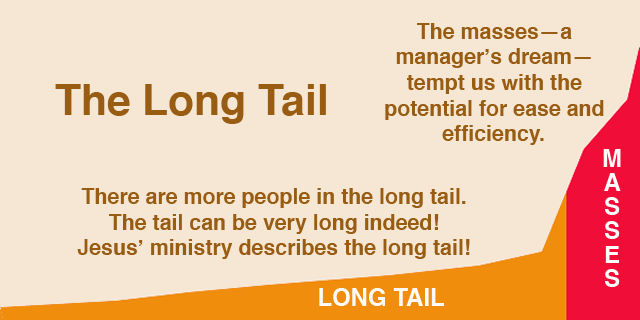
photo credit: Travis Seitler via photopin cc

Transforming Trends in the Church-5

longtailTREND 5
The Long Tail

Huh? What’s the Long Tail?

This is a term familiar to marketers. It refers to niche marketing. Major retailers are generally interested in selling lots of just a few products. The emphasis is on creating products that will appeal to everyone.

This traditional business model is why it was hard to get a book published. Publishers wanted to make sure it was worth printing 100,000 copies minimally. If your interest was canoeing in Nepal or the life-cycle of spiders, you were out of luck!

The internet has made it possible for products that appeal to smaller audiences to be profitable, too. In fact, there is great potential in recognizing the people who go against the mainstream. It is a numbers game. There are an awful lot of people in the world!

The result in the publishing world, with which I am most familiar, has been an exciting explosion of new titles.

What does this mean for Church?

Actually, the Church is the original long-tail marketer. They’ve just forgotten it! Click to Tweet.

Jesus’ approach to ministry describes the long tail. Seek and serve the marginal members of society—everyone from the rich man and educated Nicodemus—to the dead, infirm, and dying—to the women and children with no status—to the foreigners.

As the Church grew, every neighborhood was a “niche.” But today, the Church is abandoning its strength, hoping for economic strength in size.

This may be a long-term disaster.

Large churches are not filling the gap of the abandoned small faith communities. A few are growing slowly but most are in decline. People like to worship with people they know. Being part of a crowd may be fiscally desirable, but faith doesn’t work that way. Most churches will continue with memberships hovering between 100 and 300 ( a third of them active) until the Church abandons them. That’s the way it’s always been and it follows the findings of sociology that it’s the way it will always be.

We already know the small church works well—perhaps even best. The challenge to the Church is to keep small churches viable and in keeping with their expectations. This requires entrepreneurial thinking which is not prevalent in the Church.

Churches like to do things the same way (while preaching transformation). They have an expensive infrastructure that resists change and requires size.

The concept can even be seen in their approach to mission.

Redeemer’s membership was always an immigrant population. Early members were western European. The immigrants of recent years represented five continents. Many from East Africa found their way to our door. We welcomed them and they were part of a truly transforming ministry.

The Synod, on the other hand, had a different vision for us. The older immigrants and their descendants had to die. (They waited eight years for this to happen at one point in our history—2000-2008). But new members came along. Their plan was not working.

Their pronouncement: White Redeemer must be allowed to die. Black Redeemer . . . we can put them anywhere.

Actually, SEPA had a vision for a Pan-African church. Something big. Something to boast about. Something that could exist without bothering white Lutherans.

africa-truesizeA Pan-African Church! When you realize the size of Africa, the concept is ridiculous. Africa is a BIG place, with varied customs and cultures. Our African members were amused at the idea. “They don’t speak our language in Zimbabwe!”

This is nothing new. Chestnut Hill, Mt. Airy, Germantown, Roxborough, Manayunk and East Falls look so close on the map. The managerial temptation is to try to unite them for efficiency and cost-savings. Four church closings in this area have not bolstered the memberships of the other churches. (Advent in Mt. Airy, Grace and Epiphany in Roxborough and the seizing of land in East Falls). (Shh! The doors may be locked, but we are still open!)

Urban people know their neighborhoods are distinct. So, too, are their ministries.

With size and managerial motives (among others, we suspect), SEPA Synod orchestrated the closing of our growing viable community congregation. Their plan (never discussed with our leaders) was to set our white members free to fend for ourselves (excommunicate us) and assign our black members to another site. Result: 82 Lutherans locked out. A squandering of new blood!)

Unfortunately, when you close churches in the neighborhoods where immigrants live, you take the resources that would serve them. Everyone in the neighborhood loses and the takers of the property get only a short-term advantage as they quickly spend the assets the communities developed over a century.

The future of the Church may be in rediscovering its past. The trick will be finding a way to make Long Tail Evangelism fiscally viable. The more active and inviting the ministry, the more realistic this will be.

Redeemer was well on our way to implementing a plan which would be supporting the congregation today with ample dollars to spare.  We saw ourselves serving several niches and felt uniquely qualified for this type of ministry.

If the Church is to be successful in recognizing the benefits of Long Tail Evangelism, they must help congregations explore the use of their assets for ministry, not seize them for their own financial fix.

The result is long-term loss to faith, community and potential.

Perhaps it is time we return to Jesus’ approach. Love that long tail.


Redeemer Revisited: Part 4

The Power of Interdependence

Lutherans believe the autonomy of a congregation is powerful and so congregations own their own property. Their ministries are controlled by lay government—not clergy. Clergy have influence but not control.

Our founding documents call this interdependence. Congregations depend on regional and national bodies to provide competent church leaders. There was a time when they depended on them for other things, too—managing foreign missions, social services, and providing educational and worship materials, advice and inspiration.

In the new information age, these roles are significantly diminished. Local parishes sense that hierarchies are less effective—a financial burden that is crippling to small church ministry. (Most churches are small.)

National church and regional bodies are totally dependent financially on local churches (not the other way around). Under their prescribed interdependence, congregations have no financial obligations to the regional body or national church. Congregations can vote with their pocketbooks.

In fact, in 2010, when there was a great doctrinal rift in the ELCA, some regional bodies promised their member churches that their offerings could be set aside and not sent on to the national church with whom they were unhappy.

It is hard for churches with hierarchical traditions to understand. But it is foundational to Lutheran thinking. Regional bodies exist to facilitate ministry.

In the world of church this is called “congregational polity.” It is protected by the founding documents of the ELCA and individual synods’ Articles of Incorporation. These are rarely read. They state:

  • Bishops cannot convey property of a congregation without the consent of the congregation.
  • Synod Assembly’s powers are limited by the Articles of Incorporation.

There is no right to seize or vote on congregational property.

Interestingly, predecessor Lutheran bodies went even further. Synods were not allowed to own property at all. They knew it would change the mission of church leaders. This is a deeply rooted concept of Lutheranism—one of the bugs in Martin Luther’s crawl.

Today Synod Assemblies are unfamiliar with their governing rules and polity. The last few years of cozying up to denominations with different polities have obscured our awareness of our own tradition. The ranks of OWLs, Older and Wiser Lutherans, are thinning. When asked by our trusted leaders to vote on another congregation’s property, we may assume we have that right. We don’t.

This happened in 2009 in the Southeastern Pennsylvania Synod of the Evangelical Lutheran Church in America (SEPA/ELCA). They voted to take the property of Redeemer in East Falls, a small but viable congregation with an endowment fund.

SEPA had exercised this self-appointed power before without challenge. The process had always gone smoothly, Bishop Burkat reported. That doesn’t make it right!

Redeemer has among our members a pastor who spent a sabbatical researching the early history of the ELCA. He showed us the founding documents. They said this was wrong.

Property is not necessary to ministry, but property has advantages.

Property provides continuity from generation to generation. A physical presence is a a ministry tool. With property you can invite, teach, host, serve. With property you have a financial hedge against a few difficult years.

Redeemer has been ministering without property for four years. We have a very influential ministry worldwide, but we could do so much more locally if our property had not been taken from us.

Well, it was properly appealed, wasn’t it?

Do SEPA Lutherans realize that they never voted on our appeal in 2009? We appealed Synodical Administration. A totally different question—worded by the synod—was presented at the time of the vote. SEPA voted to take our property. Bait and switch. Read the 2009 minutes. You’ll have to dig. SEPA posts minutes from only 2010 on!

Do SEPA Lutherans realize that in 2010, SEPA Synod Council took it upon themselves to vote Redeemer closed without any input from Redeemer? Do they realize that Redeemer was never informed of this decision (which the Synod Council constitutionally has no authority to make)? We only know because we googled our name.

What’s done is done.

Question: What do our interdependent congregations do when mistakes are made?

This still lies in the hands of congregations.

Redeemer has a constitutional right to challenge the 2010 decision of SEPA Synod Council. We intend to formally make that request within the next few months but we will need a fair forum.

SEPA congregations have an opportunity to revisit their actions in East Falls.

It is not too late to make this right. It takes the courage to say, “Wait a minute. What did we do? How do we move forward?”

This seems to be beyond the scope of our Sunday morning confessions. 

If SEPA Lutherans do not care about their actions in East Falls, they might think about the effect their actions or non-actions have on other member congregations.

Redeemer is visiting all the churches that voted to take our property. We’ve been to 69. Many face the same treatment within the next 20 years. With SEPA’s self-proclaimed power to seize property, fueled with persistent deficits (a $250,000 shortfall last year and $275,000 the year they took our property), there is no incentive to help small congregations. Hierarchical survival is in jeopardy. They play the “wait for them to die” game.

Without responsible clergy and involved congregations, SEPA government has the power to rule by intimidation. They even seem to enjoy it. 

The Redeemer situation has proven that they are not afraid to abuse power. They use their protected status and the secular courts to bypass their constitutions. And while SEPA clergy and congregations looked the other way, hoping to not be touched, the courts have changed Lutheran polity. Now, SEPA congregations own their property only as long as SEPA says so. As Bishop Burkat has written in reference to the land in East Falls—it’s the property formerly occupied by Redeemer. In her mind, we never owned it.

The churches of SEPA could have stopped this. They still can.

Easier to let Redeemer suffer. 

Why Congregations Should Own Their Buildings: Part 1

Why Congregations Must Own
Their Ministries
(and that includes property).

quote-8713Part 1

A long time ago there was a church that had lost its way. It had many members. Almost every person in every city and hamlet belonged.

Each town had its own monument to God. These monuments were built by the people. The land was likely part of a tract of land provided by a local baron, who might have received his land as a reward for a winning role in a crusade.

The people built the resulting church or cathedral. Some laid the foundations and built the walls, some designed windows of rainbow beauty. Others made the hardware that hung the doors and secured the roof. Others carved the pews and illustrated the stories of their faith on the wall. Still others waited until the roof was complete to install the musical instruments for their best musicians to play.

And then there were the women who kept the homes going, the workers fed, the linens woven and held the hands of the many children they brought through its doors. It took several generations to make these splendid monuments to God.

These monuments became extensions of their homes. They were nurtured at their altars in their youth, strengthened through the years, and comforted in their old age.

They loved the buildings and what they meant to them, but they did not own them.

Absentee Landlords

Their churches were owned and controlled by leaders, far away on the other side of formidable mountains.

Church officials did not trust the people to own their own buildings. Their work was acceptable to God, but it was owned and controlled by hierarchy which tended to appoint and elect people who would comply and obey.

What was presented to the glory of God was used to glorify Man.

This system worked very well as long as everyone agreed on everything and there were enough people willing to enter lives of total compliance to sustain the structure. For centuries most people’s choices in life were made for them by the station of their birth. Change was seldom seen and challenges came from outside the faith.

Things Started to Change

Suddenly, the challenges of this lifestyle came not from infidels but from the faithful. How would the Church handle its own dissenters?

The knowledgeable religious began to see that sole ownership of the church by a corporate office in Rome was abusing the faithful. The Church had become a vehicle for personal advancement. Expensive lifestyles were sustained with the sacrifices of much poorer people. They were being gouged— charged even for prayer.

People wanted to believe that the Church they loved had their best interests in mind. They relied on trust—most messages from their leaders were delivered in a foreign tongue.

Then came Martin Luther and Gutenberg (among others).

He told them what was going on in their own language.

His printed message spread across Europe, uncensored by the Church for the first time.

Many of the faithful were kicked out.

Lucky! For the first time, they had some place to go!

The Church in a New Land

Many traveled to a New Land where immeasurable property was newly available. For the first time the people could actually own the property they donated and the buildings they raised. They could affiliate with a Church later.

The old system still exists today. It is failing fast. The Roman Catholic Church and the Episcopal Church still own all church property. Both bodies are closing churches at a record pace. The Episcopal Church is fighting many court battles over property. The Roman Catholic is being eaten alive in our area by the clergy sexual abuse scandals.

Some of this is because of the failing support and lawsuits. Some is control of their people. Disagree with the Church. We will take the property you built and paid for.

The Lutheran Church and other Protestant Churches, grounded more firmly in the spirit of the Reformation and growing in a new land, did not attempt to accumulate property for the benefit of a corporate church. There would be no grand collections of art and treasuries to collect the sacrificial offerings of the faithful for the benefit of clergy. We had left that thinking behind.

Protestant Churches of many sects prospered under this new system.

Early Lutherans in the New World forbade church hierarchy from owning property. They wanted to ensure that the officials of the church existed to serve not accumulate wealth.

But today the church is in trouble again. The Lutherans spent a good part of recent decades trying to unite with the Episcopal Church. They are now proudly in Full Communion (minus the long list of exceptions and disclaimers that follow the documents that most people don’t read). Full communion, sort of.

One reason today’s Lutheran bishops are comfortable claiming congregational property is this new association with Episcopal Church. In doing so, they are reverting to pre-Reformation thinking—the thrilling days of yesteryear when hierarchy controlled more than they led.

We’ll look at what this means for today’s Lutherans in an upcoming post.

Take It to the People

What If?

In yesterday’s post we talked about Bishop Claire Burkat’s tactic of bypassing clergy and church council leadership and taking issues dear to her heart directly to the congregation, who under the circumstances would be voting having witnessed the horrific treatment of their leaders.

Although this is always presented as democratic, it is a violation of church structure and a form of bullying. Sue the leaders; then ask others, whose collective knowledge of church procedure is likely to be low, to do the voting. (And if that doesn’t work, just issue an edict.)

It’s an irritating problem for church leaders. When pride and power reign and the possibility that you won’t make payroll looms on the horizon, it’s worth a try—constitutional or not. Bishop Almquist had tried it before at Redeemer (and failed).

This first Sunday of the month, as Redeemer heads out to worship in our own community, passing our locked church building (now equipped for the first time in its history with a security system), on our way to meet in the upper room of a local theater, we can’t help but wonder:

What would happen if SEPA bypassed the bishop, Synod Council and Synod Assembly and took the issue of Redeemer directly to the people of SEPA Synod?

Same strategy. Who knows what the results would be?

No worries.

It will never happen. Bishop Burkat would never stand for such a violation of church procedure. 😉

Redeemer Revisited: Part 3

In the last post we revealed SEPA Synod’s typical strategy as exercised twice in Redeemer’s history—once by Bishop Almquist and for most of the term of Bishop Burkat.

In short:

  • First eliminate clergy from the congregation. Wait for a change or force a change.
  • Second, cut the lay leadership down to size or eliminate them entirely.

Today’s post is about the third part of the Strategy—dealing with the congregation.

When both Bishop Almquist and Bishop Burkat decided to go directly to the people of the congregation they did so with an air of democracy. They were taking an issue directly to the people. Noble-sounding, indeed.

They were really manipulating the situation, using the congregation, and side-stepping the constitution.

The people they were approaching had followed their constitutions and elected leaders to—well—provide leadership. These leaders were authorized by the congregation to speak for them.

The pastor, too, had been called and could represent the congregation if he or she had the backbone.

The congregation doesn’t expect to be called together to deal with the regional body. They aren’t prepared and their interests have wide range—much of it personal, not corporate in nature. Leaders do a better job of sifting through the layers of congregational life to represent the “whole” people.

The bishop knows this. That’s why she needed these levels of leadership gone!

Redeemer knows it too. We have experienced it with both Bishop Almquist and Bishop Burkat.

In truth the congregation was being called together because the bishop and regional body knew that what they were proposing was not likely to be approved by the elected and called leaders of the church.

In Redeemer’s case, the congregation had just witnessed the inexplicable disappearance of pastors they had invested in both monetarily and emotionally.

This was followed by disregard and disrespect of the leaders they elected to act in their interest.  One church council member who had approached a Synod Council member on the congregation’s behalf had already been threatened. “Get out while the getting is good. We have no intention of negotiating with you.”

Now synod leadership was coming to them!

The message was clear: Vote our way or else.

Of course, the congregation was intimidated.

This was actually voiced by Redeemer members during Bishop Almquist’s tenure. When he called for a THIRD vote on a call question, the people said, “If we don’t vote the way he wants, he’ll shut us down for sure.” Fear would have controlled the situation, not reason.

Redeemer recovered from that time with able lay leadership taking the time to heal the congregation.

But in 2007, under Bishop Burkat, the Synod was resurrecting the same familiar tactics.

Bishops do not have the right to call congregational meetings. If they want to meet with congregations they are supposed to work with local leadership in doing so. That’s the way the constitutions are written.

Bishop Burkat never asked the local leaders for suggested meeting times. She just wrote letters saying she was coming. In her world, lay people are waiting for her to find a convenient time to pay attention to them once every decade or so.

The first time she tried this, in September 2007, she chose the local back-to-school night. Redeemer members decided they wanted to attend their children’s back to school events.

This was interpreted as resistance.

When we finally met in November, the meeting went very well. Bishop Burkat agreed to review our ministry plan and resolution to call a pastor. She promised we could work with the newly appointed Patricia Davenport. “You will love working with her,” she told us.

We were never given the opportunity. Bishop Burkat broke the promises made to us in her only meeting with our leaders.

Once again, Bishop Burkat scheduled a visit to Redeemer with no consultation with the congregation. This time she chose the Sunday of our Annual Meeting and luncheon and an afternoon birthday party for our pastor.

First, she announced the outcome of the meeting before the meeting was held. She was closing Redeemer with no congregational vote or consultation. NONE!

We informed her immediately upon notice that the date wouldn’t work. We reinforced this by email, fax and letter. We had hoped that she would meet with our leaders and work through any issues. But then NO issues had been raised.

The fabricated report that was read at Synod Assembly was written just a few days before Synod Assembly, three months after this. It was NEVER shared with Redeemer. It was inaccurate and untrue and would not have withstood scrutiny.

What happened at Redeemer was a property grab facilitated by pure bullying. It set the stage for all litigation.

Bishop Burkat arrived at Redeemer on February 24, 2008, despite our notice that the congregation could not meet at that time. She brought with her a lawyer, a locksmith and a host of witnesses.

Not exactly the atmosphere for an honest congregational vote.

Bishop Burkat was embarrassed that her plan to lock us out that day was thwarted in front of her company of witnesses. Any reasonable person could not have imagined it going any other way—but then they thought no one from Redeemer would be present. They could change the locks and surprise us the next Sunday when we all arrived for worship.

Had Bishop Burkat respected our leaders, this embarrassment would never have happened. Every subsequent action was face-saving and vindictive.

Bishop Burkat boasts of empowering laity. We have seen the opposite in her dealings with our congregation. Empowered laity are laity who comply.

Next: We will examine why Lutheran congregations own their own property.

Redeemer Revisited: Part 2

This is the second post in a series that revisits the last five years of court actions involving the Southeastern Pennsylvania Synod of the Evangelical Lutheran Church in America (SEPA / ELCA) and member church, Redeemer in the East Falls neighborhood of Philadelphia, Pa.

Understanding the Legalities  

Five years of costly and hateful  litigation have shed little light on the legalities of the land grab in East Falls.

The courts are far from united in the various rulings in all the cases of the Southeastern Pennsylvania Synod of the Evangelical Lutheran Church in America against member church Redeemer in the East Falls neighborhood and carefully selected members of the congregation.

The early rulings were that courts have no jurisdiction in church affairs.

This first ruling was upheld by a split decision of the Pennsylvania Appellate Court. Two dissenting judges strongly supported Redeemer. If the law were applied, they concluded, Redeemer should be heard.

Keep in mind that all this litigation was just about HEARING the case. It has never been heard.

A similar case WAS heard at the very same time involving a Presbyterian denomination and a member congregation in western Pennsylvania. That judge took five days to hear the case and ruled in favor of the congregation. The ruling came five days after the Redeemer “no jurisdiction” ruling. This decision has held through the appellate process and was last heard at the state supreme level this April with a decision due any day.

SEPA wasn’t satisfied with their default win. They wanted Redeemer to pay more. They went after individual members.

They held the cards now and they fixed the deck. The ace up their sleeve is “Contempt of Court.”

Synod locked the members of Redeemer out of the church within 36 hours of the ruling. Redeemer members had no access to anything in the church. Synod (again with no consultation with Redeemer members) sued members for contempt of court for not supplying things we still think ARE IN the church.

If they couldn’t find something they were looking for, they could have asked. But no! Straight to litigation where they are immune from the law and church members are not.

Redeemer members are in the position of not being able to prove that the items are in the church building.

Note to other SEPA congregations: They are likely to use this tactic again. Protect your church leaders now.

In the Redeemer case, subsequent judges have shown growing sympathy for Redeemer.

First, let’s ask, Where were the clergy?

Clergy fled at the first sign of trouble.

The pastor who had been serving us for nearly two years when Bishop Burkat was elected and who was well-liked, disappeared after a private meeting with Bishop Burkat and a congregation (Epiphany) who had been in covenant with Redeemer and was sharing our building. That church never discussed breaking the covenant with us, but after a private meeting with the bishop, they announced they were closing. The pastor gave 10 days notice by email (not the constitutional 30 days notice.) He never planned to talk with us about his decision. He left the Synod.

Epiphany continued to share Redeemer’s property outside of the covenant for six months, rent free. They were never locked out!

Redeemer found a pastor to replace him. Redeemer hand-delivered to Bishop Burkat the congregation’s resolution to call him in November 2007. In February 2008, he had just encouraged Redeemer members to “stand firm” in our ministry. He visited the bishop’s office hoping to talk things through.

This pastor had shared with us that he had been trying to talk to the synod for a year and couldn’t get a return call or a response to correspondence. (We had the same experience!).

So now he goes to talk to the Synod about serving Redeemer.

He never sets foot inside Redeemer again.

He suddenly has an interim call in Bucks County.

Clergy are out of the way.

Next. Lay leaders.

Let’s make this quick! All lay leaders, having had no hearing with Bishop Burkat on the subject of closing the church, were dismissed by letter from the bishop in February 2008. She had promised to work with us just four months earlier at a meeting which closing the church had not been discussed. No grounds were ever cited.

OK, lay leaders are out of the way.

There is still the congregation to deal with. 

We’ll tell you how that went in our next post.

Hint: Any claim that there was a process of mutual discernment is a lie.


Redeemer Revisited: Part 1

A New Look at a Tired Situation May Be Prudent

Redeemer-LocklowresThis is the first post in a series that will advocate for revisiting SEPA Synod’s involvement with member church, Redeemer Lutheran Church, East Falls in Philadelphia, Pa.

The Southeastern Pennsylvania Synod (SEPA)of the Evangelical Lutheran Church in America (ELCA) made claims on this congregation’s property in 2008. Their actions sparked five years of litigation.

There is ample room for revisiting the actions of SEPA today.

  1. If ministry in East Falls is the goal, we are on the same side.
  2. If attaining or protecting assets is the goal, the better economic decision might be to foster ministry as opposed to shutting ministry down.

Either way, the important point is that we should be on the same side. The stewardship of ministry and/or resources should be an objective. So should loving the people who make up our synod and upon whom all hope for ministry or the funding of ministry depends.

Why revisit Redeemer now?

Eight years passed between the time when Bishop Almquist looked at Redeemer in 1997-1998 and Bishop Burkat’s revisiting his decision. Things changed during those years but SEPA never adequately examined how they had changed. That was a mistake. Let’s learn from it.

Another five and one half years have passed since the 2008 land grab was attempted. Four years have passed since the court awarded SEPA our property — not on the basis of secular law or even on Lutheran law but on the basis of separation of church and state. Courts do not want to be involved in church issues. The dissenting opinion suggested strongly that the law and the church constitutions were on Redeemer’s side.

This means that justice in the Lutheran Church is the responsibility of each Lutheran. There is no room for even benign neglect of that responsibility.

Things have changed during this time too.

To not review the actions in this long and trying relationship would be another mistake. Great potential might be missed. The mistakes made in the Redeeme debacle will be repeated—over and over.

We’ll start the discussion in the five following topics (possibly more). We will look at how decisions made today will affect various aspects of many local congregations and neighborhoods, the Church as a whole, and the mission of all Lutherans.

These are some of the areas we plan to discuss:

  • Legality
  • Viability
  • Innovation
  • Community Impact
  • Short- and Long-Term Potential

We believe that the Redeemer situation poses questions that will impact dozens of congregations in the next two decades. Redeemer’s interests are also the interests of at least 30 other congregations we have visited who may be OK for today but face a very uncertain future as aging memberships lose their ability to hold things together.

Redeemer has learned a lot in the last six years. We will share what we see in a forthright manner. We will strive to leave the buzzwords and popular leadership jargon out of the discussion. The ELCA needs a frank discussion that focuses on the interests of the congregations — not the preservation of a system and protection of the interests of church professionals but the true reasons we bond together for mission in the first place.

As one of the beleaguered American Roman Catholic nuns, Sister Pat Farrell, commented tonight on 60 Minutes— “There doesn’t seem to be a safe place to talk about issues of differences. Where do people go?”

This is true in the ELCA, too. Redeemer has found no honest and open forum within the church. In fact, great effort was made to deny or control all discussion early on—when open and sincere discussion might have prevented five years of law suits and acrimony.

This forum will be open. We pledge to print any legitimate comment without any editorial response. Also, we invite guest posts on the topics we present.

Below is a form you can use to notify us of your desire to write a post on any topic we raise. Just let us know what topic you would like to address and how we can contact you. We will send you our editorial guideline (pretty simple).

Use the regular “Add your 2¢” comment box if you simply want to comment. There is no length limitation.

2×2 web site reaches about 1000 unique readers every week in addition to readers who subscribe by Facebook, Twitter or Email.

Imagination: The Source of Innovation

Hold “What If?” Parties

innovatorsThe Church is looking for innovation.
Or so they say.

Innovation is usually the result of a very few innovators.

The Church tends to be unkind to innovators. Judgmental.

Result: little innovation.

Every few centuries, an innovator makes a difference. It really doesn’t happen very often. Some of them become “official” saints. Some of them just go down in history—like Martin Luther. Often their bold thinking was sparked by the times, like Martin Luther King, Jr.

Or did Dr. King spark the times?

More often, innovators go unrecognized.

In the day-to-day life of the Church, innovation has a different definition. It doesn’t mean change in a significant way. It means finding a way to stay the same, to keep the same statistics up and the bills paid as the odds grow against that kind of success.

Look at the congregations that are viewed as most successful. Their success is often in doing ministry the same way a bit longer than other churches. Worship Sunday morning. Sunday School. Same staff positions and the same list of committees. Same set of service projects. They are successful. No need to innovate!

Innovation will come from smaller churches.

True innovation is rarely pretty at first. It takes experimentation and a willingness to take significant risks. It can be life-threatening. Ask either Martin!

Church leaders encourage innovation, but they are also waiting in the wings to assess your failures. This might be OK, if their judgment resulted in collaboration and help. However, it often results in property and asset grabs and a demoralizing treatment of church leaders and members.

Have you visited a church that was scheduled to close before the grand closing rally? Have you seen the pain of the people? Have you sensed their feeling of despair, isolation and worthlessness. This will be camouflaged when you bring in the big guns for that all-important closing service, designed to make everything seem all right — when it’s not.

Innovation doesn’t happen very often. It’s just too scary. Innovation requires resources. Those resources are needed to keep doing things the same way.

Innovation is not moving the worship time forward or backward by one hour.

Innovation is not offering Holy Communion every week.

That’s just rearranging the same things that have been part of Church in one form or other since Stephen was stoned.

Innovation is doing things differently. Listening to different people. Looking for different sources of funding. Serving a different need in a different way. Structuring your government differently. Emphasizing a different passage from scripture.

What was Martin Luther’s biggest innovation? Telling the gospel story in the native language of the people. Unheard of at the time. An abomination.

Really, not such a big deal.

What was Martin Luther King, Jr.’s innovation? Believing that all races could live together in peace and equality. This was not only unheard of at the time—it was against the law in many places.

Really, not terrible. Kind of nice. Why didn’t we try this sooner?

What sacred cows are we keeping in our pastures that need a bit of freedom? (I’m not going to use the faddy “resurrection” simile. It’s, frankly, offensive and has led to abusive behavior by church leaders. Churches don’t have to die to be reborn.)

Maybe you have an innovator in your community. Are you giving him or her half a chance?

Be aware: innovation often comes from unlikely places. If you think that by calling a certain pastor, you’ll achieve innovation, you are likely to be disappointed. Your innovators might be sitting in the back row. They might be coming only once every few weeks. They might be 80 years old. They might be 10. They may be “lifers.” They may not have joined—yet.

We need leaders who can imagine, who can think outside the sanctuary, who can ask the “what if” question and rally energy and resources to test new strategies and create new alliances.

What If?

Asking “What if?” is the rabbit’s foot of every creative person. Writers use it. Musicians, Visual artists. All creatives in every field.

  • What if we create a band without brass—just guitars and a drummer? The Beatles.
  • What if break up what we see into dots and strokes of various colors? Impressionism.
  • What if we hold a progressive talent contest that lasts 15 weeks instead of just a one-shot deal? What if we let the people vote? American Idol, a host of copycats and the rise of dozens of young artists.
  • What if we try a different kind of filament? The light bulb.

Host a quarterly What If? Party, where members can dream and brainstorm. Process the ideas presented. Make no decisions for two weeks, at least. Use that fallow time to let people talk, gripe, advocate, hone an idea. . . whatever they need to do.  

Create opportunities for those in opposition to work together. When people work together, they talk. When people talk, amazing things can result.

A What If? Party should have some kind of ice-breaker activities or exercises. Mix people up. Make it fun.

At Redeemer, we once divided people by birthdays. Four groups. One for each season. We had a small bowl on the table for each group. The bowl held slips of paper with a few ideas for a group activity—like tell some jokes, or write a skit about _____, or sing a song. Hey, it’s work to get a group of people to agree on the same song! In this case, the people had to agree on an activity and then take a few minutes to pull it off.

Then we’d have an impromptu talent show. Fun!

This was our ice breaker. There is power in this silliness. People break out of their comfort zones and work side by side with people they see every Sunday but don’t really know.

We’d follow the icebreaker with discussion on various topics.

This created an environment that influenced our ministry every week when we’d sit down together after worship for coffee and soup—at one big table—the “roundtable” (even though it had corners) where we were all equal.

  • What if we ran our own school in our own building?
  • What if we started a web site that reached out?
  • What if we encouraged our African members to invite their friends?
  • What if we found a pastor that spoke Swahili to facilitate this effort?
  • What if we used Swahili in our services?
  • What if we put the outreach in the hands of the African members?
  • What if a youth led the children’s sermon?
  • What if we used some of the equity in our property to expand our ministry?

Of course, getting the results takes time and hard work and you can’t always foresee the obstacles but it’s better than gathering dust or locking doors.

Try a What If? Party and see what happens.

Be prepared for failure. Failure is necessary for well-rooted success.


On Looking People in the Eye

boy looks owl in the eyePreferring to Work with Strangers

Today’s church is in trouble. Everybody in the church knows it. Some (fairly few) congregations are still large enough to get by without facing the new age but most churches are feeling just how tough the next two decades are likely to be.

The answer in our area of the church (the Southeastern Pennsylvania Synod of the Evangelical Lutheran Church in America) has been to check out on the people who have brought the church this far. They prefer to look for new faces to deal with—if they can find any. New faces will be easier to manage. They have no heritage at stake.

That was said to us at Redeemer in so many words by Bishop Claire Burkat.

White Redeemer must be allowed to die.
Black Redeemer . . .  we can put them anywhere.

Beyond this, when it looked like the judge was going to rule in our favor, Synod scurried and wrote a proposal to the judge. The proposal was that they would reopen Redeemer under their control and our current members were welcome to attend but would not be allowed any leadership role.

The judge sidestepped all the issues and ruled that he has no jurisdiction in church affairs. The appellate court ruled in its dissenting opinion that if the law were applied, Redeemer’s arguments should have been heard.

SEPA has hidden behind this dubious win and interpreted it as having free reign. In fact, they have free reign as long as members do not exercise their constitutional roles in running their church. The courts don’t want to do this job for you.

The problem with this conflict is that from the start, SEPA refused to deal with members. If they were to have any presence in our community, they wanted it on their terms with different people, who we can presume would thrive as long as they voted the right way.

Seth Godin addresses this modern phenomenon in our society in today’s post.

When we want to deceive or lash out, it’s easy to do. Hey, there’s always someone else we can start over with, relationships and even reputations are disposable. We don’t have to look you in the eye, it’s dark in here, and we’re wearing a mask.’

He calls this approach “an experiment in fake.”

It turns strangers into actors on a screen, and sometimes we help them, but often, we become inured to their reality, and treat them with a callousness and indifference we’d never use in our village.

Recently, I was cleaning out the home of a deceased pastor. I found a folder on a prominent table. In that folder was The Lutheran article about the life and death of one of the founding leaders of the Lutheran Church in America, Dr. Franklin Clark Fry. With it was an article from Time magazine that called him “Mr. Lutheran.” There was also a bulletin from his funeral.

Then on June 6 of this year, someone from this pastor’s family called me to honor Dr. Fry’s “glory day.”

I was surprised that anyone would recall a death of a church leader in 1968 and that they would think to call me. I am only remotely connected to Dr. Fry. His grandchildren are my cousins. But I was struck by the power of his leadership and influence. I’d heard plenty of stories about him as I grew up—mostly about how he insisted that congregations and clergy follow the rules. He would meet personally with people when he could have mailed a letter or picked up the phone.

His leadership had lasting influence.

That influence is waning as Lutheran leaders exert less and less power with more and more force.

The people they lead are treated as expendable. If you don’t think so, try disagreeing.

When this happens in the church — an institution that is supposed to matter — things get phony fast.

Our leaders no longer know the people they are leading. They never deal with them. They use clergy as intermediaries. They don’t respond to mail or email. They speak to us through letters and email blasts and call it “mutual discernment.” They deny us voice and vote in Assembly and rely on no one enforcing the rules—or even knowing what the rules are.

They are afraid to look their own people in the eye.

As Seth says. When you look people in the eye, you own the results.

You want to resolve things in East Falls? Look us in the eye.

photo credit: pcgn7 via photopin cc