4/7InkzHVUEQeEdU9vpc1tikzEhChrKmPfvXI-FSDBrBQ

Redeemer

Ethics and Morals in the Emerging Church

New Rules for Winning in the New Church

TV’s top shrink has written a new book.

I don’t want to hype it. He does a pretty good job of that himself.

It’s the subtitle that interests me. New Rules for Winning in the Real World

When talking about his book Dr. Phillip McGraw says (repeatedly) that the world has changed. We can’t approach people or situations with the same level of trust we might have had 30 years ago.

Watch out for people who take advantage of your trust.

We are told we can no longer give people the benefit of the doubt. The advice: Observe. Ask questions. Follow your instincts. Be ever alert to motives and behaviors.

Sad to say, but this is good advice for trusting Christians, too.

Today’s Church is not like the Church many of us grew up in.

We now know that we cannot automatically trust church leaders to behave in godly ways. Headlines for the last decade have shown us that the people we trust, the people we ask our children to trust, are often unworthy. Problems are no longer rare and isolated. We know that criminal behavior has been widespread and enduring, existing under the protected status of “church.” The guilt goes beyond the parish. It reaches into the highest offices.

It is a new world!

Two factors make his advice particularly applicable to religion.

  1. The Church today exists in a state of distress. Mainline membership and attendance are plummeting along with offerings. At the current rate of decline, some denominations will disappear within 40 years. The church is not attracting the best and brightest to careers of service. Seminaries are struggling to find students. Candidates are often second career or interested in part-time ministry only—at their convenience more than at God’s call. The sense of sacrifice and dedication that once characterized candidates for ministry is increasingly rare. The future of church leadership is shaky.
  2. The Church is largely immune from the law. Clergy can operate knowing that there is low likelihood of question or challenge. Many, many people will give clergy the benefit of the doubt and look with suspicion on anyone who makes any challenge.

In the free world, the church is as close as you get to absolute power. We know the saying about absolute power. It corrupts absolutely.

As the mainline church faces continued economic challenges there are greater temptations. Church leaders crave power. The power that wealth gave them is disappearing along with status as our culture grows more and more secular. They are lording power over fewer and fewer people. 

Rules start to be broken. Polity is ignored.

Constitutions are tweaked to increase power.

These actions are begging for challenge, but the Church bets that in most cases they will achieve their objectives without question.

When at last leaders are challenged, they MUST win.

All the tenets of faith are quickly forgotten. 

Let’s look at what is happening today in the Anglican Church in Canada. It begins with a familiar story—a land and asset grab. In this case the bishop takes the dispute further.

Five years have passed since this 2008 land grab. Bishop Michael Bird of the Niagara region is resurrecting the conflict by suing a lay person who wrote about church leaders on a satirical blog. The stories we’ve read are just silly, obvious farces.

Bishops expect adulation. They can’t take criticism. They have lost the ability to laugh at themselves.

And so in Canada, the bishop uses his protected status to attack a 66-year-old man, a loyal church member who undoubtedly donated a great deal to his church over the years. The bishop claims that the blog cost him $400,000 in damages. We can only wonder what kind of deficit his regional body might be carrying. We know here in Philadelphia that SEPA’s interest in Redeemer’s assets always came when SEPA faced severe budget problems.

When bishops have tantrums, they tend to be costly, and the Church or its members pay the bill.

The Canadian news has many similarities to Redeemer’s and other land grabs in ELCA synods. The common threads:

  • No attempt to work with the congregation or lay leaders.
  • No dialog, just the strong arm of the Church, wielding what is left of waning power. 
  • Legal actions against lay members with clergy running for the hills.
  • Public presentations that talk about “discernment,” “dialog,” and ridiculous but righteous-sounding allusions to “death and resurrection.” They represent that taking what does not belong to them is God’s work! That’s what they are doing, and the ELCA’s tagline is “God’s Work. Our hands.”

elca mock logo

The Church today is desperate.

New rules are needed. 

  • Don’t trust that church leaders are wise just because they are elected to office. 
  • Don’t assume that church leaders are immune from temptation.
  • Don’t assume that church leaders will practice what they preach.
  • Don’t assume that somebody else will speak up before you, if there is really something wrong going on. Years went by before the Roman Catholic Church took action against 27 priests for misconduct.
  • Do assume that things will get very bad indeed before the whole church recognizes there is any problem at all.

As it is, it’s open season on lay people. The more knowledgable, dedicated and invested in church, the more vulnerable we are.

The only safe Christians are those who sit quietly in the pews (or in the chancel).

And we wonder why churches are empty on Sunday morning. 

2×2 Is Interviewed on Social Media Podcast

2×2’s moderator, Judith Gotwald, was interviewed by D.J. Chuang for a podcast on a Social Media Church site a few weeks ago. The podcast is now airing.

This was our first such interview. Last month we posted our first multimedia video. We’re learning new skills all the time!

http://socialmediachurch.net/2013/05/social-media-saved-a-church-episode-48/

Memorial Day Message: It all began with a land grab!

Anglican Bishop Sues Vocal Lay Member

Today is Memorial Day. We honor the many who have fought for the freedoms we have today. It’s a good day to revisit what we in the Church are doing with our freedoms.

A significant story involving the Church comes to our attention this month from Canada.

It all began with a land grab.

Now it’s a court battle pitting a bishop and a denomination’s best legal minds against a vocal layman.

Should we, residents of the Land of the Free, be concerned?

There are significant similarities that ELCA Lutherans should note. Here’s an excerpt from the Canadian story.

The ultra-liberal Anglican Bishop of Niagara, the Rt. Rev. Michael Bird has sued an orthodox Anglican blogger, a layman, alleging that he was libeled 31 times on Anglican Samizdat, a blog by David Jenkins that presents facts and pokes satirical fun at liberal Anglican leaders who depart from “the faith once for all delivered to the saints.”

The Bishop of Niagara was one of his targets.

The claim seeks:

  • $400,000 in damages plus court and legal costs.
  • An interim and permanent injunction to shut down Anglican Samizdat.
  • An interim and permanent injunction prohibiting Jenkins from publishing further comments about Michael Bird.

Link to full story.

Isn’t it a bit funny that someone labeled as an “ultra-liberal” would attack free speech—even if delivered with a Canadian accent. 

Canada has its own Bill of Rights, a Charter of Rights and Freedoms.

On this side of the Niagara, the same Amendment to the U.S. Constitution that protects freedom of religion also protects freedom of speech.

The root problem is church leaders thinking so much of themselves that they shield themselves with the first amendment as they take actions that in a secular venue could be challenged in the courts—if not considered criminal.

The ruling in the SEPA-Redeemer case was made without ever hearing the case — even after five years of courtroom drama. The court determined that the issues were not within the jurisdiction of the courts under separation of church and state. However, a minority opinion concludes that if the law were to be applied, Redeemer’s arguments have significant merit. Two judges since have indicated that they, too, consider the dissenting opinion to have value.

Church leaders count on loyal obedience of followers who also benefit from their dubious actions. The same Synod Assembly that gave the bishop permission to take Redeemer’s property—defying their own governing documents—approved a healthy six-figure deficit. The Church can do anything they want. They are the Church.

Dissent is part of Lutheran heritage. How have Lutherans become so weak?

Church leaders work hard on their presentation. They hold the future of the clergy in their hands and can rely on their support. They also control all venues for discussion and media.

At least they did until the term “blog” became known.

Even now, Church leaders tell people how hard they work with congregations—how they use a rigorous process of dialog and discernment. They are very sure that everyone will believe them because they are Church leaders—even when there is no mutual discernment, dialog or any effort whatsoever to work together. No one asks for facts or evidence. Lay people who cite statistics and facts must be wrong because they are lay people. Church leaders can just repeat the same unsupported rhetoric and they are applauded. Bishops make pronouncements. Loyal followers stand back, out of the line of fire, and offer support—or more likely, say nothing whatsoever. This type of behavior prompted the Reformation 500 years ago. And here we are again.

Christians are not obligated to follow leaders simply because they are elected. Rank and file Christians are obligated to speak out when they see abuses and wrong actions and teachings. This is part of the supreme document of our faith—The Bible, sometimes called The Word of God.

In a free society that protects religion, it is imperative that religious followers monitor the actions of leaders. If they don’t they are at risk of being a cult.

Sadly, courts are not equipped to see beyond the rhetoric of religious leaders and probe the causes of their actions. Consequently any layperson who follows duty and conscience risks considerable loss, including:

  • heritage.
  • status within the faith community.
  • their property and assets (personal as well as communal).
  • their faith.
  • friends and family.
  • the fruits of years of volunteer service.
  • the benefits of years of monetary support.
  • and now, at least in Canada, all possessions, including the life savings intended to support you in old age. Mr. Jenkins is 65 years old. 

We could simply say “shame on the Canadian church leaders,” but we know how close this scenario is to what has been happening in East Falls with attacks on the individual members of Redeemer going on long after the objective of grabbing our property was decided. (Yes, right here, where George Washington camped with his freedom fighters on the same stretch of land where the LCA once had its headquarters.)

None of this costly and public conflict is necessary. Church leaders need only treat lay leaders with respect (love one another) and follow the teachings of their faith (do not sue one another, do unto others…). They need to stop coveting the property of member churches. Breaking the covet Commandments leads to breaking several other Commandments and the slow and steady deterioration of the Church’s mission.

Church leaders who encounter criticism or resistance, whether merited or not, have a less costly choice. They can write their own blog and respond to criticism. They can actually have the dialog they tell everyone they are having. Why not try peacemaking?

Using the courts against their members while they cry “separation of church and state” has the potential for a dual payoff. They might be awarded a lot of money while humiliating and intimidating lay people and thereby exerting control over anyone who might follow suit. In the Church today, pursuit of the Almighty Dollar is second only to the pursuit of power.

Mr. Jenkins already took down the offending blog posts.

I’m betting that won’t be enough to satisfy his enemies. Once bishops take an issue public, they have to win. Pride and power take control. Humility, forgiveness, reconciliation — just words for preaching.

Happy Memorial Day! Hurrah for the Bill of Rights and the people who lived and died protecting them!

Risk Taking in Today’s Church

SEPA Leadership Encourages Risk-taking

At the 2013 Assembly of the Southeastern Pennsylvania Synod, Bishop Claire Burkat exhorted member churches to take risks. Start small. Just take one risk in mission.

I beleive in risk-taking.

Many of the risks that need to be taken in the Church are long overdue.

The climate of SEPA Synod is not conducive to risk-taking.

If congregations are to take risks they must be assured that failures

  • will not be used as excuses for hierarchical seizure of everything they own.
  • will not cause them to be excommunicated from Lutheran fellowship.
  • will not put their personal welfare and that of their families in danger.

SEPA cannot provide these assurances.

Consequently, risks will not be taken.

The biggest obstacle? Involuntary Synodical Administration.

Involuntary Synodical Administration, now so common that it is referred to by the acronym ISA, did not exist in the founding documents of the ELCA. The Articles of Incorporation still forbid it.

ISA is the determination of the bishop that a church cannot survive. The Synod assumes all cash and property assets. Trustees are appointed. They serve the bishop’s interests, not the congregation’s. It is theft by constitutional tweaking.

The original constitutional statute allowed for synodical administration only with the consent of the congregation and as a temporary measure.

Synodical Administration was intended to be a tool to help struggling congregations overcome difficulty. Congregations were part of the process—the Lutheran way. Help was offered, but assets remained owned by the congregations.

Involuntary Synodical Administration is a monstrous contrivance.

The Synod’s model constitution has been tweaked to negate the promises made to the congregations when they joined the ELCA.

Consequently, congregational polity, precious to Lutherans, no longer exists in SEPA Synod.

Too bad. Congregational polity encourages risk-taking.

Without congregational polity every congregation must consider what big brother or sister will do if their risks fail —as measured by the bishop not by the congregation.  

If congregations are to take Bishop Burkat’s advice and take risks, they should seriously review and revise their own governing documents.

Taking risks, after all, is risky. You could fail.

Failure leads to knowledge which can then be put to new ministry use. Innovation is usually the result of multiple attempts that failed.

But in the world of SEPA, failure of any sort, as measured by no one but the bishop (who has minimal knowledge of congregations), leads to long-term Lutheran assets lost to short-term synodical needs.

Here’s what I know about SEPA and their ability to accept congregational risk-taking:

Once upon a time, not so very long ago, there was a small urban congregation facing the same challenges many small congregations face. The founding members who predated decades of urban unrest were dying off. The landscape for ministry was changing dramatically and at a faster pace than the “settled” Church had ever encountered.

This congregation had resources. A founding member had left an endowment with the stipulation that it be used for ministry in that neighborhood.

That endowment had already been an attractive target for s financially troubled synod, but that had been resolved eight years before. However, the memory was still fresh. The Synod refused to follow the call process after the resolution. They were betting that without help, the congregation would fall apart. SEPA need wait only a bit longer to get to the assets.

This congregation had unusually strong lay leadership. The absence of professional leaders had actually helped develop the congregation’s sense of mission. They knew they had to serve a multicultural neighborhood. Without the burden of salaries, they were free to engage pastors for specific tasks as needed.

Money was not yet a problem, but it was clear that it would become a problem if congregational leaders didn’t address the needs of the future immediately.

The congregational leaders spent six months drafting a plan. They consulted pastors, real estate experts, an accountant and a lawyer in drafting a five-year plan. Funds were needed to bring facilities up to modern standards. The congregation was willing to risk a third of their property for a short-term mortgage that might catapult them into a solid future.

The congregation had been renting its educational building to a Lutheran agency, but the congregation knew that this was no longer in their interests. The property had more potential for congregational ministry if the congregation ran its own school with the important added benefit of being able to witness in mission as the Lutheran agency was unable to do.

Two members of the congregation already experienced in childcare took the training necessary for licensure. The school was projected to bring in $100,000 annually to the congregation’s ministry within two years. Meanwhile, other sources of income were also identified and a stewardship program was implemented. 

Previous pastors were not comfortable in multicultural settings. They promised to find help but reported regularly, “There is no one.” When the last pastor left, the congregation found excellent, qualified professional leaders within a few weeks.

52 members joined in the first year and there was every indication that this was only the start of a vibrant new ministry. 

Meanwhile, the congregation presented the mission plan to Bishop Claire Burkat along with a resolution to call one of the pastors who had already been working with the congregation successfully for seven months.

There were risks, but there were strong indications that the risks would pay off.

Bishop Claire Burkat accepted the resolution and ministry plan and promised to review them. She also promised that the congregation could work with the Synod’s Mission Developer. Four months passed with no communication from anyone in the bishop’s office.

Was there to be a period of discussion and review of the 24-page mission plan? Would the bishop make suggestions or offer help?

No.

Bishop Burkat abruptly sent a letter to the congregation announcing the church was closed and all assets were to be assumed by her office (which had recently announced they were within $75,000 of depleting every available resource).  

The risks quickly escalated with law suits and personal attacks on members that continued for five years. Although Bishop Burkat wrote to clergy that all issues are settled, the fact is the case is still in the courts.

If Bishop Burkat truly believed in risk-taking, she could have taken a chance on Redeemer’s carefully crafted mission plan. She could have joined interdependently in a carefully calculated mission adventure that was already succeeding. She could have taken credit!

Bishop Burkat couldn’t risk Redeemer’s resources slipping from syndical control twice in one decade. Some of the motivation was SEPA’s own financial needs. Power and pride also entered the picture.

Risk-taking does not happen in this atmosphere.

Lay members are sitting ducks for abuse. Clergy will protect their standing.

If SEPA congregations truly want to be risk-takers for mission, they must revisit their constitutions and make risk-taking a little less risky.

Redeemer is still ready to take risks.

We’ve been pioneering mission while SEPA has been attacking us. There is nothing stopping Redeemer’s mission plan from being implemented even today.

SEPA prefers the expenses of locked churches to the expenses of mission. They spend more than $170,000 a year keeping those doors locked. Taking a risk on Redeemer’s mission plan would have cost them nothing (and it was already succeeding!)

There is more mission potential in open churches than in closed churches.

There is more economic potential in open churches than in closed churches.


Ambassadors Visit St. Andrew’s, Audubon

Beautiful Pentecost Service

We weren’t the usual Ambassadors but three Ambassadors from Redeemer spent this Pentecost at St. Andrew’s, Audubon.

St. Andrew’s pastor, the Rev. William Mueller, writes a blog. He is the first pastor of now more than sixty we have encountered to make any attempt to reach out regularly on the internet. Kudos. Here’s a link.

This is the first church website (excepting Redeemer, East Falls) to use blogging as the focal point of a web presence. It looks like they have tried both Twitter and Facebook with less frequency, but at least they are trying. Both Twitter and Facebook are harder to maintain and require a lot of babysitting. That’s why we favor blogging as a starting point for churches wanting to use social media.

It looks like St. Andrew’s started blogging in March and kept at it pretty regularly through April with activity dropping a bit in May. We hope they keep it up! We’ve been at it for more than two years. Our experience is that it takes at least six months to begin to see results. Things move remarkably quickly when you start blogging more than three times per week. (We now, after some 750 posts, have as many as 4000 readers each month.)

Pastor Mueller’s sign-off is reminiscent of one of Redeemer’s former pastors. He often ended his pre-internet sermons with “See you at the Acme.” Pastor Mueller signs off with “See you at church.”

A friendly man greeted us as we came through the door and told us about their ministry to the homeless in Pottstown. He was the only member to speak to us. He told us about their group of guitar enthusiasts who center a ministry around music.

Music and the arts are key elements in worship at St. Andrew’s. They recently produced The Wizard of Oz. They are justly proud of their modern stained glass windows and their altar cross.

Musical offerings were varied and rich from a solo (“Day by Day”) to a bell choir prelude of a hymn which had been running through my head all week, prior to today’s worship, (“Oh, How I Love Jesus”) to still another prelude or introit (“This Little Light of Mine”). The choir anthem brought a smile, the tune was borrowed from Les Miserables. Much of the music was modern but the final hymn was by Hildegard of Bingen, dating back a thousand years. Great breadth of church tradition. This was the first church we’ve encountered in a long time that sang the psalm. (Redeemer always sang the psalm.)

The opening hymn was one Redeemer often sang in Swahili. I was surprised that four years after all of us were locked out of our multicultural church that I still remember the Swahili words. I sang them. The organ was so loud no one could notice and it felt good. Besides, it’s Pentecost, a day for many languages.

St. Andrew’s confirmed ten young people today in a nice ceremony. Even though our visits are totally random, we’ve encountered several confirmations and this was the largest group of youth. 

The church was well-attended with families of the young people filling several pews.

The ceremony featured family members participating in the laying on of hands. Two of our Ambassadors, both pastors, compared that to how they conducted confirmation. They liked the custom, although one commented that he considered confirmation to be the young people standing on tbeir own in their faith—as they may have to some day.

How well we know!

The sanctuary is wide with two rows of long pews. For the first time in many visits, the ushers actually passed the plate. It seems like many churches are afraid to let go of the plate, requiring worshipers to reach across several people. This is always a bit awkward and kind of insulting. It felt good to be trusted to pass the plate. (We didn’t take anything of yours!)

There were about a dozen children present for a children’s sermon delivered by the Christian Education director. This is the first we’ve seen children at worship in a while! I doubt the children understood that the balloon represented the Holy Spirit. Object lessons appeal more to adults. They seemed to still be interested in last Sunday’s sermon which apparently focused on their Ascension stained glass window. One child commented, “We were going to say goodbye but we never did.” That seemed to stick with them!

Pastor Mueller gave a sermon that was interesting to us. He spoke about church persecution and mentioned this also in the prayers.

Once again, we see a disconnect. Why is it that SEPA clergy do not see what is happening at the hands of their leaders in East Falls as bullying and persecution?

82 men, women and children are locked out of their church home—built and paid for with their offerings and the sacrifices of their families. Allegations are made but never documented or discussed with the congregation. Although court accusations reference  “church discipline,” no matters of church discipline were ever raised with our congregation. We were paying our own way and had a very active and innovative ministry, with which no fault was ever found. SEPA claimed every available asset with no discussion whatsoever. They used our assets to pursue us in court. They are still looking for more. They stripped Redeemer members of all rights within the Lutheran Church, also with no discussion and no constitutional basis. They vilified our people when we dared to stand up for our faith — as our church taught us to do when we studied for confirmation. Our clergy were intimidated and left. This was designed to leave the laity lost and vulnerable. Instead, Redeemer’s lay leaders (which included two retired clergy) picked up the pieces and successfully grew our church community with no expectation of pay. SEPA personally attacked individual church members in court for five years, putting us in a position where we couldn’t just submit; we had to stand up for what we thought was right. Court accusations of fraud never held up. The latest judge repeated with exasperation, “Where’s the fraud? They were doing what they thought was right. Where’s the fraud?”

The Church persecutes its own.

Well, at least St. Andrew’s prayed for the persecuted, even if they don’t recognize us in their midst.

The Holy Spirit at Work in East Falls this Week?

In other Redeemer news, two leaders of Redeemer’s community music programs chanced to meet three times this week.

SEPA is not the only religious authority raping East Falls Christians of the use of their sacred property! Hierarchical need and greed are running rampant. St. James the Less was locked to members about eight years ago. SEPA locked Redeemer in 2009. St. Bridget’s Roman Catholic School just down the street was locked in 2012. Their leaders thought this fairly healthy school should bolster a struggling church a couple miles away. Both ended up closing.

We discussed how to restore Christian music education for the children of East Falls. Hard to do without property, but we hope not impossible. Redeemer had hosted a community children’s choir and summer music camp and St. Bridget’s School had a strong musical tradition. Our worship leaders had worked together before.

Three chance meetings in three days! Perhaps the Holy Spirit is at work this Pentecost!

Ambassadors Visit St. Mark’s, Clifton Heights

st. mark clifton heights
It’s Mothers Day! The Ambassadors had some business in Upper Darby, so we chose to visit the early service at St. Mark’s in nearby Clifton Heights. This way we’d have most of the day to spend with family.

One of our Ambassadors is from a church which merged with St. Mark’s. He is a bit upset that they have dropped the name. It is officially St. Mark’s Temple, he told us.

St. Mark’s is one of those back door churches. Most people seem to enter from the back door into the narthex. We didn’t see the expansive front of the church until we left.

The narthex was full of tables with various offerings. The sanctuary is long and narrow. We Ambassadors usually sit in the back. The back in this case is quite far from the front. Our new Ambassador, who is familiar with the church, chose a seat close to the front.

The early service is listed as the Praise service and they used the Praise hymnal. These modern hymns are not particularly meaty and most have just one verse. They are meant to be chanted or repeated multiple times, building emotion. Lutherans have a hard time repeating more than twice, so that leaves hymn-lovers a bit wanting. Short on theology and emotion.

It was a bare-bones liturgy with the words projected on a screen. The screen tends to replace the altar as the focal point.

The people were friendly and some recognized our Ambassador whose family has a long history at Temple. He asked about some of the historic portraiture. Apparently, they have already archived the Temple side of the merger.

The organist and her daughter did an interesting anthem that combined the Shaker Hymn, ’Tis A Gift to Be Simple, with Pachelbel’s Canon in D. Two voices managed at times to sound like more!

The congregation is in the interim pastor process. It’s been nearly a year and a half. Interminable interims! The congregation seems to have a pretty strong sense of identity and purpose. Their statistics, at least as presented on their web site, seem to be growing. We wonder why they have endured such a long interim period.

Pastor Arlene Greenwald followed the congregational custom of gathering the entire congregation at the altar for the Eucharist. There were about 30 present. As a visitor, I find it to be a bit awkward—communing with people who represent the church that has worked so hard to destroy our congregation and attacked me personally in court. So I usually sit out communion. I actually enjoy the quiet time.

We have been made very unwelcome within the church of our heritage. There has never been any attempt to reconcile with us, which makes the offering of communion seem disingenuous.  All of the congregations we visit have it within their power to make a difference. All seem content to do nothing. Year after year. Weekly communion seems to be a pacifier to the communal Lutheran conscience—along with empty offerings of prayer that substitute for action.

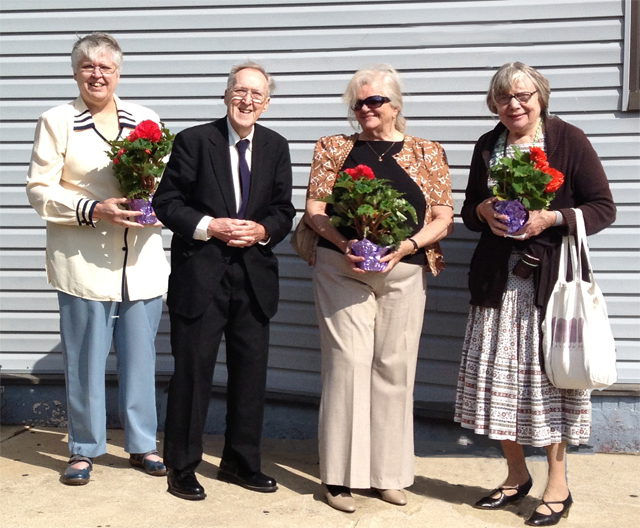
Potted posies were given as gifts to the mothers. So nice. Our pastor wanted one to put on his mother’s grave.

One of our Ambassadors asked for a detour on the way home to view some sculpture. It was worth the drive.

We had a Mothers Day Breakfast together.

Of course, at Redeemer, we all remember Mothers Day 2009, when SEPA Synod representatives visited our church and attempted to commandeer our worship service.

Measuring Diversity in the Church

“We Are Diverse”

One of the more frequent exclamations coming from SEPA Synod Assembly is the boast, “We are diverse.”

Just keep saying it and people might believe it.

Diversity in SEPA Synod is an illusion. Cloaks and mirrors.

The Synod Assembly is rigged to display diversity. Congregations are given extra votes and representation if they can prove diversity. A small church with darker skinned members can have more votes than small pale congregations.

Ecclesiastic gerrymandering also distorts gender and age. Most churches have a predominance of women in attendance, but congregations are required to send one female and one male member . . . creating the illusion of gender equality.

From the number of youth present at the Assembly, you’d think our churches were filled with energetic and engaged young people. They are not.

Diversity Within Diversity

When addressing diversity, the Church tends to fixate on skin color. Skin color alone, is broader than black and white and diversity is so much more than skin color. Skin color is easy to see and count  . . . and so we do!

Redeemer’s Ambassadors have visited more than 60 of SEPA’s 160 congregations, We began our visits in the city where racial diversity is likely to be more prevalent than in the suburbs. As we continue our visits, reaching into the suburbs, we doubt we’ll see more diversity than we already have. So far, we haven’t seen much!

We see many white congregations with a few assorted “others” and a few black congregations with a few assorted “others.” Of all the congregations we have visited we can count only about five that have a substantial representation of people from different racial or ethnic backgrounds. Each of these was a smaller congregation.

This includes Redeemer — who SEPA has excluded from Lutheran fellowship for five years. Redeemer had grown to be very diverse. We were diverse racially, culturally, linguistically, ethnically, economically, philosophically, and in gender and age. 

Our diversity didn’t earn us extra votes. In fact, we were denied any voice or vote in the Southeastern Pennsylvania Synod of the Evangelical Lutheran Church in America (SEPA ELCA) by decree of the bishop—a flagrant denial of congregational constitutional rights.

SEPA attempted to divide our congregation along racial lines. SEPA reported only our white members in reports to Synod Assembly. They further decided for our black members where they ought to go when they claimed our property—as if our black members were somehow too feeble to determine for themselves where they’d like to worship. It was OK if white Redeemer just disappeared. In fact, that was the plan.

“White Redeemer must be allowed to die. Black Redeemer . . . we can put them anywhere,” Bishop Burkat said in 2007.

Truth be told, there was great diversity among both our black and white memberships. We had African Americans, East Africans and West Africans. The Africans spoke many languages—French, Swahili and various tribal languages. We had white members born in England, Germany, Asia and America. We had regular visitors from India, France and South America and students from East Falls’ three universities. 

We don’t count.

Do Some Research

You don’t have to visit as we have to get a true picture of diversity. Just add the numbers in the parish reports available on the ELCA Trend site. The demographics of Lutheranism are very white and very aging.

Our visits reveal that most worship services are typically attended by women over 65.

More often than not, there are no children present in the sanctuary for worship. Children’s choirs, a rarity, tend to be very small and very young.

Youth are scarce. It will be 20 years (if ever) before the few young people will come to be of an age to support the church financially in the manner of previous generations. They will be saddled with college debt.

Leadership has a hard time recognizing reality when they look across the Synod Assembly and see the hand-picked representation that gathers to decide the future of the church.

SEPA has often chosen to let congregations die, providing minimal services for as long as 10 years rather than help congregations when a little help might have made a big difference.

This should be a serious concern to SEPA. Two decades could decimate dozens of congregations. It may be too late and far more costly than if this had been addressed 20 years ago.

Some Parting Questions and A Plan

Should diversity in the Church be measured at all if there is no way of recognizing it?

Is diversity so important that we create false impressions? What is to be gained?

We are one in the Lord.

The fact is diversity will soon be the new norm in most neighborhoods. We are ill-equipped to serve the changing population.

Lest you think we criticize without venturing solutions, check out vbsaid.com. It outlines a plan which 2×2 would love to sponsor and pioneer. It could help the many small, aging churches reconnect with their neighborhoods.

We dont want to see any more Lutheran property in the city, provided by the sacrifices of dedicated lay members, permanently sacrificed to plug short-sighted budget holes.

The plan requires cooperation within the church and between various expressions of the church, but we think it is worth the effort and will benefit all. Right now, all these expressions are struggling in isolation.

We know the perfect hub to implement this program. Midvale and Conrad in East Falls.

Tracey Beasley, Redeemer Trustee, Elected VP of SEPA

Journalism 101: The incoming (not outgoing) leader is the news.

We heard a rumor that Tracey Beasley of Reformation Church in Mount Airy was elected to replace the outgoing Vice President of the Southeastern Pennsylvania Synod of the Evangelical Lutheran Church in America. We looked for confirmation but came up with a story that said she was one of two candidates.

The story that comes up on SEPA’s web site is all about the outgoing vice president.

The people of Reformation are congratulating Tracey on their Facebook page. It must be true!

What do we know about Tracey Beasley? What can we expect from her leadership?

Tracey Beasley was influential in the creating the mess in East Falls that severely hurt our Christian community and neighborhood and has saddled SEPA with a costly and unnecessary five-year court feud.

She was one of four trustees appointed by Bishop Burkat to make our community wards of the bishop and convey our property and cash assets to benefit the synod, while locking out the Christians that provided this Care Package to plug the Synod’s deficit. She was co-chair, along with The Rev. Lee Miller, who left SEPA Synod last fall for New York’s green pastures.

She visited Redeemer in July 2007 along with the other three trustees. Rev. Lee Miller had demanded the meeting with only a couple of days notice — never telling us why. Only two of our council members could attend. Summer vacation season made getting people together quickly for an undesignated purpose difficult. 

The four visitors from SEPA Synod, never identified themselves as trustees nor did they inform us that we were under Involuntary Synodical Administration (a made-up term that does not appear in the constitution, but has taken on legal weight by virtue of it being tossed around often enough). Apparently, we had been under synodical administration for some time. No one told us! Not even the trustees sitting with us in our fellowship hall.

They came to our door and asked for a room where they could meet in private. Odd. 

They then sat with us and we told them about the mission plan we were drafting. It was a good discussion. At the end, they thanked us for being candid. I remember commenting, “Yes, we have been forthright, but something tells me you are not being candid with us.”

They glossed over the observation and assured us that they were there to help. We were unaccustomed to SEPA showing any interest in our ministry, so even that was odd.

The four trustees then did nothing to help us. We didn’t see or hear from them again until November 2007, when our congregation council met with the Bishop. This is when they told us about the synodical administration — some five months after it was supposedly imposed.

Tracey Beasley did not attend this meeting. The other three trustees were present. Larry House and Ray Miller said nothing but took copious notes. Lee Miller seemed to be excited by our reports of our ministry and said “I’m with you guys.” Closing the church was never mentioned at this meeting. We gave Bishop Burkat a copy of our 24-page mission plan and a resolution to call one of the ELCA pastors who had spent seven months helping us draft and implement the plan.

We were excited by the progress our congregation had been making. The meeting was concrete proof that our membership had grown steadily in the last ten years, during which SEPA was largely absent. Bishop Burkat promised that we could work with the newly appointed Mission Developer, Rev. Patricia Davenport.

Four months of silence from SEPA followed. Repeated phone calls to the Synod from our leadership, who were eager to follow up on the promising meeting, were ignored.

We were not to see Tracey Beasley again until February 2008. She was with the bishop and her party when they came to our church one Sunday afternoon with a locksmith and lawyer waiting behind the church, out of sight. She was instrumental in spreading the gossip that we tried to have the bishop arrested at this encounter. This is untrue.

We objected frequently to this false representation, but it continued to appear in court documents for five years.

Tracey Beasley spent no time with our congregation outside of that first encounter in which she lied by omitting her true purpose. She presented a report to the 2008 Synod Assembly about our ministry that was wholly inaccurate. Some of the information was just plain false. Some was so outdated that it created a false impression. And that’s what the trustees needed to sway the Synod Assembly—a false impression.

In 2008, Redeemer immediately asked for the record to be corrected. We followed up with detailed monthly reports of our growing mission and ministry. All of these were copied to Tracey Beasley and all the trustees, as well as the bishop.

There was never any response to any of our letters.

Tracey Beasley read the same fabricated report, unaltered, to the 2009 Synod Assembly.

The next time we were to see Tracey Beasley was on Mother’s Day 2009, just hours after the close of the 2009 Synod Assembly. This is the Assembly at which Redeemer appealed Synodical Administration. The Assembly never voted on our appeal. Synod leaders substituted a question allowing the Synod to take our property—a topic our appeal had not addressed. The vote was predictable. Almost everyone voted to take our property. They have NO constitutional authority to vote on congregational property.  

Tracey Beasley came to our worship that Mothers Day with Larry House. They sat through the worship service and before the service concluded they walked to the front of the sanctuary and announced, “We are in control now.”

What happened next was beautiful. The people of Redeemer rose united from the pews and surrounded the two trustees who had represented themselves as working with Redeemer but had done nothing. There had been no plan, no strategy. It just happened. I watched from the back of the church, talking to the visitors. (Redeemer had visitors almost every Sunday.)

Redeemer members confronted the two trustees about their behavior. Most notably, someone pointed out that Synod’s interference in our ministry had cost us a 25-year relationship with Ken Crest. This interference had not only cost our congregation a strong source of income, it had deprived our neighborhood of an excellent service.

Tracey Beasley claimed that Ken Crest did not leave because of them. We pointed out that Ken Crest had just signed a five-year lease with us but abruptly whited out their names. We had a letter from Ken Crest stating that they were leaving because they didn’t want to be in the middle of a property dispute.

Tracey Beasley claimed to know nothing about this and demanded to see that letter. The letter indicated that she had, in fact, been copied.

The courts ordered the property given to SEPA — not under the law, but under Separation of Church and State. They couldn’t get involved in church matters. They did not order that the church members be locked out, but Synod accepted the court win as entitling them to do exactly as they please. There is no authority in the church or out of the church to stop them (unless SEPA Lutherans follow their constitutions).

In December 2011, we read in the local news that Redeemer was opening again. There was to be a service a few days before Christmas. All welcome.

We were suspicious. Suddenly, we are open again! A public announcement. No effort to tell Redeemer’s members.

It ended up to be not so much a worship service as a gloating fest. The service, never to be repeated, was conducted by the Rev. Lamont Anthony Wells, pastor of Reformation in Mount Airy, where both Tracey and her predecessor are members.  The watchful eyes of East Falls reported that about seven people showed up and seemed to be very uncomfortable in their presence.

There was never any real intent to “open Redeemer.” The group that seemed to be from Reformation marked their territory, locked the doors behind them, and moved on.

Tracey Beasley, as a trustee and as a member of synod council, was in a position to represent the interests of the congregation. She demonstrated no inclination to do so.

She was clearly an extension of the bishop. Now she is an official leader of all congregations. Will she do so with independence? Will she now represent the interests of the congregations—as her position suggests? Will she check the power of the bishop — as is the responsibility of synod council?

If past behavior predicts future behavior, your leaders are comfortable in their view that congregational property is theirs for the taking. Because Synod Assembly seems to be powerless in enforcing their own rules, there is nothing to stop them.

Small churches (and most SEPA churches are already small or getting there) should be alarmed. You now have leadership that has shown they are capable of plotting to take your property. They have a track record using secrecy, intimidation, and deceit in doing so. They have demonstrated a clear sense of entitlement. They will not hesitate to attack lay people in court if they dare to oppose their views within the constitution. 

You elected them! 

When they knock on your doors, remember—we warned you.

Blessed Are the Peacemakers

Redeemer’s First Sunday of the Month Worship

Once a month Redeemer worships in East Falls. Our Ambassadors were happy to be home this week. One of our Ambassadors had just returned from a trip to St. Augustine, Florida, and was brimming with news of her visit to a Missouri Lutheran Church there.

She had been invited to attend a Catholic church with some of her travel companions, but she was determined to visit a Lutheran Church in this old and historic city.

We did the research in advance and found there were only two—one ELCA and one Missouri. Both were quite a distance from the hotel where she was staying.

She talked of her $10 taxi ride to find the church with the taxi driver looking at a map with a magnifying glass as she hunted for the address. 
She found a small church of 55 members. They were celebrating ten new members, nearly 20% growth! (Redeemer had 82 members when SEPA took us to court to force our closure. We were growing, too.)

Two members took her under their wings, invited her to the new member reception, and drove her back to her hotel.

The church gave her a gift of a cross with Luther’s Seal. They had fashioned the nice medallion to sell to raise money for property renovation. They are encouraging others to emulate their successful fundraiser. We are all for congregational entrepreneurship!

Another Ambassador had brought a painting an artist in a previous congregation had given as a gift many years ago. The artist, now deceased, had become quite famous and has works in the Philadelphia Museum of Art. Our Ambassador had rich provenance from his personal relationship with this artist and shared many stories. It happened that another Ambassador was planning to attend a social that very afternoon featuring an appraiser from PBS’s Antiques Roadshow. We convinced him to take his “Lutheran” painting for appraisal.

We began worship sharing our week’s activities but soon settled down to hear the message of peace that was the lectionary theme for the day. Peace — that elusive, misunderstood, but welcome Christian concept.

We long for peace that doesn’t dehumanize us. Peace with passion, perhaps. Peace that doesn’t discern victors and victims.

Which brought our Ambassadors to talking about the signs that have gone up around Redeemer this week. The patronizing signs chastise local dog owners who let their pets run freely on the vacant property. I listened for a while as the Ambassadors talked about the desecration of sacred property. I thought they were talking about the dogs desecrating the property, but I soon realized that they considered the heavy-handed signs revealing an attitude of superiority to be the desecration.

Blessed are the peacemakers. Anyone know any peacemakers?

Or is peace one of those concepts Lutherans believe in theory only?

Winning Friends and Gaining Influence in East Falls

SEPA has had control of Redeemer’s property for nearly four years. It sits there unused— vacant with its paint peeling. Unused property in an urban neighborhood is quickly claimed by dog lovers.

Neither people or dogs are welcome in God's House by order of SEPA Synod.Redeemer occasionally had to remind the neighbors that the yard is used by children. Mostly they respected that. No big deal. But now it’s different. When we worshiped this Easter on the sidewalk we watched one dog owner after another shortcut through the yard.

The people of East Falls were quite upfront at the Community Council meeting SEPA attended more than a year ago. SEPA was putting their best foot forward, trying to impress the locals with their concern for the neighborhood—something they failed to show their own supporting members in East Falls. Rev. Pat Davenport was all charm as she gratuitously asked the community what they would like to see on that corner. The members said, “a dog park.”

The absentee landowners are now peeved. Ever-accustomed to wielding a mighty arm  without resistance, SEPA now resorts to signs on every corner. Signs on the signboard. Cardboard signs propped up on folding chairs (at least they haven’t taken ALL our folding chairs).

Clearly, they mean business!

They warn the neighbors that they don’t intend to clean up after their dogs.

That should make mowing the yard very interesting.

Their attitude toward dogs is similar to their attitude towards Redeemer’s people.

East Falls is not going to take well to it.

Sometimes neighbors just have to put up with neighbors. If SEPA ever wants to open a word and sacrament church in East Falls — as Rev. Davenport claimed, but we doubt — they should adjust their attitude. Fallsers have a long memory. As new owners of old East Falls land they are already, in East Falls vernacular, considered “squatters.” (And in SEPA’s case, they are squatters who showed no mercy on the people of East Falls in pursuit of our community’s riches for their gain.)

A little advice from Redeemer on how to get along with your neighbors:

The only thing that draws more flies than dog dirt is honey. 🙂

It isn’t Redeemer members you are dealing with now. It is all of East Falls.