We, as congregations, are often asked to draft both mission and vision statements.
Out of curiosity, we started researching vision statements and visited our own regional body web site to see what their vision for their work might be.
There is a menu navigation button that says Mission/Vision. Click!
There is a Mission Statement, an abbreviated version of Ephesians 4:11-13.
“Activated by the gifts of the Holy Spirit, we equip the saints and congregations
for the work of ministry,
for building up the Body of Christ.”
We have seen only the opposite of that at work in East Falls. But then they didn’t include the next verse! “Then we will no longer be infants, tossed back and forth by the waves, and blown here and there by every wind of teaching and by the cunning and craftiness of people in their deceitful scheming.” Or the rest of that chapter.
But let’s move on! We’re looking for vision statements.
Where’s the Vision Statement? There is none posted. What is the Synod’s vision for its many neighborhood churches?
If life was always peaches and cream, we would have no need for religion. We turn to God in weakness to find our strength.
So in comes the Church.
Church leaders will explain God’s ways. We will have a roadmap for solving problems.
Church leaders are rarely at a loss for words when it comes to advising congregations. They preach guidelines for peaceful and productive lives in Christ.
Followers nod in agreement. They file out of church assemblies with a sense that they are leaving a place where people care about one another and will follow God’s Word.
A pastor recently shared his story.
He had listened to a bishop address his synodical assembly with words of peace, admonishing them to work with one another to resolve differences in accordance with the Scriptures. It was a moving message which drew a standing ovation.
This pastor and his congregation were having some issues with Synodical leadership. He was encouraged by the message. He managed to buttonhole the bishop before the end of the Assembly. He told him he was moved by his sermon.
“Let’s do it,” he said with enthusiasm. “Let’s get together and talk through our issues.”
The bishop responded. “Uh, OK, why don’t you write an agenda and send it to my office. We’ll set up a meeting.”
The pastor was excited. He drafted an agenda of the issues his congregation wanted to discuss and sent it to the bishop’s office.
Months went by with no response. At last, the bishop responded that he had been advised that the issues might end up in court and he should not meet with the congregation.
You read that right! The issues MIGHT end up in court. So what’s the point of talking.
This parallels Redeemer’s experience. Bishop Burkat had a lawyer at her right hand (literally) at her first meeting with Redeemer leaders.
This attitude of—not all, but more than one—current bishops in the ELCA violates the Gospel and is a dereliction of their assigned duties. They are no longer shepherds but predators. Clergy’s key advisors are lawyers—not more experienced pastors, not people with a spiritual gift for wisdom, and not the Bible.
The Gospel is clear that we are to attempt to work out differences without the courts. But in today’s church, leadership is not looking for resolution. They are looking for the WIN.They are looking to be seen as powerful. Resolution might call for ceding some power. Opponents must be defeated!
The Church is following the way of the world—exactly as the New Testament (both Gospel and Epistles) cautions. It is crippling the Church, one little conflict after another. Every WIN by intimidation is a defeat for the Gospel.
“Resolution” is so distasteful that the word is avoided. SEPA Synod is billing an upcoming workshop as conflict “transformation.”
Today’s Church does not believe its own scriptures.
It is a sad day when the only thing separating the Church from the world is tax exemption and immunity for its actions—but not those of its opponents—under the Bill of Rights.
Yesterday, the Southeastern Pennsylvania Synod of the Evangelical Lutheran Church in America announced an upcoming workshop for congregations. We first saw this listed as Weathering the Storm, but notice it is now advertised as Weathering the System.
Weathering the System
October 27, 9 a.m. to 3 p.m.
St. John’s Lutheran Church
505 North York Road, Hatboro, PA 19040
The six-hour workshop on conflict resolution is advertised as conflict transformation.
A buzzword unused is an opportunity squandered.
How do you weather a storm?
Make sure you win! Winning, at any cost, even at the expense of mission, outranks problem-solving in today’s church leadership. As one leading businessman wrote today, “It’s because defeat and power and humiliation and money have replaced ‘doing what works for all of us.'”
Although the names of presenters are not posted, you will learn from the best. The Southeastern Pennsylvania Synod of the Lutheran Church in America, has been involved in years and years of conflict. They know the ropes!
Topics within synod’s expertise include:
how to create and define conflict using deceit
intimidating the opposition
exploiting vulnerable volunteers
how to identify which volunteers to eliminate to ensure victory
discouraging lay involvement to assure managerial success
how to pit clergy against laity to maximize success
guidelines for effective use of inflammatory language
when to apply the constitutions
when to ignore the constitutions
how to use Roberts’ Rules of Order
how to ignore Roberts’ Rules of Order
isolating the opposition from the rest of the Church
divide and conquer: tried and true techniques to guarantee divisiveness
tips for withholding professional services while appearing to serve
demonizing your opposition
use of litigation as a management tool
ignoring facts that do not serve your purpose
how to use partial truths to gain popular support
when to lie unabashedly
best practices in name-calling and finger-pointing
how to camouflage objectives with semantics
use of charm and charisma to deflect attention from the issues
how to keep knowledgeable people from asking questions
when and how to declare your opponents as non-existent
the underestimated value and strategic use of prejudice
creative use of statistics
techniques for silencing opposition
maximizing the “gotcha” factor
when and how to ignore Gospel imperatives
counting coup: the proper way to celebrate victory
The announcement quotes a former participant:
“Conflict and stress are a part of life. Both can be positive. It’s all in how you deal with it.”
Don’t miss the upcoming workshop. Learn how to deal with conflict from the masters!
Update: a subsequent announcement names The Rev. Dr. Jennifer Phelps Ollikainen of Liberty Lutheran as the presenter. Liberty Lutheran is independent of SEPA Synod, so content may actually be helpful!
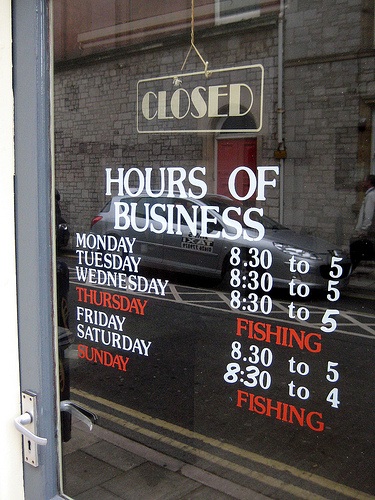
God is doing something new and the church is Out to Lunch. We are tempted to say Gone Fishing, but that might have theological implications that do not apply.
Redeemer Ambassadors always turn to the internet to plan our visits. We check service times, read newsletters and find out as much as we can before we visit.
We follow the process any newcomer to a neighborhood in 2012 would take when searching for a church home. They would Google their neighborhood and the word “church” to see what comes up.
Our search process reveals that neighborhood church seekers will have problems finding Lutheran churches.
Since we are looking for Lutheran churches, we start with the ELCA Trend Reports web site and use their Church Finder. We plug in 15, 20 or 25 miles for the radius and press the LOCATE button. Up comes a list. Then we click the link provided to each congregation’s web site.
We are now preparing for our 50th visit. We’d like to visit a nearby church tomorrow morning. Some of our ambassadors have afternoon plans. There are several possibilities. We’ll look for a church with an early service.
THIRTY of them have NO WEB SITE!
Several of those with no web site are mission churches under the direction of synodically appointed leaders. Note: These are just the churches in a 15-mile radius of East Falls.
A MISSION CHURCH with NO WEB SITE!
We Google the name of one nearby congregation. Maybe they have a web site that isn’t listed in the national database. Great! They have a Facebook page. We check it. It has NO information beyond the church’s address.
Really, SEPA churches, what are you thinking? Are you serious about outreach? Are you part of your communities? Do you open your doors on Sunday morning and expect the neighborhood to flock there by magic?
A church can have a nice looking web site for an annual investment of $25 and no more than an hour’s set-up time. Facebook is FREE, for St. Pete’s sake! 13-year-olds know how to use it.
If you don’t have a web site, you are not serious about serving your community.
Most of these congregation’s have pastors who could set up a basic site and at least have a community presence.
Even Redeemer, the church that doesn’t exist according to SEPA and the ELCA, has a web site.
In the world of the ELCA, these churches, that are not serious about ministry, feel they have the right to take votes about the ministries of other congregations and gain from their actions. (They don’t have this right under governing laws, but that hasn’t stopped the churches and clergy of SEPA!)
God is doing something new in the Southeastern Pennsylvania Synod and many churches are not equipped to perceive it—much less take advantage of it!
We’d like to think they have Gone Fishing for Men, but the evidence is they are Out to Lunch.
See the countdown box to the right. 2×2 Foundation, which grew from Redeemer’s ministry, is counting the days to the third anniversary of the Southeastern Pennsylvania Synod of the Evangelical Lutheran Church in America’s excommunication of all Lutherans in East Falls so that they could take our property and assets as their own.
We are marking the occasion with the issuance of our annual report which will include a report of our 50 visits to other SEPA churches.
Nine months after they locked our doors, SEPA’s Synod Council, with no constitutional authority or any contact with Redeemer members, voted to officially close our congregation. We found out a year later when we Googled our name. SEPA’s idea of working with us! Perhaps all churches should Google their names to see if they are open!
Why these actions do not outrage SEPA Lutherans passes all understanding. The Gospel is totally abandoned when the subject of Redeemer comes up.
‘Truly, I say to you, as you did it to one of the least of these my brothers, you did it to me.’ — Matthew 25:40
Redeemer is not closed. Redeemer is locked out of God’s House by SEPA Synod.
We look forward to sharing our annual report three weeks from today.
It’s the first Sunday of the month, the week Redeemer members pass our locked church to worship together in a community theater and gather across the street in a neighborhood bar afterwards for fellowship. The bar even added us to their calendar. (God is doing something new!)
We had many things to celebrate and give thanks for today. Two of our members were awarded good jobs and one is starting a business. We were particularly grateful that one of the retired pastors who worships with us regularly was back with us after a four-month rehabilitation after surgery.
We enjoy having our own worship—singing the hymns we choose, praying our own prayers, enjoying our own fellowship. We also enjoy our Ambassador visits on the other Sundays of the month. But there is nothing like being at home.
We know that the only reason to lock our people out our church was to destroy our community. Lesson to church hierarchies: Find another way!
We were reminded in today’s sermon of an ongoing theme of our Australian pastor — that church is not about what we “get out of it.” It is about God and His relationship with us and our response to His love.
There isn’t a church in East Falls that isn’t challenged. Some of the challenges come from the religious apathy of the community. We can’t blame them to some extent. It’s rather dangerous to be a Christian (or at least a Lutheran) in East Falls.
The greatest challenge is from the Church itself, who values property above community. It is too expensive to operate religious schools. Send the kids elsewhere. Rent the buildings.
The people who invested their time and offerings in Redeemer and St. Bridget’s (and perhaps a few other church communities before them) have had their gifts squandered by outside interests. Fallsers gave to contribute to their community. Their gifts were confiscated or devalued by people who thought they had better uses for our resources but haven’t a clue how to serve East Falls.
If only the courts could hand out consciences as easily as property!
There are reports that the Southeastern Pennsylvania Synod of the Evangelical Lutheran Church in America is negotiating the use of Redeemer Church with community leaders. SEPA spent no time considering the use of Redeemer Church with the people who built the church — the Lutherans of East Falls. They continue their attacks on our members in the courts. That should give the people of East Falls some idea of the character of the people with whom they are negotiating. East Falls beware!
At the heart of SEPA’s problems in East Falls is loss of mission — or to use church-speak — the loss of “missional focus.”
If SEPA cares, they should note: Redeemer is still a worshiping community.
Talk to us! You have a better chance of serving East Falls with the Lutherans of East Falls than without us.
As for the excommunicated members of Redeemer, we will serve the Lord.
If churches want to reach millions of independent-minded young Americans they should learn a thing or two from craft brewers. . . . It’s time, he said, for “craft churches” that reach niche audiences.
This is an astute observation. Small churches have been serving niches for some time.
Our Ambassador visits reveal that most churches, large or small, serve a niche, but probably with little intent!
The largest church we visited (non-Lutheran and twice the attendance of the largest Lutheran church we visited) was a congregation of 25-35-year-olds.
Birds of a feather . . .
Small churches know their niche. Any intention of being all things to all people, though tempting, is out of reach. Even if people wanted that kind of ministry, (and most mission statements sound like they do!), finding leadership is daunting.
Church leaders often view small churches as failures—undesirable places for pastors to serve. Part of this is economics. All churches must rise to the same budget expectations, which in the modern era have priced many communities out of the faith business. Pastors assigned to small churches often view their role as care-taking, never bothering with outreach. Some even use the offensive term “hospice ministry.”
Perhaps it’s time to seriously examine the economics of church.
People will make their church home where they can see their offerings and efforts at work. They will neither participate nor attend a church where they do not feel fully welcome.
We at Redeemer know the difference between being welcome to attend church and being welcome to participate. Our bishop made it clear that we are not welcome to participate in SEPA Synod. She seized our property and pledged to close our church and reopen it under new leadership. She wrote to us that current members could attend this new, improved Lutheran church but former members would not be permitted to participate. She unilaterally denied us vote or voice. When we started visiting churches she sent a letter to pastors warning them!
How’s that for a welcome statement!
Redeemer was welcoming East African immigrants who were moving into our community—not just to use our building, which is the more common outreach approach, but to join their traditions with ours. We saw our unique niche ministry as adding to the mosaic of the greater church.
But SEPA was determined that one population had to die before a new population could be fully welcomed. As Bishop Burkat said, “White Redeemer must be allowed to die, black Redeemer . . . we can put them anywhere.” Control of assets was the objective.
Religion is not supposed to be a spectator sport.
Part of the problem with niche ministries is that few pastors are trained to serve niche populations.
Defining a niche (while recognizing the likelihood that niches will change every decade or so) may not be such a bad idea. It will take decades to recognize and train leaders to actively serve niche ministries and not view them as “hospice” assignments.
Another problem with niche ministries is that the “niches” that are most in need (the ones the Bible talks about), often can’t support them.
The true mission of the church is defeated by cost—at least with today’s budget and funding expectations.
Meanwhile, rejected and criticized by our denomination, Redeemer has created a niche ministry. You are visiting it now. Today, two months into our third year, we are reaching more people every week than the largest church in our denomination’s local region. We are just getting started.
The following is from a letter to parishes from a SEPA dean:
When we think about what is needed to help our congregations become as healthy and as strong as they can be, we need to develop our capacity to be confident in prayer, inspiring in worship, sacrificial in service, rooted in scripture, intentional in invitation and generous in giving.
—Serena Sellers
All of these qualities describe Redeemer. We were even growing where we were planted as her letter also recommends. Too bad SEPA decided they needed our assets more than we. . . and not a single SEPA dean (who are supposed to be liaisons between the synod and congregations) spoke up.
Pastor Sellers points you to the synod website, godisdoingsomethingnew.com.
Tons of property now stand empty in the greater Philadelphia region.
Episcopal Bishop Bennison says, Where is the Gospel in this?
Good question, Bishop Bennison. The question should have been asked long ago!
The article deals with the stones and mortar problem church leaders are facing.
It barely mentions the lives of the people who have been affected.
The Church misplaced its priorities long ago. They point to a changing economy and demographics. Where were the experts on change when the changes were happening?
The neglect of God’s people is the real problem.
Most of the church leaders quoted in this article are from Roman Catholic and Episcopal traditions where church property is owned by the denomination.
One person quoted in this article, Bishop Claire Burkat, comes from the Lutheran tradition, where property belongs to the congregations. Her actions, in one neighborhood (East Falls) defied the rules of the church she serves. Courts have refused to hear the case the congregation brought. They want churches to settle their own problems, citing separation of church and state.
The Church does not have a good record of solving its own problems!
Now, they, like the hierarchies modern Lutheran leaders emulate, have a problem. They have successfully acquired property they cannot support or have any use for! Each denomination is competing for few willing buyers.
Costs are rarely discussed openly. This article states the realistic cost as $55,000 per property. No figure like this appears in the regional Lutheran church budget!
The real problem began years ago. The Church fled neighborhoods and considered the people left behind or newly moving into those neighborhoods as demographically unsuitable for their investment in ministry. They paid experts a lot of money to support their decisions.
They sought short-term solutions that would one day be someone else’s problem—presumably the laity’s.
They routinely, assigned part-time, minimal effort, caretaker pastors to see how long they might keep money flowing without actually ministering to the community.
Reliance on demographic studies is not helpful. The Evangelical Lutheran Church in America analyzed Philadelphia’s demographics and found only one zip code in the city worthy of mission investment—Chinatown.
Eventually, they officially quit trying and started helping congregations close. Initially, in the Lutheran Church, they allowed the congregations to dispose of their assets as is Lutheran law. But regional bodies were struggling, too. They started imposing new “rules” which would make the assets of congregations go to them. Any such new rules are in defiance of the ELCA Articles of Incorporation and cannot be changed by fickle, expedient bylaws. Only Redeemer is challenging this, although the practice will one day affect many.
The plan is backfiring. Even suburban churches face serious challenges.
Regional bodies are looking for any way to put properties they now manage to work. They would rather work with hot dog vendors and theater troupes than people in the neighborhoods who profess the same faith.
It’s time to start looking at more than property. 2×2 will examine the more important question.
What happens to the people and neighborhoods when churches close?
How the Internet Can Force Us to Take A Good Look at Ourselves
A young man has been ranting online about the death of his sister in a car accident and her insurance company’s maneuverings to avoid paying the benefit included in her policy. They have probably spent more than the $75,000 the policy promised.
Considering the tragic circumstances, Mike Fisher’s writing is civil. His arguments make sense and are presented graciously. The battle that his parents have had to wage reveals the failing of corporate thinking. Money and litigation experience allows the Corporation to abuse its customers.
There was a time when victims of bad corporate behavior had little recourse.
They bet on short memories and the healing power of marketing dollars, commercials and discounts. Employees are pushed to focus on bureaucratic policies and quarterly numbers, not a realization that individuals, not corporations, are responsible for what they do.
The Corporate Church is no better than Progressive. They are mired in “corporate think.” It’s handling of its members has strayed far from biblical teachings. Dollars rule. People: too bad.
In Redeemer’s conflict with the Southeastern Pennsylvania Synod and the Evangelical Lutheran Church in America, the same thinking is evident. The Church turned on its own “policy holders.” The conflict was vicious from the opening bell. The bishop attempts to make it look as if great efforts were made otherwise. They weren’t. In all the rhetoric explaining how hard they worked with Redeemer, they never give examples. There aren’t any.
The Church, from the start, used corporate power and pooled assets of 160 congregations to go after individuals in one small church.
The people of Redeemer always thought we were on the same side.
The lives of 82 lay volunteer church members have been turned upside down for four years with no end in sight. The Church is oblivious that their actions are against their own members— old people, children, immigrants, disabled people, students—faithful, hard-working people—the people the Church advertises that it cares for.
To SEPA, we are the enemy.
This enemy has been fighting for one thing—that SEPA and the ELCA keep the promises made to member churches.
The courts don’t want any part of church disputes. Unfortunately neither do other congregations, clergy, Presiding Bishop Hanson, or the national church.
Progressive Insurance creates enticing advertisements. Get the dollars flowing.
The Corporate Church preaches that it cares about bullying and social justice, love, reconciliation and compassion. When put to the test, it is just as self-protective of power and money as the Corporate Insurance Agency.
They are both in the “people business.” It’s time they both act like it.
People could stop the abuse. Will they?
We won’t buy Progressive Insurance. We still call ourselves Lutheran.
Join Bishop Ruby Kinisa as she visits small churches "under cover" to learn what people would never share if they knew they were talking to their bishop.
Undercover Bishop will always be available in PDF form on 2x2virtualchurch.com for FREE.
Print or Kindle copies are available on Amazon.com.
For bulk copies, please contact 2x2: creation@dca.net.
MISSION INSPIRATION OFFER
A visual and biblical guide to help congregations define their missions.
Contact Info
You can reach
Judy Gotwald,
the moderator of 2x2,
at
creation@dca.net
or 215 605 8774
Redeemer’s Prayer
We were all once strangers, the weakest, the outcasts, until someone came to our defense, included us, empowered us, reconciled us (1 Cor. 2; Eph. 2).
Be calm. Wait. Wait. Commit your cause to God. He will make it succeed. Look for Him a little at a time. Wait. Wait. But since this waiting seems long to the flesh and appears like death, the flesh always wavers. But keep faith. Patience will overcome wickedness.
—Martin Luther