So what should we tweet about? That IS the question.
We noticed that South Dakota Synod of the Evangelical Lutheran Church in America began their Advent season by tweeting the first verse of a popular Advent hymn:
Light one candle to watch for Messiah. Let the light banish darkness.
That’s a nice thought. We will retweet it. (More on retweeting later).
But we are also remembering the advice from the pros: social media is about connecting with others. If we want followers, our tweets have to appeal to others or people will just gloss over them. So we are going to work on a mix of material to use in our tweets. We won’t avoid the message of the Gospel but we will talk about things that might appeal to an even broader audience. In addition we will write about things happening here in our neighborhood (roughly East Falls, Germantown, Wissahickon, Manayunk and Roxborough and the tail end of City Line Avenue in Philadelphia).
We are going to start with something just for fun. It’s a riddle. We’ll pose the question in the first tweet and an hour or so later, we will tweet the answer.
Remember, we are new at this, too. This is a process of discovery for all of us.
So today’s task won’t take more than 10 minutes and half of that will be first time jitters.
Retweet the South Dakota Synod’s tweet.
Tweet our own riddle.
Tweet the answer to our riddle.
If you want to take part in the experiment. Start your Twitter account and start following us! We will follow you back! Let’s see if Twitter is as powerful as they say it is!
Facebook, the king and queen of social media, has some problems as a platform for churches.
To be used well, it is a lot of work.
It is unabashedly about monetization of cyberspace.
The rules change frequently.
It can easily become more intimidate than a congregation of unrelated people want to be part of. Facebook rules just changed recently to make posts more public than many users ever intended their Facebook pages to be. We’ll wait with everyone else for the fallout on that.
Facebook has been embraced by business and some nonprofits. They are more likely to have a top-down structure with monetary and hierarchical controls. In other words, Facebook will be part of somebody’s job. It might be their whole job. Few churches can afford that!
Twitter on the other hand comes with some control. You can create a following but you can direct your “tweets.”
The Twitter platform is stripped to the bone. You are limited to 140 characters (practically 120 characters). Who can’t write one sentence a day!?
Let’s look at Twitter. What is it, anyway?
Twitter is a social media platform first designed for people to answer the question, “What are you doing?”
People send simple, short messages. No pictures. No video. No fancy type.
The first reaction from the public, the echoes of which can still be heard, was “I don’t care what you are doing!”
But some people kept reporting their activities to the world anyway.
They soon learned the difference between “This sandwich is delicious.” and “Route 95 is backed up 20 miles. Stay away!”
Slowly with explosive bursts of potential, the world began to realize that there is power in caring about what someone else is doing and how we can influence what happens to them.
Does that not sound mission-oriented?
The power of Twitter is in making connections. Once those connections are made. It is really up to us what we do with them. Twitter is the spark.
There is a good explanation of this power in the book The Tao of Twitter, by Mark Schaefer. There are many good books explaining Twitter. Most of them are written from a marketing point of view. Marketers tend to love numbers and analytics, which if you can bear reading them, are impressive.
(We’ve provided a link to Amazon in our widget column for this inexpensive book.)
Most pastors and church people are not “numbers” people. If they were, they may have already fled the church scene. Church numbers are dismal at first glance and alarming with analysis.
Mark’s book dwells on Twitter’s power, beginning with person to person, one-on-one power. This is something every church needs. It is foundational to mission.
The current and traditional church mission focus is invitational. Build a building, open the doors on Sunday morning, and hope that people are curious enough during those few hours of the week to come to us. We sit in our big churches and wait. For decades we didn’t know how to do mission any other way. The tools to do a better job were out of reach, practically and economically. So we keep doing things the same way, rewarding the congregations that do this the best, despite the nagging realization that even the biggest churches are statistically ineffective.
To use Twitter, requires making an effort to unlearn and change this collective mindset.
How does Twitter differ from Facebook?
Twitter is beautifully stripped down. You must tell your story in less than 140 characters. Church people can respond to this limitation in one of two ways.
Protest! We can’t possibly tell our message in 140 characters.
Cheer! How hard can it be to write one sentence a day!
Twitter will be manageable for any pastor or any lay leader. It is possible to put Twitter to work with as little as 15 or 20 minutes of effort per day. That’s good news!
Advent is a big season for Lutherans and several other denominations that follow the liturgical year.
Frankly, for a lot of Christians it can be a big letdown. For years, Advent has been playing second or third fiddle to the big “C” (Christmas).
Advent is important to us. Why isn’t it important to everyone? What’s with the celebration of Christmas for five weeks and the meltdown on December 26? Every church goer knows December 25 is the first of 12 days of Christmas! Why are the Christmas trees out in the trash on Day 2!
What can we do about this?
We can wait every Sunday in Advent for the throngs to walk through our doors. We can be ready to welcome them and share our traditions. What are they again? Why do we light those four candles? Who is this Isaiah guy? And John the Baptist? Really!
We can go to the world.
Our Advent Tweet A Day is an attempt to share what is important to us with people beyond our membership. We’ll see together how that goes. But one thing we can guess. No one will follow us if all we do is talk about ourselves.
Meanwhile, here’s another idea. Instead of waiting for people to come to our congregations, what if we gathered our members and went to them. Try this! Get a group together and attend the local high school, middle school and elementary “winter” festivals. Maybe you have kids attending these schools. Maybe you don’t. That doesn’t matter.
The young people and their teachers worked hard on their music. These days many school groups are performing pretty professionally. Your group is likely to be noticed. You will have a chance to talk to others in the community.
Remember! It’s not about you. Just go and enjoy yourselves. Then write a blog article or two about it and start tweeting about your experience.
Make a habit of such community involvement. Check their web sites and subscribe if you can so that you know what’s happening.
You will start to notice more things about your community . . . and they might start to notice you, too.
Our community school concerts are next week. We can’t wait!
2×2 started as a blog. It is time to spread our little wings to other realms of social media!
2×2 has been blogging seriously for about 18 months. We started in February 2011. It took us a few months to get our bearings. Only one person visited our site that month! Our stats show that our readership didn’t break triple digits until July. From our many web visits to other church web sites we figure that’s about when most churches give up on social media. We kept at it! Patience!
Our best month of 2011 was November with 623 new readers that month.
By this time we were able to see growth patterns and we predicted that we would have 12,000 new readers visiting our blog in 2012. We should exceed that benchmark with ease.
Looking ahead to 2013, we can anticipate doubling 2×2’s reach. We are nearing 1500 new visitors a month and the growth has been steady. 110 people subscribe and have our posts go to their email every day. So that’s an additional 770 views each week! Our reach is truly worldwide.
2×2 achieved this without using any other social media platforms to enhance our SEO numbers. We followed just one strategy: Offer content that will be helpful to our mission audience — seekers and lay leaders.
We continue to be surprised by the many and strong relationships we are forming with other mission-oriented church workers, many of them not Lutheran. These are rewarding and growing. We started to introduce our readers to one another and now they are referring people to us. We look forward to many new things in 2013.
Which brings us back to our Advent project.
Research shows that Twitter is the least understood social media platform with the greatest potential to reach new audiences. Better than Facebook. There are others, too. But let’s tackle one at a time!
The biggest barrier to using Twitter is understanding its potential. That’s why we have chosen December as our month to experiment. We’ll take it step by step and report our progress.
We hope you will follow our experiment and perhaps join us and share your results. We’ll try to make it easy.
How about it!?
Sharing the Gospel—140 characters at a time!
Watch for our official invitation to join the experiment which should be posted Saturday afternoon — just in time for Advent 1.
Step 1: We just opened our account:
@2x2Foundation
This required us to have an email account. We opened a free account with Google.
2×2 corresponds with several congregations that write to us regularly. Many are start-up fellowships. Occasionally, with their permission, we put them in touch with one another. Several have formed relationships with the common denominator being that they were introduced by 2×2—a project that grew from Redeemer Lutheran Church in East Falls.
Today, we learned that two of these fellowships are planning a conference together. They are about 350 miles apart in Kenya, but they are planning to travel to have their fellowships meet, worship together, study and get to know one another for three days. One fellowship works with street children. The other is a project of a husband and wife who have taken several orphans under their wing.
We are excited to learn of their efforts!
It is validating to our ministry, which the Southeastern Pennsylvania Synod of the Evangelical Lutheran Church in America (SEPA/ELCA) declared closed two and one half years ago.
Redeemer is not closed.
We are locked out of God’s House by SEPA Synod.
Several times in the last few years, I have listened to reports from various bishops and high-end church leaders concerning their visits to Africa. Some have visited Ethiopia, some Kenya, and some Tanzania.
They travel at their denomination’s expense. They return with inspiring reports of baptizing hundreds of babies and meeting church leaders.
They give these reports because they want us, here in the United States, to give offerings to these “approved” mission efforts in other parts of the world. They want us to sense that their denomination is actively engaged in the universal Christian mission to go into all the world and preach the Gospel to every nation.
This approach to mission work has decades of experience behind it. It also has decades of pre-social media traditions dimly lighting the way.
Is continuing this style of mission work effective for today’s world?
We serve an interconnected world. Sending official denominational representatives for on-site visits may once have been the only way for congregations to interact with mission efforts overseas.
Today, each individual has the power to connect. If the Church does not harness the power of the individual using social media tools for world mission, we are failing in our stewardship of possibilities.
Each congregation and its members have the power to communicate daily with Christians around the world. No intermediary is needed.
We can share ideas and first-hand accounts of our faith journeys. The exchange can be very personal — they with us and we with them.
A forward-thinking denomination would be working to create their own online mission communities. That would be providing a service many direct benefits. They don’t have to reinvent the wheel. They can simply harness the social media platform that suits them best.
The money spent on junkets might be better spent in building these social network circles.
It would bring new life into mission work.
2×2 is experimenting with this concept now. We correspond with several such mission ventures. We identify ourselves as Lutheran, but we’ve found no need to dwell on denominational distinctions.
As a result of our online outreach, we have first-hand reports of their work, almost daily — not just on mission Sunday. We get firsthand news! Our friends in Pakistan shared that a Lutheran Church in their city had burned as a result of recent violence. We prayed for them during the unrest. Two weeks ago they sent word that they were holding a prayer meeting for us as we faced Hurricane Sandy.
We know many in these fellowships by name. We exchange photos. We pray for one another and offer ideas and strategies. The exchange is truly two-way.
In case you are wondering, we have never sent money.
What will grow from this initiative remains to be seen, but we know this. There’s no holding us back.
God is doing something new in East Falls — and the world.
The Mission Statement is written. The Vision Statement is being drafted.
The process of writing the Mission Statement helped you define your congregation.
The Vision Statement is a congregation’s crystal ball overview. Where do you see yourself as a congregation in five to ten years?
The Vision Statement is an invitation to dream.
You will be tempted to write a beautiful Vision Statement, wrapped up in all your hopes for your beloved congregation. You will stumble over one thing.
You are who you are.
Unless you are a brand new congregation, people already have expectations when they walk through your door.
This is nothing new. It’s how denominations came to be and how they continue to be defined. We expect a bit of pageantry when we enter a Roman Catholic or Episcopal Church. We expect a different focus in a Baptist or Methodist Church.
Example of Branding Challenges
The Lutheran Church (ELCA) is a good example of branding gone awry.
Lutherans are a congregation-based denomination that spans the liturgical tradition. The broad definition provides a wide door for participation, but no one quite knows what they will encounter when they enter a Lutheran Church.
The local congregation, therefore, must be diligent in defining its image.
Without definition, there is a subtle competition to be more of whatever the current trend might be. This changes over the years and varies culturally and geographically.
Currently, Lutherans are trying to emulate the Episcopalian traditions. Leaders worked hard to reach agreement at being in Full Communion, a concept that benefits only top leaders. A document was drafted accordingly. And then a disclaimer was added.The disclaimer is rarely read. It negates most of the agreements made in the document! We are in full communion — just kidding.
The result is a classic “branding” problem. Compare this to the business world.
You expect a certain type of movie from Disney. You expect a certain type of thinking to come from Apple. You don’t expect lullabies from Mick Jagger.
If a company strays from its mission, confusion and disappointment results.
What do we expect from our Lutheran congregations, especially when there is a difference between the leadership of our denomination and the congregations?
Local congregations must find a balance between sudden change and its established image.
It’s not as easy as it sounds. Denominational pressure encourages change. Demographics are examined with a marketer’s eye. The real, unstated mission is to find members willing to support the denomination.
Congregations may decide that they will attract young professionals if they offer a praise band. But that offering may go against who you actually are as a congregation and the community may read this as desperate marketing. Result: no one is comfortable. Pretty soon, your congregation doesn’t recognize itself.
On to the next marketing “hook.”
Like it or not, the Church is involved in marketing.
Know Thyself
A congregation’s “branding” must grow organically from who we actually are. Any changes on the road to transformation must first enhance the life of the existing congregation so that our members are confident in their evangelism efforts. Presumably, the drafting of a Mission Statement helps this process. Know thyself and don’t try to be all things to all people.
Otherwise you may as well lock out the faithful members of the congregation. With this unwelcoming behavior on display to the community, you can then try to build a new membership more to your liking.
This may sound absurd, but it is the actual strategy of some synods in the ELCA!
I attended a convocation of churches this weekend. About 20 churches met to celebrate the Reformation, conduct some business and listen to some teachings offered by their bishop.
Today, as I waited for Hurricane Sandy, I went through the delegate list and visited every church website — at least those that had websites.
The websites were without exception static “brochure” web sites. A couple were very nicely designed, with full presentations of their ministry. Several others were minimal sites provided by directory services. A few had Facebook websites but they had done nothing with them except list service times. I was the ninth visitor to one of them, which indicates how effective they are.
Only one provided content that might attract traffic from outside their existing community and that was minimal.
As the Web matures we are starting to identify its evolutionary stages.
Web 1 describes the early days of the web from the early 90s, when organizations struggled with clumsy html code to produce static pages with no interactivity. Using the web well meant hiring some help. Help with technology is not on the approved list of church expenses. Organists and sextons are expenses church people understand. Web masters? Not in the budget. Pity! Web masters have real potential to influence the growth of a church! This has become easier.
News flash: You no longer have to know code to create attractive sites. Anyone can do it.
The move to interactivity began about 2004 and has been mushrooming. This is Web 2. Unfortunately many churches are locked in the frustrations they encountered in the infant days of Web 1. If fear of code and technical ability is stopping your church from using the web, relax. The web has become almost as easy to use for originators of content as it is for consumers of content. It is becoming more powerful every day — and that’s no exaggeration.
We can now become involved with the people who visit our sites. Isn’t Involvement why churches exist?
Web 1 influenced the world. Web 2 changed the world.
Most churches are barely embracing Web 1. This failure is creating a widening gap between them and their communities. Catch up is going to be a tougher and tougher hurdle. Still, there is a hesitance to believe that the web can be of value to church mission.
This is foolish.
The web can connect your congregation’s members.
The web can connect your congregation to your community.
The web can connect you to other churches with similar or complementary missions.
The web can connect you to the world.
It has never been easier to go out into all the world, yet the Church is late to the airport!
Congregations were never meant to live in isolation, yet we often do — barely aware of what the congregation a few blocks away might be doing. We view other churches as competition, not potential partners.
We are defying our mission.
Rabbi Herring discusses this in the essay we referenced in two previous posts (1 and 2). He suggests that organizations, including religious organizations are poised to enter a third era of Web capabilities— Web 3.
Having lived in the interactive era of Web 2.0 for not quite a decade, we have an understanding about the nature of online community, the need for a vital organizational web presence and the requirement of interactive and dynamic communication with constituents. While still in its early evolutionary stages,
I’d like to suggest that we are already in transition to a Web 3.0 environment. Web 2.0 meant that Jewish organizations needed to replicate their bricks and mortar presence online. Bricks and mortar and bytes and click ran parallel to one another.
Web 3.0 means that defining principles of online social media, like collaboration, co-creation, improvisation and empowerment must now be practiced in the physical world. In other words, the characteristics of the web that enable individuals to self-direct their lives must now flow back into all organizational spaces: in someone’s home, on the web or inside institutional walls. This is definitely another paradigm shift for organizations.
Rabbi Herring’s observations are astute. Those few congregations that have embraced the power of the media are about to take their interactive and collaborative experiences and transform what goes on within their brick and mortar churches. It will be the elusive formula for transformation.
We at 2×2 are starting to dip our toes into this water, cooperating with some of the churches that correspond with us. It’s exciting, It’s a little scary. But it is invigorating and promising.
Those that haven’t bothered to understand Web 1 and are oblivious to Web 2 will not reap the benefits of Web 3.
Someone said recently . . .
Bragging today about avoiding the internet is like bragging you can’t read!
In the Bible, God speaks mostly to individuals. When he wants to get the attention of many, He sends a messenger. A prophet. A king. His Son.
Gatherings of the faithful have been the traditional settings for explanations of God’s Word, delivered by one earthbound messenger—the preacher!
This was difficult to do more than once every seven days.
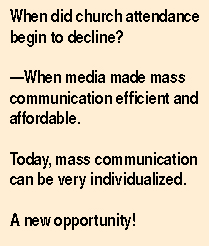
The sermon is the focal point of gatherings of the faithful. It was the most efficient way to reach people—back then.
Sermons were developed for people accustomed to listening to speakers. The pedestal was the norm. The pulpit made sense. These days, if you don’t grow up in the Church, your opportunities to listen to orators are few. As for the pulpit . . . people aren’t coming in once a week to stare at it any more. It’s easy to understand. Their listening caps are dusty!
The modern mind thinks differently. With all the information available to us, we’ve learned to process ideas in bite-sized pieces. We can wish this weren’t so, but it is. Very few people will listen to a 30-minute sermon and those that do drift in and out of attentiveness. This is natural, but listeners criticize themselves and interpret this as “they aren’t getting anything out of it.” They actually feel a little guilty and soon tend to stay away.
The Information Age brings new opportunities to connect and communicate. Pastors can be a daily presence in their congregation’s lives without anyone setting foot in a church building. They will have to learn the power of short and sweet. It will be a new expression of daily devotion. Effective communicators will hone their messages to 150 words. Pastors are in a unique position to do this with a local slant that will interest a following. BUT, they won’t be limited by geography!
This approach to preaching has more potential for growing a faith community than the dedicated weekly sermon delivered to only the most faithful.
You’ll need to tap into the web and social media, though. It’s there. It’s powerful. USE IT!
Religion — at least the way it has been understood up until now — is facing a modern challenge. It has little to do with numbers. Numbers are just evidence of a major societal change.
It has to do with the way we are wired. Young minds — Generation Y and the Millenials — have known only an interconnected world. These connections were not organized for them by their parents or tradition. They were formed by each individual opting in and out of friendships, groups, and causes at will. More than that, these generations have been taught to use modern tools to initiate actions to address their sense of justice and righteousness.
The thought of joining a church, building trust, identifying a need, communicating the need, and then rallying volunteers and support to address the need is foreign to modern thinking. This is good! The old way is archaic and inefficient by modern capabilities.
Those of us still hanging on to the past may still value a well-run organization. We look for leaders who can work together to define goals and connect with people and resources to achieve goals. Our measure of successful participation is how well members obey and contribute.
Our children don’t care about “organizations.” They are not just avoiding organized religion. They are not joining Leagues and Service Clubs either. This is not a lack of empathy. They realize they don’t need to sign on as foot soldiers in a cause defined by someone else. They can create their own networks and contribute their passion their own way.
Independence from structure is just beginning to hit the Church, where structure is worshiped at the right hand of God. If the Church thinks we are going to come up with innovative programs to attract younger generations back into the pew to contribute to church community the way their parents or grandparents did, we are chasing a dream. An expensive, doomed to fail, dream.
Join Bishop Ruby Kinisa as she visits small churches "under cover" to learn what people would never share if they knew they were talking to their bishop.
Undercover Bishop will always be available in PDF form on 2x2virtualchurch.com for FREE.
Print or Kindle copies are available on Amazon.com.
For bulk copies, please contact 2x2: creation@dca.net.
MISSION INSPIRATION OFFER
A visual and biblical guide to help congregations define their missions.
Contact Info
You can reach
Judy Gotwald,
the moderator of 2x2,
at
creation@dca.net
or 215 605 8774
Redeemer’s Prayer
We were all once strangers, the weakest, the outcasts, until someone came to our defense, included us, empowered us, reconciled us (1 Cor. 2; Eph. 2).
Be calm. Wait. Wait. Commit your cause to God. He will make it succeed. Look for Him a little at a time. Wait. Wait. But since this waiting seems long to the flesh and appears like death, the flesh always wavers. But keep faith. Patience will overcome wickedness.
—Martin Luther