Today’s object lesson is a song. Today we ask our adults to remember a time gone by when we didn’t listen to music on itunes, or the radio or on TV every minute of day. Think back to the day when our songs were in our minds and not planted in our subconscious by professionals—back to the day when we owned our own music—one of a kind—probably never repeated—no copyright needed.
That may predate your congregation.
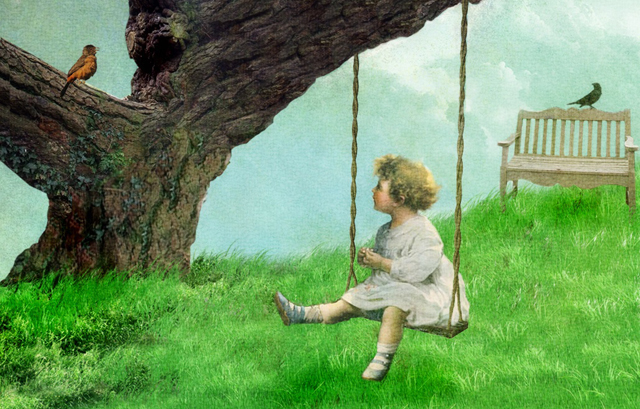
Ask them if they can remember their childhoods or watching their children or grandchildren blissfully swinging and singing a song of their own invention with each pump of their gangly legs.
Today, it is rare that songs spring from our hearts. The Bible has many notable outbursts of song. Miriam sang when the Israelites were delivered from their Egyptian captors. David sang — often.
It was a different age. They sang without a thought of ratings!
In today’s scripture, Mary sings a beautiful heartfelt song. Ask your congregation to close their eyes as you read the words of the Magnificat from the Bible.
Incidentally, recent research indicates that humans are wired to communicate in song. Early evidence indicates that all cultures may respond to music in very similar ways.
(This came up in our Twitter feed — or we wouldn’t know this to share with you!)
Song is powerful.
Today is a day to remember that we all have a song inside of us. We don’t have to wait for a professional to fine tune it and make it marketable to the masses. Just sing it. God is listening.
PS: (If you really need an object, start the talk with an iphone in your hand, adjusting your earphones as you turn to your congregation.)
I’ve had the opportunity to attend many youth concerts in the last few years. I’ve noticed a remarkable difference from my own school experiences.
Today’s young people have the ability to excel in skills beyond what was possible for all but the most motivated among those of us who were schooled 40-50 years ago.
They have constant exposure to the professional talent. We had the Mickey Mouse Club and the Ed Sullivan Show.
They have teaching tools that were unavailable to us as we learned to play our instruments. Online teachers are plentiful. There is a device that can play recorded music slowly without changing the pitch. How I remember replacing the needle on the high-fi, guessing that it was falling at the phrase I wanted to learn and trying to keep up with the pros as I practiced! I’d have died for one of them.
Suffice to say . . . the coming generations are better at many skills at an earlier age than we dreamed of being. The contestant age requirement on some of TVs singing competitions has dropped to 12. Twelve! The 12-year-olds are holding their own. The quality is there. Sometimes their lack of maturity causes them to falter, but several have made it through to the final rounds.
How does this speak to the church?
As much as we like to think of the worship experience as corporate and engaging, it really isn’t — not when measured against the potential.
Those who grew up in the church and have an understanding of what is going on in a worship service may take comfort in knowing the rationale behind the various sections of the liturgy and understand how it intends to engage them.
But these are fewer and fewer. As a result, worship becomes more and more passive. We exist in a world where our ability to express ourselves is exploding with potential. Yet in worship we are asked to behave as spectators. As spectators we have higher expectations!
For the last three years, Redeemer worshipers have been forced into a spectator role, denied access to our own sanctuary. In our own worship, we would all be involved. But that happens only on the first Sundays of the month now. Nevertheless, we take seriously our role as spectators, participating in the limited ways allowed as guests in worship.
We notice that the worshiping body is more and more passive. The larger the congregation, the more passive. Some even pay select choir members!
Congregational singing is generally weak, with many congregations content to be overpowered by an organ. The roles of worshipers are orchestrated. One will read scripture. Another will take the offering. Tradition.
Spontaneous expression is almost non-existent with the occasional exception of prayer, notably in the churches with more of an African or African-American membership.
In 52 visits, we have seen no dance (common in Redeemer worship). Choirs are fairly rare.
I miss Redeemer worship. There was always something interesting and spontaneous happening. I miss playing my wooden flute. I carried it with me and often played during hymns, just sitting in the pew. I haven’t been able to do that for years now. We haven’t seen that type of spontaneity in any worship setting we’ve visited.
A nod from a worship leader was enough to let a worshiper know that they would be leading the next part of worship. I can’t recall anyone balking.
Sometimes it was embarrassing, but human. One week, (has to be five years ago) someone stepped forward to sing a solo. Her choice ended up to be the opening hymn. What are the odds of that! So she sang it. And then we sang it. It was memorable. The hymn was “We Have Come Into His House.” Do you remember what the opening hymn was in your worship last week?
As an observer, I wonder if the structure of the worship service, which was created at a time when one or two educated members of the community directed the illiterate masses, might need an overhaul to allow for the growing talents and expectations of our community members. Their abilities make them much less likely to be content as spectators at worship and many don’t have the tradition of knowing that when they are asked to stand or sit or read the words that are printed in the bulletin in boldface — well, that’s involvement!
We have a tendency to substitute ritual and call it engagement. Are we really engaged when we all file to front of the church and hold hands out for communion?
There is a huge challenge in wondering about all this.
Most of our talented young community members are not in church.
When you attend Christmas Eve worship in your unlocked church next Monday, think what might be possible if the Church didn’t do things the same way week after week.
Until then, once or twice a year, when the Church is putting its best foot forward, might be enough for most people. Click to tweet.
Guaranteed, the first response when a congregation pushes for an online preaching presence will be the offer to post transcripts of Sunday sermons. There. Done. Let’s move on.
Also guaranteed, no one will read them. The style does not fit the habits of online readers.
People don’t read online sermons. Post them for reference if you like, but they won’t find readers, new or old.
Effective online preaching is not what the Church wants to hear about. They want people in the pews, listening to 20-minute sermons and sticking around at least until the offering plate is passed. Pastors have worked hard at their 20-minute preaching skills. They’ve studied with the best 20-minute preachers.
The effectiveness of the sermon as compared to any other form of communication is rarely discussed between pastors and congregants. The formula is so old that questioning it seems to fly in the face of the oft-heard demand for change. “We didn’t mean this kind of change!” So the 20-minute sermon is what people in the pew expect. It is what pastors are trained to do. What’s the problem?
There are very few people in the pew. The 20-minute sermon is reaching practically no ears.
It is not the first time preaching styles have changed. Decades ago people thought nothing of settling in on a wooden plank pew to listen to a preacher for two or three hours. No more. A century ago a weekend revival was a big attraction. In Jesus’ day people would sit on a hillside all day to listen to a good speaker. And now our cultural expectations are shifting again.
As a life-long church goer, I enjoy a good sermon. I am also very aware that even great sermons are ephemeral. They are forgotten in less time than it takes to deliver them.
Recently, our Ambassadors listened to a sermon in which the preacher made five points. He illustrated the points well. He even used visual props and interspersed some music. It grabbed my interest. I thought as he was speaking, I really ought to write some of this down. When we left church, one of our Ambassadors who is also a retired pastor commented that he thought the sermon was really good. A few hours later I sat down to write a few words about the sermon. I could remember three of the five points. I contacted the pastor who was with us and who had gushed about the sermon. “What were the five points the pastor made? I asked. “I can remember only three of them.” The pastor paused for a moment and finally said, “That’s three more than I can remember.”
And that’s the problem preachers have in relating to modern listeners. They are not connecting with the modern attention span and sensibility. People are wired differently today. That difference is going to grow as today’s younger generations reach church leadership age—if they stay involved long enough to serve.
People today process much more information from many more sources than did our ancestors. Our most valued skill sets are dominated by multi-tasking. We want the same information. We need for it to bedelivered in ways we can process while we do a dozen other things.
Online preaching is suited for this. Twitter is ideal. There is no reason to bemoan the decline of the Church in this regard. It is a new opportunity for the Church.
There are several online pastors I follow. One is Jon Swanson who writes a blog, 300 words a day with a second daily email blast to subscribers called 7×7 or 7 minutes with God. 7×7 is nothing more than a link to a short scripture passage and usually just one sentence to help you think about the passage. For those wanting to read more he offers a 14-minute option. In recent months, by virtue of his email links, I have read several epistles in their entirety, 1 and 2 Chronicles, Esther, Ezra and most notably the book of Nehemiah.
Pastor Swanson has effectively communicated his passion for Nehemiah in ongoing posts, supporting the daily reading. This chronicle of an unlikely building contractor is pretty easy to skip over for the average Bible reader. Nehemiah is sad to hear the temple is destroyed and sets out to rebuild it. He recruits help. He records long lists ancient names of contributors, complete with geneological references that contribute even more unusual names that haven’t been pronounced in centuries. He fights off the high and mighty who want to see him fail. As he nears completion in 52 days he recruits the people to staff the temple and returns a whole people to God. It is anything but boring when read with the gentle prods of Pastor Swanson.
In fact, it is amazingly similar to the experience of 2×2 — rebuilding a church after (or during) an attempt to totally destroy us. Nehemiah faced the the same behind-the-scenes conniving and intrigue, the same obstacles of human nature. Nehemiah, under the gentle guidance of Pastor Swanson, empowers us.
Recently, through our Twitter account, I’ve discovered Bishop T.D. Jakes. I’ve seen this guy on TV as a frequent talk show guest, but I never paid much attention to him. I won’t point you to his website. It’s easy enough to find and heavily monetized. That’s not what I admire about his ministry. His Twitter ministry is very effective. He tweets just one inspiring thought a day — just what a lot of us hunkered in the Christian trenches need. A sample:
God sees your tears! God sees your circumstances! God sees your situation! God sees your faith and perseverance! WAIT ON HIM!
These Christian leaders are mastering the 21st century art of preaching.
Why do people go out of their way to ask preachers to pray for them?
Pastor Jon Swanson points to 1 Chronicles where David outlines the duties of the Levites. One of the duties is to stand every morning to thank and praise the Lord.
OK, it’s their job. But it is our job, too.
Each of us can pray. The littlest toddlers find comfort and empowerment in bowing their heads in pray. (Comfort and empowerment are answers to prayer.)
Over the rocky years of life, we tend to lose confidence in God and confidence in our ability to speak to God. The relationship is broken.
Easy way out: assign the duty to those we feel are especially trained to do this.
When you set aside one group of people to perform a function that each person is capable of doing, the result is predictable. The larger group is going to lose its skills. Prayer is a pretty important skill—one we don’t want anyone to lose!
Another predictable result. The designated pray-ers will accept status and power. Over time, they will get lazy about their responsibilities and the prayers will become corporate in nature. Prayers will be written a year in advance, published, distributed to congregations, and read by the designated pray-ers, who no longer have to know the names and faces of the people they pray for. People will feel further lost and separated from God as their individual needs are grouped with the whole, undefined people of God.
The church must work at restoring people’s relationships — not so much with the Church but with God.
We all feel small before God and in our self-loathing we tend to think that clergy are somehow better. They are not. Clergy are servants just like every other child of God. They are capable of both good and bad. Putting them on a pedestal as the official representative of God results in scandals that grab secular headlines when things get really bad.
Clergy are charged with fostering spirituality. They are not surrogates. That kind of thinking led to the travesties that inspired Martin Luther to risk his life with his 95 Theses. Back then, people were encouraged to pay clergy to pray for them. The more money, the better the prayer. Maybe that’s what we have returned to today without using the word “indulgence.”
The disciples felt inadequate. They came to Jesus. “Teach us to pray.”
The church does not always do a good job of teaching us to pray. The laity is often OK with this. We want to know how to pray, but not if it means practicing. . . in public.
At this point we can learn from musicians. They know that no amount of practice behind closed doors can teach the skills that are easily honed playing in public.
One pastor we heard during our Ambassador visits exhorted her congregation to ration their prayers. Don’t bring your little concerns to God, she admonished. Save God for the big things.
Perhaps she meant to empower the congregation to solve their own problems, but it is definitely short-changing God. God is God. He’s not asking us to save Him time and trouble. God wants us to call upon Him. God can handle little things along with big! Nevertheless, I am sure God smiles with satisfaction when we get up from our knees and help!
There is only one way to change this. Put the responsibility for prayer into the hands of the people. Teach them to pray. Teach by example. Give lots of opportunity for practice.
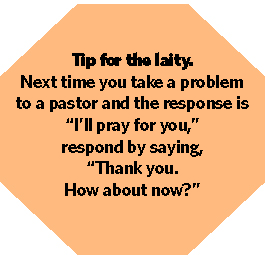
Instead of glibly promising to pray for people who come to you in distress—as a way of dismissing their concerns—stop in your tracks, take their hands, and pray with them, asking them questions in the prayer so that their answers are a voice directed at God.
Then don’t wait for magic. Prayer provides comfort and empowerment! Roll up your sleeves. Lace up your boots. Put on your gloves. Go to work! Love your neighbor!
Redeemer Ambassadors have now visited 50 churches. We’ve seen 50 versions of the weekly bulletin.
They are all pretty much the same and most are a mountain of paper to be left in the hymnal rack or tossed at the first opportunity.
The primary purpose of a worship bulletin is to direct people through the service. This is also the primary purpose of the expensive Worship Books/Hymnals sitting in the pew racks.
A secondary purpose is advertising — which these days is better done by email or Facebook. (It’s not the people who are in church that need all the reminders!)
Bulletins can be a creative outlet that provides enriching content—much more than those black and white line drawings that every church uses—the ones with short, big-eyed characters in flowing robes, acting out the Gospel for the day.
If a church is to go to the trouble of reprinting the worship book each week, it should add something to the worship experience.
We have yet to encounter bulletins as helpful as Redeemer’s—one piece of paper (11 x 17) with the entire service printed inside, including words to all hymns and prayers. Full color art from many different genres and religious poetry graced the covers. News, contact info, credits, calendar and even a Bible study or puzzle for the children appeared on the back.
There was no need to reference hymnals, which freed us to use worship elements from many sources.
Since we printed only words, we could easily substitute parts of the liturgy with an appropriate praise song or hymn.
But what about the music? The congregation developed a pretty good ear. The organist played hymns through in their entirety once. Hymnals were in each pew. Hymnal references were provided for those who wanted the music—and that was rarely more than one person.
A Redeemer bulletin was easy to follow for the presiding minister, visitors and even the children. Most important—there was a reason to take a Redeemer bulletin home to enjoy and share during the week.
Recently, a former member who now lives out of state wrote to one of our members and asked for a copy of our bulletins. She wanted to share them with her new pastor. A current member spoke up and said, “I’ll send her a few, I have them all on file.”
Others had often shared that they clipped a poem or image from the bulletin and stuck it to the refrigerator. That anyone kept them on file was a surprise!
It’s been more than three years since our last worship service in our own sanctuary, but when I cleaned my son’s room last week (who is now of age to be moving out). There, neatly folded on his dresser was the bulletin from the last Redeemer worship service —September 20, 2009.
Redeemer bulletins had mileage—even three years after we published our last one!
In this age of “going green,” it is peculiar that we publish hymnals with liturgies printed in them and place them in every pew. We brag that we have the latest and greatest worship book. Then the worship books sit unused in the racks. We reprint the liturgy in bulletins that eat up a ream or two of paper each week, a ton of toner, and wear and tear on office equipment. Preparing these bulletins takes a half day of a pastor’s time and probably a full day of office time.
Church bulletins are a huge investment with little return.
The reason we do this is probably that the hymnals are heavy and require flipping from the liturgy section to the hymn section frequently. They are awkward.
It’s also the way every church seems to do it.
But bulletins with 16-24 pages and fliers spilling out are equally awkward. Some of them were daunting to us as visitors — even with our strong church backgrounds.
Here’s an idea. Fill the hymnals with hymns—nothing else. You may end up needing to invest in fewer copies.
Print each liturgy in a small booklet that is easy to manage and won’t cost more than a dollar or two per copy. Let congregations choose which liturgy booklets they want. They can even create them themselves if they pay the licensing fee. Most churches don’t use more than one or two versions of a liturgy, regardless of how many choices are offered in the heavy worship books. An advantage of this is that new liturgies can be added at any time without waiting 20 years for the next hymnal to be published.
Now your bulletin can be one sheet of paper. Or maybe you won’t need one at all!
Save a forest. Save the church budget.
The bulletin will be easier to follow and allow for the inclusion of more art, poetry and teaching in your worship experience.
PS: We were able to forge the way in developing this because we didn’t have a pastor controlling the process.
The sign hangs close to the door of almost every church. ALL WELCOME.
A similar message of welcome will be on the church’s opening web page, usually accompanied by a photo of Christmas Eve worship—as if Christmas worship is representative of the whole church year.
We still expect our worship experience to be the entry point into community life within the Church. There may have been a day when this was true.
That day would have been when most people had some familiarity with religion and sought a new church community only when they relocated.
Today, however, a first-time visitor is often entering our doors totally unprepared for what they are about to experience.
Their first impression will be as if they were watching a foreign film with subtitles in a different foreign language.
Liturgies and hymns are laced with words from Latin and Greek and tunes from ancient choral traditions.
They will be asked to stand, sit and kneel with little explanation as to why. Obvious perhaps to church goers, but not to today’s visitors.
They will juggle bulletins with papers flying out and hymnals that have two numbering systems.
And then comes Communion, where they won’t be sure if they are among those welcome or not. They may be unsure of the local customs and have no clue what this eating and drinking of the body and blood of Christ is all about. (Many of those participating don’t know either.)
There is nothing wrong with any of this. Just realize that it doesn’t necessarily communicate to visitors. Although meant to be welcoming, it may be alienating or worse.
If a visitor is not welcome at communion, their first visit to church has been an experience of exclusion.
If communion is a weekly event, they will feel excluded weekly until they are made welcome through some form of initiation. If the Eucharist is a third of the worship service, the visitor has been excluded from a third of the worship service.
This is just something for the Church in a new age to think about as we practice our rituals.
The First in a Series of Posts about the Least Understood
Season of the Church Year
Come December, we will once again anticipate the joyous birth of our Savior by rolling out the traditions so well-known to Christians.
We’ll get our Advent devotionals and four-session Bible studies in place, we’ll buy the kiddies paper calendars, and our choirs will start practicing Christmas anthems. For worship, we’ll roll out the pre-Civil War classic Advent hymns.
We have to know we are paddling upstream. Just as the rest of the world is anticipating Christmas with happy songs, we feel the need to look ahead to the passion‚ as if we won’t be celebrating this in its own right in just a few weeks.
Those of us raised in the traditions of the Church will protest the critics of these traditions.
The chronic complainers aren’t particularly loud or noticeable. But they are many.
Mostly, they just stay home until Christmas Eve. Now that they understand!
As for us Christians, we’ll stick to our traditions, thank you very much.
Truth be told, the traditions of Advent are beautiful and deeply meaningful to the few of us who understand them. The problem we have is in communicating them to the vast majority of the world that doesn’t understand them or feel a need to bother.
The church is left with three choices.
Keep on keeping on. Proudly defend the heritage of Advent and hope someone is listening while the rest of us are still standing.
Abandon the past and cater to the modern mindset.
Find a way to communicate what is so important to us.
Choices one and two require less work and are the most popular — with predictable results.
Choice three might actually make a difference. But how?
We’ll explore possibilities during this pre-Advent season.
A pastor may think that a children’s sermon is a waste of time. The children might be better off somewhere else, engaged in age appropriate activities.
The children’s sermon time is so much more. It is a golden opportunity to introduce change to your congregation.
Many pastors do little more than talk at the children—a watered down “trailer” of the 20-minute version about to come.
It is painfully obvious in many cases that the pastor has little experience talking to children. All those years of seminary study so you can expound to five-year-olds!
The children’s sermon is a time when you can communicate to everyone. Many adult Christians have not been well-schooled in church matters. This is an opportunity to not only reach the children but to review basic church teachings without “talking down” to the adults.
You can experiment in the few minutes you spend with the children. Few will object. It is a chance to create the experience modern worship so desperately needs—something that people will remember and talk about when they go home and off to work.
In the business world, this is called creating a “remarkable” experience. Business people know that their best advertisers (evangelists) are customers (congregants). They aim to provide the best service possible so that the customer/congregant talks about his or her experience.
Most worship services are fairly predictable in format and even in content. They are no doubt meaningful to the congregants, but few are anything anyone will talk about during the week or even remember a few days later. (Quick! What hymns did you sing in church last week?)
More people will be tuned in for a ten-minute children’s lesson than for the full 20-minute version. Use this opportunity to create a “remarkable” experience.
This is a pastor’s opportunity to introduce change without objection. Congregants may not even notice that the praise song you taught the children last week is the sermon hymn this week.
The children’s sermon is an excellent opportunity to introduce media, teach the kids (and adults) to move in liturgical dance, practice a new prayer technique, read a story or poem, or perform a little drama. Don’t put a stopwatch on the activity. Some sermons may be five minutes long. But if people are engaged, milk the moment.
Here is a list of guidelines.
Don’t treat the adults as passive bystanders. Engage them in music, question and answers, or other activities. Enlist their help. They will be more likely to step up to help the children then if you asked them to do something for their peers. Ask a choir member to lead or teach a new song, for example. Or have an usher explain what happens to the coins the children put into the offering plate. It will strengthen your congregation’s sense of community.
Don’t be afraid of repetition. Kids love it. Adults learn from it, too.
Don’t be afraid of interaction. Throw out a question to the adults. Better yet, have the children ask questions. Imagine one of your older members telling the story at work: “In church yesterday, a little girl asked me a question . . . .”
It’s all about story-telling. We all love to tell the story. The children’s sermon can be the vehicle for congregational story-telling. And this can lead to transformation.
Today there are just three songs outside of church that people sing together—the National Anthem, Happy Birthday, and whatever the pop star that people paid to hear is belting out at a concert.
Singing is fun. Yet, once we graduate from lower levels of school, many of us never again experience group singing. Recognizing this, some movie theaters sponsor movie singalongs to favorites like Sound of Music or My Fair Lady.
The power of music is the power to surprise and delight.
Songs create cultural ties. Many of the commenters to the Welsh choir video wrote that they enjoyed the Welsh hymn so much they memorized it. Otherwise, they spoke not a word of Welsh. The second video shows how good music knows no cultural bounds.
Our Ambassadors gathered for Sunday morning brunch recently and someone mentioned a clock, which had been her father’s prize possession. We broke into song, My Grandfather’s Clock, with an African member looking on in amusement. “Tick-tock, tick-tock.” My Grandfather’s Clock was written in 1876, by an American Civil War songwriter Henry Clay Work after a visit to England. 136 years later, we could all sing it together, part of our common culture.
Similarly, the one meeting Redeemer had with Bishop Claire Burkat, we considered such a success that as our members left they broke into song which traveled with them down the elevator from the synod offices and across the parking lot to waiting cars. This time the song was from African culture!
Music was part of the magic of Redeemer’s ministry that was binding our diverse groups. We used eight or more hymns in our worship. Frequent repetition of select songs allowed for commonality. Soon Africans could sing I Cast All My Cares Upon You and Americans could sing Bwana Awabariki. We often sang popular hymns alternating languages and soon we could sing the chorus to Jesus Loves Me or How Great Thou Art in either language without realizing which language we wee singing!
One Sunday we had a guest preacher. He mentioned in his sermon the hymn Just As I Am. He started to read the words. The congregation began singing the hymn a cappella from memory. The hymn is part of our culture. Oddly the pastor seemed annoyed at the congregation’s initiative.
Church is one of very few places where people gather weekly to enjoy singing. Let’s take advantage of our strong points! Let the music of your church come from the people and shape your ministry.
One of my great grandmothers enjoyed playing piano. She collected sheet music and had her favorites bound into books. I have her volumes dating back into the late 1800s. None of the tunes that she found worth preserving are played on the radio today.
On the other hand, the Church is one place in our society where songs of past centuries are regularly revived. Only the words remain to the music of Bible times. The advent of a universal system of notation in the ninth century gave music—both melody and lyric—longevity. Today’s Christians sing songs that span from the Gregorian chant to the current folk and rock genres.
I attended a concert of a contemporary rock-style band recently where the tune to Of the Father’s Love Begotten from the 13th century was used as a motif.
The treasure and legacy of Christian music is most appreciated during the Christian season when even today’s pop singers make albums of music written hundreds of years ago. People who never attend church sing along with car radio (at least to the first verse).
Church music spans other seasons that are less recognized by secular culture but are a treasure of the church. Much of today’s hymnody comes from the Protestant tradition where pastors often wrote songs as a preaching tool. Martin Luther, Isaac Watts and the Wesleys were preachers and hymn writers whose work is still sung in churches around the world.
The legacy of praising God in song continues with a wealth of new music heard by many for the first time on Christian radio.
Often, hymns are a collaboration between the poet and the tune crafter—not unlike the great teams which brought us operettas and musicals. In fact, Sullivan, of Gilbert and Sullivan, wrote the tune of Onward Christian Soldier.
Knowing something about the hymns we sing adds to their meaning.
In the 1600s, Martin Rinkart was a village pastor in Germany during the years of the Great Plague. He buried as many as 50 of his parishioners a day, 4000 a year, including his wife. One of the most enduring hymns of thanksgiving came from his pen — Now Thank We All Our God.
In the 1700s, John Newton repented his life as a slave trader and wrote a perennial favorite used in both religious and secular settings — Amazing Grace. Another prolific hymn writer, Isaac Watts, broke with the tradition of sticking to the biblical Psalms as text. When I Survey the Wondrous Cross is the best known of his hundreds of hymns—some of them written specifically for children.
Some great hymns have come from the recognized masters such as Handel, Bach, and Beethoven.
Women, following the biblical tradition of Miriam, gained notice as hymn writers in the 1800s and early 1900s. They included the blind Fanny Crosby (Blessed Assurance) and Katherine Lee Bates (America, the Beautiful).
The difficult process of publishing and printing helped preserve hymns. Prior to 1980, it took about 40 years to compile and publish a hymnal within a denomination, which slowed the adoption of current music but added life to the existing hymns. Today’s publishing allows instantaneous publication and it remains to be seen how that will affect the legacy of hymnody.
Despite the wealth of tradition, many congregations stick to the tried and true. One pastor complained that the congregation he served was content to sing the same 12 hymns over and over.
Later posts will address ways to both preserve and build upon hymn legacy and the way hymn knowledge and tradition impacts faith and Christian community.
Join Bishop Ruby Kinisa as she visits small churches "under cover" to learn what people would never share if they knew they were talking to their bishop.
Undercover Bishop will always be available in PDF form on 2x2virtualchurch.com for FREE.
Print or Kindle copies are available on Amazon.com.
For bulk copies, please contact 2x2: creation@dca.net.
MISSION INSPIRATION OFFER
A visual and biblical guide to help congregations define their missions.
Contact Info
You can reach
Judy Gotwald,
the moderator of 2x2,
at
creation@dca.net
or 215 605 8774
Redeemer’s Prayer
We were all once strangers, the weakest, the outcasts, until someone came to our defense, included us, empowered us, reconciled us (1 Cor. 2; Eph. 2).
Be calm. Wait. Wait. Commit your cause to God. He will make it succeed. Look for Him a little at a time. Wait. Wait. But since this waiting seems long to the flesh and appears like death, the flesh always wavers. But keep faith. Patience will overcome wickedness.
—Martin Luther