Are you getting the support you need from your denomination?
I ask this of both pastors and lay leaders. Your needs differ!
I ask this also of professional leadership at the regional and church-wide denominational levels, with yet different needs.
The question is important now.
Denominations have serious competition—a situation of their own making. They largely ignored the technology revolution for three decades. Today’s power is held by those who have mastered tech. It may be too late to catch up.
Levels of Competition
There are three emerging forms of competition:
A rising number of pastors without calls are entering the gig market. They offer weddings, funerals, baptisms, and counselingtailored to the wants of the participants more than to denominational practices.
Individual pastors are putting up websites to attract coaching gigs. Some are mavericks. Others seem to be genuinely interested in helping colleagues even if they are bypassing usual denominational protocols.
Commercial enterprises (perhaps with non-profit status) address vital needs that are poorly addressed within denominations. Examples include ChurchFuel and PushPay. These services focus on improving giving. They are likely to help big churches get bigger.
Church tech needs are a growing market niche. A recent Kickstart campaign seeks funding to develop tech for church social media, offering incentives to contributing churches.
Congregations now realize they need technology to reach generations that have always lived in a tech-driven world. Pastors without tech skills need to hire tech skills. I’m glad they have options.
I’m in no position to condemn these enterprises. Small Church Toolbox serves similar challenging needs.
Cause for Concern
More concerning for leaders of regional bodies are individual churches, probably of the evangelical label, banding together to help other churches crossing denominational lines.
These efforts seem to be headed by well-intentioned young pastors who have studied marketing in addition to seminary studies. They are comfortable on camera and know how to build a tech team to support their work. Using the internet, they can help anyone, anywhere.
Frankly, they are doing a good job!
They communicate with hope and affirmation and provide realistic strategies.
They provide clear and helpful online trainings.
They provide coaches to walk beside small churches without the prohibitive expense of certified church consultants.
Their testimonials indicate they are reaching frustrated, burned-out pastors—pastors who don’t want a list of failed churches on their résumés.
Do they work for the churches or the pastors? It is unclear and this could be a problem in some church structures. Solving church problems requires both lay and clergy input.
They’ve figured out that churches with fewer than 200 members — 90% of all churches — cannot afford the church model expected by regional bodies. They’ve found a way to help churches facing the direst circumstances, while regional strategies often prepare churches for closure.
Closed churches provide a short-lived windfall to struggling regional bodies. They also eliminate potential for future ministries in well-populated neighborhoods that are vital to the spread of the Christian message and for the delivery of services close to areas with greatest needs. Failure to adopt technology is resulting in regional bodies losing ground where their members once sacrificed to provide important assets for ministry.
Bypassing denominational traditions
With these realities in mind, it was both refreshing and worrisome to recently attend a several-day online conference hosted by Church Marketing University (CMU).
The leaders of CMU are a few pastors with no stated denominational affiliation. The pastors represented churches in several states. I recall mentions of Virginia, Missouri, Alabama, and Michigan among the presenters.
The key host talked about his dual post-grad degrees in Bible studies and marketing. I recognized his marketing strategies from my secular communications work.
CMU’s monthly fee—$267. That seven on the end is a marketing strategy based on behavioral research. Evangelism often remains unfunded in deference to worship and property costs. This price is prohibitive to small churches with or without the seven.
However, CMU offers a generous “scholarship”—$27 per month. (There’s that seven at the end again!) They use the scarcity marketing strategies to attract churches—Hurry! Only a few spots left! This is affordable to an individual pastor—which means pastors have an alternative source of help.
Regional bodies adopted corporate practices long ago. The growth of the big box suburban churches and the teaming with government funding services for social outreach are two results. Neighborhood churches suffered when efficiency and cost-effectiveness became ministry priorities. They became expendable.
I like a lot of what I heard and saw in the CMU offerings. I worry about some strategies borrowed from the corporate world. Marketing and evangelism are close cousins; they are not the same.
CMU teaches the practice of defining an avatar. Marketing 101. This means they shape all ministry decisions around a desired demographic—the demographic that can help them achieve their goal—which easily can become finding financial support. The temptation is to create an avatar that helps you look for people that provide what we need—rather than helping meet the needs of others.
The CMU host named his church’s avatars—families and men. He elaborated—We want all our marketing materials to communicate that this is a place where men can feel comfortable. He uses models in publicity.
What church doesn’t want families? They fill programs and promise a future!
I emailed this pastor a question: What does targeting men say to the women who are presumably part of the family avatar? No response. I’ll report what I heard: “Just what we need—another place for men to feel comfortable.”
In short, tech-capable churches can target the juiciest apples on the tree!
Church marketers must exercise caution. Marketing’s goal is profit. Evangelism’s goal teaches selfless love.
A biblical church avatar would include the poor, immigrants, imprisoned, minorities, disenfranchised, elderly, children, sick, addicted, handicapped and homeless—men, women, and children.
Nevertheless, CMU provides small churches with help they aren’t finding elsewhere.
For regional bodies, it may be the beginning of the end of their influence within their own flock.
Posted written by Judith Gotwald, Small Church Toolbox
This has always been done to some extent, but the ratings were usually behind church leadership doors, judgments passed by church leaders and made public only on a need-to know-basis—a pastor considering a call, for example.
Relax, small churches. The focus is on large churches—at least for now.
Nevertheless, it should give every church pause. What ChurchClarity is doing could soon affect your ministry. Consider Yelp. It’s already there asking for ratings. Right now, people are rating pizza shops. Sooner or later, they’ll run out of pizza shops.
How will congregations respond? How will the regional bodies respond? Will outside voices influence how we do “church”?
Church leaders tend to get pretty nervous at the thought. It just isn’t done! There are protocols that MUST be followed!
Warning! These ideas are now past tense. There WERE protocols to follow.
A few years ago, our church visited more than 80 churches—more than half the congregations in our regional body. We had been locked out of our own church by a bishop who had “prayerfully discerned” that it was our congregation’s time to die and for her to take control of our property and endowment funds.
We resisted. Wouldn’t you?
It was ugly. Eventually, we were locked out of our building and members were pursued in court for another five years. For a year or so, we held home church. It wasn’t the same as having our own space. One day a member sighed and said, “I just don’t understand why they (ELCA Lutherans) want a church without us in it.”
We decided to visit churches to try to find out why we were so unwelcome in our own denomination.
We went with no agenda to rate churches. We went first to worship. We followed our own rule: to engage congregations with our story only if asked. We weren’t asked very often. In about eight of the congregations we left a letter in the offering plate telling our story. We thought they should know our experience since most of them (as we were finding) were not very different from us and might soon find themselves in our shoes. We asked for no action. We just wanted other churches to know there were two sides to the stories they were hearing.
The reaction from the regional body and the bishop that had locked us out was swift and strong. The second church we visited reported our presence to the bishop. The bishop then wrote a letter to all pastors and congregations advising them how to welcome us and how to report any trouble we might cause. Her letter opened with how biased our letter was and finished with how personally hurtful our actions were. She offered that churches usually cooperate with her efforts to close their doors. If true, a sad commentary, indeed.
We never rated any congregations we visited. We used our visits to understand trends—common problems and strengths. It was enlightening! I’d recommend to others. We enjoyed all of our visits and found value in every ministry—even the smallest.
One of the over-riding findings was few congregations (none, in fact) are effectively telling their stories in ways that reach modern audiences. That leaves congregations vulnerable to outsiders defining their mission. Their input could help us shape our mission, but it is more likely to make us more guarded.
Churches contain criticism. Unhappy members either leave or stay home. Unhappy clergy look for new calls. Problems are swept away; dirty linen bleached. Not to deal with criticism is the norm.
Neither the Church nor individual congregations can thrive in isolation any longer. Dialog will no longer be exclusively internal. People will share their experiences. They will go online. Some will love us. Some will not. Any protocols we think are in place are gone. We can only share our story, using the same media.
I’ve been reading a flurry of clergy posts on the tribulations of ministering with dwindling resources and rising expenses.
That’s a defining trait of most small congregations today.
As a long-time lay leader of small churches, I find the emphasis on assets—or the lack of them—to be self-defeating.
Perhaps this approach is meant to build camaraderie among clergy. When laity aren’t part of the dialog, it just makes lay people feel bad. We fall short no matter what we do. Why bother?
All the griping may bean attempt toidentify the challenge. But we KNOW the challenge!
Congregations that hope for a future must build on what we have. Morale should be number one.
So how does a congregation move forward to face an uncertain future?
Concentrate on what we have.
1. People
We may not have many people, but there is no point fretting about who isn’t there. Build up the people who come several times a month.
Set modern expectations. Weekly Sunday attendance may be impossible for today’s families. Sunday is no longer untouchable to employers, sports, or school. So don’t make weekly attendance a must. (The Sabbath day can be remembered in many ways—and even on days that are not Sundays. We have already recognized this by moving the Sabbath from Saturday to Sunday—the Day of Resurrection.)
When people feel good they can proudly witness. Concentrate on helping your congregation improve their witnessing skills.
2. Property
Property is important. Property provides ministry options. Yes, it is expensive. So deal with the expenses. Many churches are tempted to sell educational wings for a one-time windfall—which can be spent in fewer than ten years. Those unused buildings may be of more value if put to long-term use.
The days of supporting ministry with offerings alone is over. If you are expecting bequests from older members, wait in line with your fingers crossed. Every regional body, seminary, charitable group of your denomination and many others are paying professional fundraisers to make sure they get to your members first.
Start a stewardship program to help members understand the expenses of being “church.” But that will take years to develop.
Meanwhile, turn to your property.
Property is a ministry asset that needs to be spent in a renewable way.
Stop viewing your property as a once a week shrine. Put it to work. Make it a visible part of community life. Rent rooms that are not being used. If you have space, create rentable areas. Find partners that are doing the charitable work you wish you had the resources to do yourself. Don’t cheat yourself. Church groups are tempted to make rental agreements that benefit the tenants. We once raised the rent on a long-time tenant from $10 a week for one afternoon a week to $20. The tenant argued, “But we only use the church once a week.” We replied, “So do we.”
Secular groups have access to funding that churches don’t. Negotiate with them to do some of the needed improvements. You may be surprised at the connections you build in the community if you work with your tenants.
If you don’t cover the expenses, you won’t be there to help your community in the future. In urban areas, church buildings typically are bought at far below market price by developers who squeeze as many apartments or offices into them as they can. You can be sure they are charging market rate. Land donated for spiritual use is lost—forever.
3. Partner
When mainline denominations were thriving, partnering was rarely considered. We started our own charitable agencies, competing with other denominations. If we hoped to tap public funding streams we had to pretend we had no Christian affiliation.
Partnering is not part of our genetic makeup but it the best way for small congregations to continue ministry. More churches are supporting popular charities such as Habitats for Humanity or public food pantries. Make sure your contributions are known and extend beyond funding. If you support a prison ministry create your own visitation team. If you support a hospital, start support groups for difficult diseases or life challenges.
4. Publish
Those in academic professions have a mantra: Publish or Perish. This applies to today’s churches, too. There was a time when publishing was done by the greater church with pooled resources. The technology of the day made this practical. It also limited the church’s voice to those who controlled the press—and it was very expensive!
We live in a different world where publishing is possible for everyone. It costs practically nothing and almost everyone has the skills — except most pastors who continue to be slow in adopting modern communication methods.
Create a web site—an active website. Use the power of social media.
Are you still doing a monthly newsletter? Monthly publications belong to the day when monthly was all a congregation could handle with printing, collating, addressing and postage. This belongs to the past. You should be in touch with your congregants and with others in your neighborhood several times a day. This form of communication is far more powerful than a weekly 20-minute sermon that few hear and fewer remember. The website is your front door. It is also the modern pulpit.
The challenge is creating content and managing a site. (See below)
5. Praise
Take time to praise God. That’s what it is all about.
+ + +
How does one part-time pastor do all this? He or she doesn’t. Parishioners are likely to have untapped skills. Let the people who have the skills lead the way. If you need short-term help to kick-start a modern ministry, hire the people who have the skills you need. They may not have theological degrees.
So get started. There is no time to lose.
In November, 2x2virtualchurch will launch a companion site that will provide resources to congregations to help them develop an internet ministry. Watch for the launching of SmallChurchToolbox.com.
Conflicting Approaches to Achieving Diversity May Be Self-Defeating
Achieving diversity has been a goal of many denominations for years. Despite the desire for diversity, it never seems to take hold except in small pockets of church life. Ironically, smaller churches often make progress that goes unnoticed and under-served as leaders look for larger churches to lead the way.
Large churches are often viewed as innovators. In reality, small churches deal with the people, issues, sensitivities, and prejudices in communities that face diversity issues head on. We are experienced. The problem we face within a denomination is that we aren’t showcases for success. We are just doing the work.
The approach to achieving diversity has reached a desperate stage.
National offices encourage regional offices. Goals are set. Proposals requested. Grants made available—rarely to small congregations. Resulting quick fixes may be counter-productive.
Diversity to Meet Public Relation Needs
Numbers rule. Leaders can measure and celebrate random successes. Often, we can’t wait to see if isolated successes are replicable or sustainable. One little success and the regional body can breathe a little easier at their annual assembly. Flash in the pan? Who cares?
Frankly, diversity is just one issue where regional and national leaders inhabit different worlds than small churches (most churches). The same goals, the same language may be adopted but not to a common end.
Small churches feel as though they are constantly on the receiving end of lectures on what must be done to achieve diversity. It does not go unnoticed that the lecturers have no track record of success. That’s the congregation’s responsibility. Lectures without help leave small churches to either accept failure or to to blaze independent trails.
Ironically, our congregation started to grow in diversity when we had NO pastor—at a time when we were all but ostracized from our regional body.
Years of criticism from the regional office without offers of help left us feeling insecure and unworthy. Actually, we were at our lowest when things started to turn around. We had a part-time pastor for just a few years who understood that it is difficult to welcome others when you don’t feel good about yourself. He helped build our self-esteem and confidence.
Meanwhile, our neighborhood was changing. We had to change, too.
We can explore the details of how we achieved this in another post.
For now, let’s look at how our efforts often clashed with our regional body. Having talked with other small congregations, we know this is a common issue.
Here is a composite dialog representing conversations with our regional leaders on the topic of diversity. What you read below is true, it just spanned 30 years and involved three bishops with a number of pastors as intermediaries and dozens of lay leaders.
OUR DIVERSITY JOURNEY
Characters:
SUE, a representative from the regional office. She is about to end a six-month interim assignment and is having a final conversation with lay leaders before starting a call process. She is White, serving a White bishop.
ROGER, the middle-aged congregation president who has been a member for about 25 years. He is White.
SIMION, an immigrant from Africa and a member with his family for about 15 years. He is Black.
ESTHER, a senior member who has been part of the congregation all her life. She is White.
DENISE, an African-American church member who has been part of the congregation for eight years.
SUE: Before we start the call process for your congregation, I’ve been asked by the bishop to advise your congregation to develop diversity.
ROGER: (confused) We have members from many countries and ethnic groups. We have a broad range in age and economic status. We are diverse.
SUE: We’ve had several congregational meetings in the last six months and the diversity turnout hasn’t been apparent.
ROGER: Our people are not in a hurry to come to meetings initiated by the regional office. We’ve had bad experiences. You’ve worked with our governing board. Our governing board is representative of our diversity.
SUE: I know. I’m on your side here. I’m just the messenger from the regional office.
SIMION: So how are you describing diversity? What are you looking for?
SUE: We keep statistics about congregations. We usually measure Whites, African-Americans, Hispanics, Asian, Native American—that sort of thing.
ESTHER: Last Easter we noted that we had worshipers with roots in six continents. I’d call that diverse. Developing a ministry that is attractive to just one segment of our changing demographics seems unwise. It’s like selecting what diversity is going to make us look good. That’s not who we are. Oh, there was a time when our church was White, primarily because our neighborhood was White, but we have changed as our neighborhood changed.
ROGER: One of our congregational gifts has been helping immigrants assimilate. Our congregation is now predominantly foreign-born or first-generation American. In fact, this has always been true here—just with different native roots. We started as English and German. Our first service was in German. That first service was the only service in German. We decided English was our future. Perhaps our immigrant roots made us good at this kind of ministry. Now we are East African with a few Asian added to our older base as well as a German, a man from France and an Indian family. So it seems like we have met your challenge.
SUE: True, but your congregation is a leadership challenge. We are trying to find Black leadership for Black congregations, Hispanic pastors for Hispanic ministries—you get the picture.
DENISE: We are dealing with a new reality. Our neighborhoods were once homogeneous and stayed that way for decades. I didn’t grow up in this neighborhood, but I grew up nearby. Nevertheless, I have felt welcome here. I see danger in developing just one ethnic outreach. Within ten years that ministry could fail because demographics have changed again!
SUE: We had a consultant do a study ten years ago and they reported that there was no longer a population to support our denomination in this neighborhood. The demographics just aren’t here. We advised you then to close but your congregation resisted.
ROGER: Yes, and now we are five-times larger than we were then. We felt then that we were here to serve our neighborhood regardless of historic denominational ties. Isn’t that what the Good News is all about? You see, we need changing demographics if diversity is our goal!
SUE: Well, our regional office has been working with the national office for some time to reach diversity goals. Most congregations are struggling with inclusion.
ROGER: We will be glad to help!
SUE: The national offices are willing to fund mission congregations for specific ethnic groups. It is partly about allocating staff. We have only a few pastors interested in serving small neighborhood congregations but we could use grants to start new congregations for them to serve. We just started a Pan-African ministry where your newer members would fit in. We are also hoping to start a Hispanic ministry. By the way, we are one of the few regional bodies who are doing this. We can be proud.
ROGER: We ARE proud! We have done this work successfully—without much help from the regional office. But it seems like our success is never good enough. Now you want to divide our congregation, taking our newest members and leaving us with an aging congregation. Next, you’ll be wanting to close us down. We’ve worked too hard to allow that to happen. Isn’t it better to have many neighborhood churches than a few big regional ministries?
SIMION: Please allow me to speak for one of the ethnic groups in our congregation, We feel at home here. We are happy and involved. Our traditions have been honored. We like it here!
SUE: But you can help us make our Pan-African ministry a success. We need your leadership skills. Just think, Simion—you’d be a big fish in a bigger pond.
SIMION: I smile when you say Pan-African. Africa is three times the size of the continental United States. We speak hundreds of languages and have many differing customs. Do you really think we are all alike? I have never shared this with anyone before, but when my family was joining this congregation 15 years ago, we were visited by a representative of the regional office. He strongly discouraged us from joining this church. There was no mention of a Pan-African ministry then. He just wanted us to boost the numbers at a different church where he said we would fit in better. We chose to join here and we have not been sorry. We were the first members with East African heritage, but many of our friends and extended family have joined since. All our families, Black and White, are friends. Our children are growing up together—not just at church but also in school and in community groups. Roger and I have worked together to bring everyone into active participation. Now you want to label us as “different” and ask us to travel 40 miles round trip several times a week to go to church. What you are asking makes no sense. To tell you the truth, I suspect our East African members will find the suggestion insulting. We are able to choose a church without your help.
SUE: I hope you can understand our point of view. We are looking at the bigger picture. The truth is we can’t find leadership to serve you. They know your history.
DENISE. They know our history? What about our history? Speaking as an African-American, your approach to diversity sounds a bit like “separate but equal.”
SUE: It’s not that at all. We want faster success. Your success would be more valuable if it fed into something bigger.
ROGER: You keep coming back to viability. We are self-sustaining. We may not contribute much to the regional office, but they haven’t been helpful to us for most of the last 30 years. A few years ago, the regional office offered us funding if we would accept mission status. We learned that mission status comes with a forfeiture of property rights. We are not willing to do that. Besides, we have done well without taking that step.
ESTHER: Part of our history is meeting challenges. I have the longest history here. I know that pastors you send us are often pastors who have failed elsewhere. The part-time pastors you send us are well into retirement and do not have the energy to do what needs to be done in a growing church. When there are problems, their side of the story gets circulated in the regional office.
ROGER: Yes, larger churches have choices. We are given ultimatums. Accept this pastor or else.
SUE: So you understand what I mean by history.
ESTHER: We understand that history has more than one side and gossip is not history. A few years ago, a seminarian visited us on Sunday morning. I chatted with her after church. She said she was hearing so much negative talk about us in seminary that she wanted to see for herself. She said she was impressed. One thing she noticed was that we had young men actively involved in ministry. She said many congregations are largely older women.
ROGER: Our resilience in working with less than adequate leadership has been a strength. We developed strong lay leadership skills. Let’s get back on topic. Let me understand what you expect of us now. You want us to attract diversity and feed the members we attract to your regional ministries. Right?
SUE: We have the resources to offer a better experience.
ROGER: You have the financial resources. We are not looking for financial resources. We are looking for specific skills and qualities.
SIMION: If we cooperate and your Pan-African mission succeeds, it will be at our expense. Are we sacrificial lambs for a new diversity policy? You will always want our ethnic members to feed into regional programs. What we have achieved here may be slow, but it is organic—not forced. It feels right to us.
ESTHER: Why can’t you find pastors for us? We’ve found qualified pastors who are comfortable working with us. Let us call one of them.
SUE: You don’t seem to be willing to do undergo the studies needed to issue a call. Again, part of your history.
ESTHER: We just went through six months of interim study with you.
ROGER: Sue, please look at this from our viewpoint. Retired part-time pastors don’t have longevity. Six months of interim ministry every few years is disruptive to our mission. Visitors—and we always have visitors—don’t want to join churches in limbo. Your approach to staffing our ministry is straining our lay efforts.
SUE: The goal is stability. We want things to go smoothly when you finally call a pastor.
DENISE: If pastors have some vision of a stable ministry where 200 people are on the same page in supporting one vision, dream on. Urban neighborhood ministry cannot be stable. You can’t attract diversity without change. My family has experienced all of this first-hand.
ESTHER: One thing I got out of the last six months working with you is how much we were doing well. I love our church. I’m glad to see us moving into the future. It hasn’t always been easy. But our people are comfortable with our new members. Our lives are intertwined—just like they were 50 years ago when we were all related.
SUE: All this is well and good. Bottom line, you are too small to support a regularized call.
SIMION: We are on the verge of being significantly larger. We accepted forty new members last year. Twenty the previous year. We have property to use to develop funding streams. Your plan would undo all our progress.
SUE: You are mavericks. What works for you makes the regional office uncomfortable. Here’s how the system is supposed to work. We are supposed to identify candidates and present them to you for congregational approval.
ROGER: But that isn’t working for us. You haven’t presented us with any choices. For the last ten years, we were often without a called pastor. This didn’t seem to concern you. We discovered that when we weren’t devoting half of our income to funding a pastor, there was money to use in more creative ways. By the way, the pastors we found on our own tell us they have been trying to contact the regional offices and can’t get a return call.
SUE: They aren’t following procedure. Let me be blunt. We need to see more people of color. That’s where the grant money from the national offices is going. That’s how and why we are starting regional churches to serve specific ethnic groups.
ROGER: Well, we’ve applied for grants. Remember the In the City for Good grants? We received a nice rejection letter every year, but that didn’t stop us. I know we don’t get recognition—partly because we often don’t have a pastor to represent us.
SIMION: That’s not entirely true. We were invited to submit a report detailing our ministry efforts to the national church. One of our long-term supplies told them about us. Three of us have been working with one of our volunteer pastors to describe our ministry.
SUE: I didn’t know that. I’d like to know who you are working with in the national office.
SIMION: I’ll send you our report.
SUE: We aren’t making progress here. Let’s step back and start the conversation over. My time as interim pastor is coming to an end. What are you looking for in a pastor?
ROGER: We want a pastor who can love our community and who is comfortable working with people who speak English as a second, third or fourth language. We want a pastor who can help develop an online presence that will continue our outreach. We want a pastor who can be an ambassador for us within the denomination and help us undo the “history” that seems to taint every interaction we have with the regional office. We want to be a Christian presence in our vibrant neighborhood. Basically, we want a pastor who can lead with compassion, empathy and love as we grow to become something new.
ESTHER: I heard that our bishop is working with one of our neighboring congregations even though they are a different denomination.
SUE: That’s true, They asked for our help and since our denominations are in full communion we felt we could assist.
ESTHER: It seems like you are helping them while discouraging us. Hardly seems fair. Their attendance is lower than ours and diversity all but non-existent.
SUE: The issues are unrelated. We just don’t have pastors who want to serve in neighborhoods like yours.
ESTHER: It’s the same neighborhood as the other congregation you are working with. And we are far more diverse than they are.
SUE: All right, I’ll be honest with you. I enjoyed my six months with you. You have great people and extraordinary lay leadership. Even so, I’ve been fighting in the regional office to keep them from closing you.
ROGER: None of us is surprised. It was obvious to us the entire six months. Perhaps that is why the turnout at meetings was often poor. You saw it as lack of interest. It was lack of trust.
ESTHER: Is there some reason why we can’t call one of the pastors we know can work with us? They are qualified. They graduated from seminaries in our denomination. They are responsible for the last two years of remarkable growth. They want to be here.
SUE: Write a resolution. I’ll present it to the bishop. But don’t get your hopes up. In truth, I’ve been asked to approach your ethnic members directly to ask them to consider attending other churches. If the Pan-African Church, doesn’t suit, we can make other suggestions.
ROGER: This is SO not OK. We’ll have a resolution to you within the next ten days. But it looks like we have wasted the last six months.
POSTSCRIPT
In 2008, our synod attempted to force our congregation into closure. In the report they drafted to present to the synod assembly, the reported our membership as 13—the number of white members—excluding 62 members of color and various backgrounds who had joined in the most recent 15 years. Courts refused to hear our case, citing no jurisdiction. Black and White, we were all locked out of our building in September 2009. Our property was sold. Our sanctuary is now apartment buildings. Our educational wing was torn-down and is five townhouses. We were excluded from participation in Synod Assembly, in opposition to constitutional procedures, in an attempt to control dialog and gain support for unconstitutional policies. The Evangelical Lutheran Church in America has the lowest diversity statistics of mainline denominations, according to a recent study.
Have you noticed Washington commenters are increasingly referencing history? They are reminding us that we’ve seen chaos in government before and managed to right the course.
True! We have seen abuse of power and flagrant disregard for the constitution and rule of law before.
In the Church.
Similar stories are commonplace in our denomination (Evangelical Lutheran Church in America-ELCA) but none more dramatic than the history of the Southeastern Pennsylvania Synod (SEPA) and the little, self-supporting congregation—Redeemer in East Falls, Philadelphia.
Washington is following SEPA’s playbook.
We know the drill.
PR attacks that create doubt among those who want to believe their leaders and know little about the topic being discussed.
Truth twisted until little fibs become bold, outright lies. Truth is of little value when the prime goal is to build support for the impending abuses of power.
Jockeying of key leadership positions to guarantee leaders are in lock-step with the bishop.
Battles to control Synod Assembly procedures. Rewriting rules, if necessary. Ignoring them if you can get away with it (and they can!)
Boasts of accomplishments that wouldn’t withstand scrutiny—if anyone was tempted to ask questions and have their loyalty doubted.
Letters to supporters painting any opposition as personal attacks on leadership (when the personal attacks were the other way around)
SEPA repeatedly practiced the ecclesiastical version of the Saturday Night Massacre, making a sham of the call system just as the current president makes a sham of the confirmation process. We saw it three times.
Pastor Matthias signed an 18-month term call and the bishop removed him after three months. He was needed in Bucks County. A year later, the same pastor who should have still been OUR pastor used his familiarity in the neighborhood to visit our bank and withdrew $90,000—check written to the synod without the congregation’s knowledge.
Pastor Muse met with bishop’s office with no representative from Redeemer and was gone in 10 days—20 days short of the constitutional requirement.
Pastor Mutashobya, whom we had formally asked to call, had a meeting with a synod representative and never stepped foot in the church again. During his seven months with us we had accepted more than 40 new members. One of the first things Pastor Mutashobya did was meet with the new members and read to them the constitution.
In a fourth instance, the reverse happened. SEPA insisted we issue a call without the support of either the congregation council or the congregation. “Approve this call or there won’t be any pastor for a very long time.” The bishop demanded repetitive votes, giving up only after the third failed vote, rather like the recent health care votes.
The pesky laity don’t fall so easily. Most will run for cover. SEPA counts on that. But then there was Redeemer. Usually, the synod is in and out before people know what they are agreeing to. Bishops refer to this as things “going smoothly.” But Redeemer had experience. There were attempts to seize our assets every 10 years from formation of the ELCA. We know the tactics and strategies. We’ve seen synod leaders infiltrate our congregation council, looking for the weak links. A synod staff member actually wrote letters of resignation for our council. The congregation was unaware there were any issues. Bribes of various sorts sealed the deals. Clergy found new calls. For the laity there were tangible bribes—a computer or two, a gravestone, and a set of tools—for cooperating council representatives.
Bullying threats follow when bribery doesn’t work.
Young people watch and form their faith as they see “Stand Up for Jesus” reduced to a T-shirt slogan.
Revenge is sweetest when it is most complete. Vengeance is theirs!
In Washington, wayward staff are fired in the most humiliating ways. In the Church, you can’t fire volunteers. But you can make tough on them and their families. You can belittle them in private circles, No one needs to know.
SEPA sued our members, some of them personally, in cases that dragged on for six years. There was never any attempt to resolve issues peacefully. Every decision was the most aggressive imaginable. It still amazes me that SEPA clergy accepted as proper a visit to the congregation for the first time required a lawyer and locksmith. This outrage should have been stopped by synod council before it happened—but a good number of the synod council came along for the show.
The congregation’s resistance to such behavior was taken as a personal attack rather than what it was— the elected leaders acting diligently to represent the congregation who elected them. Doesn’t this sound like reaction to the failure of the healthcare bill? If you don’t support the party, you won’t be reelected. If you aren’t up for reelection, we’ll find other ways to hurt your state.
All this fancy footwork—and to what end? Not the good of the congregation or the neighborhood. Not the good of the synod (ask for an accounting of the costs of six years of litigation and the loss of almost all mission assets in Northwest Philadelphia). Not the good of other clergy and congregations who were afraid to speak up and now face the same likely future. “Time will tell. Time will tell.”
The only winner was a bishop who could carve a notch in her gun handle and boast of her successes. No one notices that the stated goal: ministry in East Falls was a total failure.
Yep, we’ve seen it all before. Learn from our experience. It will get uglier before it gets better. The strategies of bullying leaders is predictable. We know what it takes to stop them. A little backbone. That is starting to happen in Washington. Unlikely in a regional office.
There are two huge differences between the national leadership chaos and church leadership chaos. The courts DO have jurisdiction and the authority to correct the course in national issues. In the church, the checks and balances are all theory. It’s a regulatory honor system that is only as honorable as the players.
The second difference is that more people care about their nation than they do their church.
It is 2017. For Protestant Christians—Lutherans in particular—it is the big 5-0-0.
500 years ago Martin Luther stood up to the religious and political authorities of his day and changed Western civilization.
He lived at a pivotal time. Technology was opening doors. Information once accessible to only the elite was about to become available to anyone who could read. Luther made sure the scriptures benefited from the revolution. He took it upon himself, without official permission, to use the technology for evangelism.
Had he used technology to do what the Church had always done—present the scriptures in ancient languages—he would have wasted a huge opportunity.
Fast frame ahead. 2017 is 1517 on steroids.
How will Church fit into the world our children and grandchildren will inherit? How will the Church adapt to new possibilities? Will we see God in technology?
The strategy of most church leaders for the last fifty years was to increasingly follow corporate trends — consolidate assets and activity in a few user-friendly settings. Spanky-looking large plants with parking lots. Paid staff for every identified need. Symbols of success.
Corporate America seeks to get the most and make the most of whatever they can get their hands on. Inevitably, the elect few profit most. Philanthropy is secondary and often used to enhance public image.
Corporate America rarely sets out to serve the most needy in the toughest places.
The corporate approach to religion works about as well as the corporate approach to politics works.
Following the corporate model slowly affects denominational thinking. Size matters. Servant leadership, the Christ model, deflects rom a mission of prosperity and abundance. Protecting the roles of the professional leaders, who see themselves as CEOs, is necessary for the survival of the corporate church. The conscience-driven disruption that created the Reformation and marked the first centuries of Protestantism has little place.
When decision-makers benefit personally from group decisions, progress suffers.
A New Reformation
What would a Reformation look like in 2017?
Here’s what we know about Church from 2000 years of experience.
Large churches have never caught on. Most people belong to small churches.
Large churches are difficult to sustain. Even megachurches rarely survive the first charismatic leaders—who typically withhold millions from offerings for their own enrichment.
Large churches are more expensive to operate than small churches. Corporate CEOs expect healthier salaries for over-seeing larger operations. Ambitious pastors have difficulty embracing servanthood. Standards change.
Despite the concentration of resources, effective mission range remains local. Unlike corporations that can spread influence, establishing satellites all over the world, the focus of large churches is site- and region-centric. We dare not grow beyond geographic constraints—even though that is entirely possible in today’s interconnected world.
The Church in the Information Age
The internet is game-changer the Church fears.
The Information Age is leveling of authority. Hierarchy isn’t what it used to be.
The Church fears technology with good reason. Congregations using the full power of the internet could outgrow their regional offices. What will happen when congregations don’t need them—when the pastor of a small congregation has more influence than elected bishops? What happens will happen when laity take religion online?
A token nod to technology results—encouraged only so far as it helps us stay in our comfort zones. The result: A donation button on the home page of static websites.
The Failing Corporate Model
Modern church failure is difficult to understand. The very first congregations—with little in the way of hierarchy—managed to spread Christianity across several continents within a few hundred years! Early congregations in the New World anchored struggling families through settlement, wars and the Great Depression. Shouldn’t we thrive with today’s affluence?
The Church cannot sustain the corporate church model. What comes first in corporate thinking? Salaries, benefits and property. Congregations slowly table mission, education, and social justice as they struggle to meet these insatiable expectations.
Failure is associated with small congregations. Statistics reveal that even large congregations are in decline.
Breaking the 200-member threshold is a popular but failing benchmark. This goal supports Church as we knew it. It takes the contributions of 200 members to sustain one pastor and keep one plant. The 200-member goal is designed to achieve stability and comfort.
Make Way for Micro-ministries.
The survival of Christianity may rely on doing a 180.
Stop pursuing large. Start pursuing innovation.
Micro-ministries are inspired and fueled by the passions of a few.
Micro-ministries aren’t new. The gospel was first spread two by two. Word of mouth served early evangelists well. Home churches are the biblical model !They managed to reach every corner of the known world within a few centuries. Small groups of laity started the Sunday School movement of the 19th century.
Today’s popular small group ministries are the tip of the iceberg. These tend to serve special interests by age, gender, or some common concern such as divorce, child-rearing, significant loss, illness or addiction.
But the potential to serve in small groups is just as vital as having needs servedby small groups.
The need to control hampers micro-ministry. “But we don’t have anyone to lead that interest,” is likely to be leadership response.
We are leaving our comfort zone for a new frontier. We don’t know how to train leadership or monitor results. Who will be responsible? How will offerings be collected? Who will get the credit?
Christianity grew from micro-ministry.
Martin Luther was particularly interested in family nurturing spiritual formation. He wrote the Catechisms as teaching tools. Modern-day Christian families struggle to keep the faith in a secular society. A new Reformation would revive family faith.
Empower family leaders and you empower the church.
Luther challenged leadership. Today’s church leaders are insulated from the people they serve. Seminaries concentrate on filling clergy positions. Regional bodies create and monitor those positions. There is order in this. But it is not an order for the Information Age.
Most dialogue in the Church is professional to professional. The voice of the laity is but a whisper in leadership circles following this model. Since laity have a great deal to lose and very little influence, it is little wonder that younger generations feel a disconnect.
Laity were once far more influential. The church in early America was strengthened by lay leadership planting churches in plots carved from cow pastures. They sent for pastors from the homeland only when they could afford it.
Micro-ministry would empower individuals to use the resources on thousands of small projects as opposed to plugging congregations into national or regional programming equipped with logos and slogans but little wiggle room for innovation. Some will fail. Some will grow. Success will depend on networking.
Micro-ministry would create networks of similarly impassioned people using powerful modern communication tools. Participants will not necessarily live nearby or follow comfortable rhythms of traditional church life. Using technology your Church will be open 24/7.
This can’t happen as long as church leaders foster an expectation among a dwindling following that the primary objective of Christian community is propping up yesterday’s Church.
Those who embrace technology soon learn the power of cooperation—working with others. Other ministries are not competition.
Need an example of micro-ministry? This website, 2×2 virtual church, is the project of very few. We stay faithful to Lutheran roots although we exist entirely outside of Lutheran structure. There is no clergy oversight. Our website reaches more people every week than the largest churches in the regional body serving our area. Reach is worldwide. After six years, our website is beginning to attract bloggers looking for a platform to share their micro-ministry interests. We’ll be featuring these bloggers this summer.
Nurture the small and expect big (surprising) results. The future of mainline denominations depends on its ability to serve the least.
What we are seeing today in top level leadership is what happens when independent thought is discouraged—when top leaders make outrageous decisions, confident they have enough lemming supporters to subdue any resistance no matter how appropriate.
Insecure leaders want assurances of loyalty beyond the vows or oaths taken upon accepting their positions. They want personal loyalty. They are prepared to make examples of any who dare to say something as innocent as “Wait a minute. What are we doing? Is this a good idea? Is this what our supporters elected us to do?”
I’m not writing about leadership in Washington, D.C, I’m writing about the Church.
The type of leadership we are witnessing in Washington mirrors denominational leadership in some branches of today’s Church. We’ve lived it in the ELCA. We’ve read of similar events in other denominations.
All denominations have constitutions and bylaws. There is rarely a need to reference them. No real checks and balances exist. There is a huge chasm between the professional Christians the people who support them.
Rank and file clergy fear recriminations of “leading resistance.” No court wants to uphold church rules.
Expeditious but self-defeating.
Laity are raised to follow Christ. We are taught the sacrifices of Christ and the saints that followed. We are taught the same is expected of us. 2000 years of civilizing our religion, ironically leaves us vulnerable to our own internal inquisitions.
The usual prelude to any ecclesial decision, controversial or not, has pious words about prayerful discernment as the driving influence. Maybe so. Maybe it just deflects from the alternative facts and shady maneuverings that follow. Leaders, who might know better, calculate their political standing before deciding silence is golden.
Silence endangers the entire structure of church. Decisions are made with key factors being the needs of clergy as priorities. We hear the work of the FBI may now be compromised as FBI employees will surely weigh the impact of their actions on their ability to make a living. Often, congregational decisions are made with key factors being the impact on clergy.
In Washington, we need a patriot or two that can lead without considering the effect on their personal lives.
In the church, we need clergy to represent the gospel and the people they serve—their congregations—and not their career paths. Imagine this—a member of the clergy willing to sit up nights drafting a scholarly treatise enumerating the wrong directions the church is taking and posting ideas publicly—perhaps on the door of a prominent church (1517) or on the internet (2017). Incidentally, these types of actions are most effective when they come from within. Outsiders are too easy to ignore.
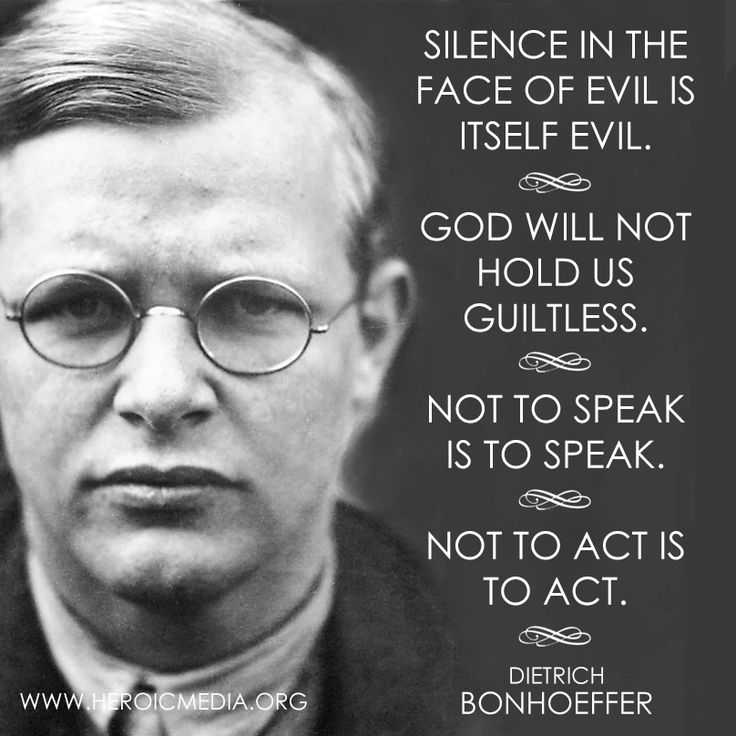
Dietrich Bonhoeffer, Lutheran minister, wrote The Cost of Discipleship as Germany inched toward disastrous policies. He would die eight years later in a concentration camp. Every catechism student should be urged to read it several times in their faith journey. But if leaders show no indication they understand grace comes at a cost, having lay leadership with passion will only cause trouble.
Last week I started a series intent on exploring language used by clergy that goes unchallenged because it is shared only in sympathetic and often sycophantic leadership circles.
Church leaders love this topic. It fuels the movement to close small membership churches. This is an important topic. 80% of all churches are considered small churches.
The movement started out with the best of intentions. Many churches struggle with changing demographics—a new norm. Church isn’t set up to deal with change. Church life concentrates on “settled” populations and long-term pastorates. Now, homogenous communities are breaking apart. The thinking complemented corporate trends of the times. From the 1960s on, consolidation was all the rage in education, business and among service providers. But church is different.
Congregational Life Cycle started as an idea worth exploring. However, it wasn’t long before it was noticed that small churches often have endowment funds and valuable paid-for properties. Sometimes they have more cash on hand than the regional bodies. And that’s added an ugly dimension to a well-intended church strategy. Securing assets for the regional bodies became part of the goal. Yet few questioned the wisdom of leaders, and congregations weren’t part of the dialog.
Plant it. Water it. Watch it Grow. This was the theme of our regional body during the years they were challenging our congregation in court. We added a frame to illustrate our reality.
The buzz phraseology always starts with “Every congregation has a life cycle.” The five steps—Birth, Vitality, Equilibrium, Decline, and Death—will be glossed over, if mentioned at all. These articles rarely explore the shift from Vitality to Equilibrium or from Equilibrium to Decline. The focus is facilitating Death.
Church leaders are so immersed in the unchallenged ideology that they are taken by surprise when congregations resist. Laity and clergy, who are supposed to be working together, are suddenly adversaries. Issues oftenend up in secular courts that don’t want to deal with church issues. (There is a reason the Bible advises staying away from court).
Within the Church, published reports are always about successes: Dying Church Gives New Life to [some other faith community or community service] is the typical headline.
What happens to the displaced people? Who cares?
Clergy advocates reference two scriptures to support this trend. Ecclesiastes—a time to be born and a time to die—and the Resurrection scripture. You know the Easter story—about how Jesus overcame death so that we might live. Both scriptures are taken out of context and used in ways never intended. Together, they become an excuse for failure.
There are other scriptures that should be part of the discussion:
the Ten Commandments,
the book of Nehemiah and the rebuilding of the Temple wall with no support from religious leaders,
the parable of lost Sheep,
“where there are two or three gathered in my name”—
and a significant gospel admonition—Matthew 18:6. “If anyone causes one of these little ones–those who believe in me–to stumble, it would be better for them to have a large millstone hung around their neck and to be drowned in the depths of the sea.”
Make no mistake. Legitimizing the “Congregational Life Cycle” as an excuse to force small congregations out of existence causes a lot of stumbling.
In fact, the Congregational Life Cycle has myriad scenarios. Some congregations exist for centuries. Others don’t outlive the first charismatic founder. There are all kinds of examples of ups and downs over the course of centuries. The five steps are not “givens.” If they were, who would put any effort into building neighborhood churches in the first place?
Leadership is entranced by this idea of congregational death. It gives pastors permission to fail. They dutifully resist the temptation to waste resources on God’s people.
At about the same time this book was published, our previous regional leader followed her advice. (They worked in the same office/fishbowl.) It was the year 2000. He was refusing to help us find a pastor. He said, “Without leadership, your congregation will die a natural death in ten years,” Yep, he used the same words that would be in the 2001 book, Transforming Regional Bodies. Ten years of neglect was already part of a leadership formula!
Here’s the problem. In most Protestant denominations, resources belong to the people. How do regional bodies make sure the assets of small congregations aren’t wasted by small congregations spending their money on their projects (efforts the regional body is not supporting because they are waiting for death)?
The desire to control assets leads to “replanting” strategies. Replanters insist that all current members must leave their church so that church replanters can work “without baggage.”The people, who constitutional have a say in the use of congregational assets have to go.
Replanting strategies are another fishbowl topic to explore later.
The Congregational Life Cycle thinking as it focuses on church closures may have started with good intentions. However, after years circulating in the clergy fishbowl without challenge, the good intentions became one-sided. Laity living with the consequences, have little voice. Rank and file church professionals are clueless at worst and apathetic at best—until their congregations are affected. No one revisits the decisions. Closed is closed. Too late to rethink.
The laity are dismissed with condescension. “They are grieving.” Clergy will plan a grand closing ceremony and remember to put tissue boxes at the end of every pew. There. The laity are taken care of.
Our congregation lived through this thinking several times. We are true veterans. Grief is low on the emotional totem pole. Church leaders ignore the feelings of abandonment—years working not realizing that the regional body had no intention of helping you succeed, squandering of member efforts, the sense of violation, worthlessness, distrust, loss of faith, deep hurt and anger. Church closures have long-term consequences. Those consequences are not studied. The clergy find new calls and their is an expectation that laity move on just as easily. They are wrong. If limited to one word “betrayal” far outranks “grief.”
The Resurrection story is not about closing churches. There is no “Church Life Cycle” in the Bible. The Bible seems to like small. Scripture empowers individuals and small groups. (That’s where we took our name. Jesus sent disciples out in groups of TWO.) The only thing small can’t do well is support an unwieldy and ineffective hierarchy.
Most churches that have been dealt the church closure hand simply disappear. Affected members lose voice and status within the church, assuring that these management strategies will continue unchallenged.
But our congregation started this blog. We want the issues facing small churches to be discussed with laity as part of the conversation. Together, we might be able to solve some issues facing today’s church.
I have a unique viewpoint of the Church. I have been surrounded by clergy my entire life. I’ve lived with clergy, worked for clergy (of several denominations), worked with clergy (also of several denominations).
But I am also a lay person, content to be a lay person. Lay people are important!
The Church is perhaps the last relic of top/down power structure in the free world. The role of laity is to support clergy. Lay observations carry little weight.
I’ve been studying “church” as a lay person for decades. I’ve read dozens of books. I follow a few blogs written by clergy. I have provided decades of lay leadership to small congregations.
Last weekend I cleaned some bookshelves and came across The Once and Future Church by Loren Mead. This book was ground-breaking thinking in 1991. Twenty-six years later, the application of its wisdom has proven to be a challenge.
1991 was early in the societal revolution created by the internet. In just 25 years, we abandoned century-old societal patterns.
The Church, however, remains behind.
The 21st century is very, very different from anything we’ve seen before.
1. More people are educated at higher levels.
2. The pace of change is ever-accelerating.
3. Diversity in the secular world is the norm in most western population centers.
And then their is the big one—the internet. Wow! What is possible today that we never dreamed possible 50 years ago!
The church doesn’t seem to understand it. Even the writings of clergy advocates are rooted in hierarchical thinking, asking only—How can the internet help us do what we already do? We just can’t get our heads around the potential.
What is stopping us?
Fish Bowl Leadership
Church leaders lead from inside a fish bowl. Leaders swim together and get along grandly in their glass encased world. They share similar experiences and ideas day after circular day.
That glass bowl muffles outside voices—in both directions. The curved glass distorts the view—from both directions.
As long as the temperature is right and someone sprinkles enough food in the tank, church thought leaders keep circling the tank, revisiting the castle and treasure chest they just passed, over and over.
In the fish bowl of church leadership, clergy talk to clergy. The fish bowl is a leadership ecosystem that never quite connects with the outside world.
Laity are frustrated hobbyists who dutifully attend to the fish without the agency to do more.
Until now.
The signature achievement of the current era is the shift of power. We see this in every aspect of our lives—entertainment, education, government, business, family and commerce. People expect to be involved. This is important for church leaders to understand. Future generations will never know a world where they couldn’t be involved. They will not be interested in sustaining a church that does not realize their potential.
Is it too late for the Church?
Change begins with challenging fish bowl thinking. Perhaps this year, the 500th anniversary of the beginning of the Reformation is a good time remember this has happened before.
But how? Where to start?
Let’s start small.
Here’s one example of fish bowl leadership thinking that has been around for a while and is rarely challenged.
I”ve heard pastors use this in sermons and at congregational meetings. I’ve read it in blog posts. Perhaps you have heard it too.
“Statistics indicate that most people become involved in church as a result of an invitation from a church member.”
This is usually presented to laity with the intent to inspire. But fish bowl leaders deliver the message unaware of how it sounds to the listeners on the other side of the glass barrier.
This is what they hear?
So, it’s our fault our church isn’t growing.
If pastors think they are empowering members by quoting this statistic they are wrong. They are guilt-tripping members while exonerating themselves of responsibility. At least that’s how it seems from this side of the fish bowl.
So let’s challenge the statement.
What does this statistic represent? How was the data gathered?
I suspect that the question was posed survey style. Something like this:
______
How did you come to join the church you currently attend?
I saw a welcome sign on the door.
I was born into a member family.
I was visited by a pastor.
A friend invited me.
None of the above.
––––––
We cannot tell from the answer if a pastor actually asked them?
Between 2011 and 2013, I and a few friends (some clergy, some lay) made a project of visiting neighboring churches. In three years and more than 80 church visits, only one pastor followed up. By postcard.
No doubt pastors use this statistic hoping to motivate members to be proactive in outreach. Do they know what we face?
Today’s laity feel pretty lonely. There are a lot fewer of us!
Frankly, we are embarrassed much of the time. Society has mocked “the church lady” for years.
The worship experience is alien to most of our neighbors and it isn’t PC to bring up religion in many venues.
Let’s assume people are better potential evangelists than pastors. How does church leadership help?
Does it model invitational behavior on Sunday morning and during the week?
Are members trained as evangelists?
Does it create an environment that members are eager and feel comfortable to share?
Is church involved in community to create the necessary opportunities for interaction?
Answering theses questions affirmatively is the responsibility of any church leader who expects members to be evangelists.
All of these require of leap of faith from the fish bowl.
This is the beginning of an extended look at fish bowl leadership and how it is silently toxic to church growth.
We’ll start with things to think about and see if some answers and strategies can be found to help us step out of the last two centuries and into a bright future.
BE ON THE LOOKOUT!
This summer 2x2virtualchurch is launching a companion website, Small Church Toolbox, a resource site to help small membership churches minister in today’s world.
Consultant Sarai Rice has benevolent interests for the congregations she serves. The love comes through.
She is probably unaware that her innocent musings feed dangerous Church trends. The trends make Christianity dangerous for laity.
Her rationale sounds good. But it encourages church leaders to think of congregational assets as their own. A slippery slope. We can’t know what offering-givers are thinking, but it is probably not to enrich hierarchy.
I’ve read similar posts from other church consultants. Church leaders enjoy relatively unchecked power. This magnifies the danger.
Ideas shape policy. Church leaders have power to make their dreams come true!
Some denominations have every right to consider the best use of congregational assets. Catholic and Episcopal traditions have long assigned property/asset ownership to the judicatory.
Not so with many Protestant denominations, including Lutheran congregations.
Lutheran polity assigns ownership and administration to congregation members. They can purchase and sell property. Even if a church decides to close, members have the right to dispose of assets following charitable guidelines.
For decades, maybe even centuries, this was unchallenged.
But this is the 21st century. The troubling economics of today’s more affluent world are difficult to understand. (That’s another post!) Regardless, encouraging church leaders to ponder how struggling churches should spend dwindling resources adds to challenges.
Regardless, encouraging church leaders to ponder how struggling churches should spend dwindling resources adds to challenges.
Guilt-tripping congregations who want to spend their resources on their ministry is cripples potential.
This sense of entitlement tempts the breaking of commandments and the abuse of power.
But Consultant Rice probably thinks she is writing only to clergy. That’s where these discussions usually start and stop. Dedicated lay leaders should start reading the blogs of the people who shape the policies we end up dealing with.
Sadly this thinking is already an influence. Judicatory leaders judge congregations by THEIR view of a congregation’s prospects. It’s natural that they weigh what’s in it for themselves. Decisions will be made that have nothing to do with the congregations in question. They will call it discernment. Prejudice might be a better word.
This affects how they lead. Why assign the most capable pastors to churches you have no hope for? Attitudes develop among clergy that a call from a small congregation is beneath them. Poor leadership only accelerates decline—in line with their vision. People who stand to benefit but who know nothing about the congregations in question assume power they were never intended to have.
Case in point: Suburban leaders look at urban congregations and decide they cannot thrive without parking lots. Makes perfect sense to suburban Christians who rely on cars for everything. Not so in the city! If they were just wrong, this would matter little. However, their view determines the allocation of resources/talent and the influence small churches have on boards, etc. Suburban church people start making decisions for urban members.
It doesn’t end there. Lay people may not be aware of the leadership concept “caretaker pastors.” Clergy know the term. Caretaker pastors are expected to do no more than care for existing members until resources fail and the church closes. Since this term is not used in the call process, the stage is set for conflict. Lay leaders wonder why the pastor isn’t doing what they expect a pastor to do! They aren’t in the plan. They are just paying for it.
When the Evangelical Lutheran Church in America was formed in the 1980s, congregations were promised control of their properties. But since then, bylaws have been added that are in opposition to these founding promises. (This would be illegal in the secular world.) They have listed conditions that allow judicatories to take control, but there are no standards to measure these conditions. Anything goes! Furthermore, they have added wording that allows them to administer a congregation’s assets for their own benefit. If a synod is running a deficit budget, an asset-rich, small congregation can kiss their ministry goodbye.
This post innocently feeds into current predatory practices.
Taking the property of others and administering it for your own benefit is the definition of theft.
Church consultants and pastors are accustomed to discussing issues in private clergy circles. But blogs can be read by anyone. Lay leaders, start reading the blogs which shape the church you serve.
Lay leaders with a vision for ministry in their neighborhoods need to beware. Other people want what you have. Church people have a way of making coveting sound noble. It’s not.
Join Bishop Ruby Kinisa as she visits small churches "under cover" to learn what people would never share if they knew they were talking to their bishop.
Undercover Bishop will always be available in PDF form on 2x2virtualchurch.com for FREE.
Print or Kindle copies are available on Amazon.com.
For bulk copies, please contact 2x2: creation@dca.net.
Contact Info
You can reach
Judy Gotwald,
the moderator of 2x2,
at
creation@dca.net
or 215 605 8774
Redeemer’s Prayer
We were all once strangers, the weakest, the outcasts, until someone came to our defense, included us, empowered us, reconciled us (1 Cor. 2; Eph. 2).
2×2 Sections
Where in the World is 2×2?
On Isaiah 30:15b
Be calm. Wait. Wait. Commit your cause to God. He will make it succeed. Look for Him a little at a time. Wait. Wait. But since this waiting seems long to the flesh and appears like death, the flesh always wavers. But keep faith. Patience will overcome wickedness.
—Martin Luther



 Are you getting the support you need from your denomination?