4/7InkzHVUEQeEdU9vpc1tikzEhChrKmPfvXI-FSDBrBQ

Commentary

Small Churches: Don’t try to swim with the big fish

disruptivePutting Disruptive Innovation to Work
Principle 3

Doing what the natural competitors consider unattractive or uninteresting

Many business books show in great detail how companies that act in the right way can crush existing competitors. Successful disruptors almost never seek a head-on collision with established competitors.

Interesting advice. Churches almost never take it. Most churches set out to be like every other church within their denomination. Many of them fail.

This is the root of the thinking of the pastor who claimed the East Falls neighborhood had enough churches and therefore Redeemer didn’t matter. There is an assumption that all churches do the same things in the same way.

This is the thinking of church professionals. Church members know that every church is not the same. They know their attendance means more to them than just sitting in the pew and walking through the weekly rituals led by a different ritual leader. That’s why members who move from one neighborhood often hop in the car on Sunday morning to travel 30 miles to the church that feels like home to them. That’s why people shop around when they move to a new neighborhood. That’s why people care. We need more churches that are different.

Small churches cannot survive if they try to minister in the same way large churches do. This doesn’t mean they are unable to do strong and worthwhile ministry.

In our Ambassador visits, we saw several churches doing things differently and well.

  • Prince of Peace, Lawncrest,  has made reaching out to varioius immigrant groups the cornerstone of its ministry.
  • Prince of Peace, Plymouth Meeting, is centering on issues that relate to family problems—serving families with members with autism and focusing on the effects of bullying within the family structure.

These are ministry niches that larger churches bypass. Remember, from a regional body’s viewpoint, a primary purpose for ministry is support of the regional body.

Unfortunately, there are other examples, some of whom are probably on Synod’s endangered list. (They deny they have one, but they referred to it in court. They claimed Redeemer was the first of six churches they intended to force into closure. Five congregations can thank us for slowing the slaughter.)

Larger churches would see service to these segments as charitable outreach. The efforts would not support their budgets. The bigger the church, the bigger the burden of the budget. Attention given to these ministries is therefore limited to the typical church budget for charitable outreach. If you are guessing that this is a minimal figure, you are probably right.

People served by these niche ministry churches would be lost in larger churches. It would take years to prove their leadership worth. If they are going to be active, they are going to be part of smaller ministries.

Redeemer, East Falls, learned this lesson. Naturally, older members discussed finding newer members who were “like them.” But they were with able to see beyond themselves, as painful as it may have been at times.

There was no need to maintain a mainstream-style church in face of neighborhood apathy for the way churches usually do business. It would have taken tons of money to support a minister for years to rebuild this kind of ministry after a decade of synodical neglect. But Redeemer was able to rely on other strengths. We had a decades-old reputation for having good daycare programs that the neighborhood traditionally supported. As a congregation we were open to the diversity that visited us. We had a part-time pastor for three years who facilitated this openness. We had lay talents that could serve and bring others into service quickly.

We built a valuable ministry around our strengths and did not try to fit our strengths into the mainline vision for church growth. We were succeeding.

Unfortunately, the Southeastern Pennsylvania Synod of the Evangelical Lutheran Church in America did not understand Redeemer. They were blinded by what they thought was easy access to our wealth. A lot of good ministry effort in East Falls has been wasted.

Disruptive Advice to small churches: Find a niche ministry that the bigger churches can’t serve and pursue it doggedly.

Transforming the Church with Disruptive Ideas

disruptiveEighteen months ago some of the remnant of Redeemer, East Falls, began visiting their sister churches that voted in 2009 to confiscate Redeemer property for their own enrichment.

Bishop Claire Burkat decided the way to transform Redeemer is to deny the congregation the services she is pledged to provide member congregations, make sure they have no professional leadership, lock out the loyal members, and sue their lay leaders. It is exactly as it sounds — ridiculous and cruel. Nevertheless it has been tacitly endorsed by the clergy and laity of a synod that is struggling and fearful that any misstep will find themselves undergoing similar “transformation.”

After our third visit, a pastor reported our activities to Bishop Burkat, which didn’t bother us. We saw nothing clandestine about attending church. We have made our reports quite public. As of this writing we have visited 52 SEPA congregations.

Bishop Burkat responded by issuing a warning letter to all pastors including instructions on what to do if we became disruptive—a new slant on the standard All welcome! sign.

Perhaps she thought we would behave the way her representatives behaved when they visited Redeemer.

But we didn’t set out to disrupt. We came to worship, learn and share. Period.

One of things we learned is how many of the congregations exist under the watchful eye of the synod. They are in transition with a synod appointed professional leader or they are in some form of mission development with clergy reporting regularly to synod.

One term cropped up regularly — transformational ministry. It actually is a common term used by church leaders, who have published many books on the subject. It sounds inspiring. It is really quite vague.

  1. It is unclear what the term means.
  2. It is unclear when it is successfully achieved.
  3. It is unclear as to how it happens—if it happens.
  4. Is is unclear if the term addresses a ministry model that is replicable or a fluke.

Generally, transformation seems to happen when a struggling church is by some means able to once again support the hierarchy.

Recently, we came across a book:

Innovator’s Gude to Growth: Putting Disruptive Innovation to Work
published by Harvard Business Press in 2008.

This is a fascinating concept and one which Redeemer had unwittingly stumbled upon entirely ignorant that Harvard thinkers were concurrently developing a new business model that mirrored our experience.

Disruption Can Spur Success

Redeemer didn’t set out to be disruptive. Nevertheless, we had a track record for success in doing ministry in unconventional ways. The Synod and its voting membership never took the time to know or understand our ministry. They were better off without our people. “Hand over your money. Good riddance. We’ll pray for you. See you in court.”

It’s going on four years since East Falls Lutherans were locked out of the ELCA. Our visits reveal that SEPA has not experienced much innovation or transformation in the three years they have worked so tirelessly to exclude us.

We are going to look at the concept of Disruptive Success and see if it might be the catalyst that is missing as the church gropes blindly for “transformation.”

Look for at least four more posts on Disruptive Innovation in the Church.

Learning about Church from Urban Planners

The Value of the Disorganized Church

Maybe it is time to seriously consider the value of the disorganized church.

Change is very, very difficult in the Church.

Why? There is really no desire to change. People rarely go to church to spearhead change and church leaders, as much as they talk about change, are really interested in change for just one reason.

Economics.

The Church wants to maintain the economic advantages it came to enjoy in the affluent Post World War II years. If the money were still flowing, if the Sunday Schools were even half the size they were in 1965, there would be no talk of change. If the building were maintained with salaries paid and if a healthy proportion of offerings were being shared with the regional and national offices (do we remember why?), then everyone would be happy.

There would be celebrations for the status quo.

Somewhere amidst the revelry the mission of the church will be left behind.

The catalyst for change is need—the more personal, the more imperative.

The need is there. The imperative is strong. But there is no strategy. We are all worried about just getting by! There is no money for mission.

Congregations are hurting. When congregations hurt, regional offices lose support. When regional leaders can’t pay tribute to the national office, you have a mess. The battle cry sounds. Change!

Under these conditions, there is a temptation to follow policies designed to mandate change. They don’t work.

Here is a link to a TED talk that addresses the problem of traffic congestion. How does this relate to church life? Watch it and see.

Here is a short vignette. It’s about the temptation to make plans and expecting other people to simply carry them out.

Back in 1989, when the Berlin Wall fell, an urban planner in London got a phone call from a colleague in Moscow saying, “Hi, this is Vladimir. I’d like to know, who’s in charge of London’s bread supply?”

And the urban planner in London says, “What do you mean, who’s in charge — no one is in charge.”

“Oh, but surely someone must be in charge. It’s a very complicated system. Someone must control all of this.”

“No. No one is in charge. I mean, it basically — I haven’t really thought of it. It basically organizes itself.”

It organizes itself. That’s an example of a complex social system which has the ability of self-organizing, and this is a very deep insight. When you try to solve really complex social problems, the right thing to do is most of the time to create the incentives. You don’t plan the details. People will figure out what to do, how to adapt to this new framework.

This is part of church life today. Regional bodies send “transition” experts to congregations and attempt to steer congregations toward newer, accepted, but not really proven, new ways of ministry. They are not recognizing what the people in the local churches know very well. It’s not working — no matter how hard you try, no matter how you veil the statistics.

The Church wants to control the distribution of bread. (No theological metaphor intended!)

What the urban planners dealing with congestion problems discovered is this: Attempts to mandate a change in driving habits had NO impact.

They didn’t achieve success until they found a gentle way to nudge drivers. The nudge was so gentle, no one even noticed that their behaviors had changed. Most people thought the changes were their idea.

The Church needs to learn to nudge. Lead, don’t dictate. We’ve been trying to force congregations to do the things hierarchy wants them to do for a while now. It isn’t working.

A little less organization. A little more incentive for grassroots initiative.

Welcome to our growing church!

Our Ambassadors have heard the same phrase used in a number of the congregations we have visited  recently.

Welcome to our growing church!

It caught this visitor’s ear, partly because the presentation was so similar in each community. The pastor  seemed to be saying, “We’re glad you are here, but we want you to know there is much more to our church than what you see.”

I believe that. Redeemer people know what it feels like to be judged. There is always more to a congregation that can be viewed at Sunday worship.

Or maybe they were saying, “We know we don’t look like much, but we have potential.”

Or maybe they weren’t addressing visitors but were reassuring members that relief was in sight.

Maybe they actually have an incredible track record for growth.

As I worked on 2×2’s statistics for yesterday’s post, I decided to look up the ELCA Trend reports of the churches I could remember using this phrase.

Each of them as of the end of 2011 was statistically in decline in some categories and doing little better than holding its own in others.

So maybe 2012 had turned things around for them. Or maybe they were measuring different statistics than TREND records. To claim undefined growth is pretty safe. It all depends what we measure. We could be measuring deficits.

Perhaps calling attention to the word growth is a way of paving the road or priming the evangelism pump. It satisfies existing members that problems are being addressed and hints of great potential to visitors. How can you go wrong?

Meanwhile, let’s consider the advice of TV’s Doctor Phil.

“You can’t change what you don’t acknowledge.”

Redeemer Ambassadors Learn More about St. John’s, Mayfair

On the first of the month, Redeemer always looks forward to holding our own worship service at the Old Academy Theater. The Ambassadors arrived still enthusiastic about our visit to St. John’s, Mayfair, last week. One of our Ambassadors enjoys the history and architecture of the churches we visit. She asked about the two cornerstones—one pre-Civil War and one from the mid-20th century. We discovered a connection we didn’t know we had. Our pastor, one of only a couple of SEPA/ELCA pastors not afraid to be seen in public with us, once served St. John’s back in the 1960s.  (Yes, we have a pastor, in fact we have two who worship with us regularly!) He told us a bit of its history, how it used to be downtown and how the new church had been designed to showcase its beautiful German windows. He talked about how the educational wing was once filled with Sunday School students and how it had a friendly competition with St. Paul’s in Olney. Its membership then was more than 2000. Latest Trend reports have them holding their own in the 600s, with a little fluctuation, most recently reported at 695, a third of them worshiping members.

Why Twitter for Churches?

Why Twitter, why not Facebook?

twiFacebook, the king and queen of social media, has some problems as a platform for churches.

  • To be used well, it is a lot of work.
  • It is unabashedly about monetization of cyberspace.
  • The rules change frequently.
  • It can easily become more intimidate than a congregation of unrelated people want to be part of. Facebook rules just changed recently to make posts more public than many users ever intended their Facebook pages to be. We’ll wait with everyone else for the fallout on that.

Facebook has been embraced by business and some nonprofits. They are more likely to have a top-down structure with monetary and hierarchical controls. In other words, Facebook will be part of somebody’s job. It might be their whole job. Few churches can afford that!

Twitter on the other hand comes with some control. You can create a following but you can direct your “tweets.”

The Twitter platform is stripped to the bone. You are limited to 140 characters (practically 120 characters). Who can’t write one sentence a day!?

Let’s look at Twitter. What is it, anyway?

Twitter is a social media platform first designed for people to answer the question, “What are you doing?”

People send simple, short messages. No pictures. No video. No fancy type.

The first reaction from the public, the echoes of which can still be heard, was “I don’t care what you are doing!”

But some people kept reporting their activities to the world anyway.

They soon learned the difference between “This sandwich is delicious.” and “Route 95 is backed up 20 miles. Stay away!”

Slowly with explosive bursts of potential, the world began to realize that there is power in caring about what someone else is doing and how we can influence what happens to them.

Does that not sound mission-oriented?

The power of Twitter is in making connections. Once those connections are made. It is really up to us what we do with them. Twitter is the spark.

There is a good explanation of this power in the book The Tao of Twitter, by Mark Schaefer. There are many good books explaining Twitter. Most of them are written from a marketing point of view. Marketers tend to love numbers and analytics, which if you can bear reading them, are impressive.

(We’ve provided a link to Amazon in our widget column for this inexpensive book.)

Most pastors and church people are not “numbers” people. If they were, they may have already fled the church scene. Church numbers are dismal at first glance and alarming with analysis.

Mark’s book dwells on Twitter’s power, beginning with person to person, one-on-one power. This is something every church needs. It is foundational to mission.

The current and traditional church mission focus is invitational. Build a building, open the doors on Sunday morning, and hope that people are curious enough during those few hours of the week to come to us. We sit in our big churches and wait. For decades we didn’t know how to do mission any other way. The tools to do a better job were out of reach, practically and economically. So we keep doing things the same way, rewarding the congregations that do this the best, despite the nagging realization that even the biggest churches are statistically ineffective.

To use Twitter, requires making an effort to unlearn and change this collective mindset.

How does Twitter differ from Facebook?

Twitter2Twitter is beautifully stripped down. You must tell your story in less than 140 characters. Church people can respond to this limitation in one of two ways.

  1. Protest! We can’t possibly tell our message in 140 characters.
  2. Cheer! How hard can it be to write one sentence a day!

Twitter will be manageable for any pastor or any lay leader. It is possible to put Twitter to work with as little as 15 or 20 minutes of effort per day. That’s good news!

Teach Us to Pray

Why do people go out of their way to ask preachers to pray for them?

Pastor Jon Swanson points to 1 Chronicles where David outlines the duties of the Levites. One of the duties is to stand every morning to thank and praise the Lord.

OK, it’s their job. But it is our job, too.

Each of us can pray. The littlest toddlers find comfort and empowerment in bowing their heads in pray. (Comfort and empowerment are answers to prayer.)

Over the rocky years of life, we tend to lose confidence in God and confidence in our ability to speak to God. The relationship is broken.

Easy way out: assign the duty to those we feel are especially trained to do this.

When you set aside one group of people to perform a function that each person is capable of doing, the result is predictable. The larger group is going to lose its skills.  Prayer is a pretty important skill—one we don’t want anyone to lose!

Another predictable result. The designated pray-ers will accept status and power. Over time, they will get lazy about their responsibilities and the prayers will become corporate in nature. Prayers will be written a year in advance, published, distributed to congregations, and read by the designated pray-ers, who no longer have to know the names and faces of the people they pray for. People will feel further lost and separated from God as their individual needs are grouped with the whole, undefined people of God.

The church must work at restoring people’s relationships — not so much with the Church but with God.

We all feel small before God and in our self-loathing we tend to think that clergy are somehow better. They are not. Clergy are servants just like every other child of God. They are capable of both good and bad. Putting them on a pedestal as the official representative of God results in scandals that grab secular headlines when things get really bad.

Clergy are charged with fostering spirituality. They are not surrogates. That kind of thinking led to the travesties that inspired Martin Luther to risk his life with his 95 Theses. Back then, people were encouraged to pay clergy to pray for them. The more money, the better the prayer. Maybe that’s what we have returned to today without using the word “indulgence.”

The disciples felt inadequate. They came to Jesus. “Teach us to pray.”

The church does not always do a good job of teaching us to pray. The laity is often OK with this. We want to know how to pray, but not if it means practicing. . . in public.

At this point we can learn from musicians. They know that no amount of practice behind closed doors can teach the skills that are easily honed playing in public.

One pastor we heard during our Ambassador visits exhorted her congregation to ration their prayers. Don’t bring your little concerns to God, she admonished. Save God for the big things.

Perhaps she meant to empower the congregation to solve their own problems, but it is definitely short-changing God. God is God. He’s not asking us to save Him time and trouble. God wants us to call upon Him. God can handle little things along with big! Nevertheless, I am sure God smiles with satisfaction when we get up from our knees and help!

There is only one way to change this. Put the responsibility for prayer into the hands of the people. Teach them to pray. Teach by example. Give lots of opportunity for practice.

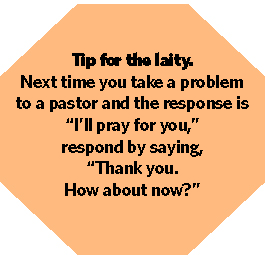
Instead of glibly promising to pray for people who come to you in distress—as a way of dismissing their concerns—stop in your tracks, take their hands, and pray with them, asking them questions in the prayer so that their answers are a voice directed at God.

Then don’t wait for magic. Prayer provides comfort and empowerment! Roll up your sleeves. Lace up your boots. Put on your gloves. Go to work! Love your neighbor!

See if those prayers aren’t answered!

Teach us to pray.

photo credit: Lel4nd via photopin cc

The Stewardship of Weekends

The concept of “weekend” is a fairly new in the history of the world. The term was first used in the late 1800s and was not commonly used until around 1935—only about 80 years!

The concept of Sabbath and one day of rest is much, much older. Thousands of years older.

Before the late 1800s almost everyone was vocationally tied to the earth. That created its own rhythm. Cows must be milked every day. Everyone worked close to or at home. The Sabbath was a gift!

The weekend came along with the shift to factory and office work.

Weekend, in its first usage, referred to Saturday noon to Monday morning. Today it spans to Friday afternoon to Monday morning and roughly once a month we add an extra day to that!

This helps our multicultural society. Islam has its Friday holy day. Judaism has it Saturday Sabbath and Christianity remembers Easter by worshiping on Sundays.

It’s great that all this time has been cleared from our schedule to relate to God. But now that most of us don’t have to milk the cows, what do we do with it?

We suspect there always has been a temptation to party away the Sabbath gift. God noticed!

Remember the Sabbath Day to keep it holy.

 
photo credit: kisocci via photopin cc

Are Program Churches Programmed Churches?

2×2 grew from a small church—Redeemer in East Falls. How small? Well, too small for the ELCA. But big enough for mission.

While we have been locked out of our sanctuary for more than three years, we took on a project of visiting the very people who locked us out for their own enrichment.

We’ve made more than 50 visits. Most congregations appear to be no stronger in numbers or wealth than Redeemer. Several would probably already have been targeted by SEPA Synod for takeover if Redeemer hadn’t been commanding their attention for the last five years. As church experts categorize churches by size, they are either in the family church (under 75 members) or pastoral church (around 150 active members) categories .

A few of the congregations we have visited fall into the next biggest category — the program church.

Program churches are big enough by definition to afford a full-time pastor or two and some additional paid staff. They can offer programs to various segments of the population led by the extra hands they can afford to pay.

There is a stark contrast between these churches and the smaller churches that struggle to compete for pastoral services and attention from the Evangelical Lutheran Church in America (ELCA).

The difference is initiative. It’s not that larger churches don’t have initiative; it’s just more “programmed.”

We can see it in little things.

In last Sunday’s visit, the pastor used five large objects in his sermon. He introduced them one by one and placed them across the front of the chancel as he talked. When his sermon ended, he walked back and forth across the chancel and removed the objects. He sang a hymn as he did so. But it seemed odd that the vicar sitting nearby didn’t offer to help—nor did the acolyte sitting nest to the vicar. I know that had this been Redeemer, one or two people would have jumped up and helped the pastor prepare for the next part of worship. There is nothing wrong with this, understand. The hymn the pastor was singing as he cleaned up was nice. It just seemed odd.

Where initiative is lacking, so is creativity. It shows in the bulletins of program churches. They invariably have long lists of credits. Who is the greeter, the reader, the usher, the offering counter, the communion assistant, the flower donator, or the nursery assistant for this week and the rest of the month? Just check the bulletin.

Presumably, if it’s not your Sunday to greet people, then there is no reason to greet anyone.

In small churches, every job belongs to every body.

Reading through church newsletters and bulletins of the program-sized churches, there are lists of activities. They are similar to every other program-sized church. Perhaps that’s where church leaders get the notion that closing/consolidating churches is good management.

The things Redeemer does aren’t on any of the lists. No Swahili outreach, no experimentation with the web and social media, very little experimenting in the worship and educational settings, no ambassadors.

Perhaps the promise that they will lose their uniqueness is why small churches resist the management “wisdom” of their leaders.

Perhaps it is why the ELCA and the Southeastern Pennsylvania Synod (SEPA) tend to undervalue their small congregations.

Redeemer is not closed.
We are locked out of God’s house by SEPA Synod.

A Country Pastor Visits the City

My Dad is not a city person. He is the child of missionaries and a career parish pastor who served in several Pennsylvania small towns and rural communities. Those towns are still too small to support a church according to ELCA experts, but they always supported us.

Retired for the last 20 years, Dad now divides his time between his children. He takes his frequent visits to Philadelphia in stride, despite some measure of culture shock. I was with him in the small towns until I was about 23. Since then, I have lived the rest and majority of my life in cities. I remember my previous “country” life and am aware of differing city ways, which I, too, had to learn. My city-born husband used to scold me for talking to strangers. Today I was reminded of where I got that terrible habit.

My Dad doesn’t know the rules of city life. If he did he wouldn’t care. He talks to everyone he passes. Sometimes people are receptive. Sometimes I catch a look of suspicion in their eyes. More often than not, he is ignored. I explain to him that city people protect their space. He pays no mind.

Today, he accompanied me to the grocery store. As I ordered some cold cuts he attempted to strike up a conversation with the person holding the customer number after mine. I noticed the woman looking at him suspiciously as if his kindness was an intrusion. Her face said, “Who is this old guy and what does he want from me?” Dad didn’t seem to notice, so I caught her eye and made light. “He’s harmless,” I said. “He’s my dad, an old preacher. He talks to everyone.”

She processed this for a second or two. She looked angry. My dad continued to talk to her as if I’d said nothing. Suddenly, she let down her guard and responded. They had a short conversation. I breathed a little easier as I waited for my pound of provolone. As I turned to leave, she commented to me,  “This world needs more people like that. It needs them very bad.”

She may be right.

Our Ambassador visits reveal that many pastors lack my dad’s skill in striking up conversations. Some disappear after church. Some go off to a corner to talk to one person—probably a council member. Few show any inclination to circulate among either members or visitors. Have they adopted city ways? Are they living in their own worlds? Does the work of the church trump fellowship? Do they think someone else is going to do the work of evangelism? Are they afraid to tell the Story? Are they too good to talk to strangers? Are they unaware that the entire congregation follows their lead?

I don’t know the answers. But I suspect that talking to people is more likely to grow a church than not.