4/7InkzHVUEQeEdU9vpc1tikzEhChrKmPfvXI-FSDBrBQ

Commentary

Web 1 (Ready), Web 2 (Set), Web 3 (Go!)

This is the second in a short series of posts springboarding from an article in The Jewish Week, written by Rabbi Hayim Herring.

Lagging Behind the World We Hope to Reach

I attended a convocation of churches this weekend. About 20 churches met to celebrate the Reformation, conduct some business and listen to some teachings offered by their bishop.

Today, as I waited for Hurricane Sandy, I went through the delegate list and visited every church website — at least those that had websites.

The websites were without exception static “brochure” web sites. A couple were very nicely designed, with full presentations of their ministry. Several others were minimal sites provided by directory services. A few had Facebook websites but they had done nothing with them except list service times. I was the ninth visitor to one of them, which indicates how effective they are.

Only one provided content that might attract traffic from outside their existing community and that was minimal.

As the Web matures we are starting to identify its evolutionary stages.

Web 1 describes the early days of the web from the early 90s, when organizations struggled with clumsy html code to produce static pages with no interactivity. Using the web well meant hiring some help. Help with technology is not on the approved list of church expenses. Organists and sextons are expenses church people understand. Web masters? Not in the budget. Pity! Web masters have real potential to influence the growth of a church! This has become easier.

News flash: You no longer have to know code to create attractive sites. Anyone can do it.

The move to interactivity began about 2004 and has been mushrooming. This is Web 2. Unfortunately many churches are locked in the frustrations they encountered in the infant days of Web 1. If fear of code and technical ability is stopping your church from using the web, relax. The web has become almost as easy to use for originators of content as it is for consumers of content. It is becoming more powerful every day — and that’s no exaggeration.

We can now become involved with the people who visit our sites. Isn’t Involvement why churches exist?

Web 1 influenced the world. Web 2 changed the world.

Most churches are barely embracing Web 1. This failure is creating a widening gap between them and their communities. Catch up is going to be a tougher and tougher hurdle. Still, there is a hesitance to believe that the web can be of value to church mission.

This is foolish.

  • The web can connect your congregation’s members.
  • The web can connect your congregation to your community.
  • The web can connect you to other churches with similar or complementary missions.
  • The web can connect you to the world.

It has never been easier to go out into all the world, yet the Church is late to the airport!

Congregations were never meant to live in isolation, yet we often do — barely aware of what the congregation a few blocks away might be doing. We view other churches as competition, not potential partners.

We are defying our mission.

Rabbi Herring discusses this in the essay we referenced in two previous posts (1 and 2). He suggests that organizations, including religious organizations are poised to enter a third era of Web capabilities— Web 3.

Having lived in the interactive era of Web 2.0 for not quite a decade, we have an understanding about the nature of online community, the need for a vital organizational web presence and the requirement of interactive and dynamic communication with constituents. While still in its early evolutionary stages,

I’d like to suggest that we are already in transition to a Web 3.0 environment. Web 2.0 meant that Jewish organizations needed to replicate their bricks and mortar presence online. Bricks and mortar and bytes and click ran parallel to one another.

Web 3.0 means that defining principles of online social media, like collaboration, co-creation, improvisation and empowerment must now be practiced in the physical world. In other words, the characteristics of the web that enable individuals to self-direct their lives must now flow back into all organizational spaces: in someone’s home, on the web or inside institutional walls. This is definitely another paradigm shift for organizations.

Rabbi Herring’s observations are astute. Those few congregations that have embraced the power of the media are about to take their interactive and collaborative experiences and transform what goes on within their brick and mortar churches. It will be the elusive formula for transformation.

We at 2×2 are starting to dip our toes into this water, cooperating with some of the churches that correspond with us. It’s exciting, It’s a little scary. But it is invigorating and promising.

Those that haven’t bothered to understand Web 1 and are oblivious to Web 2 will not reap the benefits of Web 3.

Someone said recently . . .

Bragging today about avoiding the internet is like bragging you can’t read!

Hey, Church, it’s your choice!

photo credit: gualtiero via photopin cc (retouched)

Can Lutherans learn from the past as they plan for 2017?

How do you share the grace of God in Christ with someone whose days are filled with messages that they do not measure up and who feel excluded rather than welcomed? How shall we talk about faith in a culture of mistrust and deception? In a world steeped in violence, how do we talk about the cross of Christ as the place that reveals both the depth of God’s love incarnate and where Jesus’ life for others is offered fully?

Bishop Hanson wrote this as part of a message in the recent issue of The Lutheran Magazine. He was looking ahead to the 500th Anniversary of Luther’s brave, death-defying actions, which spurred the Reformation of the Church and laid the groundwork for changes in society that we enjoy today.

Don’t expect such actions from Luther’s heirs.

A recent visit to China sparked Bishop Hanson’s comments. He doesn’t need to travel far to find a culture of mistrust and deception.

We, at Redeemer, who have experienced little but abuse within the ELCA, wonder if Bishop Hanson recognizes that his own people feel unwelcome, unvalued, violated, and deceived. We have learned to distrust the church he leads.

We know we are not alone. There has been a mass departure from the ELCA under Bishop Hanson’s watch.

Similar land grabs continue. Synodical bishops act with the certainty that Bishop Hanson will not require them to honor the intent of the ELCA’s founding documents or constitutions. Dodge’s sheriff  has gone fishing (and not for people)!

The Redeemer travesty has featured personal attacks on lay people with no way within the ELCA to object or defend.

Bishop Hanson, Lutherans are weary of empty words.

We point out once again the decision of the Pa appeal court. It may add up to a win in the short run, but this could come back to bite hard.

The appeal court’s minority opinion determined that if the law were applied, Redeemer’s arguments have merit and deserve to be heard. The majority opinion cited Separation of Church and State, relying on the Church to police its own rules. There is NO mechanism within the ELCA for this. The result: a weak church where everyone can legitimately fear injustice within their own body. Safer perhaps to criticize other cultures!

Redeemer wrote to you for help in 2008, Bishop Hanson. After about ten letters over the course of a year, we gave up. You blew us off, expressing regard for a colleague over concern for a congregation.

You advised both us and Bishop Burkat to talk it out. Today, nearly five years later, there has been no talk, just law suits.

Bishop Hanson, we want peace. We want to work things out within the Church. This is a mandate of scripture (1 Corinthian 6). It’s not going to happen if Church leaders don’t believe the scriptures they preach.

Your sheep need their shepherd. Your bishops need their shepherd.

Help us find answers to the questions you pose. Lead us in our ongoing birthright — the Reformation!

photo credit: Adam Polselli via photopin cc

The Church as Club. Want to Join?

This begins a short series of posts springboarding from an article in The Jewish Week, written by Rabbi Hayim Herring.

Is the Church a club? 

Rabbi Herring suggests that there is a “club” aspect to religious life.

The rabbi and blogger discusses the way religious, civic and non-profits rotate leadership, sharing expertise. He recognizes that organizations benefit from working with a field of trusted leaders. But he points to a serious downside.

“In this model of involvement, there was a right way and a wrong way to get things done and one year’s program often served as the next year’s template. This pattern of involvement created predictability for organizations but, over time, unresponsiveness in addressing new community problems.…

“Yet, this informal rotation of leaders from one organization to the next created the appearance of a privileged club and also fostered a narrower sense of communal vision.”

This is often true within Christian leadership circles.

Just this week, I opened a newsletter from a local Lutheran Service Agency. I glanced at the Board of Directors. The names were familiar. Some of them had served on the same board off and on for decades. Other names I recognized from other Lutheran Agency and Synod boards, councils, and committees. Many of them, too, have been serving for decades.

A great pool of expertise . . . sure! But the same pool of leadership is likely to ensure that proposed initiatives will be cookie-cutter in nature. They aren’t settled in these leadership roles because they rocked the boat! They are appointed, elected, and re-elected because they are predictably safe in their leadership style.

Same people, similar thinking. At worst, the boards become rubber stamps for leadership. And all in all, there is an element of the “club.”

I recently read reports of the last Biennial Meeting of the ELCA. Wow! It was exciting. It was inspiring. It was moving. People had stories to tell. But I didn’t get a sense that anything happened, that problems were hashed out, that new directions were forged. It appears to have been a showcase for the leadership “club.”

Synod Assemblies, too, have a “feel good” (strike that) “feel great” ambiance. The voices of the Assembly are drowned out by the “show.” Participants must return to their churches pumped with stellar reports.

This was reflected in one of our Ambassador visits. One pastor introduced the lay representative to a Synod Assembly that had taken place just the week before. The young woman told of her thrill at being there, her awe in meeting the bishop, and the exciting worship expression. She added that she couldn’t remember much about the meeting part and didn’t understand a lot of it. But it was a great experience. She couldn’t wait to attend again.

If the Church is an organization charged with service in the world where service is most needed, you’d think there would be some sobering discussions leading to unsettling feelings, cries for solutions and service, and the introduction of new issues that might open a door for the interests of new leaders.

But church problems are pretty much glossed over in quickly read reports. Questions? You have 10 minutes. On to the next stirring worship service.

The Church can so easily become a club. If you are “in,” you work hard to stay “in.” If you venture to raise issues, you risk informal (or even formal) censure and you may never feel like a part of your church again.

Is it any wonder that people are not breaking down the door to get “in”?

photo credit: JLM Photography (aka Spookman2011) via photopin cc

If SEPA Leaders Cared . . . .

ELCA motto appended to reflect SEPA's actions in East Falls.The Southeastern Pennsylvania Synod of the Evangelical Lutheran Church in America has been embroiled in trouble, largely of its own making, since 2008. It wasn’t sudden, there was a nearly decade-long prologue of neglect.

During this long period of absence from the ministry of Redeemer Lutheran Church in East Falls, SEPA leaders made unfortunate miscalculations.

SEPA had discouraged professional leadership from serving in East Falls. The strategy they were following—as published at about the same time in a book co-authored by then Synod staff member, Claire Burkat—was to let Redeemer die. SEPA presumed that lay people with no one to tell them what to do would drift rudderless and get tired. One day, the last Lutheran on board would call the Synod and beg for a lifeline.

This may have seemed like the easy way to gain the congregation’s valuable property and substantial financial assets. It is proving to be disastrous—for Redeemer and the entire Synod. It may even trickle UP to the entire ELCA as other Synods (having read the book) attempt to implement the strategy!

The book leaves out the last chapter. It doesn’t always go as planned.

The group of elderly members that Bishop Almquist assumed would soon fail by attrition did not go to their heavenly reward without laying a new foundation for the church they loved. Redeemer grew during SEPA’s years of neglect. By the time Claire Burkat was elected bishop, there was a new group of Lutherans in East Falls, who had no idea they were heirs to SEPA’s prejudice.

Had Bishop Burkat worked with Redeemer’s leaders (as she falsely claims she did), she would have seen great promise. But her intentions for Redeemer were announced long before she ever set foot on the corner of Midvale and Conrad Streets on that ill-fated day in February 2008.

Consequently, Bishop Burkat, intent on exercising powers not found in Lutheran governing documents, led SEPA into a financial boondoggle. They lack the leadership skills to retreat. They are relying on the secular courts to resolve Church problems. Courts don’t want the job.

Had Bishop Burkat cared about the people of East Falls and its mission, she would have strategized to protect her sheep as if they were as valuable as the property she coveted. The ministry that was initiated and nurtured with the investments of the laity would not have been shuttered, but would be earning a steady income, paying the congregation’s obligations with no dependence on SEPA and its member churches.

But SEPA had its own problems. It had been living on deficit budgets for most of its 20-year history. In 2008, that deficit was $275,000, approved by a Synod Assembly at a time when giving was down in nearly every congregation. There was no plan for making up this deficit except to close churches and seize assets. Bishop Burkat is insulted at this suggestion. But it was explained to that Assembly that money to make up shortfalls traditionally comes from the Mission Fund—which is the repository for the assets of closed congregations. No other plan for funding this huge deficit was presented.

Bishop Burkat further denies that selling church properties is part of synod’s survival strategy even in the face of evidence that she offered Redeemer’s property for sale to a Lutheran agency without the congregation’s knowledge just prior to the Synod Assembly that approved the huge deficit and voted to take Redeemer’s property.

There WAS (and perhaps IS) a plan to close churches and sell their property.

Bishop Burkat seems amazed that anyone would resist her clandestine takeover, fraught with deceptive maneuvering, and which defies Lutheran polity. Lutheran congregations own their properties and manage their own assets.

Resistance is a right of every congregation. But SEPA found a way to sidestep congregational rights. Declare them “terminated.” Deny them access to the constitutional benefits of church membership. Treat members as enemies.

What is going on in East Falls is dismissed in Bishop Burkat’s mind as “heart-breaking”—as if she had no leadership influence to prevent or remedy it.

She has become a victim of her own lust for power.

And it is costing all of SEPA.

If Bishop Burkat had cared about East Falls . . .

  • Redeemer would be open for worship.
  • The school Redeemer was about to open as a Christian day school would be operating to the benefit of East Falls and the income of $6000 to $10,000 a month for Redeemer.
  • Redeemer’s mission capabilities, which have continued to grow despite repression, would also be showing fruitful reward. They are already gaining influence.
  • The congregation’s expenses would not be burdening all of SEPA. (The price tag is well over $320,000.)

Instead you have locked properties and alienated members and a community that will always be reminded — The Lutherans? Yes, they are the Church that sues its members.

Even if Bishop Burkat did not trust the loyal Lutherans of East Falls, whom she did not know, she could have done something to keep the problems from escalating. She could have tried to raise funds. She could have worked with the people she leads. She did nothing but turn to the courts (which the Bible expressly discourages—1 Corinthians 6).

The Church does not need leaders to do nothing. We need leaders to solve problems. In this, SEPA leadership has failed. Pride and greed have blinded all sense of mission. Hatefulness and vindictiveness have replaced the messages of love and forgiveness. There is no effort to reconcile. SEPA wants to WIN at any cost. Silence the pastors. Call in the lawyers.

The only people who can fix this, the Lutherans of Southeastern Pennsylvania, are content to let the church attack lay people as their preferred management solution. They foolishly do not envision being in the same situation. Our Ambassador visits reveal that there are dozens of congregations in SEPA that are no larger or wealthier than Redeemer. As Redeemer goes, so will they.

In looking for the WIN, we are all LOSERS.

Speaking to the Individual . . . the Way God Does!

In the Bible, God speaks mostly to individuals. When he wants to get the attention of many, He sends a messenger. A prophet. A king. His Son.

Gatherings of the faithful have been the traditional settings for explanations of God’s Word, delivered by one earthbound messenger—the preacher!

This was difficult to do more than once every seven days.

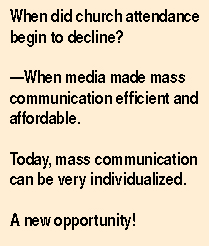
The sermon is the focal point of gatherings of the faithful. It was the most efficient way to reach people—back then.

Sermons were developed for people accustomed to listening to speakers. The pedestal was the norm. The pulpit made sense. These days, if you don’t grow up in the Church, your opportunities to listen to orators are few. As for the pulpit . . . people aren’t coming in once a week to stare at it any more. It’s easy to understand. Their listening caps are dusty!

The modern mind thinks differently. With all the information available to us, we’ve learned to process ideas in bite-sized pieces. We can wish this weren’t so, but it is. Very few people will listen to a 30-minute sermon and those that do drift in and out of attentiveness. This is natural, but listeners criticize themselves and interpret this as “they aren’t getting anything out of it.” They actually feel a little guilty and soon tend to stay away.

The Information Age brings new opportunities to connect and communicate. Pastors can be a daily presence in their congregation’s lives without anyone setting foot in a church building. They will have to learn the power of short and sweet. It will be a new expression of daily devotion. Effective communicators will hone their messages to 150 words. Pastors are in a unique position to do this with a local slant that will interest a following. BUT, they won’t be limited by geography!

This approach to preaching has more potential for growing a faith community than the dedicated weekly sermon delivered to only the most faithful.

You’ll need to tap into the web and social media, though. It’s there. It’s powerful. USE IT!

photo credit: Nick in exsilio via photopin cc

Is This the Beginning of the End of Organized Religion?

Generation X, Y and MillenialsReligion — at least the way it has been understood up until now — is facing a modern challenge. It has little to do with numbers. Numbers are just evidence of a major societal change.

It has to do with the way we are wired. Young minds — Generation Y and the Millenials — have known only an interconnected world. These connections were not organized for them by their parents or tradition. They were formed by each individual opting in and out of friendships, groups, and causes at will. More than that, these generations have been taught to use modern tools to initiate actions to address their sense of justice and righteousness.

The thought of joining a church, building trust, identifying a need, communicating the need, and then rallying volunteers and support to address the need is foreign to modern thinking. This is good! The old way is archaic and inefficient by modern capabilities.

Those of us still hanging on to the past may still value a well-run organization. We look for leaders who can work together to define goals and connect with people and resources to achieve goals. Our measure of successful participation is how well members obey and contribute.

Our children don’t care about “organizations.” They are not just avoiding organized religion. They are not joining Leagues and Service Clubs either. This is not a lack of empathy. They realize they don’t need to sign on as foot soldiers in a cause defined by someone else. They can create their own networks and contribute their passion their own way.

Independence from structure is just beginning to hit the Church, where structure is worshiped at the right hand of God. If the Church thinks we are going to come up with innovative programs to attract younger generations back into the pew to contribute to church community the way their parents or grandparents did, we are chasing a dream. An expensive, doomed to fail, dream.

The Church must redefine many of its core structures. This includes expectations of members. There is a lot to talk about. For now, we suggest reading this post from the Jewish Weekly as reposted in Rabbi Hayim Herring’s blog. Jews are experiencing the same challenges as Christians. We can learn together.

In a few days, 2×2 will start to explore the issues raised.

photo credit: Andrew Huff via photopin cc

More Pastors; Fewer Preachers

Let’s face it. One of the biggest challenges for small churches (and that includes most churches) is meeting the costs of professional leadership. Salaries and perks are the bulk of the budget.

At the first sign of financial distress, what do most churches do? Call a part-time minister.

What is the priority of every part-time solo minister? Preparing for worship and Sunday morning.

Often, that’s about all a small congregation can negotiate from their leaders. It is the frequent source of conflict.

Sunday morning preaching alone does not grow a church, especially when the sermon is delivered to only a few dozen part-time listeners. But the pressure on congregational lay leaders is to grow and transform or else, while all the congregation’s resources are tied up satisfying the salary requirement for a requisite pastor—whether that pastor is helping the congregation grow or not.

This must change.

Education is coming to realize that the responsibilities of teachers are changing. There is no longer any need for thousands of biology teachers working to craft a lecture on photosynthesis when just one expert educator can thoroughly cover the topic online, complete with visuals and links to enhance the lesson. This role can be competitive to ensure quality, but duplication in every school district is no longer necessary. The old model for education, born of pre-Information Age traditions, will soon be obsolete and recalled as quaint.

It is projected that the typical class day will flip. Listening to lectures will be the homework. Class time will be spent with instructors facilitating discussions, problem-solving and projects—what used to be called “homework.”

Similar changes will benefit the Church. Small churches do not have to devote scarce resources to pay theologians to craft a sermon on the same topic as a several thousand other pastors. This model belongs to the ages.

It may once have been necessary when information was harder to come by and many members were illiterate. As the economic model of Church shifted to totally monetary compensation, it has been pricing small churches out of existence. This is a shame. Small faith communities still hold the greatest number of total denominational membership. People like small churches. Soon, only the privileged will be able to afford to live in Christian community. The Church will have defeated its own cause.

Today, we need more pastors and fewer preachers. We need comforters, advisors, peacemakers, innovators, advocates, teachers and leaders. Knowledge of scripture and church teaching is still important in performing these roles. But the expense of dedicating one full salary to every congregation for the primary purpose of filling a Sunday pulpit is imperiling the entire Church.

If small churches are to return to prosperity, they need hands-on pastoring more than expensive preaching. Just as in education, the Church must turn its priorities upside down. Thoughtful preaching can be provided online and delivered by anyone who can speak well. Professional staff will free a day or two for hands-on interaction in the community.

This is already beginning to take shape. Luther Seminary’s online preaching helps (www.workingpreacher.org) is a resource that covers each Sunday’s lessons from the Common Lectionary. Many seminary professors from varying traditions comment on the lessons, helping to free the time of hundreds of pastors. 2×2 fashions both its Daily Devotion and the weekly object lesson from this online discussion.

Meanwhile, online preaching is being honed to an art. The temptation for many preachers is to post their ten-page sermon manuscript on-line. These do not fit the habits of online readers.

Online preaching must conform to the new rhythm of modern life. Pastor Jon Swanson broadcasts a short devotional reading daily and elaborates more fully in his blogs. 7×7 (very short daily devotion) and 300 words a day (a longer—but still short—daily blog lesson). He is growing an enthusiastic following — including 2×2.

All of us pioneers in the social media world have analytics at our fingertips. We can test and hone our skills, using actual data. Pastors preaching in sanctuaries have to guess and wait a week to correct their course.

The role of ministers must change if ministry is to remain affordable to most congregations.

Now would be a good time to start.

Imagine: A New Church for the New Age

2x2 is merging the First and Fifth Estates.The Church of the last five decades is doomed.

But that it is good news.

We have spent these post-World War years of prosperity building a model for success that only a small percentage of congregations can hope to sustain. Many congregations exist and serve amid this atmosphere of hopelessness. It is not uplifting.

There is no need to wallow in this failure, pointing blame at the people, society or the clergy.

It just doesn’t matter. The model of Church as contained in a building and managed by a person trained in theology is about to be replaced. It’s long impending doom is at last being recognized. It was born of an era when the larger church controlled wealth and a feudal mentality, providing for its support, was ingrained.

When we found ourselves living in capitalist, industrial, corporate economies, it all began to crumble. The maintenance expenses exceeded the means of the communities we intended to serve. People became less and less engaged as more and more was expected.

No need to mourn this passing! What is going to evolve is going to be so much better!

The changes will be enabled by the First Estate (the Church) harnessing the power of the Fifth Estate (the web).

Imagine.

Here are just a few ways the Church is going to be transformed.

STRUCTURE

OLD: A hierarchy manages all education, communication and publishing, assuring that doctrine and tradition are maintained.

NEW: Congregations will seek help beyond denominational lines. It will be readily available to them online at a fraction of the expense.

OLD: A hierarchy oversees the placement of qualified leaders, with long “settled” ministries being the measure of success, making sure their salaries and benefits meet prescribed standards. Meanwhile, these desirable, settled congregations are constantly urged to “transform.”

NEW: Congregations will forsake the single pastor model as poor use of their resources. They will seek qualified help for specific short-term challenges and form ongoing relationships with several pastors. Flexible teams of ministers will serve without affiliating with any one congregation.

MISSION

OLD: A centralized office seeks theologically trained candidates, immerses them in a culture, provides additional training, and places them and their families all over the world. Congregations participate by giving offerings. Missionaries return every few years and make a tour of congregations to solicit continued support.

NEW: Individual congregations will begin to make contact with like-spirited Christians all over the world online. Denomination will be reflected in their actions not in their management. Many members will correspond, share and pray for one another with weekly engagement. Members of all ages will be online pen pals with multiple Christian fellowships. Eventually, congregations will raise money to send a few members of the congregation to visit, strengthening bonds begun online. The network of online churches will crisscross the world.

WORSHIP

OLD: Large structures with a dedicated building, common liturgy and accepted “playlist” of hymns is replicated across the country every few miles. One certified theologian is given status to repeat the words of our Lord from the Bible. Church members participate in assigned roles. Their names are listed a month in advance in the bulletin.

NEW: The structure of worship will embrace many cultures. Multiple church members will lead. Sermons will be preached online by the best articulators of the Word. Local discussions will elaborate on the Word. Members will become accustomed to weekly, spontaneous participation. Published liturgies and hymnals will be passe.

EDUCATION

CURRENT: Sunday School begins at age three and ends at age nine with desperate attempts to fill in the gap between childhood and old age with confirmation, youth ministry, singles clubs, and adult forums, following expensive curricula supplied by church hierarchy. Less than five percent of the congregation participate.

NEW: Churches, via their web sites, will link members to meaningful online forums, supplementing them with local engagement either online or in church. Short daily learnings will replace hour-long classes. Congregations linked online will share their resources and traditions.

STEWARDSHIP

OLD: Church members are encouraged to pledge to the maintenance of their building and sustenance of their clergy. Regional bodies, seminaries, and various social service entities within the church beg for additional funds. The national church adds to the appeal for dollars supplied by the same small pool of people.

NEW: Church buildings will have to multi-task their usage in the community to afford their cost. Many communities will rent or borrow appropriate space in the neighborhood. Regional bodies will provide fewer direct services. Their staffs and budgets will be trimmed substantially. Church social service agencies will completely abandon church affiliation as they recognize that cord was cut when they began seeking public funding. Congregations will choose to support service agencies that resonate with their sense of mission, regardless of their affiliation with religion. This will be an opportunity for church members to personally witness in the secular environment.

CHURCH MEMBERSHIP

OLD: Members are expected to attend worship regularly and to live within an easy commute of a church building.

NEW: Members can be anywhere in the world and participate in community online. Online statistics will be published along with membership and giving numbers.

TODAY

Much of this is already happening. 2×2 is part of this evolution revolution and already experiencing many of these transformations.


First Estate, Meet the Fifth Estate: A New Reformation

The Fifth EstateIn the Church, we are still shaking off the dust of the Middle Ages. Back then, as always, there was a crying need to organize society, partly due to unparalleled spread and power of Christianity.

  • Who would have the power?
  • Who would control the wealth?
  • Who would protect the wealth and power?
  • Who would pay for everything?

There was tension between church leaders and the people they relied upon to protect their impressive assets. This ragtag group of warriors would be most effective and reliable if they were given some official status and a smidgen of power.

Somebody came up with the idea of “estates.”

The First Estate included the clergy. They controlled much of the wealth, demanding contributions of the faithful. They paid NO taxes.

The Second Estate included the warriors that were to become the nobility. They were willing to risk their lives to protect the Church, and so, they were allowed some very nice tracts of land and the power to get the general population to work for them. They paid NO taxes.

The Third Estate was everyone else—about 97% of the population. THEY paid taxes.

As for upward mobility—it was next to impossible to enter the Second Estate by any means other than birth or marriage. Is it any wonder that there was no shortage of clergy in the Middle Ages?

Then came the printing press. The Fourth Estate was born. It was soon recognized that anyone who owned a printing press held power that had to be respected (and controlled, if possible). The press became the Fourth Estate.

Along came America and the power of the press was given constitutional protection.

Today we stand at the threshold of new possibilities and the birth of the Fifth Estate. The term seems to have started in Canada, referring to the media. It is evolving to include the power that lies in the hands of millions of unfettered individuals (the same 97% who have been supporting the power structure of both Estates One and Two for a thousand years).

Enter the power of the blog—The Fifth Estate.

This is a new form of power— a bit like the press but rawer and more independent, uncontrolled by any structure and empowered as much by the low cost as the technology..

  • Blogs are available to all.
  • Blogs do not require wealth and backing.
  • Blogs can create their own following.
  • Blogs are immediate.
  • Blogs have no cumbersome internal power structures.
  • Blogs are not restricted by the costs of print, marketing and circulation.
  • Blogs are not beholding to advertising for revenue.
  • Blogs are controlled by everyone’s ability to respond if they disagree.
  • Blogs are protected by the same Bill of Rights that protects religion and the press.

Anyone can become a thought leader in this new world. You won’t need a title or fancy degree.

The Fifth Estate will outpower every other Estate.

We have already seen the Fifth Estate affect government and international relations—swaying elections, inciting rebellion, changing the world.

We are beginning to see the Fifth Estate change education with free and easy access to course material once available only to the privileged.

Business has changed. Publishing has changed.

Will the Fifth Estate change the First Estate—the Church?

It will…if we start using the power at our fingertips.

The Church’s resistance to change—which begins at the top—will hamper it. Leaders will try to protect the status quo, which is their expertise. They will continue to rely on outdated communication techniques—20-minute sermons in cavernous, empty sanctuaries, newsletters filled with fluff, feel good web sites that invite little interaction or thought leadership.

One day soon, the power of the Fifth Estate will force open the doors and windows that have been sealed for centuries. The change is not going to be dictated by the seminaries or bishops or even the clergy. It is going to come from the bottom up and it is going to be truly transforming.

Are we ready?

photo credit: BottleLeaf via photopin cc

Low Expectations and the Under-achieving Congregation

Science documents that expectations play a powerful role in laying the groundwork for success.

Good parents know this.

If we expect nothing of our children, they are likely to fail. Expecting failure takes less effort.

If we expect great things, we go to work for our kids. We cheer for them and help to create the conditions for success. We are not surprised when they change the world.

The same science works on adults and in communities. Jesus did his best to build up the people he encountered. He loved them. He showed them he understood them. He challenged them. He gave them the opportunity to fail. He showed them how to pick up the pieces and try again. That’s the training by example that he gave his disciples.

Many church leaders today have given up on the Church. They look through the statistics and see declining attendance, membership, and giving. So sad. Too bad.

A prevailing attitude among today’s church leaders is to accept failure as the norm. Bishop Burkat even recommends doing nothing to help small churches in her book, Transforming Regional Bodies.

The malaise is contagious—and deadly.

Redeemer will never forget Bishop Burkat’s first visit to Redeemer in December 2006. Bishop Burkat likes to claim publicly that she worked hard with our congregation for an extended period of time to no avail. This is what really happened.

It was a study in the power of low expectations, fueled by prejudice.

She walked into our Fellowship Hall. Gloom filled the room.

No bishop had visited Redeemer to talk with our leaders in nearly a decade. In 1997, Bishop Almquist came to break the 18-month term call (contract) he had made with us and one of his staff members just three months earlier. We were bitterly disappointed. (Bishop Burkat likes to claim that Bishop Almquist worked long and hard with us, too, but he was largely absent and he confiscated a sizeable amount of our money for two years.)

We went without a pastor for a year after that and for most of the following decade. Our lay leaders had worked hard to find ministry solutions on our own with mixed success. Still, we were enthusiastic about our prospects, especially since things seemed to be poised for significant change.

The memory of synod’s abandonment was still fresh for our leaders if not for the many new people who had come to Redeemer. We weren’t sure what to expect from the newly elected bishop, whom none of us had met, but we came ready for a fresh start.

It didn’t take long to dash our hopes. Bishop Burkat greeted us with what sounded like a rehearsed string of criticism.

She walked into the equivalent of the living room of our home and complained that the place looked junky. “No visitor will want to return to a place that looks like this.”

We explained. Epiphany, a neighboring church whose building was condemned, had just moved their things out of storage and into our fellowship hall. We were trying to help our neighbors.

We moved on.

Next. “You have no parking lot,” Bishop Burkat noticed. “A church with no parking lot has little chance of survival.” Our Ambassador visits have proved that the size of the parking lot has nothing to do with attendance at worship, but we answered defensively.

We pointed out that parking at Redeemer had never been an issue. The school and library, which share our intersection are closed on weekends and in the evenings when most church activity takes place.

The conversation continued.

Churches have personalities, Bishop Burkat said, with the clear implication that Redeemer’s personality left something to be desired.

What could we say? We turned the attention to our ministry efforts. We talked enthusiastically about the number of East Africans who were showing an interest in our congregation and the multi-cultural environment that had been fostered by one of our part-time pastors. We wanted to continue in this promising direction.

Bishop Burkat said a puzzling thing, “You are not allowed to do outreach.”

Huh? Say that again.

We told the bishop that we were disappointed in SEPA’s treatment of our ministry and very hurt that Bishop Almquist terminated our call agreement for his own convenience. That was a pivotal loss (by design, we think) for lay people to overcome, but we rose to the challenge.

The meeting ended abruptly. The bishop had a serious family emergency and we urged her to go to be with her family. Bishop Burkat promised to schedule a meeting in three to five months to talk about our concerns and try to heal some wounds. (Never happened,)

We sighed with relief when she was gone.  She exuded negativity. We were glad that only our key leaders were at that meeting. Her attitude would have dragged down the entire congregation. It would have undermined all the work we had done.

Our next encounter with Bishop Burkat, eleven months later, was similar. There were more people present. Redeemer had grown significantly during that 11 months of neglect, accepting 49 members! We came to that meeting with our recently completed 20-page ministry plan and with a resolution to call the pastor who had been serving us for about seven months.

Bishop Burkat began this meeting by ranting that Redeemer was “adversarial.” She used that word repeatedly in her opening statement. We still don’t understand her wrath!

The rant was undeserved. Only three of the thirteen people present had met the bishop before — two of us briefly, a year before. The third was the pastor we hoped to call who had been a member of her seminary class. All but two had joined the church within the last 10 years and knew nothing about ancient problems, which synod seemed ever-ready to resurrect.   

The meeting lasted more than two hours and we were able to turn the tone around, ending, we thought, on a very positive note. The bishop promised we could work with her newly appointed mission director, Rev. Pat Davenport. Our people began to sing a hymn together as we rode down the elevator and crossed the parking lot. We were excited and united.

And then NOTHING happened.

After four months of silence, including numerous unreturned phone calls, we all received letters from the Bishop announcing she was closing our church.

We wonder how many other churches have experienced such low expectations from leaders.

If this is how every church is treated, it is no wonder there is so little progress.

Our leaders have no faith in their message.

They don’t seem to care about or even like the people they serve. They don’t model their teachings about peace, repentance, forgiveness, reconciliation, love, justice, humility, or transformation (though they talk about this a great deal).

Pastors and congregations soon begin to avoid the regional body. They may even fear it.

The only transforming that takes place is destructive.

What would happen if we expected success—if church leaders went into congregations and asked one question: “How can we help you serve?”?

What if pastors—and bishops—were held accountable?  

What if we believed in the message we preach?

All things are possible.