A recent study of social media reveals that there are four main barriers to the implementation of Social Media in organizations.
They are:
Lack of knowledge and understanding
Fear
Absence of a model to follow
Unprepared leadership
The Church as an organization should study these barriers if we are to overcome them.
Each fear can be overcome. We will address each fear broadly now and later in more depth.
Lack of knowledge and understanding
The Church is no different that any other organized entity. We are facing a new world with enormous potential. We are all novices at how this new media works and we are uncertain as to how it will affect us and our mission. Scary!
Fear
There is always the fear of abuse. This is nothing new. Religion has had abusers in the past and the Church has moved forward regardless. Social Media may actually overcome some of this. It is entirely open platform. Participants lay their hearts on the line and others — anyone — can respond.
The biggest fear is not about abuse but in facing the changes that are necessary to implement Social Media. Are we prepared for the changes that are likely to happen? How do we proceed?
Absence of a model to follow
There are models to follow, but they are not necessarily in the religious realm. Until the Church adopts Social Media as a viable tool, it must follow the models of the secular world. (We might learn something in the process.) There is no way around the fact: someone has to create the first model.
Leadership
Church leaders are busy being church leaders the way they were trained to be church leaders—anywhere from one to sixty years ago. This new tool is outside the experience and comfort level of many.
The Church must recognize that leadership in Social Media may come from the bottom up. Lay people are likely to have mastered these skills while clergy were studying Greek! Both are valuable! It doesn’t do much good to understand the Gospel and then ignore the tools that will help you share your understanding.
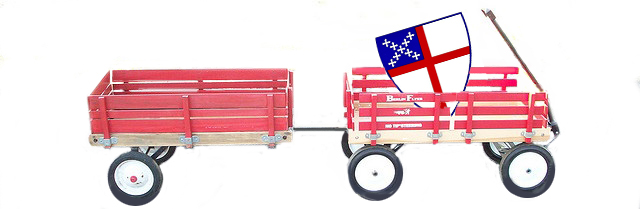
The ELCA hitched its star to the Episcopal wagon a number of years ago and announced with great hoopla that we are now in full communion. (Called to Common Mission)
Lutherans were promised that the alliance was for flexibility, broadening the resource pool. Lutheran clergy and Episcopal priests could now vie for calls and employment in either denomination.
But it has resulted in more fundamental changes. It is changing the way we think and act, which isn’t necessarily bad. But it’s not necessarily good either. Martin Luther left a good legacy.
The ELCA and its predecessor bodies are historically a broad demographic with both low and high church values represented, often among ethnic or cultural lines. The American experience, which never answered to the Archbishop of Canterbury or any European figurehead, has traditionally no such loyalty to hierarchy.
The Lutheran tradition of congregational polity is a strength which small congregations should never be asked to sign away. Small churches must be free to adapt to their changing communities. This is harder to do under hierarchies. Hierarchies understand “big.”
Did the decision, advocated mostly by clergy, change our polity? No, but . . .
Are there statistics on how much this has benefited anyone?
How much resource sharing has been going on? (There doesn’t seem to be a lot of resources for either denomination to share!)
It is becoming increasingly clear that dissenting Lutherans were correct about many things.
Lutheran leadership has become more and more hierarchical. It began with a shift in language, then in behavior.
Lay people don’t tend to care much about things like apostolic succession. We know that our bishops (which we used to call more appropriately “presidents”) are elected. Now every Lutheran clergy to be ordained must submit to Episcopal approval. Many of them have probably never set foot in an Episcopal church, but now their calling needs their blessing.
From reading this report, it is clear that we have sacrificed the wisdom of our experience to a troubled denomination.
The Episcopalians are so concerned that some want to scrap their leadership structure entirely, realizing they cannot support, nor do they need, a hierarchy. We have written about this before.
Meanwhile, Lutheran leadership is separating itself from its constituency more and more. They are planning to have full church assemblies every three years instead of two. If they operate like our local Synod Assembly, it won’t matter much—and that’s too bad. The regional assembly is fairly well orchestrated to get the approvals it wants with as little discussion as possible. But at least there was a chance of making a difference every two years. But then, maybe this is an admission that the hierarchy has less purpose.
Regardless, the action serves to alienate lay people — who still provide the support and funding for the mistakes made by the hierarchically minded.
Soon, if Lutherans want to rise to a call to change anything, they will have to wait three years. This may save money but it is unwise. Change is happening at a faster pace. More forums are needed, not fewer.
But the deed is done. We are in full communion with a denomination that doesn’t know where it is headed to the point that some talk about starting over. Have we been set up for a bait and switch?
If you think this shift in governance isn’t part of SEPA’s attitude toward small congregations, think again. In East Falls, Bishop Claire Burkat was assisting our Episcopal neighbors—we suspect for hire—while trying to destroy her own denomination’s church a few blocks away, hoping for assets to make up their huge deficit. The Episcopal Church in East Falls was of no stronger number than Redeemer with a far less desirable location for mission purposes. Bishop Burkat gave the Episcopalians of East Falls more consideration than the Lutherans.
Our Ambassadors read a flier advertising a church’s upcoming Vacation Bible School. It advertised classes for children up to age 10. Fourth grade.
Ten!
Ten is still fairly young to be the cut off age for the type of program VBS can be.
Many adults remember very little of their childhood before the age of eight. When these children become parents in another 10 or 15 years, they will have little to remember of Bible School to want to pass on to the next generation.
When Christian education stops at age 10, you end up in a few years with a church of unknowledgeable members—and probably a lot fewer of them. These unknowledgeable members will be expected to lead the church and vote on ministry decisions both within their congregations and in the broader Christian community. Without a strong church education, they will be puppets of the strongest influencers. We will become a Church of followers.
Why is age ten the cut off?
The easiest answer is that’s the age when children become involved in other activities.
But that’s the easy answer. There are other reasons. Some of them involve the Church’s inability to serve this age group.
Admittedly, the Church competes with a broad spectrum of organized activities for older children. It would be a shame if we were abandoning our youth’s faith because we have nothing to offer.
Children, still under the influence of parents, will find time when the family sees Christian education as a priority and when the educational experience meets their developmental needs. It is not acceptable to turn our backs on youth because we don’t know how to serve them and are unwilling to find a way.
Here are the challenges:
Older children are more work! Ten or eleven is the age that children are starting to come into their own and are more difficult for inexperienced volunteer teachers to handle. If we can’t train volunteers to work with our youth, we must find them. (See VBS-Aid concept).
It’s also the age when learning must become experiential. Older children cannot be confined to classroom talk. They must be challenged.
If churches want to continue to nurture youth beyond the age of ten, they must create learning environments and experiences that meet the children where they are developmentally.
The challenge of teaching older children requires more time. Older children must participate in a program with a sense of accomplishment or they won’t return.They must be free to experiment and discover their abilities. Middle School teaching is known for being hands on. A summer program for youth requires more than five days.
Older children need camaraderie. They want to be part of groups. Five day Bible Schools are not long enough to create a sense of community unless the activity is more intense than a classroom atmosphere usually allows.
Children this age need to be silly. We expect them to try new skills. They are self-conscious and prone to taking themselves seriously. Church education for children this age should give them a chance to laugh at themselves and just open up. Allowing them to be silly gives them a soft place to fall.
At times, children this age need to be dealt with in subdivided groups. While this goes against modern inclusive thinking, other fields are meeting the challenges of interesting youth by developing some separate programming along gender lines. One reason sports is perennially popular for this age is that sports recognizes this need. The music and art world is discovering that boys become involved with enthusiasm when they are not with girls. Ask boys this age to sing with girls and you will get very few volunteers. Allow them to sing with just boys and they sing with an energy you would never see in a mixed chorus. Here is a video posted by one proud teenage boy singer. Boys-only ballet programs are cropping up and improving enrolments. Here’s video about boy dancers. Giving girls a chance to bond as girls has similar benefits. They are maturing at a different rate and may need a forum for what’s on their minds. The challenge is to make sure that their time together is enhancing their potential not excluding them.
Programs that separate boys and girls find that when the groups merge (which should be often) there is greater involvement among both boys and girls.
Churches rarely take the time to consider educational developments like this, but there may be something for us to learn.
If we want our young people to continue their church involvement into adulthood, all congregations must address the challenge. To assume lack of interest on the part of young people without any effort to interest them is short-changing them and our future.
2×2 invites small churches to join this page and share ministry experience—not just successes but ideas, criticisms, problems and challenges. If we don’t talk about things, how can we improve?
(If you’d like to join, send us your story. There is no cost and no money changes hands. We share our experiences, ideas, and pray for one another.)
Five churches have been part of our exchange in our first year. In this post we will spotlight their exciting ministries.
SPOTLIGHT on Glory of Pentecost in Eastern Kenya
Glory of Pentecost’s leader, Silas Kadenga, first wrote to us last spring asking us for help with their Vacation Bible School. They had read about our idea for helping small churches restore their summer outreach efforts. Their first email did not give their location. We started asking questions. We were surprised to learn they were in eastern Kenya. Our first reaction was there was little we could do to help. Our program was focused on the USA and even more locally. But we kept firing questions. The responses revealed a very different ministry scene than anything we expected.
How many students do you expect? Do they speak English? How many teachers do you have?
The answers: About 200 students. Most speak English as a second language. Three teachers and a few more that show interest but need training. Their obvious need was training for teachers and for resource material.
We pointed them to some free resources on line and kept in regular touch.
Today, their pastor sent us a notice of a new program and asked that we help publicize it.
Please join us in prayer for their new ministry.
Welcome to The Silas Faithfull Foundation
The Silas Faithfull Foundation (SFF) is the only Kenya-wide child protection charity dedicated solely to reducing the risk of children being sexually abused. We work with entire families that have been affected by abuse including: adult male and female sexual abusers; young people with inappropriate sexual behaviours; victims of abuse and other family members.
Drawing on our expert knowledge about child sexual abuse we offer a broad range of services for professionals and members of the public. These include: assessments, intervention and treatment of known offenders, case specific advice and support, training and development courses and workshops, educational programmes for internet offenders and their families, circles of support and accountability and internet safety seminars for schools (teachers, parents and children).
In 2009, The Silas Faithfull Foundation established the prevention campaign, Stop it Now! Kenya East Africa which supports adults to protect children through providing information; educating parents, carers and other members of the public; training those who work with children and families and running a Freephone confidential helpline_+254 708 403 409 +254 707 434 093_silasabali@yahoo.com More information Stop it Now!
Through that we are looking forward to request your Support for this Organization to continue to Help more people all over the world your support of Prayer will make our Vision and Mission to be complete
Together We Can Change the World
Message from founder of Silas Faithfull Foundation Kenya-wide
SPOTLIGHT on Kiorori Church in western Kenya
Simion Sagwe and his wife, Florence, have been caring for a number of widows and orphaned children in Kisii District, Nyanza Province, Kenya.. They work hard to feed and clothe them and find the money for their medical care and schooling.
We sent them a recording of a little song we thought the children might enjoy. They wrote to tell us that they learned the song and sang it in church. Now they sing it all the time. Meanwhile, back in East Falls, we often use the hymn in worship as well!
Simion has been traveling to attend classes at a Bible College. His wife is making jewelry in hopes of starting a cottage industry to support their mission work. We may be able to help their efforts. We will work on that.
We get weekly reports of their Sunday services and walks through the village afterwards to interest new people.
SPOTLIGHT on New Life Fellowship in Faisalabad, Pakistan
Pastor Sarwar Sadiq writes to us daily, sharing Bible verses and reports of his ministry. He wants to learn as much as he can about our church and writes his prayers for us, asking about our members by name. He describes the difficult mission of growing a church as a minority religion and the effect it has on their families and their children in school. He sends many photos of their ministry.
Their internet service is iffy and we are going to try to help them by setting up a mirror service on our site.
They have a vibrant ministry in their neighborhood but take mission trips into more remote areas to spread the Gospel. The above photo is from one of their mission trips.
They pray for better and affordable space for their ministry.
SPOTLIGHT on Prince of Peace, King of Prussia
Prince of Peace is a small, suburban congregation near Philadelphia. They happen to be the first congregation our Ambassadors visited two summers ago. We have stayed in touch and tried to help them with some projects.
Their current project is called “No Family Left Behind.” It aims to reach all families with worship and learning opportunities, including families including elderly, disabled, or children with learning disabilities. They are partnering with the Community Center directly across the street from their church and with Ken-Crest, a Lutheran Social Service agency.
They plan to make iPads available to help people with disabilities communicate, read, and take part in activities. The Rev. Dr. John Jorgenson, a retired pastor serving the congregation, has drawn on his years of service with the LCA in developing curriculum to develop the innovative program.
SPOTLIGHT on Redeemer, East Falls
Much of this web site talks about Redeemer’s very active ministry so we’ll list just a few.
Redeemer Ambassadors visit churches
2×2 Foundation pioneers Social Media Ministry
Maintaining a Lutheran presence in East Falls
Staying active in East Falls organizations and government
Working to maintain Lutheran congregational polity by challenging actions of SEPA Synod
The Christian Church has recently focused on the Gospel account of Jesus sending his disciples into the world 2×2.
Jesus’ concept of mission was built on exponential growth. If two people are each successful in reaching two people — for a total of four — and they in turn form teams of two reaching four more— that’s exponential growth. The effort and cost must be repeated again and again. The church will grow with hard work and dedication.
This was remarkably effective. Within a few hundred years, the Gospel spread to the farthest borders of the known world.
Scalability is a bit different. It is a term that centers on the power of technology. How can teams of two reach a thousand or more people using the same effort it takes them to reach four?
The answer is incalculable—and entirely possible. The tools are in our hands to make mission work scalable beyond the wildest dreams of the early Christian apostles. The same work required to reach or teach 100 people can also reach or teach a million for basically the same outlay of resources.
So why aren’t we doing it?
Roadblocks to Scalability
Sadly, the church is not set up to take advantage of scalability.
Try this, for example. Take an idea to a religious institution. They will have a great deal of difficulty thinking beyond their own constituency. “But don’t you see,” you might argue, “you have the power to reach beyond your congregation, beyond your geographic territory, beyond your denomination.”
They will respond with confusion. “But it’s our job to serve our constituency. We work for [name the regional entity.]”
They will try to be helpful. Scratching their heads, they will suggest, “Take your idea to [another territorial constituency that might be a bit bigger]. Maybe they can help you.”
Any denomination can reach congregations and clergy of all denominations all over the world with truly helpful information—all for the same effort that they might put into a local symposium or workshop which they would charge 50 people $25 each to attend. They won’t, though, because tradition outweighs potential.
Oddly, the efforts to take advantage of the power of the internet are not coming from the higher echelons of the Church. Many regional web sites are of poor quality and virtually all are self-focused. Some of the flashiest regional web sites focus on only their own work—not the work of their members. They are ignoring the potential to strengthen community. They are also ignoring the potential to reach the unchurched — which is their mission.
Church leadership is accustomed to publishing and teaching coming from top down. There was a time when this was necessary. Not everyone owned a printing press and distribution system. There grew to be a comfort in the control which was part of this outdated system. Because control was once possible in publishing they mistakenly believe that it is necessary. It is not only unnecessary in today’s world; it is impossible.
The system of the past is clumsy and archaic, but the Church’s entire structure is built around it.
Smaller entities—individual institutions, small congregations and even individual church members are making stronger headway.
Examples
One example, www.workingpreacher.org, a project of Luther Seminary, features guest theologians from many backgrounds, analyzing the weekly lectionary. Directed towards pastors, anyone can study the week’s scripture guided by the insights of a seminary professor.
Another: ministry-to-children.com is a web site started by Tony Kummer, a youth/family pastor. It is a lively, interdenominational exchange of ministry ideas and resources that has a large community participating and helping one another. A small church in Africa asked for 2×2’s help in finding affordable educational resources. We directed them to this web site and they were delighted!
Jason Stambaugh writes a blog, www.heartyourchurch.com. He is an individual layperson who works in social media and is a member of a small congregation. He writes about social media in the church and other church issues.
A college student in Texas, Virginia Smith, has used the internet to help small congregations access used Vacation Bible School resources. She’s just one young person passionately engaged in mission, armed with the web. (www.vbs247.webs.com/) Virginia has been very helpful to 2×2 in networking.
And then there is this site, 2×2, the project of Redeemer Lutheran Church, East Falls, Philadelphia, a church the Lutheran denomination (ELCA) determined was too small to fulfill its mission (the old-fashioned way). Three years after locking our members out of our church building, 2×2 is reaching more than a thousand readers a month with a significant local readership with global reach. (And we are just beginning.) We offer ideas for small church ministry and attempt to prompt dialog on small church issues.
Scalable projects are our passion—not to make vast amounts of money, as is often the aim of online enterprise, but to build an new infrastructure that will provide hope and help for neighborhood ministries that we believe are the strength of the Christian Church. We believe there is fiscal potential that would provide the hands-on resources to neighborhood churches that can’t afford them the old-fashioned way. (And this is a large number of churches!)
Meanwhile, denominations concentrate on building Christian communities of a certain number so that they can afford a pastor/building and support their regional and national denomination.
This is not scalable. And it is failing. But it’s still how the Church measures success!
The Church has fostered some brilliant creative minds. Martin Luther and Johann Sebastian Bach are ancient examples in the Lutheran tradition. Modern Lutherans even like to take credit for Steve Jobs. His boundless creativity outlived his association with the denomination.
He was probably not alone. The Church is starting to recognize that creativity might be needed to meet the challenges of mission in today’s world. But old habits die hard.
At the heart of creativity is the ability to solve problems. You’d think the Church would be clamoring for creative minds!
Churches like to talk about rebirth and transformation. These desirable qualities will only take root if creativity can blossom. Too often the lauded rebirths and transformations are short-lived. That’s probably because they were engineered for short-term success—an ephemeral way to meet old-fashioned goals—not the product of true creative thinking. “Look, we’ve done the same thing we’ve done for a hundred years one more time!”
Creative thinkers soak up ideas from anywhere and everywhere. They have to surround themselves with things, ideas and people who are different. It is as necessary to their existence as water.
Creative people juxtapose the eclectic. They find in the clash of differences the spark that launches the new. They are usually surprised that other people can’t see what they see — at least at first.
Creative people who insist on using their gifts are often a threat to the status quo and seen as unable to “get along.” Getting along is important to church leaders. Often the discomfort at the presence of friction is a startling revelation to the creative mind. They thrive on friction.
What does the Church do with creative minds? We tend to give them jobs that display talent but not creativity. They become, for example, pastors who do the pastor thing or the organists who do the organist thing. What the Church is looking for is people who can fill jobs they have already defined, sometimes with exceptional flair, but often, just so-so is just fine.
Revelation: some creative people can’t preach or play the organ! These are skills. Creativity is its own skill.
Consequently, change comes about very, very slowly. The temptation to revert to old ways at the first sign of creative discomfort is a magnet. Put a drum set next to the organ, but don’t get rid of the organ!
Creativity is always a bit discomforting!
That’s why creative people don’t go to church. What is most important to them as part of God’s creation is of little value.
Traditionally, it is a goal of church management to foster long-term bonds between a congregation and one leader. These long-term pastors are called “settled” pastors.
That a settled pastor is desirable or necessary for a healthy congregation has been a relatively unchallenged concept.
Expectations are in conflict with reality from the start. The length of most pastorates is less than seven years.
Unrealistic expectations may be a root source of decline in the church.
Settled pastors evoke a caretaker image. You have a community of people who go happily about their lives, knowing that a pastor will be there to nurture the young, guide critical life decisions, celebrate life passages and hold hands in times of crisis.
But so much involving church mission is unsettling. Mission requires leaders who can strategize for change, respond to a crisis (the earlier the better), introduce the unfamiliar and shake a congregation’s sense of complacency.
The Church’s desire for long-term pastorates has created a new job title—the interim pastor.
The concept of interim ministry is to provide short-term leadership—which in the Church can mean one or two years—to help a congregation assess their ministry as they seek a new long-term pastor. Does it make sense to place a pastor for one or two years to prepare a congregation for a pastor who is likely to stay only three or four years?
Interim ministry is described as a time for putting aside affection for a departed long-term pastor (they actually use the term “grieving,”), restructuring and goal-setting.
Affection for a pastor is assumed by Church leaders. You can only measure the people who come to church. Even the best church analysts cannot count the people who stay home because of dislike or opposition to a pastor. Yet, this is a real part of congregational dynamics. So while Church leaders assume the congregation is grieving there may be a strong faction that is welcoming change and raring to go!
The concept of interim ministry was first fashioned to deal with congregations who face unexpected change in leadership (sudden death of a pastor, pastoral wrong-doing, or church conflict). It has grown to become almost compulsory.
This managerial goal may be in conflict with a congregation’s ultimate goal — mission. The Church exists in community to worship and serve God.
In a world where communities are totally restructured every decade or less, seeking a settled pastor may be undesirable, if not impossible. Yet, we still expect it, leading to a broad misconception that if a congregation has a series of short-term pastors that there is something “wrong” with the congregation. Short-term pastorates may actually be a sign of vitality!
The modern church must train all pastors in “transition” skills.
Maybe the new expectation of congregations should be mission-oriented, short-term pastors. After all, every pastor is interim — some just longer than others!
Today there was a celebration in East Lansdowne, a Philadelphia suburb.
Over the past seven years, the aging Lutheran congregation, Immanuel, found new life by hosting a community of African immigrants led by a pastor, who himself had immigrated from Liberia.
They named their community Faith.
Today they officially merged with the remnants of Immanuel to become Faith Immanuel. Congratulations to the new congregation, its lay leaders, and Pastor Moses Suah-Dennis.
Tuesday’s Inquirer carries the story and quotes the previous bishop of the Southeastern Pennsylvania Synod (SEPA), the Rev. Roy Almquist, who is ready—even in retirement—to take credit for the new congregation.
In a telling quote he reveals SEPA policy.
“Under normal circumstances, you would close a church that size,” Almquist said. “But they were determined not to close. They wanted to find a way for their church to minister in a changing neighborhood.”
He does not say who the “you” is who would close the small church. Constitutionally, it is the congregation itself that must vote to close.
In 2005, as Bishop Almquist was nearing the end of his second term, he recommended the arrangement which lead to the congregation’s merger.
At the same time, there were other opportunities beating relentlessly on his door that he just plain ignored. His inaction has been costly to his synod and to the neighborhood of East Falls.
East Lansdowne’s story is similar to that of Redeemer, less than ten miles away. The only difference is that Redeemer did not have to come crawling to SEPA, begging for help. In fact, Redeemer had more money than SEPA at the time Bishop Almquist was trying to help little Immanuel. In 2005 —and much of Bishop Almquist’s two terms — SEPA was in severe financial crisis.
Redeemer was every bit as passionate about “staying open” and had nearly four times as many members as Immanuel. Why help East Lansdowne and refuse basic services to Redeemer?
Redeemer had received a large bequest in the late 1980s and SEPA had eyes for it, actually withdrawing $90,000 from our bank account in 1998. Redeemer protested.
This conflict was unnecessary and fateful. Redeemer was left with a reputation of being “trouble.” Few Lutherans take the time to analyze the source of the trouble or to ask themselves what they might do if the Synod visited their bank without their knowledge.
SEPA returned the money (after two years of needless conflict with Redeemer) but refused to serve the congregation from that point on. Their strategy was to wait for Redeemer to die a natural death. Bishop Almquist’s message was clear: Do things my way or else. Redeemer was shunned.
Bishop Almquist refused to help the congregation find a pastor to call. Redeemer was left to fend for itself.
The rest of the story is not at all unlike Immanuel’s. Immigrants from East Africa began to join the little neighborhood church—first one family, then extended family, then friends. Redeemer found two pastors, both from Africa, willing to serve the congregation.
Having received 49 new members with many more interested, Redeemer approached the new bishop, Claire Burkat, and asked to call one of the pastors.
Bishop Burkat’s head was buried in Bishop Almquist’s play book. She took no time to consider that things might have changed since Bishop Almquist deserted his duty in East Falls.
She reviewed our reports with prejudice fueled by a six-figure deficit budget. She decided that only our white members should be counted. She assigned trustees who reported falsely that the congregation had just 13 members. (In court they are trying to hold us to a quorum for more than 70.)
Bishop Burkat pontificated, “White Redeemer must be allowed to die. Black Redeemer, we can put them anywhere.” Destroying Redeemer was the priority — not mission. She set things in motion to force the church to close. It has now been locked for nearly three years.
Why not reward success?
The answer: SEPA was passing massive deficit budgets fairly routinely, relying on closing churches, seizing assets and selling property to make up shortfalls. Redeemer was known to have money and a valuable property.
We celebrate the successful union of Faith and Immanuel and wish them the best.
However, a wise church would also review its failures. The concurrent neglect and harmful policies practiced in East Falls are routinely swept under the rug as if the mess was all the fault of the people. This is wrong and innately dishonest.
There was a song taught to children back in the 50s or 60s. It taught us to think of ourselves as missionaries.
Just around the corner lives a stranger child.
Did you smile at him? Were you kind to him?
Did you tell her of the one who loves us so?
Father, Comforter and Friend.
( I updated the lyrics to include the “forgotten” gender.) The question today is “When do we stop thinking of ourselves as missionaries and evangelists and start leaving that to the paid “experts.”
Today many churches and denominations have lost the sense of evangelism. It is just a big word that’s part of a church name. St. Mark’s Evangelical Lutheran Church in the Evangelical Lutheran Church in America, for example. Often—despite the name—congregations, regional bodies and denominations forget that their purpose is to spread the gospel to every stranger. It is so easy to become something of a club—one in which you have no right to play if you don’t sufficiently pay.
Fixing this requires an attitude adjustment—an infusion of “evangelical” thinking.
There is good news! It has never been easier or less expensive to fulfill our evangelical purpose. Any church of any size can participate.
Things have changed in the world of evangelism. Decades ago, missionaries had to be carefully trained. They needed to thoroughly understand theology and immerse themselves in a new culture and language. While, this is still helpful, the internet makes it possible for any congregant to interact with any other Christian anywhere in the world. Language barriers are toppling. So are cultural barriers.
There may be some dangers in opening mission work to the less trained, but there is a cure for that. Train us!
Training can begin with the fostering of evangelical traits.
Evangelists must be patient. Patience means listening. Patience means allowing for missteps. Patience means taking time—as much time as it takes.
Evangelists must be generous. Generosity does not have to mean money. Think first in terms of giving time and attention.
Evangelists must think constantly of others. The minute the attention turns inward, toward your congregation and your people or yourself, you will begin to fail.
Evangelists must be transparent. Deceitful practices leave lasting scars.There is no room for deceit in preaching the Gospel. Jesus looked for this trait in his disciples and he found it in Nathaniel. “Truly, here is an Israelite within whom there is no deceit.”
Evangelists preach a consistent message. We can make the Bible very complicated and confuse even ourselves. If we are confused, our message will be lost on those new to the Gospel. It may help to stick with one Gospel to get started. The Gospel of John is simple and direct, but deep in interpretation that crosses cultural barriers. It is also very inclusive with stories of Jesus’ interaction with men and women, Jew and Gentile, and both the educated and working class.
Evangelists cannot be arrogant. God made us all equal in His love.
Evangelists cannot be selfish. Our work is not about us.
Evangelists must be humble, patient and kind, slow to anger, and steadfast in love and teaching.
They must be curious—full of questions, helping others to discover answers.
Begin your congregational outreach by fostering these traits in your congregation. Start telling the old, old story. Your web site can be your hub. Start publishing mission content and Christians from all over the world will begin to find you.
Marketing Guru Seth Godin’s blog post this morning is short but speaks volumes to a topic near and dear to the hearts of Church leaders — transformation. What’s the quickest way to achieve transformational goals?
Don’t demand authority.
Eagerly take responsibility.
Relentlessly give credit.
The blog post has only one more sentence, a caveat warning that it is not the easiest way but the quickest.
Contrast this to the way Church leadership often approaches “transformation.”
They demand authority (constitutionally or not).
They relentlessly find fault within congregations and assign blame to volunteer laborers.
They grab credit for any success.
No wonder Church “transformation” so often ends with results that are counterproductive to the mandates of Christianity.
Seth says so much in just a few words. So we won’t add any more.
Join Bishop Ruby Kinisa as she visits small churches "under cover" to learn what people would never share if they knew they were talking to their bishop.
Undercover Bishop will always be available in PDF form on 2x2virtualchurch.com for FREE.
Print or Kindle copies are available on Amazon.com.
For bulk copies, please contact 2x2: creation@dca.net.
MISSION INSPIRATION OFFER
A visual and biblical guide to help congregations define their missions.
Contact Info
You can reach
Judy Gotwald,
the moderator of 2x2,
at
creation@dca.net
or 215 605 8774
Redeemer’s Prayer
We were all once strangers, the weakest, the outcasts, until someone came to our defense, included us, empowered us, reconciled us (1 Cor. 2; Eph. 2).
Be calm. Wait. Wait. Commit your cause to God. He will make it succeed. Look for Him a little at a time. Wait. Wait. But since this waiting seems long to the flesh and appears like death, the flesh always wavers. But keep faith. Patience will overcome wickedness.
—Martin Luther



 A recent study of social media reveals that there are four main barriers to the implementation of Social Media in organizations.