4/7InkzHVUEQeEdU9vpc1tikzEhChrKmPfvXI-FSDBrBQ

SEPA (Southeastern Pennsylvania Synod)

Redeemer’s 2×2 Website Surpasses 5000 Visitors

Redeemer’s experimental congregational web site just tallied its 5000th first-time visitor.

Little Redeemer reaches more people every week than most large churches reach on Sunday morning.

Redeemer started 2x2virtualchurch.com in late February 2011.

The site was started as a mission vehicle when  Southeastern Pennsylvania Synod (SEPA) of the Evangelical Lutheran Church in America seized our property.

Redeemer knows that small churches are capable of big ministry. The internet seemed to be a perfect vehicle for a congregation with no church building.

By the end of summer 2011, 2×2 had only a few dozen visits. We were posting sporadically — a few times a month.

We began posting daily.

We focused on three strengths of the congregation: Social Media, Children in Worship and Multicultural Ministry. The site also includes commentary on issues facing many neighborhood congregations today.

We learned to create content with others in mind.

We write interdenominationally, but we don’t hide our Lutheran roots.

We link to other related sites and engage in conversation in other religious forums—all things encouraged in this new communications medium.

Statistics guide our content development.

At Easter we posted a short play, written and produced by Redeemer a year before our doors were locked. It was downloaded 150 times. We responded to this interest by posting a Pentecost resource for small churches.

Much of our traffic comes from our ongoing exploration of Social Media topics.

Our Multicultural series did not attract as much attention, but it was reblogged — linked from other sites—more often. This tells us that there is intense if not broad interest.

Several seminaries posted articles from our website for discussion. One of our recent posts was broadcast by a retweeting engine.

We now have more than 80 followers who subscribe daily via Facebook, Twitter or direct email feed. An additional 30-80 visitors per day represent every state in the Union and more than 70 countries with just shy of 1000 visitors a month. As that number continues to grow, we expect to have between 12,000 and 20,000 readers by the end of our second year.

Our highest international traffic comes from Canada, France, Great Britain, the Netherlands and Belgium, South Africa, and Australia. Traffic is growing in the mid-East and Africa.

There are interesting, inexplicable spikes in readership. One day we had 26 readers in the Bahamas! The very next day we had 16 readers from the Netherlands.

We hear regularly from small mission congregations in Pakistan and Kenya and support one another with ministry ideas and prayer.

We are encountering Christians from many denominations — some of them represent very large ministries. We learn of interesting projects and try to help by providing links. A college student in Texas, who has created a ministry recycling VBS materials, gets a few daily visitors from 2×2 links.

Redeemer may be one of the most active and growing congregations in Southeastern Pennsylvania—even if we are shunned by our own denomination. SEPA justifies its actions in East Falls with accusations of lack of mission focus. There is no lack of mission focus at Redeemer. We are just using a very wide-angle lens!

We will be glad to make a presentation to SEPA Synod Assembly on our growing experience in web ministry. Just contact us!

Redeemer is not closed;
we are locked out of God’s House by SEPA Synod.

photo credit: Absolute Chaos via photopin cc (retouched)

How to Bypass the Democratic Process in the Lutheran Church

Learn from the Roman Catholics.

Name a Blue Ribbon Committee.

Who gives out those ribbons to committees as they are about to go to work? Shouldn’t the blue ribbons be given after the work is done and the decisions have proven to be wise? Or does the ribbon automatically make the decisions wise? Chicken or egg?

East Falls is still reeling with the news that the Roman Catholic Archdiocese has determined, with the help of a Blue Ribbon Committee, that the parochial school children of St. Bridget’s in East Falls should no longer walk to their neighborhood school but should hop on buses and head to a brand new (well, somewhat renovated) school three neighborhoods away—if you take the most commonly traveled route, Henry Avenue. (East Falls, Wissahickon, Roxborough, final destination Manayunk)

A new name has already been bestowed on this school. There won’t be any fighting over existing names and no debate among vying factions. St. Blaise it is. (Read what has happened since!)

There! Turn in your blue ribbons, committee members. Thank you for your service.

The Blue Ribbon Committee was entrusted with the fate of every Catholic School in the Archdiocese, most of which face economic challenges. They originally announced 40-some closings but changed their Blue Ribbon minds on more than a dozen of their decisions after protests were staged and appeals heard.

You have to wonder why the Blue Ribbon Committees don’t listen to the people before making Blue Ribbon decisions.

St. Bridget’s in East Falls has not fared well in the reconsideration process. They wrote letters, signed petitions, solicited the support from the community council and government representatives—as if Blue Ribbon Committees give a hoot about the views of elected officials. The Catholics of East Falls are left at this point with little but the knowledge that they tried. And we hope they keep trying. (Redeemer is in your corner.)

Why Manayunk?

The Blue Ribbon Committee reports that the parishes of Manayunk have already experienced loss and they don’t want to inflict more on them.

It’s East Falls’ turn to suffer.

Sounds familiar to us at Redeemer, just up the hill from St. Bridget’s.

Redeemer once heard the same reasoning. It was 1998. There were three struggling Lutheran Churches in Roxborough. None in Manayunk. None in Wissahickon. And then there was little Redeemer, sitting on a prime property (owned and paid for by the people of East Falls) with a healthy endowment.

In moves SEPA Synod and the Lutheran bishop with an attempt to close Redeemer.

Bishop Almquist appointed his own version of a Blue Ribbon committee. He called them “trustees.”

“Ministry in East Falls is not good use of the Lord’s money,” one Synod official said.

“We want to merge the churches in Roxborough into one riverfront church,” said another.  Redeemer’s assets were to fund the project. Redeemer was never consulted.

Some even dared to invoke the Resurrection parallel. Redeemer should die so that the churches of Roxborough might live. When in doubt turn to Scripture.

Only Redeemer was not dead.

There was a plan made by the Lutheran version of the Blue Ribbon Committee. Redeemer was  supposed to submissively fund this venture — which was never likely to work. The three congregations in Roxborough, the largest geographic neighborhood in Philadelphia, were too different. It might have been possible, but there was no unification plan short of ordering Lutherans to do as the Synod says, which doesn’t work very well. Those pesky constitutions keep getting in the way.

The Lutherans of East Falls successfully fought this folly, but the memory of our advocacy for our own ministry in our own neighborhood (the Lutheran way) festered in the minds of SEPA Synod leadership. Pastors disappeared. SEPA Synod began the death watch.

Ten years. That ought to do it.

In 2008, a new bishop moved in again. This time, there would be no fooling around with any attempt at working with the Lutherans of East Falls — which by now was an almost entirely new membership. Bishop Claire Burkat asked for action against Redeemer from the Synod Council—having never met with leaders of Redeemer. Then they waited nearly five months with not a word to the congregation that they were assuming control.

When the cat jumped out of the bag, Redeemer fought back.

The Bishop visited our property with a locksmith. Redeemer turned her away. Fort Sumter.

Bishop Burkat used the committee angle, too. She didn’t call it “blue ribbon.” That probably wouldn’t fly among Lutherans, who believe in the equality of lay and clergy leadership. She named trustees. She simply announced by letter that the trustees were replacing the elected leaders of the congregation — the names of which she didn’t bother to check.

The name change trick was invoked. When Plan A—to sell the property out from under the congregation—failed, the talk turned to closing the church for a few months and reopening under a new name, this time with a synod-approved council.

If only the people of East Falls could have been relied upon to vote the Bishop’s way! Then all this would have been unnecessary.

So take notes, Lutheran bishops. Blue Ribbon committees carry more clout. Forget the constitution. Just find a few loyalists, give them Blue Ribbon status, be clear about the game plan, and declare your work done.

Blame the committee if things go wrong.

Oh, and those three churches in Roxborough. Grace and Epiphany are closed and Bethany soldiers on alone.

photo credit: kevinthoule via photopin cc

Seeking Transparency in Church Leadership

This is an election year. We as a nation will elect a president—a decision we must all live with for four years.

It is also an election year in the Southeastern Pennsylvania Synod (SEPA) Synod of the ELCA. SEPA will elect a bishop for a six-year term and congregations will live with that choice for more than half a decade.

We will take less time preparing for this choice.

The Church has a history of cloistering leaders. Clergy may know one another. Most lay leaders have little knowledge of the names presented to them on the floor of Synod Assembly.

People, today, want to know who their leaders are and what they stand for. We want to know this every day, not just at election time. There was a time when this was difficult. Communication was expensive and unwieldy. This is no longer an excuse. Church leadership can and should interact with church members on a daily basis. This should be a joy not a drudge.

There are long traditions of leadership by intimidation and fear in the Church. It didn’t start out that way, but it goes back centuries. The Reformation tried to address this but even today this leadership style rears its head in defiance of the Christ’s message of love.

In the business world, people have a choice. They can work for a company or they can leave.

It’s a bit different in the Church. People want to stick with their faith and their congregational community. It’s all wrapped up in their relationship with God, their understanding of who they are, and their personal and family faith journeys. When dissatisfied, they aren’t likely to look for a new Church as a first option.

In other words, they care.

That’s a good thing—a treasure!

As SEPA Synod prepares for its 2012 Annual Assembly, the topic is worth consideration.

SEPA Synod delegates need to carefully examine the relationship between synod leadership and the congregations—the only reason synods exist.

The relationship between the synod and its impressive list of rostered leaders is more difficult to analyze but just as important. Each question asked below might also be asked by each rostered professional leader.

Perhaps its best to start by examining the relationships between congregations, their elected leaders and synod leadership.

  • Do you know one another? Are you working together — interdependently — as the operating constitutions require? What do you know about the names on the ballot? What do they stand for? What do they know about you?
  • What do your leaders believe?
  • Do your members have a voice? Under Lutheran polity, you are supposed to! It’s a precious Lutheran concept that clergy and laity have equal leadership standing.
  • Do your elected leaders listen to the people they are serving? Is there two-way communication?
  • Is there a plan for reversing strong downward trends—or will that be presented after a six-year decision is made?
  • Are your lay members comfortable with synod leadership? Must all communication go through your pastor? Are your phone calls returned? Are dates for meetings mutually agreed upon? Are they scheduled within a month of request?
  • Is there trust?
  • What is the synod’s vision for moving forward? Is every congregation included in the vision?
  • Does SEPA treat every congregation and its leaders with respect and dignity — as valued members of God’s kingdom? Are elected congregational leaders treated with respect?
  • Is your only interaction with synod when there is a leadership change? When was the last time a bishop visited your congregation just to listen and get to know you?
  • Do you know what your leaders are doing in your name and in the name of God?

The choice of bishop is pivotal to the image of our Church. Let’s do this carefully.

Redeemer Celebrates Third Easter Locked Out of Church

Redeemer members gathered for a third Easter in front of the locked doors of Redeemer Lutheran Church in East Falls.No stone was rolled away at Redeemer this year. Maybe next year!

Nevertheless, Redeemer members gathered in front of the church, read the Easter Story, and prayed before heading to a member’s home for Easter fellowship. We had three new attendees this year, which has been steady growth since the lock out.

Please keep in mind that Redeemer members still live in fear of SEPA leadership. Not all will agree to be in a photograph—very sad commentary on the state of ministry in SEPA Synod of the ELCA.

(Our sign, which Bishop Burkat couldn’t wait to have torn down and destroyed as she pretends to honor the memory of Redeemer, will continue to live on as a witness to our ministry through the magic of Photoshop!)

We had a wonderful Easter — no thanks to the church!

Christ is risen indeed!

Redeemer’s Good Friday Litany of Loss

Loss within the church is a theme this week.

Kenneth J. McFayden lists ten losses to the church in an article posted on the Alban Institute Roundtable.

On this Good Friday, as the members of Redeemer approach a third Easter locked out of their house of worship by SEPA Synod, we examine McFayden’s list.

  1. Loss of Members: Redeemer was growing. 52 members had joined within the 18 months prior to SEPA’s interference.
  2. Loss of Centrality: Redeemer was an integral part of our members’ lives. Our membership had quickly assimilated to its changing demography—not always possible, but accomplished seamlessly at Redeemer—a tribute to good leadership.
  3. Loss of Pastors: Redeemer had difficulty getting the attention of SEPA in calling a pastor. Redeemer believes this was intentional neglect, a way of purposely creating conditions to allow synodical interference. Nevertheless, Redeemer had many good relationships with pastors who supplied our pulpit regularly and long term. We had asked to call a rostered Lutheran pastor and had reached agreement on terms. Bishop Burkat ignored the congregation’s request.
  4. Loss of Traditions: Redeemer never lost its traditions, even when accepting new members. We embraced many new traditions but never asked any existing members to sacrifice what was important to their faith—again, a tribute to good leadership.
  5. Loss of Structural Support: This was a challenge for Redeemer made all the more difficult by SEPA. Bishop Almquist’s administration encouraged Redeemer leaders to resign and refused to give attention to the congregation’s wishes to call a pastor. Bishop Burkat worked with Epiphany, a congregation in covenant with Redeemer, to break its covenant and close, thereby removing pastoral services from both congregations and forcing Redeemer to restructure its council with ten days notice. Eventually, Bishop Burkat simply declared Redeemer’s council to not exist — by letter, not by any process of mutual discernment.
  6. Loss of Status in the Community: Redeemer always had the respect of the community and was a leading force in interdenominational initiatives. This was made difficult by SEPA locking the building for three years to both members and the many community groups who enjoyed easy access to our facilities. Now SEPA is working in our community supposedly toward opening a new church at Redeemer — one that would exclude Redeemer members from full participation.
  7. Loss of Stability: Redeemer had worked very hard on creating a plan to assure a stable future. We were working with many new members and it takes time to develop giving and stewardship among the newly churched, but we had a solid stewardship outreach in place as well as plans for supporting our ministry with our school and other outreach projects. We’d stand our ministry plan next to any  SEPA congregation’s. Our plans were ignored.
  8. Loss of Confidence: Redeemer remains confident even under intimidating circumstances.
  9. Loss of Energy for Ministry: Never a problem at Redeemer! How many other SEPA congregations would still be functioning after five years of multiple and personal lawsuits?
  10. Loss of Identity: We know who we are? Do the churches that voted to take our property know us? Did Bishop Burkat take the time to know us? (The answer is NO!)

Redeemer “lost” nothing. We had much taken from us. There is a difference.

That’s why no service was ever held in East Falls to “celebrate our ministry” and “mourn the loss” of this congregation.

The loss is among SEPA leadership. It’s a loss of integrity and conscience.

The impact of our loss will be felt across the denomination as time moves forward and SEPA leadership now has a mandate to exercise powers not given them in their constitutions.

The losses imposed on us cloud our vision of the wondrous cross. We are left this Good Friday repeating the words of Psalm 22.

My God, my God, why have you forsaken me? …
Why are you so far from saving me,
But you, LORD, do not be far from me.
You are my strength; come quickly to help me.
Deliver me from the sword,
my precious life from the power of the dogs.
Rescue me from the mouth of the lions;
save me from the horns of the wild oxen.
I will declare your name to my people;
in the assembly I will praise you.
You who fear the LORD, praise him!
All you descendants of Jacob, honor him!
Revere him, all you descendants of Israel!
For he has not despised or scorned
the suffering of the afflicted one;
he has not hidden his face from him
but has listened to his cry for help.

Usually, the despair of Good Friday is quickly replaced with the joy of Easter. Redeemer will remain locked out of God’s House by SEPA Synod.

As SEPA Synod Assembly 2012 approaches . . .

“Why don’t ‘you people’ just find another church and stop all the anger?” a pastor asked one of our ambassadors on a recent visit.

That would make life so easy—if only victims would not fight back when they are bullied.

We assure the people of SEPA that Redeemer does not like being angry. Sometimes anger is appropriate.

Jesus became angry at the sight of the moneylenders defiling the Temple. For the last four years, Redeemer has watched those with financial interests in our property behave in similarly greedy and self-serving ways in our sacred space.

Anger is not fun. The alternative — to ignore anger—is to deny our sense of worth, our passion, our community…and not least…our faith. SEPA demands we mothball our memories and our heritage and that we break our friendships and connections with the community where we still live. We are expected to hide our light under a bushel and become passive pew-warming Christians in some other place than our own community.

SEPA discredits the volunteer hours that went into making Redeemer grow in the last ten years. Our documented successes go unrecognized; they collide with SEPA’s prejudice and true goals — acquisition of our assets.

The resulting conflict was needless. Despite reports to the contrary, there was NO forum for mutual discernment, NO long period of working together, NO consideration for the elected leaders of Redeemer.

There WAS ample abuse of the constitutional processes.

Lawsuits could have been avoided. Financial challenges could have been minimized. There were numerous paths to peace. SEPA leadership chose aggression at every turn.

In another synod, a congregation much smaller than Redeemer appealed a similar synodical decision to close. Their story is much like Redeemer’s, complete with a locksmith raid. But comparisons end there. Their Synod Assembly supported the congregation. This congregation is still small but has started community outreach that is funding their church well. They have been helping Redeemer.

Redeemer, easily five times the size of this church, had similar plans which by now would have been quite lucrative and supporting an exciting ministry in East Falls.

Instead Bishop Burkat continues to create a widening wake of hurt, anger and destruction.

Lutheran constitutions and government depend on the understanding that laity and clergy are equals and the organizations within the church are interdependent. Lutherans are supposed to work together.

This cannot happen as long as SEPA Lutherans stand on the sidelines and watch in silence as member churches endure abuse.

Back to the pastor who advised us to just stop being angry.

Why don’t we just find another church?

Our answer. We’ve been vagabond Lutherans for nearly three years. We’ve reached out to 43 of SEPA’s 160 congregations. We’ve visited. We’ve left contact information. We’ve written letters. We’ve made some friends along the way, but the fact is . . . none of the congregations still within the ELCA have reached out to us. No active pastor has visited our members to offer any kind of pastoral care. (Two retired pastors have helped.)

SEPA, the conflict is in your hands. You could turn this around at May’s Synod Assembly by demanding your leadership work to reconcile with the Lutherans of East Falls.

We repeat a wonderful quote all congregations should take to heart.

People should not have to find a church.
The church should find them.

Significant progress made in healing SEPA/Redeemer conflict

Redeemer is happy on this joyous Palm Sunday to report significant progress in reconciling  all differences with the bishop and representatives of the Southeastern Pennsylvania Synod of the Evangelical Lutheran Church in America.

In a lengthy arbitration process, SEPA leaders agreed to drop all lawsuits against the congregation and its individual members and work together toward peace. It was noted with pride that SEPA is a reconciling denomination.

In a statement read by a SEPA representative, it was further noted that the Bible recognizes that differences will arise within the church, but by following biblical remedies, peace can be attained with love and mutual respect. “How can we expect to reconcile with people of different faiths if we cannot reconcile with our own people?” a SEPA spokesperson asked.

It was announced that the congregation will worship in the sanctuary (that has been locked for three years) beginning this Easter. The service will be presided over by a clergy representative from SEPA’s roster, chosen by the congregation. The service will follow both African and East Falls worship traditions within a traditional Lutheran liturgical structure, reflective of Redeemer’s congregational makeup.

A series of biweekly meetings will be held to include the congregation’s remaining church council, Redeemer members, and synodical representatives. Regular worship and the reopening of the congregation’s day care and after-school programs will be first on the each meeting’s agenda with projected revenues supporting Redeemer’s ministry.

The synod will assign a pastor to visit every Redeemer member to extend an olive branch of peace and reconciliation.

Redeemer will be restored to the list of active congregations with full voice and vote in Synod Assembly with its rightful number of delegates as a multi-racial/cultural church under SEPA’s constitution.

A summer outreach will be conducted focusing on a two-week Vacation Church School, led by members and local college students. The school will feature a major community service project. Redeemer has worked on this concept during its three years of exile from the Lutheran Church.

The congregation will approach the neighboring public school to work on a flex-time religious education offering.

A long-term plan for settling the debts incurred from four years of litigation will be negotiated. A low-interest loan will be sought to pay off the congregation’s high interest loan, thus ending third-party claims against the church and the synod. The congregation’s loan has been in default since January 2010 after SEPA was granted the deed to Redeemer’s property by Commonwealth Courts in a suit which resulted in a split PA Commonwealth Court decision favoring SEPA. Redeemer will repay the loan under 20-year terms.

A first congregational meeting will be held a week after Easter to restore Redeemer’s  council and government. Semi-annual meetings will be held with SEPA leadership to monitor progress in reestablishing the congregation.

The congregation’s comprehensive mission plan, presented to SEPA in 2007, will be revised to take into account new realities. The congregation will vote on the revisions at a meeting to be held within six months. A SEPA staff person who recently approached East Falls community members requesting ideas for use of the Redeemer property was pleased with the careful thought put into the plan by Redeemer members.

A pastor skilled in multicultural outreach will be sought with input from Redeemer members. The search process will begin immediately.

A Reconciliation and Atonement service with transfer of the property to Redeemer Lutherans will be scheduled to be held after the details of Redeemer’s government are worked out.

Redeemer and SEPA leaders, in a joint news conference, announced that they were pleased to be working together in mission and to the glory of God. “Forgiveness and compassion are key qualities of the church,” a spokesperson for Redeemer said. “We long to take any and every step possible to reach out to our brothers and sisters in Christ in the spirit of Christian unity.”

A SEPA representative noted that Palm Sunday, the day the people of Jerusalem lauded Jesus as King and begged for salvation, was a fitting time to exercise the teachings of the Church and to begin working together interdependently in the Lutheran tradition.

Happy April Fools Day!
(A Church can dream, can’t it!)

And if all of this doesn’t happen today, on April 1, it never will!

Ambassadors Visit Tabernacle in West Philadelphia

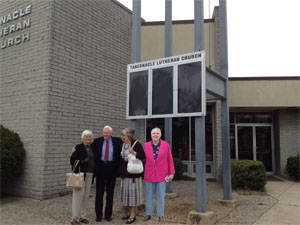
The Redeemer visited Tabernacle on 58th and Spruce in West Philadelphia for a spirited two-hour worship.

Rev. Carlton Rodgers led worship punctuated by music from many genres, with a fine seven-member choir, which the congregation often joined in song. Pastor Rodgers has been serving Tabernacle for nine years.

The pianist, Peter Charalambidis, was excellent and moved effortlessly from liturgy to gospel song to praise hymn to mainstream hymn. A deacon, Samuel Barham, led much of the service and singing with a resonating voice.

The pastor referenced hardship with no specifics. One member told us they had recovered from two fires. We saw on their website that one had occurred in 1969 and destroyed their large stone structure. Redeemer had also recovered from a devastating fire so we know something about recovery. We rebuilt our sanctuary without any outside help and went on to build an education building a few decades later, also with no synodical help.

Tabernacle is a “transformation” church which means they are receiving some special attention in reviving their neighborhood ministry. Our congregation had undergone a transformation that synod refused to recognize, probably because it was largely lay led, but we had begun to attract many new members with dedicated work of our membership.

The people of Tabernacle made a special effort to greet us. The passing of the peace was not part of the service but we were passed the Peace of the Lord by almost everyone we passed as we left the sanctuary.

Attendance was about 30 although we made no effort to count. There were about five children and youth.

The congregation led prayer with a number of people leading lengthy and heartfelt prayer requests. A book we are about to review, Scattering Seeds, points to the ability of lay members to lead unscripted prayer as a sign of congregational vitality. Tabernacle has that.

The congregation seemed to enjoy each other’s company and many plans for congregational events were discussed.

Here’s an idea for SEPA . . .

The laity need a voice.

The Synod is dominated by clergy. Their voices and interests outrank lay concerns simply because they are involved more with leadership on a daily basis and somewhat dependent on their standing with the Synod for career advancement and security.

Many lay representatives at Assembly are new to church governance and follow their pastors’ lead.

The Synod Assembly agenda is tightly scheduled, leaving little room for lay delegates to explore ideas, which might be old to clergy but are new to them.

Lay people who become involved at the synodical level must first pass through a nominating process that is reviewed largely by clergy or lay people who have already passed muster.

Redeemer, years ago, attempted to nominate a lay member and received a phone call from a clergy representative who said they’d consider our nomination only if we “felt strongly” about it. Puzzling! Why have a nomination process?!

Generally, there is little contact between church leadership and the people they serve. Contact is often orchestrated toward SEPA leadership’s objectives.

One dedicated lay person once shared that they went to an Evening with the Bishop excited to be part of dialog. He left, frustrated and disappointed, after an hour of listening to the bishop talk with no attempt at interaction with attendees.

Redeemer’s experience with the last two bishops was that they wanted congregational interaction on their own terms, subject to their own timing, agenda and control. Congregational leaders, who had attempted dialog for years with no response, were ignored — and eventually replaced by decree.

So here’s an idea. What if there was an annual LAITY ROUNDTABLE, say two months before the Annual Assembly, where ANY lay person could attend, discuss challenges and formulate ideas and proposals to bring to the Synod Assembly’s attention? The retreat could be one-day, on a Saturday perhaps, and should be entirely lay led. No clergy allowed. Trust your lay people!

The LAITY ROUNDTABLE would serve no purpose but to review ideas and proposals of individual congregations for inclusion on Synod Assembly’s agenda.

There would be added benefits:

  • Laity would understand common challenges and be inspired to find solutions.
  • The interests of the churches would be lifted up.
  • Lay involvement and leadership would grow.
  • Churches would feel more involved with the denomination which can only help SEPA.
  • Large churches and small churches would interact as equals.
  • Community would expand as laity come to know one another without pastors as gatekeepers.
  • Interchurch problem-solving would pump some fresh blood into our church . . . and we still consider it our church even though we have been kicked out — without a voice!

East Falls Weighs In on How to Use Redeemer’s Property

What is SEPA’s mission in East Falls?

Redeemer members attended the East Falls Community Council meeting to listen to Rev. Patricia Davenport attempt to make inroads into the East Falls community with SEPA’s plans to use the property they seized from Redeemer. The discussion lasted 18 minutes. That’s 18 minutes more than Rev. Davenport gave the people of Redeemer before she came to our door with a locksmith back in February 2008.

Her timing was off. She told the community the building has been empty for four years. It’s not quite two and half. (September 27, 2009). She applauded when someone mentioned parking. Bishop Burkat used lack of parking in her opening volley against Redeemer back in 2006. Parking has never been an issue at Redeemer!

She claimed repeatedly that she very much wants a Word and Sacrament church there, but didn’t explain why they locked out the Word and Sacrament church that had been there for 103 years.

Her presentation was more noted for what she didn’t share about their involvement with the property. We thought for a moment she might attempt some candor when someone asked her when they were going to start using the property. She deflected this by coyly saying — if I say when, you’ll hold me to it and so I won’t say when.

As for the community, one member who was active in the children’s choir hosted by Redeemer suggested that the discussion was premature. Others stated that they missed the arts program which Redeemer used to host. Pastor Davenport talked about having a school . . . as if Redeemer had never had a school and wasn’t about to open a new one when they evicted us. So far every idea mentioned Redeemer had already done or planned to do. We doubt Pastor Davenport noted that.

The local newspaper editor thought the education building should be senior housing. That wouldn’t affect parking. Sounds like Redeemer should become a parking lot!

There was one suggestion so insulting that we almost forgot. It was the first one offered. Our church should be made into a dog park.

No one asked the BIG questions.

If SEPA’s oft-stated passion is to have a Word and Sacrament church on the corner of Midvale and Conrad, why don’t they just open a church?

Why did they work for a decade to destroy the church that was there?

Why are they making overtures to the community, if they know their mission?

It was an evening at the theater. SEPA has no money or resources for dog parks or art centers and it is not about to enter the kind of renovations necessary for housing anyone — especially when none of these are within their mission as a Synod. Any of these peripheral uses would side-track and delay their supposed mission and protected tax status.

They were trying to create the illusion that they care. They have demonstrated very well that they don’t.

Someone asked about desanctifying the land. It has already been defiled by Synod’s behavior.

They are waiting for clear title to the land they seized. That could take years in the courts. Then they are likely to sell the property — their plan from the start. Would you house Aunt Nellie in Redeemer’s education building only to uproot her when the day comes for SEPA to hightail it out of East Falls, cash in hand, once and for all?

SEPA told Redeemer in 1998, “Ministry in East Falls is not good use of the Lord’s money.”

Dog parks? That’s another story.

We video-taped the discussion. The EFCC allowed us to distribute a flyer.