4/7InkzHVUEQeEdU9vpc1tikzEhChrKmPfvXI-FSDBrBQ

Social Media and the Church

Categories Give Blogs Structure and Direction

Categories are collections of content that relate to a designated topic.

A previous post explored how “categories” help readers wade through pages of valuable content. They can also be a valuable tool for you as author.

If you are like most people, you started your blog with just a couple of posts in mind. Categories were the last thing you were thinking about. Now, several months later, you have a blog with a dozen or more posts and your interests are beginning to broaden.

Scroll through your posts. You are probably finding some of your best content buried, requiring a dedicated reader to scroll for seconds to find them. Placing them in a category is the fastest and easiest way to make your older posts more prominent.

Look again through your blog posts. Do you see any recurring themes? Make a list. These are your categories.

You do not want to create a category for only one post. In your mind you are just starting to write on the topic. To readers it looks like you have no passion or authority on that topic. So hold off until you are sure you can offer your readers more than a fleeting opinion.

Creating categories becomes a useful planning tool. You will begin to understand your blog and its structure. This may give you insights about your blogs future and help you plan future posts.

Here are the steps to take when creating categories and developing your blog into a useful resource.

  • Review your content.
  • List the topics you are writing about.
  • If you see a topic that is of great interest to you, but you’ve posted only one article, pull out your editorial calendar and brainstorm more topics for that category. Hold off on creating a category until you have at least five posts to add.
  • Your review of categories might identify a dominant topic. This could lead you to create a separate page for that topic or even to create a separate blog.
  • Once you’ve identified a few categories, plan for how you will continue to address each topic. You might want to address each topic every week. Soon you may find a structure. Write about topic A on Mondays and Topic B on Wednesdays, for example. You might want to add a special feature such as a poll on Fridays. Soon you will have a PLAN!
  • Review your editorial calendar and make sure each category is regularly represented.
  • While you are at it, brainstorm new content ideas for each category you’ve identified.

As you develop your blog, you will want to start publishing newsletters, white papers and perhaps even ebooks. If you’ve carefully maintained your blog categories, you’ll be able to easily identify content to adapt to other purposes. A good bit of the organizational work for larger ventures will be done!

Blog Categories Help Readers Find Your Posts

If your church has a blog — and you should — you will encounter the option in blogging software to list your blogposts in a “category.”

Categories are helpful organizational tools for three reasons (at least):

  1. Categories give search engines more opportunity to find your blog.
  2. Categories help readers wade through dozens of blog posts.
  3. Categories can guide you as you develop your blog’s mission and help you keep content balanced and on topic.

Using Categories is totally optional, the option becomes desirable…and soon necessary to maintain sanity!

Categories can be described as a Table of Contents in a cyber sense. Unlike a book, this Table of Contents is not linear. Readers do not move from Chapter 1 to Chapter 2. Instead, categories organize the content in an interwoven tapestry. You, the author, get to choose where the information goes. It can go in both Chapter 1 and 2, and maybe even Chapter 30!

You can add a single post to any number of categories. For example, a 2×2 post on Social Media Outreach might be placed in a “Social Media Ministry” category AND a “Church Growth” category AND a “Transformational Ministry” category. Be judicious as you decide which categories to place your blogs. It defeats the purpose of Categories to place every post in every category!

Placing your blog in a Category does not remove it from the daily blog feed. It adds it to the collection of topics on the same subject. A reader can click on the Category and read all the other posts relating to the same topic without scrolling through posts which are not of immediate interest.

Placing your posts in a Category gives them longevity. As a blogger you may be writing on several topics of interest in no particular order or changing topics from day to day. Your list of blog posts will grow quickly if you are serious about publishing. You may have great posts on an important topic that you published months before. If you do not place it in a Category, it will be buried.

Using categories helps your readers focus on the content of most interest to them. Once you have a dozen or so posts, take time to create a set of categories and assign each blog post accordingly. Each new post can be assigned a category before posting.

Now sit back and feel satisfied. You’ve helped search engines find your content. You’ve helped readers find the content that interests them.

Tomorrow’s post will show how that same few seconds you spent placing your post in a category also helps you!

14 Reasons Congregations Should Avoid Social Media Ministry

Maybe Social Media Ministry isn’t right for you. There are plenty of good reasons to avoid it. 🙂

  1. Religion is a mystery. Let’s keep it that way!
  2. Let people form their opinions about our religion from the popular media. They do a pretty good job!
  3. Social media allows for too much interaction between clergy and laity. It’s best to maintain boundaries.
  4. We do not want to be known by our works. It’s a theological thing.
  5. Why monitor our image? We have a great reputation. No one could possibly have a beef with us.
  6. What if people who don’t know anything about us take cheap shots online? So what! Everybody knows the truth. No one will pay any attention to them.
  7. We want the people who join our church to know as little as possible when they join. That way we can tell them what’s what! We don’t want their ideas to mess up something good.
  8. Our congregation is a close-knit family. We are busy helping each other and don’t have time for other people’s problems.
  9. Pen and ink were good enough for St. Paul. No need to make any changes there.
  10. We think it is a bad idea to reach more people with the message of God’s love. What’s in it for us?
  11. If we start writing with other people in mind, they may get the idea that we care more than we really do.
  12. We can’t afford to serve any more people than we already serve. It’s just not in the budget!
  13. Who has time for this Social Media nonsense? Our current members keep us plenty busy as it is.
  14. Everything is great just the way it is.

Calls to Action Are Nothing New to Christianity

A Call to Action helps your reader take the next step.

As you get comfortable with blogging you will want to start creating more interactivity with your readers. If you want interaction, you’ll have to ask for it. That’s where the Call to Action comes in.

Calls to Action are so important to the business world that they have their own acronym (CTAs).

You see them every day in advertising: “Call 1-800 . .,” “Send $24.95 to  . . . .” 

Typically, advertisers try to create a sense of urgency — a reason for people to take action NOW! They know that people need incentive to get off their backsides and do something. And so you see the warnings! “Act now. Offer ends July 4.” “Supply is limited.” 

This is not new thinking to Christians. Our whole faith is built on Calls to Action: “Follow me,” “Come and see,” “Do Unto Others . . . ,” “Love one another.” The challenge to the modern church is to translate biblical Calls to Action to reach modern Christians or seekers.

How do you create Calls to Action on your web site or blog?

Again, you see CTAs on web sites every day. “Click here,” “Download,” “Submit,” or “Enter.”

Churches can use the same tools. The goal is engagement with others and growth in Christian community.

Pace yourself as you build your community’s engagement and trust. 

Your CTAs should be stepping stones to involvement in your community. Help people move from the anonymity of cyberspace to “what’s in it for me?” participation to “how can I help?” commitment. In other words, watch your interactions with your readers grow from anonymous participation to sharing an email, to providing a name and eventually a physical presence.

Here’s a plan described in tiers or levels of engagement:

Your first-tier or introductory Call to Action might simply be to pose a question at the end of your blog article.

  • “What do you think?”
  • “Can you recommend a resource?”
  • “Share your experience.”
  • “Do you know anyone who can benefit from this idea?”
At this level of engagement, your only goal is to get people thinking about their involvement.

A second-tier Call to Action might be to provide a way for people to answer those questions on line with a comment box. Another possibility is to engage readers in a simple poll. Blogging software makes this easy. Limit your poll to one question and suggest just a few possible answers. It allows your readers to test the water. There is no risk. They are not sharing any personal information with you. Keep it fun. Everyone wants to know how their ideas stack up to others. Report the results of the poll in an entertaining way.

A third-tier Call to Action might be to offer something for download. 2×2 offers the Editorial Calendar for example. You can have this information offered freely (as 2×2 does) or you can ask for information when they download and begin to create an opt-in email relationship.

A fourth-tier Call to Action might be to interest readers in some action that requires a bit more initiative from your readers. Tele-evangelists, for example, often ask for prayer requests.

  • Sign up for our Walk for Hunger.
  • Volunteer to work in the Food Pantry or Thrift Shop.
  • Join our Prayer Chain.
  • Join our youth on their Mission Trip to New Orleans.
  • Attend our workshop on Autism.

A fifth-tier Call to Action asks for information and offers something of value in return for the information (an incentive). Do not ask for more information than you need. An email address may be enough. A physical address might be desirable. Keep in mind that the less information you require, the more comfortable it is for readers to participate and the higher the response. If all you need is a name and email address — that’s all you should ask for.

  • RSVP for Our Community Thanksgiving Dinner by November 1 and receive a beautiful Advent Calendar. (Blogging software will allow you to create the form.)
  • Sign up for Hunger Walk by October 15 and receive a free T-Shirt at the starting line.
We’ll explore the nuts and bolts of how to create and use CTAs in a future post.

How to Monitor Your Congregation’s Social Media

It will take a while to create online dialog, but start preparing.

If you want to encourage engagement on your site, remember to ask. Businesses use Calls to Action or CTAs. Every good ad has one. It could be a phone number to call or a web site to visit. The interactivity of the web allows you to get fancier. Ask questions at the end of your post. Include a simple poll on the topic you are covering. Direct readers to something you’d like them to download. Link to another page. We’ll talk more about this later.

There are three major forums for interaction in Social Media. Facebook, Twitter and your Blog. Focus for now on your blog. Blogs encourage thoughtful interaction. Facebook is more of a free-for-all. Twitter plays an important role, too. All need to be monitored. If help is short, start with the blog. Blog platforms send the administrator an email when a comment is posted. You can review the email before it goes public. (We’ll address Facebook and Twitter in future posts.)

There are tools to help you monitor your Social Media, but the focus of our series is helping churches use this media. The reality is that church experience with social media probably relies on volunteers. Much of the advice you find online will not help you get started with the resources you have.

Begin by Drafting Community Rules

Draft a short statement to readers about the type of content you will accept.

Post Community Rules prominently in a sidebar on your blog and Facebook or on its own tab. Rules should be very short and should encourage participation and give readers a sense of comfort in joining your community. They’ll know someone is watching out for them.

Suggestion for Community Rules:
We welcome you to participate in discussion on our parish blog with opinions or questions that are presented thoughtfully, responsibly and with respect to our readers. We will not publish profanity of any sort and reserve the right to exclude comments that bully, harass, threaten, are libelous, hate-oriented, racist, or illegal. You may post anonymously but do not impersonate someone else. If you read content on our page that you think is inappropriate, please report it. We want this forum to make the world a better place. We know that includes criticism. Following the Community Rules will make this a safe place for everyone to have a say.

It is important to be open in your approach to monitoring. Negative comments should be deleted only if they violate the Community Rules.

Negative comments are an opportunity to address issues which may concern many people. It is a chance to witness! Do so thoughtfully.

  • Answer all comments. It creates relationships.
  • Accept positive comments graciously.
  • Address negative concerns openly. You may want to ask the pastor to respond, depending on the nature of the complaint.
  • If you encounter a “troll,” someone who is out to make trouble on your blog, here are a few steps to take.
    Respond publicly to the first comment or two. Address concerns in a forthright manor. If the complaint is legitimate the negative comments will stop. If negative comments persist, respond publicly one more time, saying that you are going to address future concerns offline. Then do it. Your readers know that you are responding but any nastiness is no longer public.

You are likely to receive more positive comments than negative, but both are important. Personal attacks should not be allowed. Give more leeway for criticism of public figures or elected representatives. By virtue of their office, they are open to criticism.

Monitoring Social Media is work. We recommend that you designate a few people to monitor comments. Have a talk about how you will respond and what to do if you don’t know the answer to a question. Divide the responsibility, assigning committee members certain days.

People expect replies within 48 hours. The value of the discussion decreases dramatically after that.

Over the course of a few months, you will see patterns to participation and can prepare for busy days. But make sure someone checks daily so that questionable comments are not hanging in cyberspace without your attention and those in need know you are listening.

How to Write Powerful Headlines that Draw Readers

Headlines are the most important part of your post. They are the first thing your reader sees. Lackluster headlines will have readers moving on.

People who depend on headlines to improve sales study their effectiveness in the most minute detail. We know that most church workers do not want a degree in headline science. Nevertheless, we can learn from the people who make their living figuring out what works best. 

We’ll condense their advice. If you want to know more, go to the experts. Here’s one.

Your major goals are to:

  • Pique interest
  • Inform readers
  • Help your readers solve a problem
  • Entertain! No one wants to be bored!

We’ve already covered that headlines should contain key words so that search engines find them. Arranging those words is the next challenge.

Some authorities recommend writing your headline first to help you focus your post. Others say write your headline last to be sure it truly reflects your message. Try both! Write a headline to help you focus and then revisit your headline before you post. Make sure you’ve kept the promise you made to your readers.

Headlines should address the question “What does this blog have to offer the reader?”

Let’s say you are planning to write a post to offer ideas on a common problem for many churches — post-holiday drop in attendance. Let’s figure the key words are some combination of “Church Attendance” and perhaps “Holiday” or “Post-Holiday.” If you are publishing at “Christmas” or “Easter” those words might figure as well.

Here are nine approaches to consider:

PROMISE A SOLUTION (HOW TO)
Does your post solve a problem? Use the words “How to” in the headline.
How to Improve Post-holiday Church Attendance

NUMBERS
Will your post give simple, practical advice? Use numbers. The people who study headlines can prove it boosts readership. They’ve even figured out that the number 7 works best!
7 Ways Your Church Can Boost Post-holiday Church Attendance

UNIVERSAL APPEAL
Certain Words Appeal to Readers. (easy, quick, free, more, better, new, grow, improved, guaranteed, fresh, you and your)
7 Easy Ways to Improve Your Post-holiday Church Attendance Quickly

QUESTIONS
Questions can make good headlines.
Does Post-Christmas Church Attendance Give You the Blues?
or
Church Attendance Down? Where Did All the People Go?

TESTIMONIAL
Will your article include real examples?
How Grace Church Brought Members Back after the Holidays  

AUTHORITY
Will your article quote an expert? Say so.
Archbishop Smith Recommends 5 Ways You Can Improve Church Attendance Year-Round

URGENCY
Your headline can take an authoritative tone.
Failure to Boost Church Attendance Year-Round Challenges Mission Budgets 

EXPLORE THE PROBLEM
Help your readers understand why they share a problem.
7 Reasons Why Church Attendance Plummets after Christmas

BE CLEVER!
Headlines can be a place to have fun! Play on words. Use current hot buttons or old writer tricks like puns or alliteration. Shift the key words to the opening paragraph or perhaps a subhead before the opening paragraph.
Done with Church ’til Easter? Santa’s Making a List!
or
Here’s the Church. Here’s the Steeple. Where Are the People?

As you look at the differences in headlines for the same proposed story, you will notice that the tone of the headline will influence the angle of your story. Remember: Write the headline. Write the story. Revisit the headline to make sure the story keeps the promise made to the reader in your opening words — your headline.

That’s the end of our short primer. Just one more bit of advice:

Don’t be boring!

Evangelists Can Learn from Marketers

Have you noticed that the business world has adopted words commonly used in the religious world? Companies once hired spokespeople. Now the job title is “evangelist” (for example, Guy Kawasaki, former evangelist for Apple).

The business world also talks about a successful sale as a “conversion.”

Church evangelists can learn a great deal from modern marketing. Marketing and evangelism share many of the same goals. They can also share the same strategies.

The hottest trend in marketing goes by several names: Inbound Marketing, Relationship Marketing and Content Marketing are just a few. These three emphases fit beautifully into any church’s evangelism program.

INBOUND MARKETING

In a nutshell, Inbound Marketers make lots of helpful information available to everyone for FREE, using blogs and websites, coupled with Facebook, Twitter and LinkedIn networking tools. While sharing their expertise, they gain authority. When people are ready to buy, they think of the people who were so helpful to them on the web. This marketing technique is tailor-made for Church Evangelists. Help people and they will come to you.

This marketing specialty grew from the modern challenge salespeople faced. As a people, we once were amenable to the knock on the door, the cold call, or chatting it up with visiting sales reps in the company cafeteria. Today we are security conscience. We ban solicitation, check Caller ID before answering the phone, and we do not allow anyone to enter our work space without passing security.

Marketers looked for new ways to get their message/product before potential customers. They used modern tools and technology to attract interest. It is a breath of fresh air for the business world. They no longer feel like nags. They refer to the old days (just a few years ago) as the days of “Interruption Marketing.” They are glad they are no longer distracting irritants. They know that the people they talk to are already interested in their message.

RELATIONSHIP MARKETING

Companies don’t want to work harder than they have to. Finding new customers is more work than keeping old ones. Businesses look for ways to stay in contact with their customers and continue to serve them long after the initial transaction. This can begin on the web. Some of it will rely on other strategies which we will discuss in later posts. Churches must learn from relationship marketers. It will help them be better Christian witnesses.

CONTENT MARKETING

Content Marketing is related to both Inbound Marketing and Relationship Marketing. Content is the helpful information you provide for FREE that attracts people to your message or product. Churches of any size can do this. It is a redirection of energy, but it is a potentially powerful evangelism tool. Provide helpful advice, meaningful thoughts, valuable information, and show that you care. People will notice and begin to build a relationship with you.

Churches must consider implementing these outreach techniques. It requires work and retooling ministry concepts, but these new methods can be very effective. It is not enough for congregations to be witnesses for Christ. They must be effective witnesses for Christ. That means looking for strategies that will make a difference in people’s lives and in the life of your congregation.

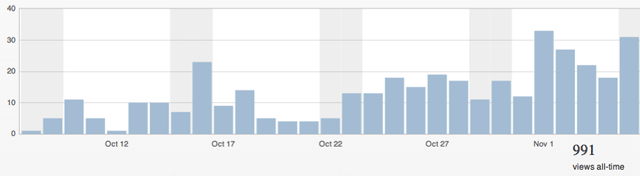
The above chart reveals 2×2’s web site’s pattern of growth. This is a project of a very small congregation. We began using Inbound Marketing techniques in February when we launched this blog. We took a few months to learn the ropes. In mid-summer we began following best marketing practices. We slowly started adding content more regularly (now daily). We monitored the statistics. Weekly, we saw interest growing. Today we expect to welcome our 1000th site visitor (almost all within the last four months!). We are averaging close to 30 new visitors every day. We’re not sure where we are going, but we are following a plan that seems to be appreciated. Thanks to all readers. We encourage you to start your own web ministry. We’ll be glad to help.

Key Words Help Readers Find Your Posts

Key Words are the words people type into search engines when looking for articles on topics which interest them.

Blogging platforms give you a chance to list some key words before you post. Writers should also use identifying key words in their headlines and within their article.

Search engines analyze everything going on everywhere on the web and present lists of what they find relating to those words. Key Words introduce writer and reader.

People wanting to know how to bake bread will type “how to bake bread” into their search engine. Often the science of key words is just that simple.

The problem is that there are probably thousands of people worldwide writing about baking bread. All of them want search engines to notice their web site first. The trick, therefore, is to find the words which make your article stand out. 

There are people who will help you with this for a fee. They will run a “key word search” and give you a list of how many people looked for “how to bake bread” as opposed to “baking bread” or “bread recipes.” Often, the results are unimpressive because they are obvious. Yep, your key words are “how to bake bread.”

Key words were once critical. Search engines concentrated on them. Today search formulas measure other things — like incoming and outgoing links. But don’t worry about all of this. There are strategies you can use that will work without stressing about search engine algorithms. Here are a few:

  • Use the words that are obviously important to your story in the headline and also in the first paragraph or two.
  • Craft your headline using popular formulas. (We’ll have a separate post about this). For now, we’ll share that headlines with numbers draw readers (7 Secrets for Baking the Perfect Loaf of Bread). Also headlines with “How to” are effective (How to Bake the Perfect Loaf of Bread).
  • Use common sense. Write for your readers — not the search engines. For a while some bloggers repeated the “key words” so often that their writing became dull and search engines caught on and adjusted their strategies.
  • Use photographs or video (both of which attract attention) and make sure that you use the key words in the description and alternate text boxes which present themselves when you load the picture.
  • Be authentic. Don’t use words that are popular but have nothing to do with your story. This trick has been used unscrupulously to lure people into finding their web site. It is dishonest. Search engines watch for this. It is one reason they changed their search tactics to measure more than key words. (When we posted this article, WordPress suggested we use “baking bread” as key words, but this article is not about baking bread!)
  • Write about things people want to read about. People will find you faster than you may think!

Our experience: About three weeks ago, 2×2 started this series of articles on Social Media Ministry. If you are reading this, you found us! So have 600 others. When we plugged the words “social media ministry” into a popular search engine last week, 2×2 ranked #1. We paid for no analytics. We just used the strategies listed above.

A word of warning to churches: Your key words should be what the people you want to reach are looking for. Use key words that describe your ministry, not just the name of your church. If the name of your church is Trinity, that word will not work as a key word. It has too many meanings and there are many churches named Trinity. Also, you will miss out on traffic that is looking for topics and not just your church. (Trinity Smithtown Feeds Homeless, Trinity Smithtown Youth Walk for MS, Day Care in Smithtown, might be more effective.) You can pay to have someone figure this out, but just get started. Keep your current audience — and most important — your target audience in mind. You’ll do just fine.

How to Prepare Content for Your Church Social Media Blog

How long should your blog posts be?

Social Media experts have differing ideas on this. Most say that content posts should be short and recommend 250 to 500 words. 

This is good advice for many topics. How-to Articles tend to be longer since detailed directions are what your audience is seeking.

The correct answer may be that it depends on what you have to say and the urgency of your need to say it. Do your readers need to know everything now or can you spoon-feed information over a few days without frustrating them?

The best yardstick is to ask yourself, “If I were looking for information about this topic, would I appreciate the content (whether it be 250 or 1000 words)?

2×2 posts tend to be about 800 words on average — too long according to the experts. We violated the rule because we wanted to post thorough content that would be helpful to our audience quickly. This approach has been successful. Our audience has grown steadily.

Nevertheless, as we move forward, we will begin to keep a closer eye on the length of our posts. Here are some ways bloggers can divide content into shorter, more palatable doses.

Journalist’s Formula

Long topics can be divided using the standard journalistic formula. WHO, WHAT, WHERE, WHEN, WHY and HOW. One post could then become a six-part series.

Chronological Approach

Other topics might lend themselves to chronolgical subdivision. Detail topics in formative steps. We used this approach in our Social Media Ministry Series, starting with the concept of Social Media Ministry and forming a committee. Later posts covered the work of the committee, etc.

Geographic or Cultural Focus

Some topics might lend themselves to geographic or cultural subdivisions. Many of our topics address small churches in general. We could talk about small urban churches or small rural churches. We might contrast Southern churches with New England churches.

If your posts are longer, look for ways to break up your words or copy so that there are focal points that lead you through the post.

Studies show that web readers scan a page in the shape of the letter F. They read across the top, then skip down. They hit the next topic sentence, and read across and continue down the left side of the page, occasionally drifting to the right as things attract interest.

Tools for breaking up text

There are several tools built into blogging software that you can use to lead your readers’ eyes.

  • Headlines
  • Subheads
  • Bulleted Lists
  • Numbered Lists
  • Photos or Art (with or without captions)
  • Quote Callouts
  • Boldface/Italic Text
  • Indented Text
  • Use of color

Pay attention to your own habits as you read web sites and blog posts to understand how others read your pages.

Thus ends this post of 458 words!

Using Video on Your Social Media Website

Here’s a link to an article that gives you tips on how to use an iphone to add audio/video to your web site.

http://www.socialmediaexaminer.com/5-tips-for-creating-video-and-audio-content-with-your-iphone/