4/7InkzHVUEQeEdU9vpc1tikzEhChrKmPfvXI-FSDBrBQ

Social Media Ministry

20 Rules for Online Engagement —Do’s and Don’ts

What messages of love are you sending?

Many people get involved in internet dialogue with hesitation. Typically, they lurk for a while, reading but not daring to comment. It is daunting to press that first submit key. It gets easier with practice.

Marketers and other self-interested web users can be tempted to use online forums for self-promotion. Congregations can be tempted, too. Beware! Your readers can spot self-serving comments with 5G rapidity. It can harm your reputation more than it can help. Enter the conversation carefully and keep the readers of the online community in mind. Remember, no one likes to be sold!

Pinterest entered the scene with its image sharing social media platform. It was received as a breath of fresh air. Marketers quickly saw a new advertising tool. Now there is talk about how marketers have ruined the fun. It remains to be seen if marketers will curb their own behavior or if Pinterest will revise community rules.

2×2 encourages online dialog. Here are a few basic guidelines.

  1. Remember to share with a purpose. Be helpful. Be informative. Be clear. Be entertaining.
  2. Use your real name. No one takes hidden identities seriously and being honest about your identity is fundamental to building trust.
  3. Don’t pretend to be an authority if you are not. Consistent participation in forums is a way of creating authority, but don’t jump the gun. Build your reputation through conscientious commenting.
  4. Participate in dialogue but don’t try to sell your stuff at someone else’s fleamarket. There is NO delicate way to do this. You always come off looking crass and self-serving. It’s a real turn-off and others might report you to the moderator as inappropriate. Limit your self-promotion to adding your title, position, company or church name to your signature. That gives readers a choice. If they want to know more, they’ll find you.
  5. Share good things about others. If you know a good source that will further the dialog provide a link. It helps to build their reputation — and yours.
  6. Acknowledge sources of ideas you are sharing.
  7. Don’t bad talk your competition. Showcase your strengths, not other’s weaknesses. Leave the bad-talking to politicians.
  8. Keep your comments on point. Reread the thread to make sure you are adding to the conversation, not just repeating what others have said.
  9. Write with appropriate detail. If the forum tends to feature three-sentence thoughts, don’t write four paragraphs. On the other hand, if you are offering detailed help, use whatever length is appropriate to be truly helpful.
  10. Use standard English and complete sentences. Without the nuances of a physical presence, it is easy to get wrong impressions. Take the time to be as clear as possible. Using jargon and allowing typos impedes conversation. Communication is the goal. Remember, the internet is worldwide. Not all readers will understand colloquial shortcuts.
  11. Do not use vulgarity — ever.
  12. Proofread your comment at least three times. Reading it aloud is very helpful.
  13. Avoid direct criticism of individuals. Public figures are an exception.
  14. Correct your mistakes as quickly as possible. 
  15. Be compassionate and forgiving for online gaffes. We all know how easy it is to click a  button by mistake and send something with no way to call it back. If you notice an error, be gracious. Ignore it if it is innocuous. Notify the commenter privately if it is particularly embarrassing.
  16. Don’t use other people’s mistakes, once they are admitted, to stoke the fire under your own cause. Sometimes passionate threads result from misunderstanding. Reaction is appropriate right up until the originator of the thread admits an error. To continue online ranting after an apology has been made is taking advantage of another person’s mistakes and is hurtful.
  17. Be a voice of reason. Try to keep conversations on track and keep peace.
  18. Respect others privacy. Don’t share personal information without permission.
  19. If someone is abusing the forum, report it to the moderator. If you have a serious beef, handle it as privately as possible with a direct message.
  20. Remember the Golden Rule.
photo credit: Micky.! via photo pin cc

What SEPA Synod Can Learn from Redeemer

Today, SEPA (Southeastern Pennsylvania Synod of the Evangelical Lutheran Church in America) Communications Director Bob Fisher sent a plea to SEPA congregations for interaction on a web site the synod created for congregations to share ministry ideas. The site was launched in November and had an initial outpouring of about 100 submissions. Then it fizzled. Involvment on the web site has been flat ever since.

There is little reason to post a time deadline on a web site like this. But Fisher’s request for submissions asks for responses by April 26 — one week before Synod Assembly. You want good statistics for Synod Assembly!

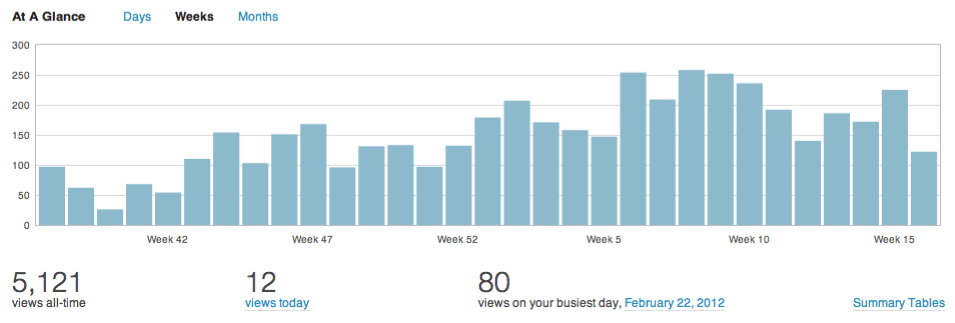
Meanwhile, during the same period, 2x2virtualchurch.com, sponsored by the SEPA-excommunicated members of Redeemer, has grown to more than 200 visits per week, with more than 80 followers and 30 new visitors daily. We’ve pioneered social media in church work and have been gaining respect around the world for our work — interdenominationally and among churches of every size. Look at  2×2’s statistics for roughly the same period (screen shot taken in midday/midweek for last bar):

The concept of SEPA’s web site is flawed. No one needs to submit ideas for review and verification by a central office any longer. There is nothing stopping any church from posting their successes and ideas on their own website. Synod should be encouraging community between congregations without a middle man. Don’t worry . . there’s plenty of work for communications middle managers.

This site is not likely to create dialog. It is rigid in a medium that operates best with freedom. It allows three categories of questions. It limits responses to 50 words. (Most of the questions had close to 50 words.) The message conveyed to a visitor to this site is that their ideas will be monitored, judged and verified — controlled. This thinking is foreign to internet users who are accustomed to the free flow of ideas on Facebook, Twitter and blogging platforms—all of which are community-building platforms.

Why invest time posting to a site that might reject you?

There are other ways to achieve sharing. Start developing content that is helpful to congregations so there is a reason to come to the site in the first place. Begin linking and commenting and taking part in the dialog. Recognize that there are no boundaries to good ideas. Why limit the submission of ideas to just 160 congregations when there is a world of mission out there? It’s the social media way. And it works.

Redeemer would submit its ministry ideas to www.godisdoingsomethingnew.com, but we doubt our ministry would be recognized. It hasn’t been for a long time!

No problem. We post our ideas daily on 2×2. Welcome!

(2×2 be glad to help any church get started in social media. Just contact us! We can have a web site up and running for you in a week, train members to use it and even help you develop content.)

Social Media and Branding Your Congregation: Part 1

Branding is a marketing term. Branding is how people distinguish one company from another. Branding tells your story.


Corporations spend a lot of time, money and attention on branding. They know how important image is in today’s world. They establish lengthy rules and guides to control their public image.

Branding includes things like logos, fonts, colors and the “look” of anything produced by the company. It also includes intangibles — ways of thinking, priorities and behaviors or policies.

Most small or even large congregations never gave branding a passing thought until recent years. But in today’s world, it can be a valuable tool. As congregations look beyond their established communities they will want to be conscious of how they are perceived.

Many churches take part in a branding process without realizing it.

Have you discussed a vision or mission statement lately? That’s an important first step in any branding process.

Key question: What do you want the world to know about your congregation?

  • What is important to your past?
  • What is important to your future?
  • What is there about your congregation’s personality and mission that makes you special?

Once a vision or mission statement is approved, the most common place to start branding is a logo. Many churches have their own logos in addition to logos of their denominational affiliation. Check with your denomination for rules.

Logos used to be black and white and simple. This comes from the days of black and white printing or photocopying. Enter the digital age. Use color.

Decide which one, two or three colors are going to represent your ministry. You’ll be using them in many, many things. Make sure they are colors you can live with!

Use imagery that represents the answers to the bulleted questions above. What makes your congregation unique?  A church near the seacoast might want to use ship, water, or anchor imagery. A farming community might want to use wheat, bread or nature imagery. Urban churches might focus on people, buildings, or multicultural images. There is always the image of your building to fall back on, but your logo is an opportunity to say much more.

Your logo should be something that any member can relate to your congregation’s mission in one simple sentence. Simplifying the complex is part of the art of branding.

Keep in mind how your logo will be used.

  • Signage
  • Stationery
  • Bulletins
  • Newsletters
  • Ads
  • Posters and Fliers
  • Website
  • Avatars (which are square)
  • Video/Powerpoint Backgrounds
  • SWAG (you may want to get some promotional giveaways like mugs or pens)

This list is growing just as our communications options are growing. You may even want to animate a logo for use on the web! There are many possibilities.

There should also be a black/white version. There will still be a need occasional one-color printing.

Surf the internet for examples of church logos. There are some very nice ones.

The logo image is important enough to hire some help if you do not have artists in your community. In fact, it might make the process go easier with outside input.

The process of deciding on a logo can take a while. It should include many people. That always lengthens the decision process. But remember, the logo belongs to your whole congregation—past, present and future. You want the involvement of many. Try to make the process part of your mission conversation.

Dive in and have fun. We’ll address other aspects of church branding in later posts.

photo credit: vapour trail via photopin cc

You Think Church Work Is Hard!

Here is a charming video about a boy with vision, ingenuity, perseverance. and with a little help, the ability to network. View and discuss! There’s a lot to learn from this video that applies to church work.

Facebook: A Force for the Church to Reckon With

Facebook and the Church are entering relatively uncharted territory.

Congregations with broad age demographics are likely to use Facebook as a way of promoting activities. There are a few youthful congregations who have implemented a Facebook social media strategy that is more comprehensive, encouraging lively interaction among members.

Facebook is something the Church must learn with caution. It may be something we should teach as well, but it will take some experience to become authoritative.

A congregation should consider demographics when using Facebook. Measure them against these statistics.

  • 81% of Americans aged 12 to 17 check Facebook daily.
  • It is likely that a quarter of a congregation’s members over 65 are on this Social Media platform and this statistic is quickly growing.
  • Close to three-fourths of your members 25-45 engage in Facebook use.
  • Business people in your congregations are surely exploring Facebook strategies.

Your members are already on Facebook. Grandparents are following the activities of their grandkids. Youth are likely to be in touch with dozens of friends while you think they are having dinner with you.

How many of your members check your congregation’s web site daily? How many read the newsletter? How many members participate in creating the content on your web site or in your newsletter?

The reins of information are no longer in your church leaders’ hands.

There is no doubt that Facebook is a force to reckon with and a tool to consider.

Facebook is changing the way we think. Privacy is valued much less. There is a driving need to be in touch. Facebook has an entry age of 13, but figuring out what year you have to be born to qualify takes elementary math. Children are using Facebook.

When our way of thinking changes, our ways of acting follow. What this means to the Church is not known. Will members become more engaged? Will they see less use for Christian community?

If the Church hopes to influence the answers to these questions, we must engage in the conversation.

The problem Churches may have in building Facebook community is that the thinking of older members and younger members may clash. The impact could be felt across a congregation. One piece of private information, innocently shared on your congregation’s Facebook network, could create serious fallout. Pictures that seem fine to someone posting on multiple walls might not pass the vanity test of others in the congregation.

Though not excluded, deep thoughts are rarely shared on Facebook. It tends to be a lively conversation with lots of inside innuendo going on. This could be fun for those in the know. Others could feel left out.

Still, Facebook is here to stay and it is changing the way we think. If churches hope to reach the people in their community, we must adapt our mission strategies for today’s way of thinking.

Maybe Facebook will force the Church to dust off the cathedral rafters!

Social Media Helps the Church Say Yes

Maybe we should blame the Ten Commandments for setting the stage. Early in the formation of our religion, the faithful were presented with “No” Lists or “Don’t” Lists.

  • Do not eat of the fruit . . .
  • Thou shalt not . . . .

The New Testament shifts to the positive with ideas of what the people of God CAN do and SHOULD do. It is all summed up in “Love one another.”

Leaders in authority often rely on “No” to exert their power. In reality, it exposes their weaknesses.

“Yes” is a much more powerful word. Good parents instinctively know that the more they can say “yes” to their children’s wants and dreams, the more the children will listen when “no” is needed, the more they will feel loved, and the more they will explore their true potential. Parents who attempt control with stern prohibitions that defy explanation are headed for trouble!

And yet the Church clings to “No” Lists.

“No” shuts down the work. Things seem safe.

When in doubt, say “No.” Don’t do that outreach. Don’t spend that money. Don’t dance. Don’t play that music. Don’t wear those clothes. Don’t take on that project. Why? Because the person saying “No” said so.

Saying “No” is a way of exerting power. Questions will be discouraged. Innovations will be few and far between — left to the most tenacious who will be labeled “troublemakers.”

The regular use of the word “No” is probably at the root of the Church’s precarious state.

Saying “Yes” is empowering to others, but it is more work. “Yes” means things will happen (but not necessarily the way we thought)! “Yes” means entering the unknown. “Yes” means loss of control. “Yes” means change.

The Church can no longer afford to follow “No”sayers. We no longer have to.

“Yes” has never been more possible. The resources of the world are at our keyboards. We can so easily find the people with energy, hope and ideas. It has never been easier to follow the Church’s positive mandates.

That’s the great thing about Social Media’s potential for the Church. Social Media makes it easier for us to look outside of ourselves and who we think we are. We can look beyond our church walls, our membership, our community, our denomination.

Anybody can join the conversation. We will be trailblazers.

But then, so were those disciples. Jesus had good advice for them in dealing with “No”sayers—shake off the dust and move on!

Say “Yes” to Social Media.

Stop Blaming Congregations for Failure

Let Social Media Save the Day

We lay people have been taking it on the chin for years.

  • We’ve been ridiculed. We don’t tithe. We don’t evangelize. We aren’t welcoming. We don’t volunteer.
  • We’ve been labeled. If we aren’t strong, we are backward and resistant to change, and dying. If we are strong, insisting on answers, we are adversarial and resistant to authority.
  • We are made to feel inferior and inadequate, unable to find our way in the world without hanging onto the robes of the clergy.

—all because mainline churches are failing.

IT’S NOT OUR FAULT.

  • It’s not our fault that the church is structured to nurture homogenous cultures of yesteryear that  naturally replenish and grow in numbers from generation to generation.
  • It’s not our fault that, in the New World, community demographics shift every decade
  • It’s not our fault that even the least dysfunctional families experience their own diasporas every generation or so.
  • It’s not our fault that fewer people enter the ministry as a life call and see the only road to advancement as moving to suburban settings, making neighborhood ministries less desirable.
  • It’s not our fault that leadership has been just as unprepared for changes in society as we were.
  • It’s not our fault that the Church, despite a strong start in the Reformation, managed to sit out the Renaissance and stayed mired in the Middle Ages for the last 500 years.

Now that we are in a new age yet to be named (the Information Age?, the Digital Age? the Age of Globalization?) we’re all playing catch up.

In the hierarchical past, this meant creating a position headed by a well-paid think tank leader with an alphabet of credentials after his name. It meant funding an office with a staff, providing an adequate budget for developing resources, allowing three to five years for development, and the creation of a network to implement resulting initiatives. Implementation would be easy because all churches would be alike, waiting for answers to their problems to be delivered to them. After all, there would be nowhere else for them to turn.

Today, we are standing at the door of the future. The answers will come by inspiring community. There will be much less need for a centralized office of any sort.

The church of the future will be led by a conductor who stands at the podium, signals the opening downbeat and walks away, allowing the musicians to get their cues from one another, to take off in an imaginative riff, to return to the group to enjoy another artist’s take.

Welcome to the Information Age, the Age of Social Media, the Age of Globalization. It’s all coming together just in time to save the mainline church . . . if the mainline church is paying attention.

There is a lot of rethinking that needs to be done. Lay people might be best equipped to lead the way!

photo credit: DeusXFlorida via photopin cc

Facebook Changes the Rules in Two Days

For churches using Facebook:

As of April 1, all Facebook users will have to conform to new Facebook guidelines.

The biggest change is that the Timeline feature will be incorporated across the board. You must create a banner. Facebook calls it a cover photo. You have two days to do it!

So go into Photoshop or your imaging program and create a file 851 pixels wide and 315 pixels tall.

Add the name of your church at least and think about what else you can do with the banner.

Facebook has new rules about this.

The biggest “don’t” for churches is DON’T include any contact information on the banner. NO website address. NO Address. NO Phone.

Also: You cannot use a Call to Action. That means you cannot say “Visit us,” “Come to” or “Give to.” You can say “We welcome you.”

Just give basic facts: The Who, What, When and Where and Why. Telling How might be considered a Call to Action.

You can include:

  • Mission Statement
  • Service Times
  • Programs or Events
  • Event Times and Places
  • Pastor Names

Your site can be taken down if you do not comply.

Here is the banner we created. Note: We put the programs we emphasize on our site and used the basic words and imagery of our web site. It won’t be hard for anyone to find us in  a search engine. And we are doing this without breaking the Facebook rules.

There are more changes afoot. We’ll cover them later! Get to work on your timeline cover photo!

The Role of Facebook in Christian Community

We have not advocated that churches, as a body, rely on Facebook. Our main reasons are the intimate nature of Facebook and the need to monitor it, both of which we think present challenges for churches and are best managed individual to individual — not institution on behalf of an individual.

But the fact is, most of your church members are probably on Facebook. We can advise and encourage individuals to use Facebook in a loving way — which will strengthen Christian community on or off the Social Media grid.

HeartYourChurch web blogger, Jason Stambaugh, shared his experience on Facebook when he recently reported the death of his mother. We extend our sympathy to Jason and his family and thank him for sharing with us and so many other “strangers.”

Jason’s blog post is an intimate account of his feelings on “pressing the button” to share his personal tragedy. It is worth a read.

He ends his post with four suggestions on the use of Facebook when sharing personal news.

(1) Like the post and leave a comment. By liking and commenting, you are helping to circle that person and their family with love.

(2) Share the post or link with your own personal message. I shared a link containing information about my Mother’s viewing and funeral. A handful of people reshared that link with a personal message about my Mom. Not only did I appreciate that they were helping me spread the word, I really enjoyed seeing what they had to say.

(3) Send the person a message. With so many likes and comments flowing in, it was hard to keep track of what everyone was saying. About a dozen or so people sent me Facebook messages that I received directly, like an email. They were easier to read and keep track of. If you have something you’d really like to share with the bereaved, send them a message.

(4) Do something.  Follow up your like, comment or message with an action. Whether it’s attending the viewing or funeral, sending a card or making a casserole, it will mean a lot to the person and/or family. The follow-up action makes your words “mean” something.

The last point is the most important. Facebook in the Church cannot replace the loving touch, the soft shoulder, the warm embrace, a hand held in prayer or the sympathetic tear. It sounds so old-fashioned, but we must remember to send a card, flowers, or deliver a hot-dish to the family—and attend the funeral.

Share this with your Facebook-loving congregants.

photo credit: John-Morgan via photopin cc

Using the Internet to Reach the Person Next Door

Anyone with adolescents in the house has witnessed the scene where two or three young people are huddled in the rec room, each with his or her own cellphone or laptop, intently texting or instant messaging each other. Their eyes never meet unless something strikes them as funny and then heads fly back with youthful, exuberant laughter. Hearing that volcanic laughter rise out of silence will take adults by surprise. It is representative of just how engrained social media has become in the lives of more and more people.

Now Social Media is being used in this way by the church.

Pastors can use social media to reach their members and some may enjoy it. Be careful though. Social media such as Facebook are very public and people are still very private on matters of personal faith. A scan of some congregational Facebook pages can reveal all kinds of unsettling personal information.

Nevertheless, Social Media is a tool and according to this article, some pastors are starting to use it. As interesting as this article is, the comments that follow add more dimension, noting that it is not unusual for congregational social media to attract worldwide attention. That realization must be kept in mind at all times!

2×2 uses blogging as the hub of its social media outreach. We “meet” on the blog and correspond by email. We have befriended congregations in Pakistan and Kenya with weekly exchanges of news and mission. We ask permission before publishing anything about our friendship on our web site. We also have regular exchanges with churches across the United States and Australia. Few of them are of our own denomination, but that hasn’t mattered.

We don’t do this on Facebook. It’s too public and freedom of religion hasn’t reached every corner of the world.

It’s still a bit odd. There is a feeling of privacy when there really is none. An innocent exchange could cause trouble.

Worldwide dynamics are going to change the church. Congregations no longer need to wait a year or two to hear a Temple Talk from a sponsored missionary home on furlough. They can follow the work and ministry daily online. This will be a strength of the emerging church. Ironically, it will weaken the structure of the church while it makes the church stronger.

photo credit: Mike Licht, NotionsCapital.com via photopin cc