4/7InkzHVUEQeEdU9vpc1tikzEhChrKmPfvXI-FSDBrBQ

Uncategorized

Seven Access Points for Churches Who Want to Grow

People promoting a message often talk about looking for seven access points — seven ways people can learn about their product or service. What can serve as “access points” for churches? Here are some possibilities.

Each access point is a link in a strong chain.

Worship

The first, most obvious (and often only) access point is the Sunday morning worship service. Good start. Is it effective for growing your church?

Is it participatory? Is everyone involved? Many professional entertainers point to their youthful experiences in church as the entry point to their life careers. This doesn’t happen if worship is presented in a static way with paid professionals providing all the leadership.

Child Care

Child care is a common access point for congregations. Judging from the number of children our Ambassadors encounter in church, it’s not working very well. It’s a good idea and churches should analyze their child care programs to make them effective as church access points not only for the children but for families.

Advertising

Advertising is a way of creating access. This was once an expensive proposition with little measurable return. The internet is changing that.

Newsletters may seem like an access point. They are not. Only church members read them.

Use of the internet has a better chance as serving as an access point, especially if churches use the internet to communicate with the unchurched. Social media makes this very possible. That includes everything from Facebook, Twitter, Pinterest to Blogging and web sites. Very few churches have scratched the surface of this promising access point.

Media can be an access point. Some denominations have TV or radio programs. The old Davey and Goliath animated children’s programs from the 60s (or earlier) are still aired—complete with a scratchy rendition of the Reformation hymn at the end.

Service

Social service projects can be access points if the congregation can interact. Sponsoring social service projects without a human face attached does not promote the Christian message. Yet many religious social service agencies have followed the lure of government subsidies and lost their ability to convey their message. As hard as we work and as much money as church people contribute to social service agencies — and even with the immeasurable good they do — the message is lost.

Cultural Excellence

Cultural excellence can be access points. Church schools (pre-K through university) were once associated with religion. Many church-sponsored schools have focused on enrolments and bottom lines and abdicated their religious affiliation. Even the Catholic church with its traditional parish school system is struggling with this concept.

The arts can be cultural access points. Often churches host concerts. The more hands on a church makes their art offerings, the more effective they will be as access points.

Church Camping

Often overlooked or viewed as a quirky a la carte church offering, church camping is one of the most effective church access points. Church camps unabashedly teach and preach and work with the hearts and souls of campers who take the time (usually just five days) to leave the world behind and think about their relationships with God and the world. Church camps, with a purity of message, interest many in church vocations.

Small churches — get your members to camp! There are opportunities for all ages. Sponsor seekers.

Summer Programming

People make life changes in the summer. They relocate. They change jobs. They change schools. But many churches exist on short rations in the summer. Think about it. What opportunities to you offer that will attract people in transition?

Community Involvement

Encourage your members to be involved in community activities. Show your colors and get involved. Be front and center at community meetings. Volunteer as a church for community projects. Wear church t-shirts and send a crew to park clean-up day. Take a table at the local flea market.

Special Needs Interest Groups

People need help. Grieving people. The poor. The hungry. The sick. Elderly. The addicted. The mentally and physically challenged. Families. Youth. Caretakers. Care needers. So many potential access points for congregations!

We were looking for seven. That’s nine. Are there more?

Hey, Church! Put on Your Listening Ears

A first rule in business is “Listen to Your Customer.” Good businesses are good listeners . . . and amazing responders.

The Church can learn from this.

Every time we are tempted to think we know what’s best for the people we hope will support our churches we should stop dead in our tracks and ask, “Is our ministry driven by their needs or by our needs.”

Are we listening?

Listening is humbling. It is admitting we don’t have all the answers.

We want people to accept us just as we are. That’s natural.

Strangers to church are looking for the same acceptance. We are equally needy.

And so we are on a treadmill. The Church keeps on churning out variations on the same themes, done pretty much the same way, by the same people . . . with the same results.

What we have is cinema’s iconic “failure to communicate.”

When people care enough to tell us exactly why the church has turned them off, we owe it to them to listen — not in a patronizing way. “Poor souls! They just don’t know how wrong they are.”

When we don’t listen, we don’t know what we are missing.

The modern church needs to listen to modern people.  If people are talking to us at all, that’s a sign that they care. If all we do is nod our heads and then criticize them as soon as their backs are turned, we will never be able to reach them.

And they will have proved their point.

An argument is always that we are not of the world. We are here to transform others—to follow the way. However, we are hoping to reach people who are of this world. God sent his Son from heaven to come to earth to be like us, to suffer and die. The only reason He had was that He cared about us. That’s how He approached transformation. The least we can do is listen.

Listen to objections. Find ways to overcome objections. Look for ways to help the entire congregation overcome objections.

Of course, some of the objections are nothing more than excuses. Keep listening until you find the real reason people prefer separation from God’s people.

You’ll be demonstrating that you care.

photo credit: The Pack via photo pin cc

Getting Over the Fear of Facebook

If you want to drive the message of the Church, hop in. But you won't be the only car on the road.

Facebook remains an enigma to the Church.

The few churches using it seem to use it as nothing but a digital bulletin board.

There is power in Facebook. The power is twofold.

  1. Facebook can build relationships.
  2. Facebook has reach.

Building Relationships with Facebook

Jason Stambaugh of heartyourchurch.com talks about Facebook as the Weekday Bridge of the Church. It can be used to foster relationships that happen Monday through Saturday. Face-to-face encounters are invaluable, he recognizes. But the little midweek interchanges help to build the connections that make face-to-face interactions more possible, more frequent, and foster more tightly knit community.

The discussion will not be led or moderated as is the custom in the world of religion. That may be why the Church doesn’t understand it. There’s nothing stopping anyone from adding their two cents.

Part of the hesitance of the church to embrace Facebook is fear of losing control.

The fact is the Church lost control of its message a long time ago.

Yesterday, you could control your message with cumbersome qualifying hoops and censorship. Hard habits to break.

Today, the only way to control the message is to be part of the dialogue.

If you want to drive, hop in. But you won’t be the only car on the road!

The Incredible Reach of Facebook

Looking at rough and round numbers, the average Facebook user has nearly 200 friends (a number which continues to grow). Allowing for overlap, each of those friends adds another 100 or so to the network. So if your congregation has 50 people using Facebook during the week, your community has the potential to reach 10,000 people at the first tier of the network and 1,000,000 at the second tier of the network.

  • What is your Sunday attendance?
  • What is the circulation or readership of your parish newsletter?
  • What’s the circulation of your denominational magazine (which probably reaches only those already involved in Church)?

Just do the math and stop spinning your wheels.

photo credit: Stuck in Customs via photo pin cc

What the Church Has Learned from American Politics

Redeemer's right to be represented at SEPA Synod was removed by decree of Bishop Burkat before the 2009 Synod Assembly.

Redeemer's right to be represented at SEPA Synod Assembly was removed by decree of Bishop Burkat before 2009 Synod Assembly one week before the 2009 Assembly — before there was ever a hearing or vote of Synod Assembly. Redeemer appealed this decision but Synod Assembly did not vote on it. In fact, Synod Council didn't vote on this until June 2010. Constitutionally, Redeemer should have had a right to challenge that 2010 decision. Redeemer should have had voting privileges in 2009 and 2010. Redeemer never voted to close. There is no requirement for congregations to own buildings. Redeemer remains faithful in worship and mission. Since the only aspect of our appeal addressed by Synod Assembly was our property, Redeemer still has voting rights under SEPA's constitution.

Today is election day in Pennsylvania. We are expected to go to the polls as informed citizens to make wise decisions. Most of what we have heard for the last six months is what’s bad about the other guy.

Mud-raking in American politics is an old tradition. The best mud-raker wins. And so, one quality every presidential candidate must have is the ability to tear the figurative limbs from opponents.

Successful mud-raking gets leaders their way.

But there is a cost. The cost is to the spirit of the people, who go to the polls weary and uncertain that they are voting for the most capable leader . . . or the best-funded, best-organized critic.

Politics is part of American life. It’s also part of the Protestant Church. We elect our leaders. Unfortunately, our leaders have learned lessons from secular politicians. You can gain support by tearing down your opponents.

We don’t have campaigns between “hopefuls” so it is a field day for those in power. Opponents in the church can be anyone who challenges the status quo.

The techniques are more subtle in church politics. In the ELCA, each bishop has six years to plant innuendo, to ignore opponents’ good ideas, to neglect some churches and curry favor in others, to charismatically rally support. Every action is supported by well-chosen Scripture.

Who are the opponents? In the Southeastern Pennsylvania Synod of the Evangelical Lutheran Church in America, it can be the very churches who provide support — but not enough support in the leaders’ eyes. It can be clergy who speak against policy or who simply advocate for new policy. It can even be the congregational members who volunteer with no expectation of power, or recognition, monetary or otherwise. It can be congregations who have small memberships but more assets than SEPA.

Looking for faults becomes a habit. Finding faults (an easy job) can have  rewards when powers (constitutional or not) are exerted.

American politics is wearying. Church politics is self-defeating.

Church politics are supposed to model servant leadership—also true of public servants — but in the Church we have the life of Christ as guide. In the Lutheran Church, the constitutions assign equality to each entity. There really is no power to wield. We are supposed to be partners in ministry.

Violating the intent of the constitutions makes immediate winners/losers—a situation which is unChristian. In the end the whole Church suffers. It takes awhile, but the erosion of spirit over a decade becomes obvious.

The Church relies on knowledgeable people doing the right thing. Abdication of that role leads to abuses of power.

And yet, in the Lutheran Church it is not uncommon to hear the best educated church leaders justify non-participation with “we elected the leaders; we have to support them.” This is nonsense—an abdication of responsibility. You don’t have to support a leader who is making bad decisions.

This is also an election year for SEPA. What kind of leader will you elect? One who finds fault with the congregations served and their volunteer members who dare to disagree? Or one who builds on their strengths and nurtures them in faithful service to God and His people?

photo credit: JosephGilbert.org via photo pin cc

Telling Your Church’s Story — the Real Story

During a recent panel discussion, a reporter explained the process of ferreting out the news. She described the many story pitches that come to her every week from enthusiastic, community-minded groups that are doing “worthy” things — but not “newsworthy” things.

Your walk for charity is not “news.” Lots of people are doing this — every weekend.

She went on to say that when an interested party calls, she begins to engage the caller in conversation about the upcoming event. The caller, with great passion begins to talk about the people, and suddenly, the reporter senses there is something newsworthy in telling the story about the people involved — not the event itself.

Church communicators can learn from this. Our story is often best told through our people. When we tell our church story we should focus on our people and their faith stories. If church makes a difference in their lives, it may make a difference in someone else’s life. You don’t have to use names (although it’s nice when you can). Tell the story of your people on their faith journey and you will be teaching the Gospel.

Facebook is a good place to tell the people side of your story.

One Maryland church applauded a 12-year-old member who made and served the congregation lunch after church one Sunday. It’s Facebook page encourages the readers to press the “Like” button on the story to show the young man how much his work is appreciated. (It’s in the scroll bar on the left of the linked page.) Just that one short note on their web page tells any reader that their church values and encourages the contributions of their young people. It is likely to be far more effective than any newsletter or bulletin kudo.

You can use the same technique in focusing on your members’ faith stories.

Tell your story . . and make it personal!

“I love to tell the story, for those who know it best,
seem hungering and thirsting to hear it like the rest.”

Rejection in the church. It’s all too common.

You’ve seen the signs. Most churches have one. “All Welcome.”

Easier said than done.

Lucas Cranach Painting

A topic in a popular church forum today discusses inclusion—specifically that of the disabled in the life of a congregation. The author cites the profound sense of rejection experienced by members of a group home for the mentally challenged who were asked to not return. You know why — they were different and differences are unsettling. The Church loves neat and tidy.

Rejection by the Church is all too common. Frequently, the rejected have no voice. They must rely on an outside advocate. Fortunately for the members of that group home, they found an advocate who helped them find love inside the church’s walls.

Rejection isn’t a one-time incident. It stings forever.

The members of Redeemer have experienced rejection. Big time and long-term. The Lutheran Church locked us out, literally and figuratively. Having rejected us from Christian community, they continue attacks on our members.

The increasingly common scenario has become a process which, as Bishop Claire Burkat of the Southeastern Pennsylvania Synod of the ELCA attempts to justify, usually “goes smoothly.”

What makes this horrific process seem smooth? Well-orchestrated use of the age-old weapon of the Church — fear.

The process is designed to be as pain-free as possible for the perpetrators. The pain of the victims: there’s an app for that!—the closing worship service which even has an official liturgy.

Church officials gather in full clerical regalia as the emotions of the faithful are put on display. The swelling tones of the soon to be moth-balled organ drive the nails into the coffins of a faithful worshiping community. The doors are locked, remaining bank accounts secured, and no further thought is given to the people. Neat and tidy.

Most abandoned church members never find a new church. They are gone and forgotten. The elderly are left without the support of the church they served faithfully in more capable years. Newcomers are left to feel inadequate — like fools for buying into the welcoming message. The clergy return to their parishes to preach the message of love, forgetting that love is a verb.

It’s not OK, fellow Lutherans. Damage continues long after you walk away with the spoils.

  • Relationship with the surrounding community is damaged.
  • Relationship with the faithful is damaged.
  • Families are damaged.
  • Children are damaged.
  • Youth, at a turning point in their lives, are abandoned by the church that had cradled and nurtured them.
  • The disenfranchised (often major participants in community worship) are abandoned with little recourse.
  • Faith is damaged.
  • Economic and social damages extend beyond the community.
  • Stewardship is damaged. Any member of a small congregation can wonder if their offerings will be confiscated.
  • Individual Christians can wonder if their years of devotion had any value.

The process is a slap in Christ’s face.

We’ve listened to the excuses of the clergy as if the gospel they preach happens without effort—as if Christ had not died for them. Most laity seem unaware of what’s going on.

Redeemer can tell you how it feels to be rejected by the Church, to be vilified for our beliefs.

Faith makes us strong. Why do we act as if we are powerless?

Following Jesus or Following Orders?

“Since they haven’t talked to us they don’t actually know what we do, but they inferred something from something.”

This quote from Sister Simone Campbell, head of Network, a Catholic social justice lobby, sounds so like Redeemer’s experience. We, too, have faced criticism that defies explanation or proof.

The Sister goes on to analyze the Roman Catholic Church’s male-dominated hierarchy. She claims it simply doesn’t know how to deal with the encouragement women religious received under Vatican II.

We suspect the rift has less to do with male hierarchy than the nature of hierarchy itself.

The Lutheran Church, which constitutionally is not a hierarchy at all, is exhibiting the traits of the Roman and Episcopal Church hierarchical systems. The ELCA is no longer male-dominated. Nevertheless individual Lutheran bishops are muscle-flexing. The three 2×2 knows the most about are women.

The church in the 21st century is entering an era where hierarchies have little purpose. Consequently, those who have reached the pinnacle of church leadership find themselves with little to do — hierarchy-wise.

Lutherans as a congregation-based denomination have similar challenges. Top leaders have meetings, travel, visit, write occasional messages to the people, and seek the status of appointments to high level advisory positions — while the churches they serve operate without them.

Try this—write to Chicago (Lutheran national offices) and ask for help. If your experience is like Redeemer’s, you will receive no response or a letter denying responsibility for involvement.
So what do we pay them for?

Lutheran constitutions give the power to manage congregations not to the bishop, not to the parish pastor, but to the congregations.

Unfortunately, current challenges to the national church involve assuring member churches that all the players follow the rules. No one is watching the constitutions. They are becoming meaningless. That puts lay people at risk — if they insist on following the rules. Any volunteers?

Economic challenges have exacerbated the problems of purpose-challenged hierarchies. Self-preservation becomes a priority. This exhibits itself in budget crises and in leaders’ relationship with member churches. They can view the respect given to their role as power. Power craves control — bigger staffs, more programs. But bigger staffs and more programs are proving to be unneeded. Decreasing staff and cutting programs feels like failure. It’s not. It just feels bad.

Constitutionally Lutheran bishops have very little power. The constitution calls for consent of the congregation at every turn. Bishops are assigned the role of servant leader, which doesn’t mix with illusions of power very well.

It is interesting to watch the conflicts in the Roman Catholic Church. One can’t help but wonder if this latest pronouncement will distract attention from the other challenges facing the American Roman Catholic Church — a drought in the pool of clergy and religious professionals, the clergy sex scandals and its drain on the Church’s assets, the departure of the faithful from regular  participation in the parish and the resulting trickle-down effect on one of the traditional strengths of the Roman Catholic faith community — its school system (its future).

Lutherans have plenty of problems as well. We don’t seem to have leadership that is ready for the 21st century.

How should our non-hierarchical leaders keep busy?

They should be serving the congregations most in need. That’s the way Lutheran governance is designed. And it’s biblical.

As the Sister concludes, “I don’t think the bishops have any idea what they are in for.”

They should — but probably won’t — start by listening.

20 Rules for Online Engagement —Do’s and Don’ts

What messages of love are you sending?

Many people get involved in internet dialogue with hesitation. Typically, they lurk for a while, reading but not daring to comment. It is daunting to press that first submit key. It gets easier with practice.

Marketers and other self-interested web users can be tempted to use online forums for self-promotion. Congregations can be tempted, too. Beware! Your readers can spot self-serving comments with 5G rapidity. It can harm your reputation more than it can help. Enter the conversation carefully and keep the readers of the online community in mind. Remember, no one likes to be sold!

Pinterest entered the scene with its image sharing social media platform. It was received as a breath of fresh air. Marketers quickly saw a new advertising tool. Now there is talk about how marketers have ruined the fun. It remains to be seen if marketers will curb their own behavior or if Pinterest will revise community rules.

2×2 encourages online dialog. Here are a few basic guidelines.

  1. Remember to share with a purpose. Be helpful. Be informative. Be clear. Be entertaining.
  2. Use your real name. No one takes hidden identities seriously and being honest about your identity is fundamental to building trust.
  3. Don’t pretend to be an authority if you are not. Consistent participation in forums is a way of creating authority, but don’t jump the gun. Build your reputation through conscientious commenting.
  4. Participate in dialogue but don’t try to sell your stuff at someone else’s fleamarket. There is NO delicate way to do this. You always come off looking crass and self-serving. It’s a real turn-off and others might report you to the moderator as inappropriate. Limit your self-promotion to adding your title, position, company or church name to your signature. That gives readers a choice. If they want to know more, they’ll find you.
  5. Share good things about others. If you know a good source that will further the dialog provide a link. It helps to build their reputation — and yours.
  6. Acknowledge sources of ideas you are sharing.
  7. Don’t bad talk your competition. Showcase your strengths, not other’s weaknesses. Leave the bad-talking to politicians.
  8. Keep your comments on point. Reread the thread to make sure you are adding to the conversation, not just repeating what others have said.
  9. Write with appropriate detail. If the forum tends to feature three-sentence thoughts, don’t write four paragraphs. On the other hand, if you are offering detailed help, use whatever length is appropriate to be truly helpful.
  10. Use standard English and complete sentences. Without the nuances of a physical presence, it is easy to get wrong impressions. Take the time to be as clear as possible. Using jargon and allowing typos impedes conversation. Communication is the goal. Remember, the internet is worldwide. Not all readers will understand colloquial shortcuts.
  11. Do not use vulgarity — ever.
  12. Proofread your comment at least three times. Reading it aloud is very helpful.
  13. Avoid direct criticism of individuals. Public figures are an exception.
  14. Correct your mistakes as quickly as possible. 
  15. Be compassionate and forgiving for online gaffes. We all know how easy it is to click a  button by mistake and send something with no way to call it back. If you notice an error, be gracious. Ignore it if it is innocuous. Notify the commenter privately if it is particularly embarrassing.
  16. Don’t use other people’s mistakes, once they are admitted, to stoke the fire under your own cause. Sometimes passionate threads result from misunderstanding. Reaction is appropriate right up until the originator of the thread admits an error. To continue online ranting after an apology has been made is taking advantage of another person’s mistakes and is hurtful.
  17. Be a voice of reason. Try to keep conversations on track and keep peace.
  18. Respect others privacy. Don’t share personal information without permission.
  19. If someone is abusing the forum, report it to the moderator. If you have a serious beef, handle it as privately as possible with a direct message.
  20. Remember the Golden Rule.
photo credit: Micky.! via photo pin cc

What SEPA Synod Can Learn from Redeemer

Today, SEPA (Southeastern Pennsylvania Synod of the Evangelical Lutheran Church in America) Communications Director Bob Fisher sent a plea to SEPA congregations for interaction on a web site the synod created for congregations to share ministry ideas. The site was launched in November and had an initial outpouring of about 100 submissions. Then it fizzled. Involvment on the web site has been flat ever since.

There is little reason to post a time deadline on a web site like this. But Fisher’s request for submissions asks for responses by April 26 — one week before Synod Assembly. You want good statistics for Synod Assembly!

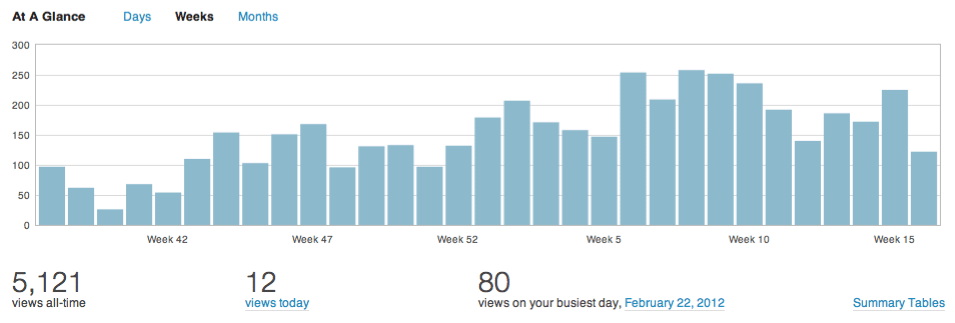
Meanwhile, during the same period, 2x2virtualchurch.com, sponsored by the SEPA-excommunicated members of Redeemer, has grown to more than 200 visits per week, with more than 80 followers and 30 new visitors daily. We’ve pioneered social media in church work and have been gaining respect around the world for our work — interdenominationally and among churches of every size. Look at  2×2’s statistics for roughly the same period (screen shot taken in midday/midweek for last bar):

The concept of SEPA’s web site is flawed. No one needs to submit ideas for review and verification by a central office any longer. There is nothing stopping any church from posting their successes and ideas on their own website. Synod should be encouraging community between congregations without a middle man. Don’t worry . . there’s plenty of work for communications middle managers.

This site is not likely to create dialog. It is rigid in a medium that operates best with freedom. It allows three categories of questions. It limits responses to 50 words. (Most of the questions had close to 50 words.) The message conveyed to a visitor to this site is that their ideas will be monitored, judged and verified — controlled. This thinking is foreign to internet users who are accustomed to the free flow of ideas on Facebook, Twitter and blogging platforms—all of which are community-building platforms.

Why invest time posting to a site that might reject you?

There are other ways to achieve sharing. Start developing content that is helpful to congregations so there is a reason to come to the site in the first place. Begin linking and commenting and taking part in the dialog. Recognize that there are no boundaries to good ideas. Why limit the submission of ideas to just 160 congregations when there is a world of mission out there? It’s the social media way. And it works.

Redeemer would submit its ministry ideas to www.godisdoingsomethingnew.com, but we doubt our ministry would be recognized. It hasn’t been for a long time!

No problem. We post our ideas daily on 2×2. Welcome!

(2×2 be glad to help any church get started in social media. Just contact us! We can have a web site up and running for you in a week, train members to use it and even help you develop content.)

Social Media and Branding Your Congregation: Part 1

Branding is a marketing term. Branding is how people distinguish one company from another. Branding tells your story.


Corporations spend a lot of time, money and attention on branding. They know how important image is in today’s world. They establish lengthy rules and guides to control their public image.

Branding includes things like logos, fonts, colors and the “look” of anything produced by the company. It also includes intangibles — ways of thinking, priorities and behaviors or policies.

Most small or even large congregations never gave branding a passing thought until recent years. But in today’s world, it can be a valuable tool. As congregations look beyond their established communities they will want to be conscious of how they are perceived.

Many churches take part in a branding process without realizing it.

Have you discussed a vision or mission statement lately? That’s an important first step in any branding process.

Key question: What do you want the world to know about your congregation?

  • What is important to your past?
  • What is important to your future?
  • What is there about your congregation’s personality and mission that makes you special?

Once a vision or mission statement is approved, the most common place to start branding is a logo. Many churches have their own logos in addition to logos of their denominational affiliation. Check with your denomination for rules.

Logos used to be black and white and simple. This comes from the days of black and white printing or photocopying. Enter the digital age. Use color.

Decide which one, two or three colors are going to represent your ministry. You’ll be using them in many, many things. Make sure they are colors you can live with!

Use imagery that represents the answers to the bulleted questions above. What makes your congregation unique?  A church near the seacoast might want to use ship, water, or anchor imagery. A farming community might want to use wheat, bread or nature imagery. Urban churches might focus on people, buildings, or multicultural images. There is always the image of your building to fall back on, but your logo is an opportunity to say much more.

Your logo should be something that any member can relate to your congregation’s mission in one simple sentence. Simplifying the complex is part of the art of branding.

Keep in mind how your logo will be used.

  • Signage
  • Stationery
  • Bulletins
  • Newsletters
  • Ads
  • Posters and Fliers
  • Website
  • Avatars (which are square)
  • Video/Powerpoint Backgrounds
  • SWAG (you may want to get some promotional giveaways like mugs or pens)

This list is growing just as our communications options are growing. You may even want to animate a logo for use on the web! There are many possibilities.

There should also be a black/white version. There will still be a need occasional one-color printing.

Surf the internet for examples of church logos. There are some very nice ones.

The logo image is important enough to hire some help if you do not have artists in your community. In fact, it might make the process go easier with outside input.

The process of deciding on a logo can take a while. It should include many people. That always lengthens the decision process. But remember, the logo belongs to your whole congregation—past, present and future. You want the involvement of many. Try to make the process part of your mission conversation.

Dive in and have fun. We’ll address other aspects of church branding in later posts.

photo credit: vapour trail via photopin cc