4/7InkzHVUEQeEdU9vpc1tikzEhChrKmPfvXI-FSDBrBQ

Does Social Media Threaten the Future of the Organized Church?

A veteran parish pastor, now retired, loves to tell the story of a conversation he had many years ago with a young adult congregant who was drifting away from church after years of faithful attendance as a child.

“I don’t believe in organized religion,” the young woman said. The pastor quipped, “Do you prefer disorganized religion?”

Today, that pastor could safely quip, “Not to worry! There is no such thing as organized religion.”

The organized Church is unraveling.

The Roman Catholic Church, the paradigm of structure, is scrambling to bolster its traditional teachings against changing popular sentiment and practices. Its hierarchical structure is threatened by disinterest. There are fewer candidates for priesthood and religious orders. That means the power of the hierarchy is made available to fewer candidates, leaving weaker talent to rise to the top. It should be no surprise that scandal has followed. Without the traditional pool of workers to staff parishes, the foundations of parish traditions — the schools — are closing or merging. They may be more economic but will struggle to provide the parish identity which parishioners value as highly as the quality of education.

Protestants are not immune. They tend to get less media attention, but they, too, face challenges attracting professional leadership, dwindling support, and their share of scandal.

What does this mean to the average believer?

It means the laity will carry a greater burden in maintaining and administering parishes. They will do so with negligible support from any hierarchy. They will be asked to commit  time and resources that begin to outweigh the investment of professional leadership. They will have no support system when there is trouble—and there WILL BE trouble.

As a result, lay Christians will think twice before committing to supporting any congregation. The remaining hierarchy will reward the laity who are strong followers and penalize the laity who step into the leadership void. The faithful will have a tougher time meeting the expectations set for them in healthier days. Since lay involvement is, for the most part, volunteer, they, too, will become fewer in number.

As things deteriorate the blame game will begin. As the stakes get higher, the game will become nastier. The basic tenants of Christianity will be tested.

Much of this prediction is already happening.

If you don’t believe in organized religion, there was never a better time to sign up!

But 2×2 does not like to leave any reader feeling hopeless. While troubling, we view this as growing pains. 

The old structure is crumbling but a new Church is emerging. New life will take root in the ruins of the past.

The internet is rebuilding the foundation of the Church. The laity now have a voice. The hierarchy won’t like it and will try to control it. They will fail.

There are controls, however. The “joy stick” is not in any one person’s hand. We are entering a time when we will be held accountable by one another, not by a hierarchy.

Hang in there, Christians. This is going to get exciting!

photo credit: Denise ~*~ via photopin cc

A New Direction for the Changing Church

The Church cannot escape what is happening in all of society. Things are changing!

Warning signs were posted long ago, but few understood their significance. Church attendance dropped. Length of pastorates shortened. The ministry became attractive as a second career more than a life’s calling. Families, the traditional foundation of parish life, were in disarray.

Church leaders are beginning to discover that the methodologies of church leadership taught and practiced for decades are no longer relevant. Leaders are feeling a bit lost. Their earned “expertise” is of less value.

But there is still a way — an exciting way, in fact.

Marketer Seth Godin wrote today in his daily blog, “The map has been replaced by the compass.”

He goes on to explain that detailed step by step management processes are no longer effective. The world changes too quickly.

Knowing what direction you are going is very important…  even critical. Throw out the map. Follow the compass.

Today’s leaders in the church must retrain. They are not alone. Many sectors of society are finding their classroom education no longer serves them. They, too, must retool their expertise. The church needs to find ways to get new training to pastors and professional leaders who graduated years ago. Seminarians can no longer expect 20 or 30 years of serving a congregation without ongoing continuing education. Other fields (medicine and education, for example) demand it. The church must, too. Congregations cannot wait for a decade before having the opportunity to find leadership able to meet their needs.

Failure to take steps now means setting up pastor after pastor and congregation after congregation for  failure. Expectations will not be met. Conflict will be rampant. Resources will be squandered with vain attempts to right things — the old way.

New professional leaders must be trained for a changing world. Many of yesterday’s tried and true tactics need to be abandoned. Pastors will not need a thick binder of policies as much as they will need a Bible and a compass. This may be harder to teach, but it is necessary if the church is to reach out in mission.

Without a sense of direction, the church will become as archaic as the robes donned for worship.

Let’s get out our compasses and point the church in the right direction. The foundation is laid out in the Bible. We just have to apply the new tools of today’s society.

Learning in the church is truly a lifelong undertaking. It begins with professional leadership.

Are we ready for it?

photo credit: victor|bonomi via photopin cc

20 Questions for Congregational Teams

Today’s Alban Institute Roundtable discussion reviews the proper functioning of congregational staff teams. Susan Beaumont lists 30 characteristics of a healthy team of professional leaders who have separate areas of expertise and overlapping responsibilities.

Most likely, this post resonates with a minority of churches. Most congregations have only one professional leader and even that may be part-time.

But the team concept may still apply to congregations and many of the points may relate. After all, every congregation is a “team” of believers. Even the smallest congregations must perform the basic functions of church and many are doing this with very little outside help.

Small churches unknowingly form “ministry teams.” Let’s measure small congregational teams against 20 of the 30 points made by Susan Beaumont.

  1. Does your congregation have a compelling vision for the future?
  2. Does your congregation take time to hear God’s Voice and find direction in His Spirit?
  3. Is the teaching ministry of your church reaching all members?
  4. Do your members understand the full purpose of “church”?
  5. Are your church goals clearly defined and part of every church activity?
  6. Does your church have the leadership skills needed to reach your congregational goals or do you need to complement your pastor’s skills or availability?
  7. Does your congregation celebrate its accomplishments as a team?
  8. Are the practical needs of the congregation understood and addressed or do you have a large number of members who think the bills are paid and snow is shoveled by magic?
  9. Do you take time as a congregation to examine your ministry for unaddressed needs? Often the needs of the most active members are overlooked!
  10. Does your entire congregation understand that they are part of a team accountable for progress and failure so that either is not entirely attributed to the pastor and select lay leaders?
  11. Is it clear who will plan worship, pay the bills, keep records and care for the property?
  12. Are individuals loved and made to feel important within your congregational team?
  13. Is there a system of checks and balances in all administrative tasks?
  14. Are leadership meetings and congregational meetings focused and productive?
  15. Can your congregation respond to a crisis efficiently?
  16. Is your congregation flexible? Is there room for sharing and teaching jobs or will Mr. Smith always be the treasurer?
  17. Does your congregation take the time to mix up the work teams, so that you can learn new things about member skills and interests and so that members can explore and grow their God-given talents?
  18. Are your members comfortable participants in church life or are they afraid to offer ideas, volunteer, or complain?
  19. Do your members support one another in resolving differences?
  20. Does your congregation have fun? It’s important that members enjoy being together if they are to work well together.

Ambassadors Return to the Road: St. Paul’s, Ardmore

Our own events, weather and other commitments grounded the Redeemer Ambassadors over the holidays but we returned in good force this week with a visit to St. Paul’s, Ardmore. This was our 39th visit.

St. Paul’s has two services with fellowship in between. We entered their fellowship area and were met at an Official Visitor’s Center. St. Paul’s has been working on its outreach to visitors. We had a long talk with several members before the service began. Several members made a point of greeting us away from the greeting station. Pastor McDowell greeted us after the service as well. It is always noticeable when congregations are consciously practicing welcoming hospitality.

One of the greeters said she was a fairly new member but explained that the visitor’s greeting desk was begun about five years ago. They present a visitor with a gift mug filled with goodies as they leave. If you are in the neighborhood, they offer to bring the gift along when making a follow-up visit. We noticed in their newsletter that they accepted about ten members last quarter.

The 10:30 service had about 60 in attendance, including 17 serving at the altar and in the choir. The music offerings were glorious and included a violin solo, which we missed because we entered the sanctuary during the announcements, after the prelude, and an ambitious anthem set to the tune of the “Let All Mortal Flesh Keep Silence.”

The congregation is on its fourth building and has been at its present site since the 1940s. The colorful stained glass windows were saved from previous buildings and incorporated into a colorful sanctuary. The color seemed to leap from the windows’ traditional depictions from the life of Christ to the exposed beams arching across the sanctuary. The color throughout the sanctuary complemented a more reserved chancel area, accented by a small, circular depiction of Christ at prayer. All in all . . . beautiful.

While there were children in the fellowship area, we saw none at this second worship service.

Their bulletin flier was filled with projects and service opportunities.

One of our ambassadors commented that while she misses our own church she really enjoys our church visits. The Ambassadors have begun to look forward to our Sunday morning excursions and fellowship during and after our church visits. We share breakfast together and plan church activities for the week.

Redeemer is not closed; we are locked out of God’s House by SEPA Synod.

Blogging Ideas for March

Keep blogging!

Here are some ideas to help you keep your church blog active during March. It’s only two weeks away. Starting scheduling posts now!

Spread the work around and assign one of the topics below to other social media team members.

Key Scripture Passages

Meditate on Scripture assigned to the Sundays in March and think of one thought or illustration which would help communicate its meaning. Keep it short. Search for a free online photo to go with your meditation. photopin.com

March 4

Psalm 22:27-28
All the ends of the earth shall remember and turn to the LORD; and all the families of the nations shall worship before him. For dominion belongs to the LORD, and he rules over the nations.

Mark 8:34-35
He called the crowd with his disciples, and said to them, “If any want to become my followers, let them deny themselves and take up their cross and follow me. For those who want to save their life will lose it, and those who lose their life for my sake, and for the sake of the gospel, will save it.

Mark 9:7
Then a cloud overshadowed them, and from the cloud there came a voice, “This is my Son, the Beloved; listen to him!”

March 11

Exodus 20:1-17—The Ten Commandments

1 Corinthians 1:19 & 25
For it is written, “I will destroy the wisdom of the wise, and the discernment of the discerning I will thwart.”  . . .  For God’s foolishness is wiser than human wisdom, and God’s weakness is stronger than human strength.

John 2:19
Jesus answered them, “Destroy this temple, and in three days I will raise it up.”

March 18, 2012

Psalm 107:1
O give thanks to the LORD, for he is good; for his steadfast love endures forever.

Ephesians 2:8
For it is by grace you have been saved, through faith—and this is not from yourselves, it is the gift of God. (This passage helped to launch the Reformation. Write about it!)

John 3:16
“For God so loved the world that he gave his only Son, so that everyone who believes in him may not perish but may have eternal life. (Remember the signs that the faithful would carry to the pro-football games, hoping for media attention.)

John 3:20-21
For all who do evil hate the light and do not come to the light, so that their deeds may not be exposed. But those who do what is true come to the light, so that it may be clearly seen that their deeds have been done in God.”

March 25

Jeremiah 31:34
No longer shall they teach one another, or say to each other, “Know the LORD,” for they shall all know me, from the least of them to the greatest, says the LORD; for I will forgive their iniquity, and remember their sin no more.

Psalm 51:10-12
Create in me a clean heart, O God, and put a new and right spirit within me. Do not cast me away from your presence, and do not take your holy spirit from me. Restore to me the joy of your salvation, and sustain in me a willing spirit.

John 12:24
Very truly, I tell you, unless a grain of wheat falls into the earth and dies, it remains just a single grain; but if it dies, it bears much fruit. Those who love their life lose it, and those who hate their life in this world will keep it for eternal life. Whoever serves me must follow me, and where I am, there will my servant be also. Whoever serves me, the Father will honor.

March 25

is Annunciation Day (a reminder in the midst of Lent that the Christ child is coming)

As March ends, Holy Week begins

  • Write about Holy Week, especially the lesser known or observed celebrations.
  • Saint Patrick’s Day—Saint Patrick’s life is fascinating but flooded with shamrocks and leprechauns on that day, few people know much about the real St. Patrick.
  • St. Patrick’s Day is an opportunity to teach the Trinity. That’s what the shamrock imagery is all about!
  • Remind people of Daylight’s Saving Time. We lose an hour on March 11.
  • March 20 is the first day of Spring.
  • Girl Scout Week is March 10-16: feature your girls. Ask them to contribute to the blog.
  • March is Women’s History Month: highlight your women. Ask for a guest blog from women leaders.
  • March is National Nutrition Month—Promote a food drive for local food bank.
  • Easter is in April this year, but you might run a photo of Easter/Palm Sunday in past years. History helps build community.

Write about Lent and Lenten customs.

  • Shrove Tuesday
  • Ash Wednesday
  • Maundy Thursday (meaning of Maundy)
  • Burying the Alleluias
  • Meaning of the Word Alleluia
  • Difference between Hallelujah and Alleluia
  • Foot washing
  • Green Thursday (“grief” Thursday from German tradition)
  • Pretzels and Lent (post a recipe)
  • Hot Cross Buns (post a recipe)
  • Stripping of the Altar
  • Veiling of the Cross
  • Secular Easter customs (rabbits, eggs, flowers, candy, etc) Newcomers to America have a tough time with these. Help them!
  • Liturgical Colors for Lent and Easter
  • Write about the links between Passover and Easter and overlapping customs of the related faiths
  • Explain a Seder

Just do a search engine search for these topics to find information.

Make friends with your search engine!

Use your search engine to find meaningful art to discuss. Play around with terms. Different things will come up. For example, start with “art Maundy Thursday”. Then try “painting Maundy Thursday”. Then try “art Jesus foot washing”.

Poetry is an oft-overlooked medium. Plug in “poetry Lent” or “poetry Easter” and help your readers find meaningful resources.

Solo Pastors Must Be Evangelists

Most small congregations function with solo pastors. Solo pastors must be evangelists.

But some solo pastors rely on miraculous intervention for church growth. Denominations even have a term for this ministry style—caretaker ministries. Caretaker ministries are a terrible idea! They are an insult to mission of the church. In addition, they are at the heart of much church conflict.

The problem: congregations are not in on the “caretaker” secret. Lay people think they have called a pastor equipped to help with all aspects of ministry, including evangelism. They are unaware that their caretaker pastor has just one goal—to appease a congregation’s current membership for however long it takes for them to fail. The reason stated with confidence: the culture and demographics can no longer support the neighborhood church.

So here is what happens. The caretaker pastor faithfully serves needy members, visits regularly, prays with them, and becomes loved and respected for the personal attention given. Meanwhile, lay leaders, who are responsible for the overall health of the congregation, become concerned that the congregation is not fulfilling other aspects of vital ministry. They begin pressing for evangelism, educational services and ministry efforts the caretaker minister had no intention of ever providing.

The needy congregational members see escalating conflict as an attack on their beloved caretaker. They are content and unconcerned with church growth and budgets. Suddenly, a congregation is divided. All the players are good people with worthwhile goals, but lines are soon drawn—”good guys” vs “bad guys.”

A predictable scenario: the caretaker pastor will insist evangelism is the role of the laity.

Laity, on the other hand, think that professionally trained pastors are in a better position to conduct outreach.

A corporation does not unleash their sales force without intense training. If the Church is to rely on lay evangelists, it must give them similar support.

2×2 has experience with this situation. Over many years, we had conversations with our clergy pressing for services that might grow the congregation. We became familiar with the professional reasoning that ended up with inaction on anyone’s part.

Then one day in 2006, we found ourselves with no pastor and no hope of cooperation from our denomination in finding professional leadership. We crafted our own initiative, put the reins in the hands of untried but enthusiastic members, and pledged as a congregation to support their efforts. They met with early success and were even able to find qualified professional support (help our denomination insisted could not be found). Remarkable growth resulted.

Our denomination responded by condemning our work. The only reason given: it was not done in cooperation with the Synod Mission Office.

How silly! Congregations are not required to ask permission to invite people to come to church.

Can the Church have it both ways? Can they insist that lay people are responsible for outreach and then complain when clergy don’t lead the outreach?

If church mission must be “in cooperation” with church professionals, then they must take responsibility. They must provide pastors who roll up their sleeves and lead evangelism by example and by training, equipping, and encouraging laity—and they must be held accountable.

Denominations must insist solo pastors engage in evanglism. Do not wait for years of failure before implementing steps for success.

Quit blaming demographics and culture. Christianity has been standing up to these forces from the start.

Christ’s answer to the challenge was to empower the lay workers.

A Special Easter, Ascension or Pentecost Service

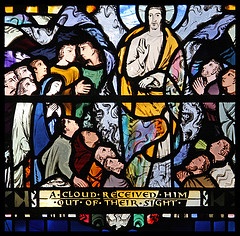
The 14 Stations of the Risen Lord

The Roman Catholic tradition has long featured the Stations of the Cross. They are part of Catholic architecture.

Five or six years ago, we found photos online of a church with windows that depicted the 14 Stations of the Risen Lord, an interesting variation on the Stations tradition. If memory serves, the church is in Washington State, but a search online today did not help us find the photo references.

At that time, we researched some material to create a service of scripture, meditation, prayer and song which follows the 14 Stations of the Risen Lord. We regret that any references we used at the time were not recorded.

But we thought small churches might enjoy this variation for special observances of the Easter, Ascension or Pentecost seasons.

The attached PDF is prepared in printer’s spreads, which means the pages are in position to be printed and folded into a booklet. They are, however, numbered, so you can follow the Stations by number.

All the stations are biblical except one. The windows depict the Risen Christ appearing to his mother, Mary. The Bible does not record this, but scholars have long debated its likelihood.

Please feel free to choose your own hymns and prayers or even to add your own meditations. This is presented as an idea for small churches to adapt for creative worship.

We will be glad to add attributions, if they are found. Just drop us a comment, please.

photo credit: Lawrence OP via photopin cc

Learning from Our Unique Experience as A Virtual Church

2×2 is the voice of Redeemer, small congregation in the East Falls neighborhood of Philadelphia, Pa. Our denomination decided for us that we could no longer fulfill our mission and seized control of all our property and financial assets for their own use. They locked the Christians of East Falls out of the church, we can only assume, so that they could more easily have their way. Our church building, under SEPA management, has been an empty witness to Christianity for going on three years — a definite failure to fulfill mission!

Redeemer, however, continues as 2×2.

We were not about to abandon our mission under such selfish circumstances. We had spent several years fostering a world view as we had visitors and members from all over the globe. This made it easier for us to take our ministry online, but we had no idea what to expect. Thinking globally and acting locally, we are discovering that our mission can impact the world.

We no longer worry so much about Philadelphia, although we are ready at any moment to reopen our physical church. We think our neighborhood still counts in God’s Kingdom.

Meanwhile, we are beginning to hear from congregations far away. A mission worker in Eastern Europe thanks us for our social media ministry. A pastor in Pakistan sends us regular updates on his congregation’s efforts to reach the poor in remote villages. A church in Africa thanks us for our ministry and describes their need to care for orphans.

Having been ousted from our denomination, we are no longer cloistered within Lutheranism. We are in regular contact with churches and church leaders across the United States. A few have provided both financial and spiritual support. Some have interesting projects and experiences which we incorporate into our ministry. We are more “in full communion” than when we were part of a “full communion” denomination — and this was achieved without decades of dialog!

At home in Philadelphia, we have become friendly with several parishes we knew little about when we were cozy in our own property.

Most congregations, near or far, are looking for little more than attention and prayer, which we are able and happy to provide.

We did not know what we were getting into when we started our virtual ministry, but it has opened the door for new mission and new possibilities. We are no longer just talking about mission but have  never been more actively engaged.

Meanwhile, our own denomination behaves as if we never existed.

Why Church Growth Is So Elusive

Most churches never set out to grow.

Churches talk about growth all the time — even when there is little or no growth evident across a denomination. Denominations can even adopt airs of successful growth in their convocations and publications, camouflaging double digit decline.

Why is growth desirable? Is it because of the Church’s burning need to save souls, or is it to meet the escalating costs of Christian community? There is surely some of both in the answer and other options. Nevertheless, it might be worthwhile to ponder what is really spurring the current demand for growth and change.

The problem is that we are measuring success by statistics that no one really set out to fulfill.

Imagine how big every church would be if for the last 100 years every congregation accepted 20 new members net (allowing for natural attrition). Twenty new members each year should be a modest goal for a church that is growth-oriented. It should get easier every year and explode exponentially!

It rarely happens!

Most churches and church communities are designed to fill the needs of the founding members. Growth to keep up with the economy was not in their crosshairs. Special ministries to changing communities were not what most members signed on for.

Most congregations and clergy are content when numbers provide a sense of stability.

Look at the average church building erected 100 or 200 years ago. Most were not built with growth in mind. Many were situated on donated land and built to fit the lots and house the existing worshiping community. The biggest number in mind was how many might show up on Easter morning and Christmas Eve.

When growth happened, older buildings were abandoned, new ones built or wings were added. In some cases the only option for growth was to add worship services. But these days services are often added for convenience or worship style options — not to accommodate growth.

If growth is so important, why isn’t it planned from the beginning?

When are extra pastors added? Answer: when growth has already happened and the congregation can afford an additional salary. Extra hands are rarely sought when the mission work justifies it but only when there are already more service needs and a foreseeable budget to sustain those existing needs.

If growth is truly a goal and more hands are needed to achieve growth, we have to start thinking outside the foresight of our founding matriarchs and patriarchs. We have to return to true mission, not economic salvation.

We have to provide help where it is most needed — neighborhood churches. Yes, even the small ones. That’s where true denominational growth will take root.

The temptation for denominational leaders is to look for easier success formulas and provide the strongest support to the congregations who can sustain their current budgets—for the time being, at least.

We have to take some chances.

Where do we start?

photo credit: BurgTender via photopin cc

An Easy Easter Play for Small Churches

Here is an Easter Play written for the smallest of churches. It is extremely flexible. You can stage it as simply or elaborately as you like. You can pick and choose your own music . . . or use none at all.

It can be used as the format of a worship service for mid-week Lenten or Sunday Service.

The play calls for a minimum of four actors, but you will see that a few more can be added. Each actor delivers a soliloquy so there is no need for hours of rehearsing dialog. Your actors can even read their parts if they don’t want to memorize lines. Couldn’t be easier!

This is 2×2’s Lenten/Easter gift to you. Enjoy! Were You There?

Were You There?

2x2Avatar2Consider Subscribing to 2×2

2×2 is a project of a small church. We know what it’s like to review resources that call for four-part harmony an organist and choir director when all we have is a few people willing to do their best.

We started developing our own resources and sharing them!

2×2 resources can be easily led and can be adapted to use with the skills of the people you have.

2×2 offers occasional dramas and song ideas, but we also have two weekly features.

  • A slideshow (entirely editable) that complements the lectionary and liturgical year. Individual slides can be used in church bulletins and newsletters or on your church web site.
  • An object lesson to use with adults or with a mixed group of adults and children. Object lessons are a great opportunity for small congregations to learn together.

We also encourage small churches to begin using social media and have several series with tips and tricks.

Our little church reaches between 2000 and 3000 readers each week—tripling our reach each year. We are happy to help others do the same.

Please consider subscribing and sharing! It’s free!

Thanks!

Blessings for your ministry!

Subscribe to Blog via Email

Enter your email address to subscribe to this blog and receive notifications of new posts by email.