4/7InkzHVUEQeEdU9vpc1tikzEhChrKmPfvXI-FSDBrBQ

Judith Gotwald

Ideas for Churches to Blog About in April

Here are some ideas to help keep your blog active next month. Start writing now!

April begins with Easter but most of your writing about Easter should have happened in March.

Recap your congregation’s Easter. Include photos or video.

Explore weekly scriptures and themes:

April 15, 2012
Acts 4:32-35  •  Psalm 133  •  1 John 1:1–2:2  •  John 20:19-31

The theme of the second Sunday of Easter is fellowship. The first lesson deals with the distribution of wealth among the early Christians. The Psalm continues the theme: “How very good and pleasant it is when kindred live together in unity!” The apostle John also talks about the importance of fellowship in Jesus. His discourse shifts to a discussion on sin and includes the familiar words of confession used in many liturgies. The Gospel story is the Thomas, the Doubter, story which concludes with one of the first Christian creeds, “My Lord and my God!”

Write about your congregation’s fellowship outreach and how your congregation works together.

April 22, 201
Acts 3:12-19  •  Psalm 4  •  1 John 3:1-7  •  Luke 24:36b-48

The impact of Jesus and the Resurrection is a theme of third Sunday of Easter. Sin is overcome by forgiveness and Jesus’ sacrifice. The Gospel is another story about a visit from the resurrected Christ, one where he proves his return to human form by eating fish with his disciples.

April 27, 2012
Acts 4:5-12  •  Psalm 23  •  1 John 3:16-24  •  John 10:11-18

The theme for the fourth Sunday of Easter is Good Shepherd Sunday. Explore some art and poetry based on the 23rd Psalm. Several well-known hymns parallel the verses of the psalm. Write about the hymn history of these or other Easter season hymns. The sacrifice of the shepherd, founded in love and caring, can be explored. What examples of this type of love can you find in your ministry?

April 4 is the anniversary of the assassination of Martin Luther King, Jr.
April 14 is the anniversary of Lincoln’s death. Tie the two together.

April 15 is the tax filing deadline in the United States. Tie the need to fund our government with the need to fund our church.

April is Autism Awareness Month. Explore ministry to families with autism.

April is Poetry Month. Feature some religious poetry. Hymn lyrics count.

April 22 is Earth Day. Write about stewardship of the earth. Tie it to service projects.

Look ahead to Pentecost. Will you have a confirmation or first communion class? Feature the class members.

School activities and celebrations peak toward the end of the month. Are there concerts, plays or picnics your members might like to support?

Does your congregation have graduates to honor?

Many churches/denominations have spring convocations. Include news or explore issues that will be discussed.

Start promoting your Vacation Bible School. Write about the theme or any events. Interview teachers about why they are willing to teach.

Start promoting your Church Camp.

Review the activities of various church committees and groups. Ask them to guest post!

Join the Crazy Ones! It’s never boring!

Our little church has been called a lot of names over the last decade and put through our own share of hell — by the people who are supposed to support us.

Despite the years of degrading name-calling we are really just a community of believers who wants to worship in our own church, in our own neighborhood, fashion our own ministry with our own “discernment,” paid for with our own resources — the very things promised to us by the ELCA. As we approach our third Easter locked out of our house of worship, we revisit a 1990s quote from Apple. We don’t think we are crazy or geniuses. We just believe in our mission — what all church members are asked to do.

Enjoy! We also made a Wordle out of the words — just for fun.

Here’s to the crazy ones. The misfits. The rebels. The troublemakers. The round pegs in the square holes. The ones who see things differently. They’re not fond of rules. And they have no respect for the status quo. You can quote them, disagree with them, glorify or vilify them. About the only thing you can’t do is ignore them. Because they change things. They push the human race forward. While some may see them as the crazy ones, we see genius. Because the people who are crazy enough to think they can change the world, are the ones who do.  

5 Ways Social Media Will Change Your Church’s Life

If your congregation wisely chooses to invest time and passion in social media, be prepared for many things to change. We’re not talking about self-centered Facebook prattle; we’re talking about online interaction that looks outside your parish to the community and, by the nature of the internet, the world.

This may be the hardest thing for the Church to grasp. The internet connects individuals with the world. There is no intermediary. No church council, no pastor, no synod or its equivalent, no bishop, no national church can control congregational interconnectedness.

This means that congregation’s must be more mindful of  things which may have been neglected. While it is easy to reach the world, one mission of the individual Christian community will become more intense—the care and nurturing of individual Christians.

  1. Congregational Education is vital. A congregation must be confident in knowing who they are and what thy believe if they are to engage neighbors or the world in their mission. This has always been a focus of parish life, but educational components of many churches have been dropped in the last few decades. As long as the focus of congregational life was local, it didn’t seem to matter. This needs a remedy. Education must be intertwined with every activity.
  2. Social Awareness must be nurtured. You will begin to hear from Christians from places you never considered as being Christian. Congregations must understand, for instance, the challenges Christians face in Islamic nations, where Christians can be ostracized from their families or jailed. While freedom of religion is taken for granted by many Americans, some religions maintain cultural holds on their people even IN America.
  3. The Church needs to become attuned to the minute causes of community as well as the big picture. We live in an age where anyone can bring a cause to the public’s attention. Yellow ribbons, pink ribbons, donation cans, something-a-thons become very focused. Keeping up with them will be an ongoing mission challenge.
  4. Personal faith must be deepened. Savvy companies teach every employee that they are a representative of their company culture. The Church needs to foster the same sense of ownership among members. Every member reflects on the congregation. Congregations will want their members to be knowledgeable and engaged as representatives of their church.
  5. The biggest change is that many congregations will be able to rebound from survival mode and see themselves as important. Their interconnectedness will give them energy, resources and renewed purpose.

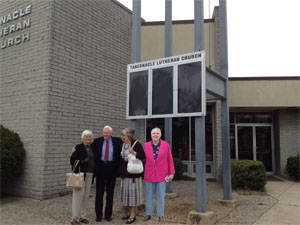
Ambassadors Visit Tabernacle in West Philadelphia

The Redeemer visited Tabernacle on 58th and Spruce in West Philadelphia for a spirited two-hour worship.

Rev. Carlton Rodgers led worship punctuated by music from many genres, with a fine seven-member choir, which the congregation often joined in song. Pastor Rodgers has been serving Tabernacle for nine years.

The pianist, Peter Charalambidis, was excellent and moved effortlessly from liturgy to gospel song to praise hymn to mainstream hymn. A deacon, Samuel Barham, led much of the service and singing with a resonating voice.

The pastor referenced hardship with no specifics. One member told us they had recovered from two fires. We saw on their website that one had occurred in 1969 and destroyed their large stone structure. Redeemer had also recovered from a devastating fire so we know something about recovery. We rebuilt our sanctuary without any outside help and went on to build an education building a few decades later, also with no synodical help.

Tabernacle is a “transformation” church which means they are receiving some special attention in reviving their neighborhood ministry. Our congregation had undergone a transformation that synod refused to recognize, probably because it was largely lay led, but we had begun to attract many new members with dedicated work of our membership.

The people of Tabernacle made a special effort to greet us. The passing of the peace was not part of the service but we were passed the Peace of the Lord by almost everyone we passed as we left the sanctuary.

Attendance was about 30 although we made no effort to count. There were about five children and youth.

The congregation led prayer with a number of people leading lengthy and heartfelt prayer requests. A book we are about to review, Scattering Seeds, points to the ability of lay members to lead unscripted prayer as a sign of congregational vitality. Tabernacle has that.

The congregation seemed to enjoy each other’s company and many plans for congregational events were discussed.

Make Way for the Non-geographic Future Church

We are polishing our crystal ball again. This is what we see . . .

The Church of tomorrow will have only two sociological geographies — the local church and the worldwide church. Intermediary layers will be defined by local congregations as needed — not by hierarchies.

Denominations and regional authorities will become expensive drains on local churches with waning benefits.

They and national church offices — at least as we know them today — will become archaic, outliving their purpose and mission. Once the hub of thought leadership, educational/resource publishing, and social ministry implementation, they are already being phased out by economic realities. Any congregation can form alliances with a multitude of social causes locally, nationally and internationally. Any congregant can publish.

Congregations will become identified by their works which will make them more relevant and help them grow. If they are to survive they will find vitality — quickly!

Congregations will soon realize that the dollars they are sending to regional bodies are better spent in ways they can monitor and become involved with directly. Giving will improve when results are more visible.

This is all the result of the internet.

Every congregation has the same power at its fingertips. Soon churches will realize they will get more help and better advice if they bypass the systems of the past.

Part of this is driven by economics of scale. Business has a saying: “Go big or go home.”

The church will discover this, too.

In the past, each individual judicatory duplicated similar services supported by its own 100-200 congregations. Better services will be supplied by pooling resources of more churches than one regional body can support. Local churches will bypass judicatories and go directly to enterprising thought leaders who no longer need denominational affiliation to gain an ear.

The economic failure of judicatories will return talent now stagnating in management to work in congregations.

The best ideas will be too expensive for regional bodies to implement. They will, for a while, keep trying to do things the same way . . . and fail. Frustration will turn the tide.

Denominational lines will blur as the internet helps ideas cross traditional lines. Congregations will find their own sister congregations . . . and they could be anywhere.

In the past, denominations might have worried that doctrines and traditions would be compromised without layers of oversight. No longer! Everyone has access to the same technology. This will create its own checks and balances.

Turf wars are likely at first. They could be ugly. But the realization that hierarchies are no longer needed will begin to set in.

For a while, middle management judicatories will flex muscles, trying to rein in congregations as their power weakens. There will be casualties that will be an enduring shame…but a new church will emerge.

The local congregation will become more important than ever. It will be the local hands-on expression. They will display renewed vitality as they tap resources beyond the offering plate. They will identify mission and form alliances with like-minded organizations.

We’ve spent decades in interdenominational dialogue to achieve what the internet will achieve in just a few years!

The coming Church is going to be exciting!

photo credit: frompandora via photopin cc

Laity Need to Learn to Speak the Clergy’s Language

Talking with clergy lately, we heard some terms we doubt many lay people have ever used or heard.

Some terms universally understood among clergy describe congregational health. These terms include “hospice,” “caretaker ministries,” and even “undertaker ministries.”

Ask a lay person, “Is your church on hospice?” and they will probably look puzzled. As it dawns on them that hospice is a service provided to dying people, they will start to realize that the clergy person is asking if their church is dying and unlikely to receive meaningful support from their denomination.

They will keep listening as they recover from shock and anger sets in.

“Who’s your pastor?” might be the next question. “Is he/she part time?”

If the answer is “Yes, that’s all we can afford right now,” the clergy might nod and mutter, “Ah, —sounds like you have a caretaker ministry.”

The lay person has probably never heard this term either. When it is explained that “caretaker ministers” are assigned to churches to hold members’ hands as their congregations die, the sense of shock and anger is rekindled.

With any sensitivity, the clergy person does not use another term used among clergy — “undertaker ministers.” This type of minister has NO intention of growing a congregation’s mission and the assignment, in all probability unknown to the congregation, is that this minister is there with the denomination’s understanding that the congregation’s ministry be brought to a close with as little muss and fuss possible.

This is a prescription for church conflict.

Laity NEVER consider their congregations as dying. They are usually aware that they face challenges, but when they call a pastor they are ALWAYS looking for help with their ministry. Lay people understand that the mission is to serve. They think every clergy person they talk to or call — even on a part-time basis — has congregational health and outreach as their goal.

Laity need to use a bit of “clergy talk” when calling their ministers. If they sense the candidate understands that the mission under consideration is to close the church—not grow the church—the congregation needs to move on and make sure their denomination understands that the congregation considers mission and ministry the goal.

It might help if we all spoke the same language!

photo credit: aldenjewell via photopin cc

LinkedIn Can Help Church Pros Connect . . . If They Use It

LinkedIn is a powerful networking tool similar to Facebook but with a professional focus.

It packs a powerful punch for anyone wanting to connect with people in a specific sphere of interest. You can use LinkedIn to find professionals who might be willing to help you. Say, for instance, you are looking for someone who has worked in ministry with disabled people or who can preach in Arabic. You can look for people with those specific skills.

Conversely, you might have a skill you feel is underused. You can feature your special interest in your profile.

LinkdIn is an “opt-in” medium. The user chooses to particpate in the online community. Users can look for connections, accept referrals, and ask for introductions.

LinkedIn users can join groups . . . also entirely opt-in. Professionals can only connect by getting someone they already know to introduce them. Even then, the person of interest must accept and initiate any resulting communication.

It’s a fairly safe way to form relationships with peers that can be helpful in your work.

One would think that anyone going to the trouble to complete a LinkedIn profile would be serious about using this amazing networking tool. Most groups are filled with names willing to be found or to help others in their searches.

2×2 found a very odd exception. We looked at a group formed around a Protestant denomination. The group had hundreds of members with very detailed profiles. Most of them had their identities shielded!

What a waste of communication potential!

Again, the Church fails to understand how the tools of today’s world can be used in mission. What are church LinkedIn members afraid of? Why bother joining a professional network and then back away from any ability to take advantage of its potential?

It’s crazy! Back to the cloister!

photo credit: JeremyMP [Catching Up] via photopin cc

Here’s an idea for SEPA . . .

The laity need a voice.

The Synod is dominated by clergy. Their voices and interests outrank lay concerns simply because they are involved more with leadership on a daily basis and somewhat dependent on their standing with the Synod for career advancement and security.

Many lay representatives at Assembly are new to church governance and follow their pastors’ lead.

The Synod Assembly agenda is tightly scheduled, leaving little room for lay delegates to explore ideas, which might be old to clergy but are new to them.

Lay people who become involved at the synodical level must first pass through a nominating process that is reviewed largely by clergy or lay people who have already passed muster.

Redeemer, years ago, attempted to nominate a lay member and received a phone call from a clergy representative who said they’d consider our nomination only if we “felt strongly” about it. Puzzling! Why have a nomination process?!

Generally, there is little contact between church leadership and the people they serve. Contact is often orchestrated toward SEPA leadership’s objectives.

One dedicated lay person once shared that they went to an Evening with the Bishop excited to be part of dialog. He left, frustrated and disappointed, after an hour of listening to the bishop talk with no attempt at interaction with attendees.

Redeemer’s experience with the last two bishops was that they wanted congregational interaction on their own terms, subject to their own timing, agenda and control. Congregational leaders, who had attempted dialog for years with no response, were ignored — and eventually replaced by decree.

So here’s an idea. What if there was an annual LAITY ROUNDTABLE, say two months before the Annual Assembly, where ANY lay person could attend, discuss challenges and formulate ideas and proposals to bring to the Synod Assembly’s attention? The retreat could be one-day, on a Saturday perhaps, and should be entirely lay led. No clergy allowed. Trust your lay people!

The LAITY ROUNDTABLE would serve no purpose but to review ideas and proposals of individual congregations for inclusion on Synod Assembly’s agenda.

There would be added benefits:

  • Laity would understand common challenges and be inspired to find solutions.
  • The interests of the churches would be lifted up.
  • Lay involvement and leadership would grow.
  • Churches would feel more involved with the denomination which can only help SEPA.
  • Large churches and small churches would interact as equals.
  • Community would expand as laity come to know one another without pastors as gatekeepers.
  • Interchurch problem-solving would pump some fresh blood into our church . . . and we still consider it our church even though we have been kicked out — without a voice!

A Return to the Days of Muhlenberg

The Lutheran Church recently celebrated the 300th anniversary of its American patriarch, Henry Melchior Muhlenberg.

Muhlenberg was a German pastor who came to America’s East Coast at a time when its forests were first being cleared for farms. There were pockets of German settlers longing for pastoral help in establishing congregations that worshiped in their traditions.

Muhlenberg came to Pennsylvania and began founding churches. But he didn’t sit still. He planted churches all along the East Coast. Most congregations had only an itinerant pastoral presence, perhaps as little as once or twice a year. And they grew.

Ironically, after 300 years, we are at a similar time in history. The Lutheran Church is well-planted but its foundations are shaking. After a century of working to unite, we are subdividing. There is no unifying voice, no forum to bring us together.

Corporate thinking of previous decades may be responsible for the current crisis. As populations shifted to the suburbs, consolidation for economic benefit was favored. We began to measure our churches’ value by their ability to park cars.

We are learning today that the neighborhood church is vital. People want to worship close to home where the sense of community truly impacts lives and where they can make a hands-on difference.

But damage has already occurred. During the affluence of the 1980s, congregations that thrived through the hardships of the Great Depression, began to struggle. Part of the struggle was the need to fund a full-time pastor at higher levels of compensation than they had ever known. That in itself became the focus of church life . . . and it’s no wonder people became less attracted to church.

Small churches can survive this, but it will require fresh thinking.

Worship and mission must return as priorities. We have to think as creatively as our colonial foreparents thought.

It is time, once again, for the structure of the local parish church to change.

We must concentrate on the work that needs to be done, not the positions that must be compensated.

Clergy, it must be recognized, have a vested interest in the solutions they propose. Pastors deserve compensation, but looking for larger salaries from one congregation may no longer be possible as the norm. Churches that admit they cannot do this need alternatives. Locking church doors is NOT the answer.

Lay leaders must speak and be heard. Their forums are few.

Recognizing Jesus

Too bad none of the disciples were artists! They could have helped us all with one of the biggest questions of our faith. What did Jesus look like?

Biblical evidence is that Jesus looked like most people in Galilee and Judea. It took the kiss of Judas to help soldiers distinguish him from the others in the Garden of Gethsemane.

Artists over the centuries put their imaginations to work depicting Christ until the images began to look startlingly similar — however unlikely.

The earliest Christians didn’t seem to care about appearances. They had first-hand accounts of the disciples and apostles. The first depictions surviving today are from the 200s and 400s and are not very detailed. In fact, the depictions show Christ in action. His physical appearance is secondary to his works. They are like cartoons in simplicity.

The Eastern Church and its emphasis on icons in worship began to concentrate on the details of Christ’s appearance. Although they are stiff and representative, they are also beautiful, designed to be contemplated.

The Western church developed a genre of story-telling and teaching in church adornment and architecture that took the Eastern representations and made them breathe with realistic features in familiar biblical settings. The depictions were stereotypical and stiff in the Middle Ages but became more realistic with the rise of humanism. Jesus became easily recognized with features recognized to us today.

Modern people still want to know what Jesus looked like. We are accustomed to treasuring photographs, which is a very new historical phenomenon — not even 200 years old.

Our curiosity is insatiable. Recently anthropologists decided to answer this question once and for all. They used forensic methods to analyze excavated skulls to rebuild the face of the typical Jewish male who lived in Israel in the era that was unknowingly passing from BC to AD.

Now we know!

Jesus looked like the typical Jewish male of 2000 years ago.

Jesus looks like us today.

Jesus will look like our descendants to the thousandth generation.

But does it matter? Jesus asks us to see him in each other. Treat others well and you will be honoring me, he tells us.

No matter who takes the brush or chisel in hand, we don’t have trouble recognizing Jesus in art. It’s harder to see him in each other!