One of the great things about being relatively small and unknown is that the cost of failure is not that harmful. — Srinivas Rao
This business writer goes on to explain why innovation comes from small companies.
Small companies have the leverage to dare.
Small churches have the same leverage—the leverage to dare.
Would the big flagship church in the mammoth building on the corner of Broad and Main change the liturgy dramatically? No, too many people who like things just the way things are would leave with ruffled feathers.
Do bigger churches start innovative outreach ministries? Sometimes. But they are more likely to use their resources to add another pastor or tie into some established social ministry project supported by other big churches.
Small churches have the power to rock the world—the same power once placed in the hands of 12 disciples.
We small churches can change the worship time and survive the grumbling.
We can include non-English words in worship and not worry about losing 10% of the congregation.
We can do one-on-one ministry because we are more likely to personally know the life challenges of each person facing the altar.
We can fund a small foundation and charge it to do spread innovative ideas on the web without a pastor feeling his or her territory has been invaded.
Some 2×2 readers who live in the Middle East are being seriously impacted by the recent violence prompted by a single video posted months ago on the internet that was suddenly discovered by Muslim viewers all over the Middle East. Most Americans have seen no more than one frame in the news magazines. We are told it ridicules Mohammed.
Behind the rage is the misunderstanding that one person’s view does not necessarily represent an entire nation’s sentiment. It is the view of the people who made and posted the film. Americans, for the most part, never noticed it sitting out there in “American” cyberspace.
So blood is spilled and lives are lost because the views of very, very few are projected onto the entire American nation. The lives of Christians in predominantly Muslim countries—not an easy position even in peaceful times—are disrupted needlessly.
Other nations view America as a Christian nation. It is undeniable that our founding values were rooted in the Christian understandings of the time, but Americans know that freedom to not be Christian is also part of the American tradition. The fabric of American life is a tight weave of many religions.
The actions that incited the current violence were not the actions of America—a difficult point to make amidst the rhetoric of gunfire.
Most religions are about good values. Christianity is centered on love. But the message is all too easily put aside by the desire to be right and the desire to dominate.
We don’t have to go to the Mideast to see these powerful anti-Christian sentiments displayed by people who consider themselves to be religious. It is the stuff of history — in the early church, in the Crusades, in the Reformation, in our own era of slavery and Indian wars. We can see it today in our local churches—the need to win at any cost.
That cost is the abandonment of our very purpose.
We are praying for the Christians in Middle East just as hard as they are praying for the Lutherans in East Falls.
Yesterday I received an email from a young fellow who makes videos with passion. He had a brainstorm and he was soliciting help. He wanted to make a video of people telling their “Why Story.” He made a little video imploring people to send a short video with an answer to the question, “Why do you do what you do?”
I had never taken a self-video before. But I spent about a half hour creating my Why video. I had never responded to a video by posting a film to YouTube before. But by the end of the day I had mastered that. Took four tries.
This morning I came across a video of a TED conference presenter, Simon Sinek. He gave a 17-minute talk on how the Why question drives all successful enterprises. Watch it.
It seems the Why question is pretty important. How well does your church communicate your “why”?
Why do you gather together on Sunday mornings? Why do you want others to join you? Why does faith matter in the lives of your individual members?
If your only answer is “so that we have enough financial support to keep going,” you will not succeed as a church.
The definition of the word “faith” is the foundation of any remaining schism between Catholicism and Protestantism.
Up until 1522, faith meant agreeing with church doctrines.
Martin Luther redefined the word. He wrote, “Faith is a living and unshakable confidence, a belief in the grace of God so assured that man would die a thousand deaths for its sake.”
This definition requires a level of commitment for each Christian that surpasses the ordinary. Doctrine does not rule us. Faith in a forgiving and merciful God rules us.
How many of us would die a thousand deaths, relying on the grace of God?
The Protestant Reformation was powerful because it interpreted scripture with fresh eyes.
As great a moment as this was in religious and cultural history, it was never expected to be the last. The leaders of the Reformation were scholars, explorers, and discoverers.
This challenge to an accepted definition of one word gives us a freeing foundation to think and act boldly within our faith, knowing that we serve a merciful and gracious God — not any one thinker of any age — no matter how great.
If life was always peaches and cream, we would have no need for religion. We turn to God in weakness to find our strength.
So in comes the Church.
Church leaders will explain God’s ways. We will have a roadmap for solving problems.
Church leaders are rarely at a loss for words when it comes to advising congregations. They preach guidelines for peaceful and productive lives in Christ.
Followers nod in agreement. They file out of church assemblies with a sense that they are leaving a place where people care about one another and will follow God’s Word.
A pastor recently shared his story.
He had listened to a bishop address his synodical assembly with words of peace, admonishing them to work with one another to resolve differences in accordance with the Scriptures. It was a moving message which drew a standing ovation.
This pastor and his congregation were having some issues with Synodical leadership. He was encouraged by the message. He managed to buttonhole the bishop before the end of the Assembly. He told him he was moved by his sermon.
“Let’s do it,” he said with enthusiasm. “Let’s get together and talk through our issues.”
The bishop responded. “Uh, OK, why don’t you write an agenda and send it to my office. We’ll set up a meeting.”
The pastor was excited. He drafted an agenda of the issues his congregation wanted to discuss and sent it to the bishop’s office.
Months went by with no response. At last, the bishop responded that he had been advised that the issues might end up in court and he should not meet with the congregation.
You read that right! The issues MIGHT end up in court. So what’s the point of talking.
This parallels Redeemer’s experience. Bishop Burkat had a lawyer at her right hand (literally) at her first meeting with Redeemer leaders.
This attitude of—not all, but more than one—current bishops in the ELCA violates the Gospel and is a dereliction of their assigned duties. They are no longer shepherds but predators. Clergy’s key advisors are lawyers—not more experienced pastors, not people with a spiritual gift for wisdom, and not the Bible.
The Gospel is clear that we are to attempt to work out differences without the courts. But in today’s church, leadership is not looking for resolution. They are looking for the WIN.They are looking to be seen as powerful. Resolution might call for ceding some power. Opponents must be defeated!
The Church is following the way of the world—exactly as the New Testament (both Gospel and Epistles) cautions. It is crippling the Church, one little conflict after another. Every WIN by intimidation is a defeat for the Gospel.
“Resolution” is so distasteful that the word is avoided. SEPA Synod is billing an upcoming workshop as conflict “transformation.”
Today’s Church does not believe its own scriptures.
It is a sad day when the only thing separating the Church from the world is tax exemption and immunity for its actions—but not those of its opponents—under the Bill of Rights.
A recent blog written for nonprofits addressed the difference between involving supporters or engaging supporters. Read it. It applies to faith communities.
Congregations have levels of involvement.
Attendance at functions.
Attendance at worship.
Involvement in education.
Support with offerings.
Greater support with offerings.
Participation in worship (reading the lessons, taking the offering, communion assistance)
Participation on committees and governing boards.
And then we come to outreach, a most fundamental reason for gathering together in Christian community.
There are levels of involvement here, too. Many congregations never pass levels one and two.
Attendance.
Support with offerings.
Active support to raise money. (Bake sales, car washes)
Support of social service agencies. (Walk-a-thons, Charity runs)
Assisting organized charities or social service agencies in events (helping with a building project for Habitat for Humanity, traveling to disaster areas to help with clean-up)
Active involvement in a cause (running a day school, organizing a food pantry, visiting a prison, cooking and delivering meals to the homebound)
This last level reaches the highest level of commitment—hands on engagement in ministry.
In the Church, we often settle for coins in the coffer when sweat on the brow is better stewardship.
It’s the difference between involving people in ministry and engaging them. It may make the difference in the vibrancy of your congregation.
Think about it! No one talks about their offerings. People talk about the things they actually do! What a great way to tell the story!
How might your congregation engage your members in ministry?
Yesterday, the Southeastern Pennsylvania Synod of the Evangelical Lutheran Church in America announced an upcoming workshop for congregations. We first saw this listed as Weathering the Storm, but notice it is now advertised as Weathering the System.
Weathering the System
October 27, 9 a.m. to 3 p.m.
St. John’s Lutheran Church
505 North York Road, Hatboro, PA 19040
The six-hour workshop on conflict resolution is advertised as conflict transformation.
A buzzword unused is an opportunity squandered.
How do you weather a storm?
Make sure you win! Winning, at any cost, even at the expense of mission, outranks problem-solving in today’s church leadership. As one leading businessman wrote today, “It’s because defeat and power and humiliation and money have replaced ‘doing what works for all of us.'”
Although the names of presenters are not posted, you will learn from the best. The Southeastern Pennsylvania Synod of the Lutheran Church in America, has been involved in years and years of conflict. They know the ropes!
Topics within synod’s expertise include:
how to create and define conflict using deceit
intimidating the opposition
exploiting vulnerable volunteers
how to identify which volunteers to eliminate to ensure victory
discouraging lay involvement to assure managerial success
how to pit clergy against laity to maximize success
guidelines for effective use of inflammatory language
when to apply the constitutions
when to ignore the constitutions
how to use Roberts’ Rules of Order
how to ignore Roberts’ Rules of Order
isolating the opposition from the rest of the Church
divide and conquer: tried and true techniques to guarantee divisiveness
tips for withholding professional services while appearing to serve
demonizing your opposition
use of litigation as a management tool
ignoring facts that do not serve your purpose
how to use partial truths to gain popular support
when to lie unabashedly
best practices in name-calling and finger-pointing
how to camouflage objectives with semantics
use of charm and charisma to deflect attention from the issues
how to keep knowledgeable people from asking questions
when and how to declare your opponents as non-existent
the underestimated value and strategic use of prejudice
creative use of statistics
techniques for silencing opposition
maximizing the “gotcha” factor
when and how to ignore Gospel imperatives
counting coup: the proper way to celebrate victory
The announcement quotes a former participant:
“Conflict and stress are a part of life. Both can be positive. It’s all in how you deal with it.”
Don’t miss the upcoming workshop. Learn how to deal with conflict from the masters!
Update: a subsequent announcement names The Rev. Dr. Jennifer Phelps Ollikainen of Liberty Lutheran as the presenter. Liberty Lutheran is independent of SEPA Synod, so content may actually be helpful!
There is a demographic that the church rarely considers, the Boomers, the generation born between 1946 and 1964. They were called Boomers by their parents’ generation before that generation christened themselves The Greatest Generation.
The Boomers are an outstanding generation that face difficult years. While their parents had a World War to unite them, the Boomers faced the rise of individualism and the moral and societal changes of a democracy gaining sudden world prominence.
Their experience and strengths represent many and varied feats.
Many are caring for The Greatest Generation and putting children through college, while taking on increased grandparenting demands.
Professionally, their careers were peaking when the Recession hit. Many are struggling to find employment comparable to their pre-Recession lives.
Adding to the challenge is the sharp shift in job skills that technology has demanded. Most Boomers feel a need for schooling and juggle learning with work and home demands — while their competition (their own children) still live under their roof, unburdened by the financial pressures of running a home.
They are experienced. They lived through the Korean War, Vietnam War, the Civil Rights Movement, the Space Age, The Gulf War, Iran, Afghanistan (too many unrests to mention) and now 9/11 and the Arab Spring. They’ve witnessed the end of the Cold War and demolition of the Wall that remained from the war their parents fought. They have battled polio, AIDS, and new virus strains. They’ve seen cures for the diseases that claimed their grandparents. They’ve witnessed the societal change among the races and genders. They have seen the Church crippled by scandal.
The maps they studied in school have been recharted dozens of times.
Boomers were part of information revolution that continues to reshape society.
Women of Boomer age were at the forefront of the fight for equality. Some achieved it. Most still struggle.
Many boomers are divorced or widowed. Many parent blended families. They know firsthand the challenges that younger Americans will face.
They are reaching the age when their health may be challenged.
They are facing end of life decisions—their parents and their own. They can be troubled and grieving.
With all the challenges that Boomers face, they are still a capable lot! They have skills and better health than previous generations. Many were raised in church even if they have abandoned religion as adults.
They are the decision-makers of many families. They are not likely to go to church to be told what to do. It is more likely that the Church can learn from them.
With all the attention on youth and the Greatest Generation, they feel forgotten.
They are a generation that could be very well served and also serve the Church.
Should we mention that the commercial world is discovering they have economic clout?
But how many churches set out to serve the Boomers?
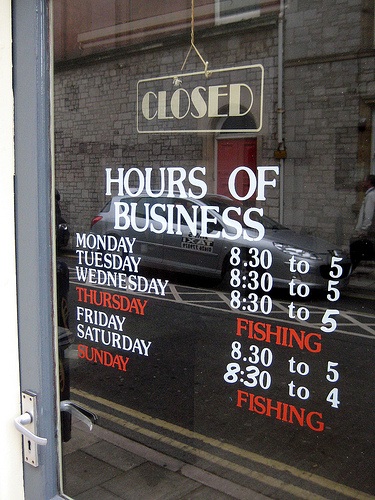
God is doing something new and the church is Out to Lunch. We are tempted to say Gone Fishing, but that might have theological implications that do not apply.
Redeemer Ambassadors always turn to the internet to plan our visits. We check service times, read newsletters and find out as much as we can before we visit.
We follow the process any newcomer to a neighborhood in 2012 would take when searching for a church home. They would Google their neighborhood and the word “church” to see what comes up.
Our search process reveals that neighborhood church seekers will have problems finding Lutheran churches.
Since we are looking for Lutheran churches, we start with the ELCA Trend Reports web site and use their Church Finder. We plug in 15, 20 or 25 miles for the radius and press the LOCATE button. Up comes a list. Then we click the link provided to each congregation’s web site.
We are now preparing for our 50th visit. We’d like to visit a nearby church tomorrow morning. Some of our ambassadors have afternoon plans. There are several possibilities. We’ll look for a church with an early service.
THIRTY of them have NO WEB SITE!
Several of those with no web site are mission churches under the direction of synodically appointed leaders. Note: These are just the churches in a 15-mile radius of East Falls.
A MISSION CHURCH with NO WEB SITE!
We Google the name of one nearby congregation. Maybe they have a web site that isn’t listed in the national database. Great! They have a Facebook page. We check it. It has NO information beyond the church’s address.
Really, SEPA churches, what are you thinking? Are you serious about outreach? Are you part of your communities? Do you open your doors on Sunday morning and expect the neighborhood to flock there by magic?
A church can have a nice looking web site for an annual investment of $25 and no more than an hour’s set-up time. Facebook is FREE, for St. Pete’s sake! 13-year-olds know how to use it.
If you don’t have a web site, you are not serious about serving your community.
Most of these congregation’s have pastors who could set up a basic site and at least have a community presence.
Even Redeemer, the church that doesn’t exist according to SEPA and the ELCA, has a web site.
In the world of the ELCA, these churches, that are not serious about ministry, feel they have the right to take votes about the ministries of other congregations and gain from their actions. (They don’t have this right under governing laws, but that hasn’t stopped the churches and clergy of SEPA!)
God is doing something new in the Southeastern Pennsylvania Synod and many churches are not equipped to perceive it—much less take advantage of it!
We’d like to think they have Gone Fishing for Men, but the evidence is they are Out to Lunch.
These days it is a common for regional offices to request congregations, especially congregations searching for a new pastor, to draft a vision statement.
This is always done by a group. Sometimes a special committee is named.
The problem: groups rarely have vision. Vision is a gift that usually comes to the masses via an extraordinary person. With luck, your local visionary is also a godly person and a communicator with some leadership skills and the ability to work hard. With real fortune, your visionary will be someone people like and will listen to.
If you think this is the job of professional leaders, think again. Pastors are not required to be visionaries. Most aren’t.
This is nothing new. Jesus chose 12 disciples. Only a few, maybe only one — or maybe none — can be said to have been men of vision. Their leadership skills were nurtured and tested over time.
So what happens when congregations draft vision statements.
They end sounding remarkably the same, the better to please regional offices.
We are going to call a dynamic, charismatic pastor. We are going to reach out to the community and they are going to love us and support us.
Join Bishop Ruby Kinisa as she visits small churches "under cover" to learn what people would never share if they knew they were talking to their bishop.
Undercover Bishop will always be available in PDF form on 2x2virtualchurch.com for FREE.
Print or Kindle copies are available on Amazon.com.
For bulk copies, please contact 2x2: creation@dca.net.
MISSION INSPIRATION OFFER
A visual and biblical guide to help congregations define their missions.
Contact Info
You can reach
Judy Gotwald,
the moderator of 2x2,
at
creation@dca.net
or 215 605 8774
Redeemer’s Prayer
We were all once strangers, the weakest, the outcasts, until someone came to our defense, included us, empowered us, reconciled us (1 Cor. 2; Eph. 2).
Be calm. Wait. Wait. Commit your cause to God. He will make it succeed. Look for Him a little at a time. Wait. Wait. But since this waiting seems long to the flesh and appears like death, the flesh always wavers. But keep faith. Patience will overcome wickedness.
—Martin Luther