4/7InkzHVUEQeEdU9vpc1tikzEhChrKmPfvXI-FSDBrBQ

Object Lessons for Adults

Adult Object Lesson: Acts 10 and Acts 11:1-18

balloons2

God’s Boundaries/Our Boundaries

Today’s object is a balloon.

The story of Peter’s dream addresses the concept of boundaries and rules in the Church. No wonder it is not one of the more prominent Bible stories.

I like to point out that as described in the preceding chapter of Acts (Acts 10) this message came to Peter at an inattentive moment. Peter was waiting for his host to put dinner on the table. Peter’s best intention was to spend some time on the rooftop “patio” in deep prayer. His intentions were derailed by his human shortcoming. He fell asleep.

No worries! God can use our shortcomings. He came to Peter in a dream. A rather bizarre dream . . . the kind you don’t forget when you open your eyes.

Blankets fell from the sky with all kinds of disgusting animals emptying from them. And God told Peter to kill them and eat, despite the fact that Jewish law forbids it.

God challenged Peter to open his mind and expand his thinking.

We have a way of creating boundaries. Boundaries usually begin as a way of defining who we are. They help us sort out what we believe and the kind of people we want to have around us. We often have no trouble justifying the boundaries we create even in the face of absurdity.

“All Welcome,” as we’ve pointed out before, is a common notation on church signage, but it often comes with unspoken caveats. Those who don’t fit in will know it and disappear. No need to dwell on it.

That many churches are nearly empty might be a sign that we need to expand our thinking.

We create rituals with rules that can change only with divisive confrontation. These rules create boundaries that often blind us to possibility and mission opportunity. Wine or grape juice? Cups or chalices? Contemporary or traditional music? Pastor’s job, women’s job, or men’s job—who is responsible? Should we waste our money reaching people who cannot contribute or should we court families with two incomes?

The big rule on Peter’s mind (perhaps in his subconscious and hence God’s use of a dream) was “Jew or Gentile?”. To open the community to Gentiles meant accepting ways that violated Jewish law and custom. Food was an obvious symbol of the differences but circumcision was among others. It was a problem to sit at the same table!

As you talk about this Bible story, pause now and then in puff into your balloon. Your congregation will watch it expand as you talk about how Peter’s dream led him to greater acceptance and expanded the community of believers.

Discuss God’s message.

“What God has made clean, you must not call profane.”

As your balloon is about to pop, end with the thought: We will still create boundaries. It’s human nature. We will still argue about what God considers clean.

This could lead to many discussions on many topics (the age for communion, the role of women, the inclusion of modern customs, accepting diversity, the ordination of homosexuals).

Address what might be on your congregation’s mind.

You can let your balloon pop to make the message a bit more memorable. Or you can ask someone to come up and stick a pin in it.

The message of this lesson can be tied to the gospel message for today. Love one another. Period

photo credit: MildlyDiverting via photopin cc

Jesus as Shepherd: Images

Adult Object Lesson: Part 2

In yesterday’s post, which was our weekly object lesson idea for adult listeners, we proposed having your congregation draft a résumé for Jesus.

Modern résumés often included visuals and your resume for Jesus can take advantage of this.

We suggested that your listeners consider attaching a photo of Jesus as shepherd to their résumé to enhance your congregational discussion.

Images abound on the internet. We’ve chose a few that have varying nuances.

The topic is one of the earliest to be depicted in Christian art.

goodshepherd8


Here is an Eastern religious icon.

goodshepherd7There are more familiar depictions. The painting by German artist, Bernard Plockhorst, has been reproduced in stained glass art in sanctuaries all across America. Note the mother sheep nudging at Jesus left hand as if to encourage him to care for her lamb he is carrying. (See yesterday’s post.)


There are comforting presentations. In this image, Jesus pays careful attention to the youngest in the flock.

goodshepherd3


Here are two depictions that were published in France as prayer cards, probably in the 1800s.

The flock is chained to the cross. In the second depiction, Jesus seems to be engaged in work. There is intentional effort in his love.

goodshepherd5 goodshepherd4


Here we have a pensive Jesus. He is thinking of more than the sheep’s physical needs.

goodshepherd1


Last, we add a proactive, risk-taking Jesus, who under the shelter of an eagle’s wings risks his safety to reach out to sheep in danger.

goodshepherd2

Which image would you choose for Jesus’ résumé?

Adult Object Lesson: John 10: 22-30

Write A Résumé for Jesus

goodshepherdPlockhorstJohn’s Gospel has one major objective. John seeks to define Jesus in a way that people will believe him to be the Messiah or Christ.

Every incident in John’s narrative adds new dimension to this mysterious person named Jesus.

He is a carpenter’s son, part of a well-known but common family. Often he is seen as a rabbi or teacher. The woman at the well calls him a prophet. Son of God? Son of Man? There are attempts to anoint him as King. He teaches. He heals. He raises people from the dead. Who is Jesus?

In today’s Gospel reading, Jesus makes a pronouncement from the portico of the temple used by temple authorities to pronounce judgment. This is a place where people go to have difficult decisions explained to them.

So what Jesus says here —in this important place—may be his big moment.

The excitement must have been palpable. Would he declare himself King of the Jews? Would he use this moment to elevate his position? Would the lucky members of this audience experience an historic moment they will someday share with their grandchildren?

Jesus instead claims one of the lowliest jobs one can ever type into a résumé.

Occupation: Shepherd

Filling out a résumé is something your congregation will have experience doing. Ask them to write a résumé for Jesus. Describe his work experience as a shepherd and how these skills qualify him to be their spiritual leader.

Give them plenty of time to think beyond the obvious and do as little prompting as possible. Adults are capable of applying metaphors. Help them explore the metaphor more fully.

Be prepared for answers such as:

  • Comes from an experienced family
  • Save flock from predators
  • Ability to get rid of predators
  • Can feed flock
  • Can find clear water for flock
  • Keep the flock together
  • Heal the sick or wounded
  • Make each sheep feel wanted
  • Plays with lambs
  • Responsibility to account for each sheep and lamb
  • Seek fresh resources when food and water supplies are low
  • Train helpers when needed

Use a flip chart or white board to record the answers as you fill out Jesus’ résumé.

You might project some art. If you use several images, ask your members which one they would include on the résumé.

We’ll suggest some images tomorrow.

Adult Object Lesson: John 21:1-19

call

Receiving the Call

This week’s Gospel revisits the concepts of call and commission. The structure of the Church today grows from Jesus’ threefold exchange with Simon Peter. The concept of call among clergy can be profound. Pastors discuss with passion the moment or process that brought them to “their call.” The process is a bit fuzzier for lay people and it often comes with less recognition and respect. The concept of call is not limited to clergy. Each person sitting in your church has a call. Some answer it with ease. Some struggle to discern and follow it.  Tell the story of Simon Peter’s call. Remember, Jesus was talking to an ordinary man — a fisherman. He was meeting with him in his place of work—the seaside. Jesus and Simon Peter have a threefold exchange. We view this conversation as atonement for Peter’s threefold denial of Christ as he waited in the courtyard prior to the Crucifixion.

Do you love me? Yes, I love you. Feed my lambs.   Do you love me? Yes, I love you. Tend my sheep.   Do you love me? Yes, I love you. Feed my sheep.

Jesus packs a lot into a few short words. His message to us today is also told in three short words.

Love one another.

Put a person’s name in front of his two-word quote and you have another three-word quote.

Simon, follow me. Joe, follow me. Bridget, follow me.

Talk with people about their sense of call. Listen to their “call” stories. Chances are no one has ever asked them about their “call.” Your object today can be a cell phone. Ask two or three members in advance to leave their cell phones on. Call them right there during your sermon. Tell them you have a biblical message for them and a question. The biblical message: (Person’ name), follow me. The question: How will you follow the Lord? Consider finding ways to recognize the call of lay people. It can only make the Church stronger!

photo credit: Funky64 (www.lucarossato.com) via photopin cc

Adult Object Lesson: Thomas the Doubter

shell gameJohn 20:19-31

The power of doubt

Poor Thomas. What a scapegoat he has been for all of us these last 2000 years!

Thomas’s mistake was not so much his unbelief—he wasn’t alone in that—then or now.

Thomas made his mistake in boasting about his superior intellect. He was no fool to be caught up in fantastic rumors.

You guys can talk all you want about the risen Lord. I’ll believe it when I see it. Strike that! I’ll believe it when I can touch his wounds.

What might have happened at this point? Jesus might never have appeared to Thomas. Thomas might have lived the rest of his days as the obscure apostle who doubted something only a few people were taken in by. In his superiority, he might have spent his remaining life retelling his “I told you so” story.

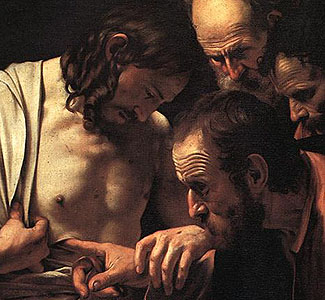
ThomasArtists in depicting Thomas’s encounter with the risen Lord have done him a great disservice. They like to show Thomas reaching out to touch the wounds of Christ, still open and bleeding. It’s more dramatic than depicting a dumbfounded Thomas.

In fact, this Gospel telling of the story reveals a proud man caught in a self-made trap.

John, the Gospel writer, does not tell us

…and then Thomas placed his hands in Jesus’ side and he believed.

Instead, John tells us that Thomas backs away from his boast. He immediately is humbled. He confesses his faith, “My Lord and my God.”

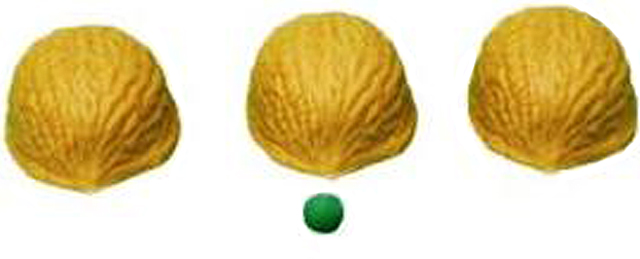
Your object lesson today is a shell game. Have three paper cups (or walnut shells) and three peas/beans or a similar small object. Set up the game in advance placing a bean under two cups ahead of time. A real shell game operator will make a great show of each cup being empty before the game starts. But your people trust you, don’t they?

As you begin your talk about Thomas, place the third bean under the third cup. Have your congregations watch as you shift the cups around as you talk.

Talk about how our fear of being proven wrong is the root of our resistance to God’s message. At the end, have someone choose a cup and reveal that there is indeed a bean to be discovered. You can reveal the other beans if you like. The point is that God made sure Thomas believed so that we might one day believe too.

God is in control of the outcome of the game.

Oh and by the way . . .

What actually became of Thomas?

Thomas is believed to have carried the gospel story as far as India. He wrote his own account of Jesus’ childhood and his own “revelation” that did not make it into the Bible.

We tend to forget the result of Thomas’s doubt.

Thomas’s doubt caused millions to believe.

photo credit: Mike Licht, NotionsCapital.com via photopincc

Adult Object Lesson: Easter

crossThe Imagery of Easter

Ask your adults to name the images of Easter.

A typical list will include:

  • The egg
  • The rabbit
  • Flowers
  • Butterflies
  • Seeds and flowers
  • Lilies
  • Candy

All of these are symbols of new life and growth. Even candy eggs have a surprise sweet filling inside and jelly beans will grow your belly if nothing else.

And there is the symbol of the lamb—the sacrificial lamb.

No shortage of objects for Easter lessons!

But one symbol is missing. Surely someone will name the cross. If they don’t be prepared to point to the cross.

Without Easter, without Jesus’ conquering of sin and death, the cross would mean very little to us. The whole Lenten journey would have evaporated—untold—into history. All those other symbols would be the trappings of pagan celebrations.

CrucifixThe cross on its own is a  symbol of torture and death. The vilest sinners were tortured on crosses. Many of the disciples standing at the foot of the cross would have their turn at torture. We have to think to remember which martyrs died which way.

We would not be likely to hang the symbol of crime, torture and death on the walls of our home—without the Resurrection.

We remember Jesus’ death on the cross, because he beat it. We look to this gruesome symbol with incongruous feelings. 

In remembrance of Christ’s sacrifice, some denominations emphasize the Crucifix. Jesus is depicted in agony on the cross. 

For others, the empty cross is a symbol of Easter. The cross has been overcome.

All the other symbols of Easter, many borrowed from pre-Christian customs, point to the cross — the empty cross — as the foundational symbol of our faith. It is the symbol of hope and expectation.

This topic resonates very differently with adults than with children. Hope is that core feeling inside of us that something in our lives will result in good.

Children hope that good will happen to them—that people will be kind—that their needs and wishes will be met.

Adult hope is often more desperate. 

Will our lives make a difference? Will we accomplish what God intends for us? Will we die appreciated? Does life mean anything? Does death mean anything?

Help your adults think about these things and draw strength today from the Easter story. 

You might close with a hymn written in the 1980s by Natalie Sleeth. It is a simple hymn suitable for all ages. It is a hopeful. Despite its simplicity, adults can embrace it.

Here is a publishing link.

The tune is lovely and simple. You can learn it by listening. Key of G or F will work.

Listen to the tune here. The singer is playing the guitar in the key of G, so you can follow his chording. The sheet music is written in F.

Hymn of Promise

In the bulb there is a flower;
In the seed, an apple tree;
In cocoons, a hidden promise:
Butterflies will soon be free!
In the cold and snow of winter,
There’s a spring that waits to be,
Unrevealed until its season,
Something God alone can see.

There’s a song in every silence,
Seeking word and melody;
There’s a dawn in every darkness,
bringing hope to you and me.
From the past will come the future;
What it holds, a mystery,
Unrevealed until its season,
Something God alone can see.

In our end is our beginning;
In our time, infinity.
In our doubt, there is believing;
In our life, eternity.
In our death, a resurrection;
At the last, a victory
Unrevealed until its season,
Something God alone can see.

Upper photo credit: fusky via photopin cc

Adult Object Lesson: Philippians 2:5-11

Paul Teaches New Christians How to Think

This Sunday is Palm Sunday, a busy Sunday unto itself. In recent years the Church has combined Passion Sunday with Palm Sunday. The result is a marathon of emotions that is too broad for people to absorb. It doesn’t really work very well. We can neither enjoy Palm Sunday or take in the depth of the entire Passion Story.

There is probably little time in this liturgical panorama for an object lesson. The concentration will be on reading 114 verses from Luke. But let’s look at the lesson from Philippians and a bit of Isaiah 50:4-9a and Psalm 31:9-16, too. They are there for a reason.

Paul is teaching his new followers a new way of thinking.

Your object today is a pitcher of some sort and a bowl. You might even use the congregational chalice filled with water and be prepared as you end your talk to refill it with the wine that will be used for Communion—the blood of Christ shed for us.

Your pitcher is filled with water. Empty it slowly into a bowl.

Talk about how Christ emptied himself. The Passion Story is all about wearing down the Son of Man. Jesus took everything they threw at him. He turned his cheek to those who would pluck his beard—a wonderful image from Isaiah, today’s Old Testament lesson.

You might call attention to today’s Psalm in which the psalmist cries out that he is like a broken vessel. Totally empty.

But Christ’s empty vessel is not broken. It will be refilled. Christ empties himself and refills the void with something fresh, something no one expects of the Son of God.

He fills the empty space with the attributes of a slave. He becomes humble and accepting of God’s plan for him. He is obedient unto death — even a terrible death.

In his obedience, he becomes a servant.

It is hard enough for us to empty ourselves. It is painful. We would refill the void with our wants, our own sense of importance.

Christ fills the void with humility. It is a choice.

We, too, have the power to shape our thinking and passions—to fill the void in our hearts with things that are godly. That we would learn this lesson was one reason for Christ’s sacrifice. We should not ignore it.

How will we fill our hearts?

Adult Object Lesson: Jesus Visits Mary and Martha

coffeeIt’s a Matter of Priorities: John 12:1-8

Here is a video link that will help you springboard a conversation about the domestic conflict that results from Jesus’ visit to the home of Mary, Martha and Lazarus.

Your adults are surely familiar with today’s gospel story. Jesus comes to visit Mary and Martha who become indebted to him for resurrecting their dead brother, Lazarus.

Mary sits at Jesus feet and anoints his feet with very expensive perfume. At least one disciple is upset. The narrator of this story, John, does not hold back in letting us know how he feels about Judas.

In comes Martha. While Mary has been doting on Jesus, Martha has been preparing to feed and entertain Jesus and his entourage. Dinner for at least 16—no small feat in the pre-appliance age.

Jesus responds with a lesson in values and priorities.

If you can share this video with your members, please do. Show it in church, during fellowship, or at least include a link in your weekly email newsletter. (You do have a weekly email newsletter, don’t you?).

If you can’t show the video, tell the story. Your object can be a cup of coffee — or two cups of coffee—one paper, plastic or styrofoam cups and one more elegant. You might conduct your own experiment and offer an assortment of cups to your group. You might show the video at coffee fellowship.

Note that the professor in this video serves coffee to his guests after listening to a gripe session. He is not unlike Jesus in this regard. The former students were feeling put upon by the world — like Martha.

This story is not so much about right and wrong as it is about priorities. Weave the video’s message with Jesus’s message about how we determine what is important in our lives. Discuss the viewpoints of each key figure in the story—Jesus, Mary, Martha, Judas, and Lazarus. You might also include the author of this gospel, John. He chooses to tell this story for a reason!

Enjoy a cup of coffee.

photo credit: H is for Home via photopin cc

Adult Object Lesson: The Prodigal Son

The Prodigal Father

prodigalToday’s object is the story itself.

The Story of the Prodigal Son is one of the best known of Christ’s parables.

The adults in your congregation are likely to have heard the story hundreds of times. Today, we can think about the story anew by turning the tale inside out.

This is a true story. A church leader traveling to the growing church in East Africa brought this story home.

While, the organized church in the United States is suffering deep and ongoing losses, the church in Africa is growing by leaps and bounds. It is now commonplace for American Church leaders to travel to Tanzania, Ethiopia, Kenya and other East African countries to meet with leaders of the growing church and to experience some of their success.

How is this happening? they ask with some measure of envy.

One African bishop responded, “Let me tell you the Story of the Prodigal Father.”

Huh?

He explained,

“The American and European church came to Africa many years ago with the message of God’s love. You asked us to believe and we did. You were our spiritual fathers. We were your sons and daughters. We believed. 

You went home. We kept on believing the message you brought to us. We shared what you taught us. We grew.

Now your churches are troubled. They have stopped believing. Now you come back to us — your children in faith. You tell us your troubles. We welcome you back. We celebrate your visits. And that’s why we call our story The Story of the Prodigal Father.”

The adults in your congregation who have heard the Story of the Prodigal Son will appreciate this twist in an old biblical story. It will give them something new to think about after hearing the old, old story—one more time.

Adult Object Lesson: Luke 13:1-9

Do We Earn Misfortune?

Today’s gospel starts out with the common human feeling of hopelessness and despair. The people are reporting one tragic news story after another, laying each at Jesus’ feet, and asking “Why?”

“Why?” is the question that draws many people to religion. We want to live in a world that makes sense.

Jesus does not really answer his questioners. He is like a mother turning to a relentlessly inquisitive tot and saying “Why? Because! That’s why.”

He decides to tell the story of the fig tree. Divert their attention—another mother’s trick!

You can tell the story of the fig tree, too. You might follow it with another story that might help them see this parable in a different way.

Tell the Story of the Three Little Pigs. 

The Big Bad Wolf blows Or let the congregation tell the story. They probably know it better than the parable of the fig tree and telling it along with the Jesus’ story may help them remember it.

Start the story and ask them what happens next.

There are many versions. So expect some different answers. That will be part of the fun of letting others tell the story. Some tellings of the story have the first two pigs deserving to lose their lives and homes. They were lazy and arrogant, preferring to do just enough to get by and playing away the rest of their lives. They deserve to be the Big Bad Wolf’s dinner. Only the third pig who planned ahead, worked hard, and sacrificed to build a strong home deserved to be spared.

Similarly, the Wolf deserves to boil in the third pig’s soup pot.

The Disney version has the first two wolves running to the third pig’s brick home for safety. The wolf survives having learned a lesson from being burned. Happy endings all around.

It’s human nature to try to make sense of stories and have them apply to our need for fairness and justice. We like when stories have happy endings. We want to love that reformed wolf.

That’s exactly what the people who came to Jesus with their troubles are hoping for—answers that make sense. Bad things must be reserved for bad people in our earthly thinking. What’s the point of religion if good doesn’t flow steadily from its fountain?

But look at the Story of the Three Pigs this way.

  • The three pigs each face disaster.
  • One lives in a straw house.
  • One lives in wooden house.
  • One lives in brick house.
  • The evil one, the Big, Bad Wolf sets out to hurt each little pig. Why? Because he wants to and because he thinks he can. The motive of all villains.

What did the pig who built his house of straw do to deserve losing everything? If laziness and arrogance were reasons for misfortune, many would suffer daily!

The pig who built his house of wood had taken more precaution than the pig who used straw. Shouldn’t he be spared something?  Aren’t their levels of righteousness?

We usually see the brick house as being the solution. Create for yourself a safe world that evil cannot penetrate.

Adults know that there are no such guarantees. There are clever and persistent wolves out there.

True, the wolf was unable to blow down the brick house, but that didn’t stop him. He plotted to lure the pig out of the house. The third pig outwitted him until at last the Big Bad Wolf decides to come in through the chimney. The third pig doesn’t just sit there. He does something. He lights a fire and the Big Bad Wolf gets his just dessert.

None of the three pigs deserved to be the target of the evil. Evil and misfortune happen.

But none of the pigs was a bit the better for simply accepting his lot. The third pig got ready. He used his head. He stoked the fire.

Returning to the biblical story, he took care of the fig tree.

By the way, if the Story of the Three Pigs doesn’t work for you, you can always use Old Testament account of Nehemiah. They share the same basic plot!