4/7InkzHVUEQeEdU9vpc1tikzEhChrKmPfvXI-FSDBrBQ

Redeemer

What the Church Has Learned from American Politics

Redeemer's right to be represented at SEPA Synod was removed by decree of Bishop Burkat before the 2009 Synod Assembly.

Redeemer's right to be represented at SEPA Synod Assembly was removed by decree of Bishop Burkat before 2009 Synod Assembly one week before the 2009 Assembly — before there was ever a hearing or vote of Synod Assembly. Redeemer appealed this decision but Synod Assembly did not vote on it. In fact, Synod Council didn't vote on this until June 2010. Constitutionally, Redeemer should have had a right to challenge that 2010 decision. Redeemer should have had voting privileges in 2009 and 2010. Redeemer never voted to close. There is no requirement for congregations to own buildings. Redeemer remains faithful in worship and mission. Since the only aspect of our appeal addressed by Synod Assembly was our property, Redeemer still has voting rights under SEPA's constitution.

Today is election day in Pennsylvania. We are expected to go to the polls as informed citizens to make wise decisions. Most of what we have heard for the last six months is what’s bad about the other guy.

Mud-raking in American politics is an old tradition. The best mud-raker wins. And so, one quality every presidential candidate must have is the ability to tear the figurative limbs from opponents.

Successful mud-raking gets leaders their way.

But there is a cost. The cost is to the spirit of the people, who go to the polls weary and uncertain that they are voting for the most capable leader . . . or the best-funded, best-organized critic.

Politics is part of American life. It’s also part of the Protestant Church. We elect our leaders. Unfortunately, our leaders have learned lessons from secular politicians. You can gain support by tearing down your opponents.

We don’t have campaigns between “hopefuls” so it is a field day for those in power. Opponents in the church can be anyone who challenges the status quo.

The techniques are more subtle in church politics. In the ELCA, each bishop has six years to plant innuendo, to ignore opponents’ good ideas, to neglect some churches and curry favor in others, to charismatically rally support. Every action is supported by well-chosen Scripture.

Who are the opponents? In the Southeastern Pennsylvania Synod of the Evangelical Lutheran Church in America, it can be the very churches who provide support — but not enough support in the leaders’ eyes. It can be clergy who speak against policy or who simply advocate for new policy. It can even be the congregational members who volunteer with no expectation of power, or recognition, monetary or otherwise. It can be congregations who have small memberships but more assets than SEPA.

Looking for faults becomes a habit. Finding faults (an easy job) can have  rewards when powers (constitutional or not) are exerted.

American politics is wearying. Church politics is self-defeating.

Church politics are supposed to model servant leadership—also true of public servants — but in the Church we have the life of Christ as guide. In the Lutheran Church, the constitutions assign equality to each entity. There really is no power to wield. We are supposed to be partners in ministry.

Violating the intent of the constitutions makes immediate winners/losers—a situation which is unChristian. In the end the whole Church suffers. It takes awhile, but the erosion of spirit over a decade becomes obvious.

The Church relies on knowledgeable people doing the right thing. Abdication of that role leads to abuses of power.

And yet, in the Lutheran Church it is not uncommon to hear the best educated church leaders justify non-participation with “we elected the leaders; we have to support them.” This is nonsense—an abdication of responsibility. You don’t have to support a leader who is making bad decisions.

This is also an election year for SEPA. What kind of leader will you elect? One who finds fault with the congregations served and their volunteer members who dare to disagree? Or one who builds on their strengths and nurtures them in faithful service to God and His people?

photo credit: JosephGilbert.org via photo pin cc

Rejection in the church. It’s all too common.

You’ve seen the signs. Most churches have one. “All Welcome.”

Easier said than done.

Lucas Cranach Painting

A topic in a popular church forum today discusses inclusion—specifically that of the disabled in the life of a congregation. The author cites the profound sense of rejection experienced by members of a group home for the mentally challenged who were asked to not return. You know why — they were different and differences are unsettling. The Church loves neat and tidy.

Rejection by the Church is all too common. Frequently, the rejected have no voice. They must rely on an outside advocate. Fortunately for the members of that group home, they found an advocate who helped them find love inside the church’s walls.

Rejection isn’t a one-time incident. It stings forever.

The members of Redeemer have experienced rejection. Big time and long-term. The Lutheran Church locked us out, literally and figuratively. Having rejected us from Christian community, they continue attacks on our members.

The increasingly common scenario has become a process which, as Bishop Claire Burkat of the Southeastern Pennsylvania Synod of the ELCA attempts to justify, usually “goes smoothly.”

What makes this horrific process seem smooth? Well-orchestrated use of the age-old weapon of the Church — fear.

The process is designed to be as pain-free as possible for the perpetrators. The pain of the victims: there’s an app for that!—the closing worship service which even has an official liturgy.

Church officials gather in full clerical regalia as the emotions of the faithful are put on display. The swelling tones of the soon to be moth-balled organ drive the nails into the coffins of a faithful worshiping community. The doors are locked, remaining bank accounts secured, and no further thought is given to the people. Neat and tidy.

Most abandoned church members never find a new church. They are gone and forgotten. The elderly are left without the support of the church they served faithfully in more capable years. Newcomers are left to feel inadequate — like fools for buying into the welcoming message. The clergy return to their parishes to preach the message of love, forgetting that love is a verb.

It’s not OK, fellow Lutherans. Damage continues long after you walk away with the spoils.

  • Relationship with the surrounding community is damaged.
  • Relationship with the faithful is damaged.
  • Families are damaged.
  • Children are damaged.
  • Youth, at a turning point in their lives, are abandoned by the church that had cradled and nurtured them.
  • The disenfranchised (often major participants in community worship) are abandoned with little recourse.
  • Faith is damaged.
  • Economic and social damages extend beyond the community.
  • Stewardship is damaged. Any member of a small congregation can wonder if their offerings will be confiscated.
  • Individual Christians can wonder if their years of devotion had any value.

The process is a slap in Christ’s face.

We’ve listened to the excuses of the clergy as if the gospel they preach happens without effort—as if Christ had not died for them. Most laity seem unaware of what’s going on.

Redeemer can tell you how it feels to be rejected by the Church, to be vilified for our beliefs.

Faith makes us strong. Why do we act as if we are powerless?

Following Jesus or Following Orders?

“Since they haven’t talked to us they don’t actually know what we do, but they inferred something from something.”

This quote from Sister Simone Campbell, head of Network, a Catholic social justice lobby, sounds so like Redeemer’s experience. We, too, have faced criticism that defies explanation or proof.

The Sister goes on to analyze the Roman Catholic Church’s male-dominated hierarchy. She claims it simply doesn’t know how to deal with the encouragement women religious received under Vatican II.

We suspect the rift has less to do with male hierarchy than the nature of hierarchy itself.

The Lutheran Church, which constitutionally is not a hierarchy at all, is exhibiting the traits of the Roman and Episcopal Church hierarchical systems. The ELCA is no longer male-dominated. Nevertheless individual Lutheran bishops are muscle-flexing. The three 2×2 knows the most about are women.

The church in the 21st century is entering an era where hierarchies have little purpose. Consequently, those who have reached the pinnacle of church leadership find themselves with little to do — hierarchy-wise.

Lutherans as a congregation-based denomination have similar challenges. Top leaders have meetings, travel, visit, write occasional messages to the people, and seek the status of appointments to high level advisory positions — while the churches they serve operate without them.

Try this—write to Chicago (Lutheran national offices) and ask for help. If your experience is like Redeemer’s, you will receive no response or a letter denying responsibility for involvement.
So what do we pay them for?

Lutheran constitutions give the power to manage congregations not to the bishop, not to the parish pastor, but to the congregations.

Unfortunately, current challenges to the national church involve assuring member churches that all the players follow the rules. No one is watching the constitutions. They are becoming meaningless. That puts lay people at risk — if they insist on following the rules. Any volunteers?

Economic challenges have exacerbated the problems of purpose-challenged hierarchies. Self-preservation becomes a priority. This exhibits itself in budget crises and in leaders’ relationship with member churches. They can view the respect given to their role as power. Power craves control — bigger staffs, more programs. But bigger staffs and more programs are proving to be unneeded. Decreasing staff and cutting programs feels like failure. It’s not. It just feels bad.

Constitutionally Lutheran bishops have very little power. The constitution calls for consent of the congregation at every turn. Bishops are assigned the role of servant leader, which doesn’t mix with illusions of power very well.

It is interesting to watch the conflicts in the Roman Catholic Church. One can’t help but wonder if this latest pronouncement will distract attention from the other challenges facing the American Roman Catholic Church — a drought in the pool of clergy and religious professionals, the clergy sex scandals and its drain on the Church’s assets, the departure of the faithful from regular  participation in the parish and the resulting trickle-down effect on one of the traditional strengths of the Roman Catholic faith community — its school system (its future).

Lutherans have plenty of problems as well. We don’t seem to have leadership that is ready for the 21st century.

How should our non-hierarchical leaders keep busy?

They should be serving the congregations most in need. That’s the way Lutheran governance is designed. And it’s biblical.

As the Sister concludes, “I don’t think the bishops have any idea what they are in for.”

They should — but probably won’t — start by listening.

What SEPA Synod Can Learn from Redeemer

Today, SEPA (Southeastern Pennsylvania Synod of the Evangelical Lutheran Church in America) Communications Director Bob Fisher sent a plea to SEPA congregations for interaction on a web site the synod created for congregations to share ministry ideas. The site was launched in November and had an initial outpouring of about 100 submissions. Then it fizzled. Involvment on the web site has been flat ever since.

There is little reason to post a time deadline on a web site like this. But Fisher’s request for submissions asks for responses by April 26 — one week before Synod Assembly. You want good statistics for Synod Assembly!

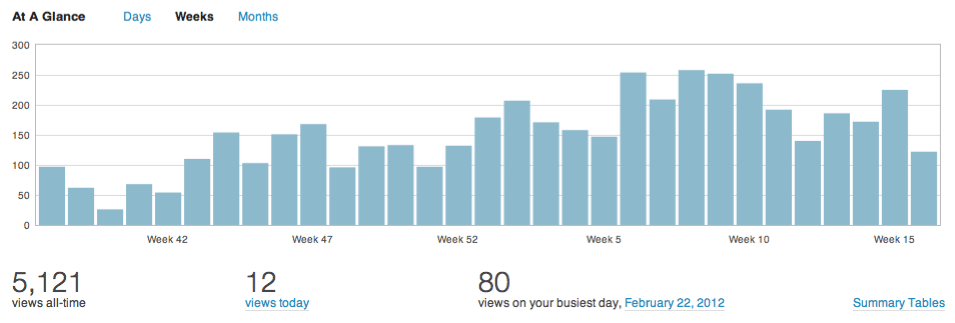
Meanwhile, during the same period, 2x2virtualchurch.com, sponsored by the SEPA-excommunicated members of Redeemer, has grown to more than 200 visits per week, with more than 80 followers and 30 new visitors daily. We’ve pioneered social media in church work and have been gaining respect around the world for our work — interdenominationally and among churches of every size. Look at  2×2’s statistics for roughly the same period (screen shot taken in midday/midweek for last bar):

The concept of SEPA’s web site is flawed. No one needs to submit ideas for review and verification by a central office any longer. There is nothing stopping any church from posting their successes and ideas on their own website. Synod should be encouraging community between congregations without a middle man. Don’t worry . . there’s plenty of work for communications middle managers.

This site is not likely to create dialog. It is rigid in a medium that operates best with freedom. It allows three categories of questions. It limits responses to 50 words. (Most of the questions had close to 50 words.) The message conveyed to a visitor to this site is that their ideas will be monitored, judged and verified — controlled. This thinking is foreign to internet users who are accustomed to the free flow of ideas on Facebook, Twitter and blogging platforms—all of which are community-building platforms.

Why invest time posting to a site that might reject you?

There are other ways to achieve sharing. Start developing content that is helpful to congregations so there is a reason to come to the site in the first place. Begin linking and commenting and taking part in the dialog. Recognize that there are no boundaries to good ideas. Why limit the submission of ideas to just 160 congregations when there is a world of mission out there? It’s the social media way. And it works.

Redeemer would submit its ministry ideas to www.godisdoingsomethingnew.com, but we doubt our ministry would be recognized. It hasn’t been for a long time!

No problem. We post our ideas daily on 2×2. Welcome!

(2×2 be glad to help any church get started in social media. Just contact us! We can have a web site up and running for you in a week, train members to use it and even help you develop content.)

Redeemer’s 2×2 Website Surpasses 5000 Visitors

Redeemer’s experimental congregational web site just tallied its 5000th first-time visitor.

Little Redeemer reaches more people every week than most large churches reach on Sunday morning.

Redeemer started 2x2virtualchurch.com in late February 2011.

The site was started as a mission vehicle when  Southeastern Pennsylvania Synod (SEPA) of the Evangelical Lutheran Church in America seized our property.

Redeemer knows that small churches are capable of big ministry. The internet seemed to be a perfect vehicle for a congregation with no church building.

By the end of summer 2011, 2×2 had only a few dozen visits. We were posting sporadically — a few times a month.

We began posting daily.

We focused on three strengths of the congregation: Social Media, Children in Worship and Multicultural Ministry. The site also includes commentary on issues facing many neighborhood congregations today.

We learned to create content with others in mind.

We write interdenominationally, but we don’t hide our Lutheran roots.

We link to other related sites and engage in conversation in other religious forums—all things encouraged in this new communications medium.

Statistics guide our content development.

At Easter we posted a short play, written and produced by Redeemer a year before our doors were locked. It was downloaded 150 times. We responded to this interest by posting a Pentecost resource for small churches.

Much of our traffic comes from our ongoing exploration of Social Media topics.

Our Multicultural series did not attract as much attention, but it was reblogged — linked from other sites—more often. This tells us that there is intense if not broad interest.

Several seminaries posted articles from our website for discussion. One of our recent posts was broadcast by a retweeting engine.

We now have more than 80 followers who subscribe daily via Facebook, Twitter or direct email feed. An additional 30-80 visitors per day represent every state in the Union and more than 70 countries with just shy of 1000 visitors a month. As that number continues to grow, we expect to have between 12,000 and 20,000 readers by the end of our second year.

Our highest international traffic comes from Canada, France, Great Britain, the Netherlands and Belgium, South Africa, and Australia. Traffic is growing in the mid-East and Africa.

There are interesting, inexplicable spikes in readership. One day we had 26 readers in the Bahamas! The very next day we had 16 readers from the Netherlands.

We hear regularly from small mission congregations in Pakistan and Kenya and support one another with ministry ideas and prayer.

We are encountering Christians from many denominations — some of them represent very large ministries. We learn of interesting projects and try to help by providing links. A college student in Texas, who has created a ministry recycling VBS materials, gets a few daily visitors from 2×2 links.

Redeemer may be one of the most active and growing congregations in Southeastern Pennsylvania—even if we are shunned by our own denomination. SEPA justifies its actions in East Falls with accusations of lack of mission focus. There is no lack of mission focus at Redeemer. We are just using a very wide-angle lens!

We will be glad to make a presentation to SEPA Synod Assembly on our growing experience in web ministry. Just contact us!

Redeemer is not closed;
we are locked out of God’s House by SEPA Synod.

photo credit: Absolute Chaos via photopin cc (retouched)

How to Bypass the Democratic Process in the Lutheran Church

Learn from the Roman Catholics.

Name a Blue Ribbon Committee.

Who gives out those ribbons to committees as they are about to go to work? Shouldn’t the blue ribbons be given after the work is done and the decisions have proven to be wise? Or does the ribbon automatically make the decisions wise? Chicken or egg?

East Falls is still reeling with the news that the Roman Catholic Archdiocese has determined, with the help of a Blue Ribbon Committee, that the parochial school children of St. Bridget’s in East Falls should no longer walk to their neighborhood school but should hop on buses and head to a brand new (well, somewhat renovated) school three neighborhoods away—if you take the most commonly traveled route, Henry Avenue. (East Falls, Wissahickon, Roxborough, final destination Manayunk)

A new name has already been bestowed on this school. There won’t be any fighting over existing names and no debate among vying factions. St. Blaise it is. (Read what has happened since!)

There! Turn in your blue ribbons, committee members. Thank you for your service.

The Blue Ribbon Committee was entrusted with the fate of every Catholic School in the Archdiocese, most of which face economic challenges. They originally announced 40-some closings but changed their Blue Ribbon minds on more than a dozen of their decisions after protests were staged and appeals heard.

You have to wonder why the Blue Ribbon Committees don’t listen to the people before making Blue Ribbon decisions.

St. Bridget’s in East Falls has not fared well in the reconsideration process. They wrote letters, signed petitions, solicited the support from the community council and government representatives—as if Blue Ribbon Committees give a hoot about the views of elected officials. The Catholics of East Falls are left at this point with little but the knowledge that they tried. And we hope they keep trying. (Redeemer is in your corner.)

Why Manayunk?

The Blue Ribbon Committee reports that the parishes of Manayunk have already experienced loss and they don’t want to inflict more on them.

It’s East Falls’ turn to suffer.

Sounds familiar to us at Redeemer, just up the hill from St. Bridget’s.

Redeemer once heard the same reasoning. It was 1998. There were three struggling Lutheran Churches in Roxborough. None in Manayunk. None in Wissahickon. And then there was little Redeemer, sitting on a prime property (owned and paid for by the people of East Falls) with a healthy endowment.

In moves SEPA Synod and the Lutheran bishop with an attempt to close Redeemer.

Bishop Almquist appointed his own version of a Blue Ribbon committee. He called them “trustees.”

“Ministry in East Falls is not good use of the Lord’s money,” one Synod official said.

“We want to merge the churches in Roxborough into one riverfront church,” said another.  Redeemer’s assets were to fund the project. Redeemer was never consulted.

Some even dared to invoke the Resurrection parallel. Redeemer should die so that the churches of Roxborough might live. When in doubt turn to Scripture.

Only Redeemer was not dead.

There was a plan made by the Lutheran version of the Blue Ribbon Committee. Redeemer was  supposed to submissively fund this venture — which was never likely to work. The three congregations in Roxborough, the largest geographic neighborhood in Philadelphia, were too different. It might have been possible, but there was no unification plan short of ordering Lutherans to do as the Synod says, which doesn’t work very well. Those pesky constitutions keep getting in the way.

The Lutherans of East Falls successfully fought this folly, but the memory of our advocacy for our own ministry in our own neighborhood (the Lutheran way) festered in the minds of SEPA Synod leadership. Pastors disappeared. SEPA Synod began the death watch.

Ten years. That ought to do it.

In 2008, a new bishop moved in again. This time, there would be no fooling around with any attempt at working with the Lutherans of East Falls — which by now was an almost entirely new membership. Bishop Claire Burkat asked for action against Redeemer from the Synod Council—having never met with leaders of Redeemer. Then they waited nearly five months with not a word to the congregation that they were assuming control.

When the cat jumped out of the bag, Redeemer fought back.

The Bishop visited our property with a locksmith. Redeemer turned her away. Fort Sumter.

Bishop Burkat used the committee angle, too. She didn’t call it “blue ribbon.” That probably wouldn’t fly among Lutherans, who believe in the equality of lay and clergy leadership. She named trustees. She simply announced by letter that the trustees were replacing the elected leaders of the congregation — the names of which she didn’t bother to check.

The name change trick was invoked. When Plan A—to sell the property out from under the congregation—failed, the talk turned to closing the church for a few months and reopening under a new name, this time with a synod-approved council.

If only the people of East Falls could have been relied upon to vote the Bishop’s way! Then all this would have been unnecessary.

So take notes, Lutheran bishops. Blue Ribbon committees carry more clout. Forget the constitution. Just find a few loyalists, give them Blue Ribbon status, be clear about the game plan, and declare your work done.

Blame the committee if things go wrong.

Oh, and those three churches in Roxborough. Grace and Epiphany are closed and Bethany soldiers on alone.

photo credit: kevinthoule via photopin cc

Redeemer Enters East Falls Chili Cook-Off

Two members of Redeemer vied among 18 East Fallsers for top chili recipes. One of our entries was a dish that became a staple at Redeemer socials after we had a short time with a vicar from Puerto Rico. He asked us to make a favorite chili-like dish of his native Puerto Rico — sancocho, which combines beef and a larder-full of vegetables and even fruit. The spices used, we were to learn as our membership grew among native Africans, were similar to those in African cooking. This was all part of our journey as a growing community of faith and quite a deviation from the blander cuisine of Redeemer past! Yes, sancocho uses more than salt and pepper! For the cook-off we called it Sweet and Sour Chili because it had pineapple in it.

While locked out of our church, Redeemer intends to remain active in our community.

We are not closed; we are locked out of God’s House by SEPA Synod.

Redeemer Celebrates Third Easter Locked Out of Church

Redeemer members gathered for a third Easter in front of the locked doors of Redeemer Lutheran Church in East Falls.No stone was rolled away at Redeemer this year. Maybe next year!

Nevertheless, Redeemer members gathered in front of the church, read the Easter Story, and prayed before heading to a member’s home for Easter fellowship. We had three new attendees this year, which has been steady growth since the lock out.

Please keep in mind that Redeemer members still live in fear of SEPA leadership. Not all will agree to be in a photograph—very sad commentary on the state of ministry in SEPA Synod of the ELCA.

(Our sign, which Bishop Burkat couldn’t wait to have torn down and destroyed as she pretends to honor the memory of Redeemer, will continue to live on as a witness to our ministry through the magic of Photoshop!)

We had a wonderful Easter — no thanks to the church!

Christ is risen indeed!

Redeemer’s Good Friday Litany of Loss

Loss within the church is a theme this week.

Kenneth J. McFayden lists ten losses to the church in an article posted on the Alban Institute Roundtable.

On this Good Friday, as the members of Redeemer approach a third Easter locked out of their house of worship by SEPA Synod, we examine McFayden’s list.

  1. Loss of Members: Redeemer was growing. 52 members had joined within the 18 months prior to SEPA’s interference.
  2. Loss of Centrality: Redeemer was an integral part of our members’ lives. Our membership had quickly assimilated to its changing demography—not always possible, but accomplished seamlessly at Redeemer—a tribute to good leadership.
  3. Loss of Pastors: Redeemer had difficulty getting the attention of SEPA in calling a pastor. Redeemer believes this was intentional neglect, a way of purposely creating conditions to allow synodical interference. Nevertheless, Redeemer had many good relationships with pastors who supplied our pulpit regularly and long term. We had asked to call a rostered Lutheran pastor and had reached agreement on terms. Bishop Burkat ignored the congregation’s request.
  4. Loss of Traditions: Redeemer never lost its traditions, even when accepting new members. We embraced many new traditions but never asked any existing members to sacrifice what was important to their faith—again, a tribute to good leadership.
  5. Loss of Structural Support: This was a challenge for Redeemer made all the more difficult by SEPA. Bishop Almquist’s administration encouraged Redeemer leaders to resign and refused to give attention to the congregation’s wishes to call a pastor. Bishop Burkat worked with Epiphany, a congregation in covenant with Redeemer, to break its covenant and close, thereby removing pastoral services from both congregations and forcing Redeemer to restructure its council with ten days notice. Eventually, Bishop Burkat simply declared Redeemer’s council to not exist — by letter, not by any process of mutual discernment.
  6. Loss of Status in the Community: Redeemer always had the respect of the community and was a leading force in interdenominational initiatives. This was made difficult by SEPA locking the building for three years to both members and the many community groups who enjoyed easy access to our facilities. Now SEPA is working in our community supposedly toward opening a new church at Redeemer — one that would exclude Redeemer members from full participation.
  7. Loss of Stability: Redeemer had worked very hard on creating a plan to assure a stable future. We were working with many new members and it takes time to develop giving and stewardship among the newly churched, but we had a solid stewardship outreach in place as well as plans for supporting our ministry with our school and other outreach projects. We’d stand our ministry plan next to any  SEPA congregation’s. Our plans were ignored.
  8. Loss of Confidence: Redeemer remains confident even under intimidating circumstances.
  9. Loss of Energy for Ministry: Never a problem at Redeemer! How many other SEPA congregations would still be functioning after five years of multiple and personal lawsuits?
  10. Loss of Identity: We know who we are? Do the churches that voted to take our property know us? Did Bishop Burkat take the time to know us? (The answer is NO!)

Redeemer “lost” nothing. We had much taken from us. There is a difference.

That’s why no service was ever held in East Falls to “celebrate our ministry” and “mourn the loss” of this congregation.

The loss is among SEPA leadership. It’s a loss of integrity and conscience.

The impact of our loss will be felt across the denomination as time moves forward and SEPA leadership now has a mandate to exercise powers not given them in their constitutions.

The losses imposed on us cloud our vision of the wondrous cross. We are left this Good Friday repeating the words of Psalm 22.

My God, my God, why have you forsaken me? …
Why are you so far from saving me,
But you, LORD, do not be far from me.
You are my strength; come quickly to help me.
Deliver me from the sword,
my precious life from the power of the dogs.
Rescue me from the mouth of the lions;
save me from the horns of the wild oxen.
I will declare your name to my people;
in the assembly I will praise you.
You who fear the LORD, praise him!
All you descendants of Jacob, honor him!
Revere him, all you descendants of Israel!
For he has not despised or scorned
the suffering of the afflicted one;
he has not hidden his face from him
but has listened to his cry for help.

Usually, the despair of Good Friday is quickly replaced with the joy of Easter. Redeemer will remain locked out of God’s House by SEPA Synod.

Palm Sunday in Pakistan

Our sister church in Pakistan sent us many pictures of their fellowship’s Palm Sunday celebration, witnessing in the city streets. Here is just one!

Our congregations correspond weekly and pray for one another.

Blessings for their ministry.