4/7InkzHVUEQeEdU9vpc1tikzEhChrKmPfvXI-FSDBrBQ

Redeemer

As SEPA Synod Assembly 2012 approaches . . .

“Why don’t ‘you people’ just find another church and stop all the anger?” a pastor asked one of our ambassadors on a recent visit.

That would make life so easy—if only victims would not fight back when they are bullied.

We assure the people of SEPA that Redeemer does not like being angry. Sometimes anger is appropriate.

Jesus became angry at the sight of the moneylenders defiling the Temple. For the last four years, Redeemer has watched those with financial interests in our property behave in similarly greedy and self-serving ways in our sacred space.

Anger is not fun. The alternative — to ignore anger—is to deny our sense of worth, our passion, our community…and not least…our faith. SEPA demands we mothball our memories and our heritage and that we break our friendships and connections with the community where we still live. We are expected to hide our light under a bushel and become passive pew-warming Christians in some other place than our own community.

SEPA discredits the volunteer hours that went into making Redeemer grow in the last ten years. Our documented successes go unrecognized; they collide with SEPA’s prejudice and true goals — acquisition of our assets.

The resulting conflict was needless. Despite reports to the contrary, there was NO forum for mutual discernment, NO long period of working together, NO consideration for the elected leaders of Redeemer.

There WAS ample abuse of the constitutional processes.

Lawsuits could have been avoided. Financial challenges could have been minimized. There were numerous paths to peace. SEPA leadership chose aggression at every turn.

In another synod, a congregation much smaller than Redeemer appealed a similar synodical decision to close. Their story is much like Redeemer’s, complete with a locksmith raid. But comparisons end there. Their Synod Assembly supported the congregation. This congregation is still small but has started community outreach that is funding their church well. They have been helping Redeemer.

Redeemer, easily five times the size of this church, had similar plans which by now would have been quite lucrative and supporting an exciting ministry in East Falls.

Instead Bishop Burkat continues to create a widening wake of hurt, anger and destruction.

Lutheran constitutions and government depend on the understanding that laity and clergy are equals and the organizations within the church are interdependent. Lutherans are supposed to work together.

This cannot happen as long as SEPA Lutherans stand on the sidelines and watch in silence as member churches endure abuse.

Back to the pastor who advised us to just stop being angry.

Why don’t we just find another church?

Our answer. We’ve been vagabond Lutherans for nearly three years. We’ve reached out to 43 of SEPA’s 160 congregations. We’ve visited. We’ve left contact information. We’ve written letters. We’ve made some friends along the way, but the fact is . . . none of the congregations still within the ELCA have reached out to us. No active pastor has visited our members to offer any kind of pastoral care. (Two retired pastors have helped.)

SEPA, the conflict is in your hands. You could turn this around at May’s Synod Assembly by demanding your leadership work to reconcile with the Lutherans of East Falls.

We repeat a wonderful quote all congregations should take to heart.

People should not have to find a church.
The church should find them.

Significant progress made in healing SEPA/Redeemer conflict

Redeemer is happy on this joyous Palm Sunday to report significant progress in reconciling  all differences with the bishop and representatives of the Southeastern Pennsylvania Synod of the Evangelical Lutheran Church in America.

In a lengthy arbitration process, SEPA leaders agreed to drop all lawsuits against the congregation and its individual members and work together toward peace. It was noted with pride that SEPA is a reconciling denomination.

In a statement read by a SEPA representative, it was further noted that the Bible recognizes that differences will arise within the church, but by following biblical remedies, peace can be attained with love and mutual respect. “How can we expect to reconcile with people of different faiths if we cannot reconcile with our own people?” a SEPA spokesperson asked.

It was announced that the congregation will worship in the sanctuary (that has been locked for three years) beginning this Easter. The service will be presided over by a clergy representative from SEPA’s roster, chosen by the congregation. The service will follow both African and East Falls worship traditions within a traditional Lutheran liturgical structure, reflective of Redeemer’s congregational makeup.

A series of biweekly meetings will be held to include the congregation’s remaining church council, Redeemer members, and synodical representatives. Regular worship and the reopening of the congregation’s day care and after-school programs will be first on the each meeting’s agenda with projected revenues supporting Redeemer’s ministry.

The synod will assign a pastor to visit every Redeemer member to extend an olive branch of peace and reconciliation.

Redeemer will be restored to the list of active congregations with full voice and vote in Synod Assembly with its rightful number of delegates as a multi-racial/cultural church under SEPA’s constitution.

A summer outreach will be conducted focusing on a two-week Vacation Church School, led by members and local college students. The school will feature a major community service project. Redeemer has worked on this concept during its three years of exile from the Lutheran Church.

The congregation will approach the neighboring public school to work on a flex-time religious education offering.

A long-term plan for settling the debts incurred from four years of litigation will be negotiated. A low-interest loan will be sought to pay off the congregation’s high interest loan, thus ending third-party claims against the church and the synod. The congregation’s loan has been in default since January 2010 after SEPA was granted the deed to Redeemer’s property by Commonwealth Courts in a suit which resulted in a split PA Commonwealth Court decision favoring SEPA. Redeemer will repay the loan under 20-year terms.

A first congregational meeting will be held a week after Easter to restore Redeemer’s  council and government. Semi-annual meetings will be held with SEPA leadership to monitor progress in reestablishing the congregation.

The congregation’s comprehensive mission plan, presented to SEPA in 2007, will be revised to take into account new realities. The congregation will vote on the revisions at a meeting to be held within six months. A SEPA staff person who recently approached East Falls community members requesting ideas for use of the Redeemer property was pleased with the careful thought put into the plan by Redeemer members.

A pastor skilled in multicultural outreach will be sought with input from Redeemer members. The search process will begin immediately.

A Reconciliation and Atonement service with transfer of the property to Redeemer Lutherans will be scheduled to be held after the details of Redeemer’s government are worked out.

Redeemer and SEPA leaders, in a joint news conference, announced that they were pleased to be working together in mission and to the glory of God. “Forgiveness and compassion are key qualities of the church,” a spokesperson for Redeemer said. “We long to take any and every step possible to reach out to our brothers and sisters in Christ in the spirit of Christian unity.”

A SEPA representative noted that Palm Sunday, the day the people of Jerusalem lauded Jesus as King and begged for salvation, was a fitting time to exercise the teachings of the Church and to begin working together interdependently in the Lutheran tradition.

Happy April Fools Day!
(A Church can dream, can’t it!)

And if all of this doesn’t happen today, on April 1, it never will!

Women Are Key Influencers in the Church (always have been!)

A business blogger recently posted statistics claiming that women are the most powerful “brand ambassadors” in the world. The business world sometimes uses a church term, evangelist, for this job description. Once again, the church can learn from the world of business.

Steve Olenski, in socialmediatoday, cited a study that showed that:

  • Women are 80% more likely than men to try new products/services based on advice of a friend.
  • Women are 74% more likely than men to encourage friends to try new products and services.
  • Women tend to stay more engaged (74%) with products and services they like.
  • Women are 42% less likely to share negative experiences with products or services.
  • Women are only 32% less likely to avoid products or services based on a friend’s negative experience.

These interesting statistics remind us of something we encountered in our own experience and on our Ambassador visits. Redeemer’s greatest period of growth was nurtured less by pastors but by the presence of a deaconess, who ran the educational and social programs in the church. Older Redeemer members could tell us the names of pastors but they talked about the work of the deaconess. In our visits we encountered several churches that referred lovingly to a long-departed deaconess.

And then we remembered the power of the women’s group at Redeemer, which operated independently with their own budget and bank account. Unhampered by church council they chose their own social pursuits — all of which reflected well on Redeemer as a whole. We thought back to the days of the Women’s Auxiliaries and Ladies Aid Societies.

Many of the churches that struggle today to afford pastors have their roots in the less recognized and less compensated devotion of women.

In a television program that follows well-known entertainers as they research geneology, Actress Helen Hunt appeared to be mortified by the revelation that her great grandmother had been a powerful force in the women’s temperance movement of the 19th century and early 20th century. She sat with an historian who pointed out to her that this movement was actually revolutionary, fighting serious societal problems that were affecting their communities in a world that gave women no vote or voice.

Women have always had a voice — just not a publicly recognized one. Their voice was easily overlooked because men controlled publishing as well as the board room. The powerful women’s groups of the era grew from passion, commitment and perseverance to make a difference in a world that refused to recognize their abilities.

No more!

The church would be considerably stronger today if it recognized and unleashed women’s powerful inclination to nurture — which is what the statistics quoted above reveal.

Consider this as you make plans for church growth. The challenge is to find modern, equitable ways to do this.

It is time to bring back Palm Sunday

Palm Sunday is a favorite Church Holiday at Redeemer—perhaps even more than Easter. Many of our young members traveled to visit family on Easter. Palm Sunday was our day to celebrate with Christian family with a stirring worship service, followed by a festive congregational dinner.

Our members love Palm Sunday music and joyous Hosanna anthems and the singing of the old relic hymn, The Palms (over the protests of our youthful organist).

We enjoyed our Hosanna Day, an important psychological part of the Holy Week saga.

This year, Palm Sunday falls on the first Sunday of the month, when Redeemer members, while locked out of our church, worship in our own neighborhood.

But our Ambassadors want to be with others on Palm Sunday.

We set about looking for a church that did more than hand out palms fronds and sing All Glory, Laud and Honor before plunging into the Passion Story for 90 minutes—a pshychological mood swing that doesn’t really work in the worship setting, no matter how hard we try.

This is a new development in liturgical practice—the brainchild of theologians who asked,”Why not combine Palm Sunday and Passion Sunday?” but didn’t take the time to answer their own question.

This was probably an attempt to compress the Holy Week experience into one worship service for the vast numbers of people who do not attend Holy Week services.

The triumphant entry into Jerusalem is now given a few opening minutes of worship. The Passion Story overshadows it by its sheer length. When we leave church on Palm Sunday, we are already experiencing the agony of Good Friday.

There are many good reasons to keep Palm Sunday pure.

We need Palm Sunday. We need the joy and the longing for salvation. We need to revel in the day—the whole day. Musicians need to have time to soar with anticipatory excitement. Children need the physical expression of joyous movement. We all need to sing and pray Hosanna! We need to enter Holy Week in joy! It’s part of the Passion Story!

So we vagabond Lutherans of East Falls may end up celebrating Palm Sunday by ourselves. But at least we will be celebrating Palm Sunday!

photo credit: Lawrence OP via photopin cc

Ambassadors Visit St. John’s, Ambler, Pa.

Redeemer’s Ambassadors visit St. John’s in Ambler, just off the main drag in this suburban community business district.

We discovered a delightful small church that reminded us of our own. Even the layout of the sanctuary and fellowship hall were familiar to us.

Attendance was about the same as Redeemer with only two children, but there was talk in the announcements of some youth activity.

Hudson and Freda helped with the blessing of the stuffed bears to be given to needy children.

The service began with the distribution of stuffed bears and a small stack of prayer shawls. The stuffed animals were cared for throughout the service, blessed during the prayers, and gathered for presentation with the offerings. The bears will be given to children as part of St. John’s support of Interfaith Housing. It is hoped that the children can cherish and love the stuffed animals and feel the comfort of the congregation’s blessing. The prayer shawls were passed throughout the service to each member.

The service music was excellent and accompanied by various combinations of flute (Cindy LeBlanc), cello and piano (Jim Holton)  and organ and included both hymn renditions and some classical themes. Christine Djalleta served as cantor, led singing, and sang Softly and Tenderly as an offeratory. The amount and breadth of music reminded us of a Redeemer service, the only difference — no Swahili words!

The pastor’s sermon (Sandra Ellis-Killian) was an interesting mix of Scripture and Shakespeare.

All members were welcoming and ready to engage in conversation.

They were looking forward to a busy week or two as Easter approaches and were planning for a Maundy Thursday meal (much like Redeemer’s Green Thursday tradition). They were also planning a labyrinth mediation walk at a nearby church and a commemoration of the 14 stations of the cross.

We enjoyed robust fellowship and were interested in the after church Bible Study on Isaiah, led by a lay member, but we slipped out to return home.

It was nice to be in a church that “felt” like Redeemer. There is beauty and power in small churches like St. John’s — and Redeemer.

East Falls Weighs In on How to Use Redeemer’s Property

What is SEPA’s mission in East Falls?

Redeemer members attended the East Falls Community Council meeting to listen to Rev. Patricia Davenport attempt to make inroads into the East Falls community with SEPA’s plans to use the property they seized from Redeemer. The discussion lasted 18 minutes. That’s 18 minutes more than Rev. Davenport gave the people of Redeemer before she came to our door with a locksmith back in February 2008.

Her timing was off. She told the community the building has been empty for four years. It’s not quite two and half. (September 27, 2009). She applauded when someone mentioned parking. Bishop Burkat used lack of parking in her opening volley against Redeemer back in 2006. Parking has never been an issue at Redeemer!

She claimed repeatedly that she very much wants a Word and Sacrament church there, but didn’t explain why they locked out the Word and Sacrament church that had been there for 103 years.

Her presentation was more noted for what she didn’t share about their involvement with the property. We thought for a moment she might attempt some candor when someone asked her when they were going to start using the property. She deflected this by coyly saying — if I say when, you’ll hold me to it and so I won’t say when.

As for the community, one member who was active in the children’s choir hosted by Redeemer suggested that the discussion was premature. Others stated that they missed the arts program which Redeemer used to host. Pastor Davenport talked about having a school . . . as if Redeemer had never had a school and wasn’t about to open a new one when they evicted us. So far every idea mentioned Redeemer had already done or planned to do. We doubt Pastor Davenport noted that.

The local newspaper editor thought the education building should be senior housing. That wouldn’t affect parking. Sounds like Redeemer should become a parking lot!

There was one suggestion so insulting that we almost forgot. It was the first one offered. Our church should be made into a dog park.

No one asked the BIG questions.

If SEPA’s oft-stated passion is to have a Word and Sacrament church on the corner of Midvale and Conrad, why don’t they just open a church?

Why did they work for a decade to destroy the church that was there?

Why are they making overtures to the community, if they know their mission?

It was an evening at the theater. SEPA has no money or resources for dog parks or art centers and it is not about to enter the kind of renovations necessary for housing anyone — especially when none of these are within their mission as a Synod. Any of these peripheral uses would side-track and delay their supposed mission and protected tax status.

They were trying to create the illusion that they care. They have demonstrated very well that they don’t.

Someone asked about desanctifying the land. It has already been defiled by Synod’s behavior.

They are waiting for clear title to the land they seized. That could take years in the courts. Then they are likely to sell the property — their plan from the start. Would you house Aunt Nellie in Redeemer’s education building only to uproot her when the day comes for SEPA to hightail it out of East Falls, cash in hand, once and for all?

SEPA told Redeemer in 1998, “Ministry in East Falls is not good use of the Lord’s money.”

Dog parks? That’s another story.

We video-taped the discussion. The EFCC allowed us to distribute a flyer.

Ambassadors Visit Trinity, Manoa/Havertown

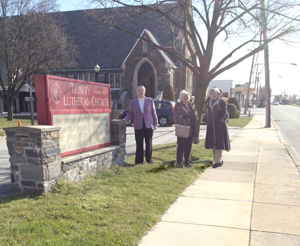
Three Redeemer Ambassadors visited this active church on West Chester Pike near City Line Avenue this morning. The congregation has been of interest to us for some time since one of our members, a retired Lutheran minister, remembers serving his internship year with this congregation 60 years ago. Unfortunately, he wasn’t with us this morning, but we took photos to share with him!

The 10:45 service had about 60 in attendance, including a nine-member choir and piano accompanist for all worship. A lovely solo, Panis Angelicus, began the service. The sermon was about keeping the first commandment — giving your all for Lord. The message rang clear to our Ambassadors as our people have sacrificed greatly for our church, laying much on the line as individuals. Our devotion has been ridiculed and taken advantage of by denominational leaders. But the pastor, Dr. Dolores Littleton, admitted in her sermon that it is a difficult commandment to honor.

Members were quite friendly. Several went out of their way to talk with us and we had several good conversations.

The congregation seemed to be pulling together on many projects including an upcoming mission trip to West Virginia. It was older adults bragging to us about their youth’s activities. Their youth had just participated in a youth retreat in New Jersey and slides from that event were on display in the fellowship room.

One member talked to us about a ministry meeting in their building called Oromo. We had seen this listed in directories but could learn nothing about it. He described it as a ministry exclusive to those from an area of Ethiopia. We discussed our East African outreach with him and how we had grown into a multicultural congregation.

The pastor expressed a sentiment that she wished Redeemer members could move on and forget all the anger. Anger is a rightful byproduct of injustice.

No one suggesting we should move on — including our bishop — ever presents any realistic options. Law suits filed against our church and individual church members left no choice but to defend.

Which church near us (all which voted to take our property) would be willing to welcome us? We’ve visited almost all of them. They are very much like Redeemer in size and joining one of them is likely to find us being treated the same way all over again in a few years, just as our nearest neighbors — Grace and Epiphany, Roxborough, were before us. We care about our church and neighborhoods and are bound by faith to minister in our own community.

Redeemer is dedicated to finding answers to urban ministry challenges — not shuffling people, their faith and properties like playing cards.

2×2 Has 4000 First Time Visits and Counting

Today 2×2 registered its 4000 first-time visitor just as we began our second year of posting.

We created our virtual church after our denomination locked us out of our property nearly three years ago. It’s been a grand experiment and we’ve learned a lot, all of which we are glad to share.

We’ve been watching the statistics and they reveal a great deal about the reality and challenges of ministry today.

Here’s a short rundown:

  • In the first two months of 2012 we matched the traffic for all of 2011 with more than 2000 visitors. If traffic continues to grow we may have 20,000 visitors by this time in 2013.
  • Someone from every state has visited 2×2 with the most visitors from Pennsylvania, California, Georgia, Iowa, Texas, Ohio, New Jersey, Minnesota and Illinois.
  • 68 countries have visited 2×2 with regular readership in France, Great Britain, Canada, Australia, Pakistan and the Netherlands. Traffic in Africa and South America is beginning to pick up.
  • Traffic comes in peaks and valleys but the peaks are growing taller and the valleys less deep.
  • We have about 80 readers subscribing to our daily blog feed and an average of 37 miscellaneous visitors every day. Together that’s more than 100 readers every day.
  • We’ve had more than 200 new weekly visitors for the last four weeks (not counting subscribers).
  • Most readers come looking for advice on using social media or for the worship resources we’ve made available.
  • Our multicultural series was reposted in Texas.
  • Two seminaries have shown an interest in 2×2’s thought leadership. Our posts have been circulated for discussion among students.
  • We are starting to form friendships with churches all over the world as we make it a point to write to anyone who comments. Some are becoming pen pals, praying and fasting for our church. We pray for them regularly as well.
  • We’ve created links for special projects of others and are helping their ministries grow.
  • Our most popular post continues to be a review of our visit to Trinity, Fort Washington, and their pastor’s object lessons for adults.
  • Just in the last month, dialog started to pick up on the topics we’ve introduced, drawing comments from leaders of some sizable churches.

2×2 is a small church fulfilling a big mission. We’ve just begun!

Does SEPA Have A Plan to Close Churches?

Bishop Claire Burkat of the Southeastern Pennsylvania Synod (ELCA) recently wrote to professional leaders outraged that people (specifically members of Redeemer) have suggested she is following a plan to close SEPA congregations.

She denies this.

We present to you the following evidence which makes it clear SEPA weighs the benefits to SEPA when assessing the strength of member ministries. SEPA has relied on church closings to fund its budget.

1998

In 1998, Bishop Almquist had his eye on Redeemer, a small church with a large endowment. He created conditions that led to imposing “involuntary synodical administration” and raided our bank account. When at last he gave up on the “administration” ruse he took an additional year to return the confiscated money, keeping some for Synod expenses. He then issued a plea to congregations for help in restoring the depleted “Mission Fund.” The amount he was asking for was almost exactly the amount returned to Redeemer. Redeemer in effect had supplied SEPA with an involuntary, two-year, interest-free loan.

2001

The issue with Bishop Almquist resolved in 2001, but he failed to find leadership for our congregation, trying to force us into long-term relationships with pastors who were clearly minimally commited. From 2001 to 2006, little concern was shown for Redeemer. It was even stated that left alone for ten years we were likely to die a natural death. Further evidence that this is a leadership philosophy: In 2001, Bishop Burkat as a member of Almquist’s staff holding the title of Mission Director, co-authored a book for regional church leaders, recommending a triage system for small churches. Do not spend time and resources on churches that will die in ten years, the book advises leaders.

2005

In 2005, just prior to Bishop Burkat’s election, SEPA treasurer reported that the Synod was within $75,000 of depleting every resource available. That’s about one month’s payroll for a staff of 14. Synod was in financial crisis.

2006

Redeemer had been working with Epiphany for nearly two years to unite our congregations and thought we were making progress. In October 2006, Epiphany abruptly announced its intention to break our covenant and close. We learned this vote was taken after Bishop Burkat met with Pastor Muse and Epiphany’s president. Redeemer was not consulted.

Pastor Muse gave 10 days notice, leaving Redeemer with no professional leadership. For six months, Bishop Burkat “helped bring closure” to Epiphany’s ministry . . . while neglecting Redeemer who was still housing Epiphany’s congregation but now with no advantages to their ministry. Epiphany was never locked out of Redeemer during their six-month closure process.

2007

Redeemer was launching a new ministry outreach which was showing great promise. By 2007, the national Church had already made note of our innovative ministry. We were attempting to get the attention of SEPA’s Mission Director. Phone calls were unreturned. We were told at last: “It doesn’t matter what your congregation does, the Bishop intends to close your church.” So much for the process of “mutual discernment”!

2008

SEPA Synod Assembly voted for a hefty deficit budget several years in a row. In 2008, when Bishop Burkat officially announced its intentions for Redeemer, the approved deficit was shy of $300,000—about 10% of the total budget. It was well known at the time that offerings and membership were in steady decline. Even larger SEPA congregations were experiencing hardship. Was there a plan presented for how to come up with $300,000?

Yes. It was reported that budget shortfalls are made up from the “Mission Fund.” Only later was the Assembly told that the Mission Fund was the repository of assets from closed churches.

In February, Bishop Burkat brought a lawyer, a locksmith and a sizable posse with her to what she thought was to be her first meeting with Redeemer. “Mutual discernment” began with intimidation.

2009

Synod Attorney John Gordon, before Judge Lynn in its actions against Redeemer, argued that Redeemer was the first of six congregations SEPA intended to close, suggesting to the court that it was a normal and benevolent procedure. That in itself is admission that SEPA has a plan to close churches.

2010

In the fall of 2010, Redeemer Ambassadors encountered a member of Epiphany in one of our visits. She spoke of her outrage that it was only after Epiphany voted to close that the congregation was informed that all but 5% of its assets had to be turned over to the Synod. There are many published reports of Lutheran congregations closing and dividing assets to causes of their choosing. There is no rule that congregational assets automatically go to Synod.

Statistics show that 80% of members from churches forced into closure never find a new church home. The members of closed SEPA congregations we encounter are hurt and angry. Those impressively orchestrated closing ceremonies do little more than assuage the consciences of leaders. We suspect that the process of closing churches that Bishop Burkat describes as going smoothly is not satisfactory from the congregations’ view.

We invite congregations to tell of their experiences. 

2011

It was not until the 2011 Synod Assembly that the Assembly insisted on a balanced budget, but still earmarked about 3% as coming from the Mission Fund—progress that came too late for about six SEPA congregations.

November 2011

We encountered a businessman on one of our visits who told us his company had attempted to help an urban church with a property problem. He received a phone call from Bishop Burkat ordering him to stop helping this church. Why? The plan, she explained, was to close the church and sell the property. This congregation is still open. Our Ambassadors have visited it twice. Members are fervent in their passion for their ministry.

There is ample evidence that closing churches is part of Synod’s plan to fund their budget.

SEPA member churches and clergy MUST take responsibility for the leadership they elect.
Many innocent people sitting in pews across five counties rely on you. Lay servants may think twice when they see how Redeemer leaders have been treated. They provide offerings, energy, property, buildings, and passion to SEPA’s ministry. SEPA is taking advantage of them.

The measure of a Synod is in how it treats its smallest congregations.

photo credit: jaxxon via photopin cc

Learning from Our Unique Experience as A Virtual Church

2×2 is the voice of Redeemer, small congregation in the East Falls neighborhood of Philadelphia, Pa. Our denomination decided for us that we could no longer fulfill our mission and seized control of all our property and financial assets for their own use. They locked the Christians of East Falls out of the church, we can only assume, so that they could more easily have their way. Our church building, under SEPA management, has been an empty witness to Christianity for going on three years — a definite failure to fulfill mission!

Redeemer, however, continues as 2×2.

We were not about to abandon our mission under such selfish circumstances. We had spent several years fostering a world view as we had visitors and members from all over the globe. This made it easier for us to take our ministry online, but we had no idea what to expect. Thinking globally and acting locally, we are discovering that our mission can impact the world.

We no longer worry so much about Philadelphia, although we are ready at any moment to reopen our physical church. We think our neighborhood still counts in God’s Kingdom.

Meanwhile, we are beginning to hear from congregations far away. A mission worker in Eastern Europe thanks us for our social media ministry. A pastor in Pakistan sends us regular updates on his congregation’s efforts to reach the poor in remote villages. A church in Africa thanks us for our ministry and describes their need to care for orphans.

Having been ousted from our denomination, we are no longer cloistered within Lutheranism. We are in regular contact with churches and church leaders across the United States. A few have provided both financial and spiritual support. Some have interesting projects and experiences which we incorporate into our ministry. We are more “in full communion” than when we were part of a “full communion” denomination — and this was achieved without decades of dialog!

At home in Philadelphia, we have become friendly with several parishes we knew little about when we were cozy in our own property.

Most congregations, near or far, are looking for little more than attention and prayer, which we are able and happy to provide.

We did not know what we were getting into when we started our virtual ministry, but it has opened the door for new mission and new possibilities. We are no longer just talking about mission but have  never been more actively engaged.

Meanwhile, our own denomination behaves as if we never existed.