God's light filtered through the city scape as the Redeemer Ambassadors pose in front of St. Michael's, Kensington.
The Ambassadors made a lovely visit to St. Michael’s, Kensington this morning.
We were struck by the friendliness of the neighborhood before we walked through their doors. A member on her way to church offered to help us by taking our picture. All the traffic waited at the stop sign, allowing her time to get her bearings with our camera.
Most members stopped by our pew to say hello on their way into the sanctuary. The pastor (Rev. Marjorie Neal) was away, but the service was led by very capable lay people.
We thought they were passing the peace at the beginning of the service and so we were surprised when they seemed to be passing the peace a second time toward the end of the service. They explained, the first time is the “Welcome.”
LBW liturgy was used with numerous hymns from LBW and WOV.
The congregation uses a beautiful ground-floor chapel. The original sanctuary above is also beautiful but they told us it has not been used in a year. It is difficult to maintain. All we city churches know about that!
They had recently had a flea market and were planning for a big St. Michael’s Day celebration on the 25th to which they are inviting all the many groups who use their building.
They operate a Christian Day Care and were planning to send some of their youth on a mission trip to New Orleans. Their bulletin also mentioned a food pantry.
As one member gave us a tour of their sanctuary and building, the front doors and gate were locked. We had to walk the length of the building to the back door to get out. In doing so, we passed a group preparing for a meeting. They quipped, “That’s a change. You thought you were locked out. Now you are locked in!”
The Lutheran Magazine recently reported on the hundreds of churches that have left the Evangelical Lutheran Church in America this year. At the August Synod Assembly, ELCA Secretary David Swartling reflected on the statistics, issuing a statement that smelled a bit of sour grapes. 54%, he noted, were congregations in communities of 10,000 or less.
“Given the small size of these communities, profound questions exist about the long-term viability of many of these congregations and their capacity to be effective in ministry and to develop the kind of interrelationships that they had in the ELCA.”
ELCA, wake up!
Speaking from our own experience in Southeastern Pennsylvania, small churches can no longer count on the ELCA for interrelationships or support in ministry. Small churches are being written off.
Our denomination acts as if they can continue to get away with serving as if they are the only game in town. This is most noticeable at the synodical level, but frankly, the national church has also looked the other way when small churches asked for help.
In Redeemer’s case (which you can read about elsewhere on this site), Bishop Hanson responded to Redeemer’s first request for help in our now four-year conflict with SEPA Synod by telling us of his regard for our bishop and urging both sides to negotiate. (Record of correspondence) He ignored every other letter our congregation sent to him . . as did the bishop and the rest of SEPA leadership. We understand his regard for a colleague in ministry. We do not understand why this regard translates to no regard for the people they both serve.
Small churches are frustrated with good reason. Church leadership should ask how long corporations would remain profitable if (and Redeemer experienced each of these):
The corporate office did not return phone calls. The corporate office did not respond to letters. Requests for appointments were given dates 3-5 months away–which then became 11 months. Decisions regarding local management and profitability were made with no interaction with local management. Key leadership positions went unfilled for years. Customers and clients were totally ignored but expected to eagerly embrace every new product. The workforce was asked to go through a grinding 12-18 months of interim limbo with every change of manager. Sales initiatives for each branch had to be managed by one corporate officer serving scores of branches. The manager had orders from middle management to placate workers until they grew discouraged and quit. Corporate never visited the branches unless they wanted something from them.
There was a time when congregations had no choice, but things have changed. New Lutheran denominations are emerging and time will tell if they are able to serve effectively.
More critically, small congregations now have mission opportunities outside the ELCA with organizations that pay more attention to them and are eager to work together.
If the ELCA wants to continue as an effective presence in our nation’s small towns and urban neighborhoods, they must find ways to help congregations face modern challenges. Meanwhile congregations are sending a message.
All those ELCA interrelationships — we aren’t feeling it!
In our last post we noted that Redeemer Lutheran Church in East Falls had achieved the goal of expanding multicultural ministry. The national church recognized our success, but the regional church (SEPA Synod) totally disregarded our ministry.
At the last National Assembly, the leaders of our church reported poor progress on meeting this goal nationwide. We think Redeemer’s experience can shine some light on why these goals are not being met.
There are at least three roadblocks:
1. Regional bodies are not comfortable with the goal.
There seems to be no infrastructure for implementing this major change in the denomination. When it comes to multicultural ministry, most churches and leaders are experimenting. Many of the smallest churches are strategically located in neighborhoods with the most potential for multicultural ministry, but they have the least help in achieving this important goal and may very well be on a synod’s endangered list.
Regional bodies have a tendency to cripple congregations with labels. They see congregations in terms of the past. Congregations, led by professional leaders who are familiar with those names, have a hard time ministering beyond low expectations. Regional bodies are unconsciously saying NO to the potential for multicultural outreach by failing to provide leaders for neighborhoods experiencing cultural change. Caretaker pastors will ignore the cultural changes happening all around the congregation as they hold the hands of existing members, waiting for them to die. When regional bodies lose these neighborhood outposts, they lose valuable assets for achieving their goal of multicultural ministry.
What would happen if synods approached neighborhood churches with high expectations and gave them the help they needed to reach them?
Redeemer did not set out with multicultural ministry as our objective. We just welcomed all who came to our door. This was met with resistance from SEPA leadership, who had predetermined that slow death was to be our fate.
The first Tanzanian family who came to Redeemer in 1998 asked for their two infant sons to be baptized. Bishop Almquist had declared synodical administration. We were advised to NOT baptize the children or encourage new membership. (They had NOT declared us closed but that’s what they had in mind!) The family shared only recently that a synod representative had visited them and discouraged them from joining Redeemer, which was only a few blocks from their home. “Why do you want to join a church with no black members?” they were asked. They suggested they join a church with black members several neighborhoods away.
This family joined Redeemer anyway. They were to play an important role in Redeemer’s multicultural future.
2. Pastors are not comfortable in multicultural ministry.
As this family became active, they often expressed the desire to reach out to more of the East African immigrant community. Extended family and friends began joining. One was active in social work near our church and wanted to expand outreach to nearby Hispanic neighborhoods. This ministry direction had been discussed often at council meetings with our pastors, who admitted they were not equipped to lead this type of ministry. We asked them to help us find extra help. The report was always the same. “There is no one.” Redeemer wanted to move in a direction professional leadership was unable or unwilling to take us.
Within weeks of our last pastor’s resignation, lay members had identified two qualified Lutheran pastors with roots in East African culture who were willing to visit and invite. Within a few months, Redeemer had 49 new members. During this time, SEPA leadership totally ignored us. They had no interest in helping a church they perceived as dying. When we sent a resolution to Bishop Burkat to call one of the pastors who had been working with us for seven months, she declared Redeemer closed.
3. Congregations are not comfortable with multicultural ministry.
Congregations naturally will wonder what will become of their culture if you open the door to other cultures. Redeemer faced this challenge, too.
First, we made sure that veteran members were not neglected and were active in welcoming. The church service became a bit longer with the incorporation of other languages and music, but the old membership did not have to forsake cherished traditions. Strangers were not valued more than they. God’s love grows community; it does not neglect one community to lavish attention and resources on another.
In light of these three roadblocks, the ELCA has set a goal which few people share except in theory. Here is advice from our experience on how to detour these roadblocks.
Invite.
Being invitational must be taught not just preached. Pastors often say this is the congregation’s job, but in today’s climate it must start with the pastor. The pastor must model this for the congregation, especially if a congregation has been suffering. Members will be of low morale and unable to invite. Pastors should visit, talk enthusiastically about their visits, encourage members to come along, and make sure there are quality offerings for members to promote with enthusiasm. This will rebuild invitational confidence.
Don’t cut the roots.
Popular advice from church hierarchy touts allowing churches to die so that Christian community can be “resurrected.” This is a distortion of the Resurrection message. The Bible does not advocate evicting the faithful to invite new members. As cheery as this may sound, it is cruel in practice. Time will tell if these theories have longevity or if their cited successes are flashes in the pan.
We suspect the Church will not grow if you cut the roots. If veteran members are ignored, criticized, and evicted, the neighborhood will notice. Sensitive new members will ask themselves if one day this will be their fate. Make sure that old members are part of the process of welcoming new members. Change may be desirable but keep some things the same. New members will know that they are influencing a new chapter in a long tradition.
Ministry is not multicultural if cultures never mix.
Redeemer began by offering a separate service for East Africans, but this lasted only a few months. Both “old” Redeemer and “new” Redeemer wanted to be in communion. Some congregations never move beyond this and become two congregations sharing the same building while calling it multicultural.
We faced the challenge of merging communities with FOOD.
Many churches have coffee hour. It was our observation that coffee hour does not create true fellowship. People grab their styrofoam cup and find a corner to talk to people they already know.
We began serving soup. One pasta pot of soup brought in from home will feed a small church fellowship. Easy to serve; easy to clean up. Soup encourages people to sit down together. Soup is multicultural. “Old” Redeemer tasted “banana” soup, a Tanzanian staple. A Puerto Rican vicar introduced us to sancocho beef stew — “not spicy, just tasty.” If conversation stalled, we talked about the soup, asking who made the soup and what was in the soup. Stories followed about how mother made the soup, how spices were chosen . . . and suddenly you have a proud congregation sharing traditions.
When the arts are explored, minds open.
We wanted the message that our congregation was welcoming to all cultures to be clear. It’s hard to change the stained glass windows, but we featured art and poetry from different cultures on our bulletins. We occasionally practiced the Taize traditions with icons and chants. Liturgical dance became part of our tradition. Drums were played by members sitting in the pew, but the church organ still whined away. Some of the art/music featured was traditional. We did not replace what was dear to people. We added to it.
Use the gift of language.
Foreign languages make Americans nervous. Our new members graciously recognized this and switched to English when others were present. It was a considerate, unsolicited gesture that helped create community.
In worship we alternated languages between verses in singing hymns. We said the Lord’s prayer in Swahili and English until Swahili-speaking members objected, saying God needs to hear our prayers in only one language. English-speaking Redeemer objected, saying “But we need to hear it in Swahili.” We didn’t debate; we alternated.
Soon, English-speaking Redeemer began adopting Swahili phrases in conversation.
Which brings us to our final point for today.
Be flexible.
In one way of thinking all churches are multicultural. Concentrating on the multicultural in ministry is forging new ground. Develop a welcoming atmosphere and follow your instincts.
If you’d like a team from Redeemer to make a presentation on our multicultural experience, please leave a comment and we will get back to you.
At August’s (2011) national ELCA Church Assembly, some memorials were given special attention by the delegates. Three were issues Redeemer had already addressed!
1. Expanding Multicultural Ministry
The Assembly addressed concern that the ELCA has not yet reached the goal of 10 percent members who are people of color or primary language other than English.
Two thirds of Redeemer members were immigrants from East Africa. Members and regular attendees and supporters hail from six continents. SEPA Synods response to our congregational mission work was first to try to stop us. When we told Bishop Claire Burkat of our plans to reach out to friends and extended family of current Redeemer members of African descent (2006), she responded, “You are not allowed to do that.” A year later, when our outreach resulted in dozens of new members, Bishop Burkat attempted to divide our church racially by suggesting black members go to another church. When that proved offensive to the entire congregation they attempted to force us into closure regardless of our membership and vitality. They sued our congregation. Although some of this behavior appears to be racist, their law suits against the congregation are more equitable. They evicted all of us — black and white — from our building. They chose both a white member and a black member to sue personally. In fact, the African member they chose to sue was served with the court papers on the same day he received his permanent residency papers. Welcome to America!
2. Acknowledge the International Year for People of African Descent
The Assembly asked the presiding bishop to issue a statement acknowledging this special designation. The stated purpose is to encourage congregations to affirm the gifts of people of African descent . . . and to examine factors that keep people of color and/or whose primary language is other than English from experiencing the fullness of leadership and inclusion in the ELCA.
Redeemer encouraged full participation of our growing East African community. Our worship services reflect their culture. Both English and Swahili-speaking members enjoy singing hymns in different languages. Prayers were often offered by a member whose first language was French. Worship and Bible study leadership was shared and when “black” membership outnumbered “white” membership, every effort was made to assure appropriate representation on our congregation council.
The National Church was interested in our ministry and asked us to provide a report — which we did. (Report on Kiswahili Ministry) But on the local level, we received no recognition or encouragement. SEPA Synod’s eyes were on the prize, and the prize was our property/assets.
This brings us to the third specially considered memorial by the National Assembly.
3. Bullying and Harrassment
The Assembly approved a resolution addressing bullying, harassment and related violence and urged Congregational and Synodical Mission to collaborate in addressing and preventing bullying and harassment.
Redeemer has been the victim of synodical bullying for years, escalating to litigation in 2008 and seizure of our property in 2009. As is often the case in bullying, onlookers — our sister congregations and the national church — have done very little to stop this. No reason to say more here. See our post:
As Redeemer Ambassadors began our second year of church visits in August, we began to feel more comfortable in our visitation. Perhaps that’s because we are beginning to discover connectivity — sometimes spanning decades, sometimes a century or more.
Our first visit rekindled an old working friendship which had been dormant for decades. In November we visited St. Mark, Conshohocken. The grandfather/great grandfather of two of our Ambassadors was one of the founding pastors of that congregation and visiting the church we had heard about so often from our ancestors was very meaningful. We also discovered that some of the Epiphany members who once shared our building were now worshiping there.
Almost every week, we find something in common with the people we visit. At St. John, Folcroft, one of our ambassadors mentioned her college and a St. John member responded, telling us about her college. We soon learned that the woman had been college friends with one of our ambassadors who was not present and had sung in the college choir with his wife.
At Grace, Mantua, we learned that the pastor and his wife shared mutual good friends with one of the Ambassadors. Similarly, we learned that the pastor of liberti presbyterian shared mutual friends. We had heard stories about one another for years but had never met!
This morning, we visited Trinity, Fort Washington, where one of our former members attends. We were pleased to talk with her many friends. Our former member and her family had been among the earliest and strongest Redeemer supporters. We also discovered that their new pastor was from a church near the childhood church of one of our ambassadors and they knew some of the same people. His home church was that of one of our ambassador’s earliest relatives to come to America hundreds of years ago.
As we share stories of our other visits, we learn of their connections with the people we are currently visiting. “That’s where I was married.” “That’s the church my husband and I visited when we were trying to decide on a church.”
Redeemer is part of the precious interconnectivity of Lutherans and Christians everywhere. Locking our doors won’t take that away!
We recently came across the Southeastern Pennsylvania Synod’s statistical reports as presented to the Evangelical Lutheran Church in America — the national church — on the ELCA web site. The report was dated August 17, 2010. We were surprised to see Redeemer listed at all, since elsewhere on the internet SEPA Synod reports our congregation as closed as of June 10, 2010. Redeemer seems to be open when Synod wants to count us and closed when they want us to be closed.
Where did these statistics come from?
The statistics in this report begin in 2004 when we are listed as having 28 members. Redeemer was listed in the same sort of report in 2005 as the only congregation in the SMALL category that was GROWING. Now Redeemer is categorized in the same year as DECLINING! The most recent report rewrites history and shows Redeemer having only THIRTEEN members in 2005 and every year thereafter, including 2010. We have been locked out of our church since September 2009.
UPDATE : In February 2012, SEPA Secretary Rev. Ray Miller and Redeemer “trustee” testified in court that Synod records had Redeemer’s membership at 26 or 28 (ignoring the list of some 70 names we had provided to them). Yet the report issued to SEPA Synod Assembly stated 13. Synod’s lawyer went on in the same proceeding to attempt to prove that Redeemer acted without authorization because the congregational vote of 17 did not constitute a two thirds quorum. It is now clear that SEPA was lying to its member churches to solicit the vote they craved.
Redeemer has very few members. Honest!
For the record, REDEEMER was a growing congregation with slow but steady growth throughout most of this time period. Part of this growth was among East African immigrants. We experienced a significant growth spurt in 2006-2007 when we began a concentrated outreach to the friends and extended families of members who had been part of Redeemer for as many as 10 years.
This favorite number, 13, keeps cropping up. It was the statistic included in the Trustees Report to Synod Assembly which was first read to the entire assembly in 2008 (along with other inaccurate information) without ever having been shared with Redeemer. We asked in writing for Synod Leadership to correct this report, but it was dragged out again before the entire Assembly in 2009. Redeemer was denied voice or vote at this Assembly.
FACT: Our church council met with Bishop Claire Burkat on November 1, 2007, and presented our membership list along with a detailed ministry plan and a resolution to call a pastor who had agreed to our payment terms and was willing to commit to five years of service. Our membership list had been carefully compiled for this report and was part of a 16-page ministry plan (see page 11). The congregation had worked on this plan months. It included the names of approximately 75 members (full members, associate members and children). We accepted a few more into membership after that meeting. We had many more who had expressed interest in joining our ministry.
The list we presented to the bishop was a conservative count. Had we included a few “drifters” (young people of college age who hadn’t attended in a year or so, for example) we could have claimed another dozen members, but we wanted to be accurate in representing our changing congregation. We had nothing to be ashamed of . . . we were growing quickly!
At this meeting Bishop Burkat reviewed our membership list and commented that many of the names “looked African.” She then added, “White Redeemer must be allowed to die. Black Redeemer . . . .we can put them anywhere.”
In about 2007 or early 2008, the synod demanded a monitored congregational vote on a resolution we had presented to the bishop. We complied with their request and a Synod Council representative attended the meeting, reporting 14 present for the vote. Synod challenged the quorum, so they believed at that time that Redeemer had 42 voting members and even more non-voting members. Redeemer has few members when Synod wants us to have few members and many members when Synod wants us to have many members.
Who came up with these statistics? We had no pastor during much of this time, so we know the forms were not filled out by anyone at Redeemer. The secretary of Synod, Rev. Ray Miller, also served as a trustee for Redeemer. Does he have the answer to this question? Were these statistics presented to the court to justify their takeover? Since Synod has defined “two” Redeemers, dividing our church along racial lines, are the 13 members they are counting our white members?
All churches should check the accuracy of these documents in reference to their congregations. Otherwise these statistics could be used against you some day. Here’s a link:
The Evangelical Lutheran Church in America (ELCA) and its synods, including the Southeastern Pennsylvania Synod (SEPA), have bullying on their minds.
At the May 2011 SEPA Synod Assembly, our synod issued a statement condemning bullying.
Easy to say. Not so easy to live.
What would SEPA see if it looked closely in a mirror?
Bullying has been part of SEPA’s leadership style for some time. It has been an active part of its relationship with one of its member churches for more than a decade. Redeemer Lutheran Church is not likely to have been the only bullied church. We may be the congregation to offer the most resistance. Bullies count on making the road to resistance as rocky and unpleasant as possible. Conflict is not what most people are looking for when getting dressed for church.
You may be tired of hearing about Redeemer. Bullies count on that too. Lutheran congregations need to listen.
What is happening will affect more than just Redeemer. It is a shift in how the church interprets their constitutions, which were not written to support hierarchy but interdependence. Congregations, in the Lutheran tradition, are supposed to own and control their own property and resources. By challenging one small congregation after another — hoping for no resistance — the synod is creating precedent. Their pattern of behavior becomes more entrenched with each unchallenged church closure. Soon, rank and file Lutherans forget that this is not the way Synods are supposed to interact with congregations.
They are attempting to create hierarchical rights similar to that of Roman Catholic structure. The sense that the Synod manages congregations rather than serves them will have far-reaching influence for a very long time.
When other congregations are asked to vote about a sister congregation’s property (something the Articles of Incorporation forbid), they may assume that Synod worked hard with congregation before encouraging closure. Redeemer can tell you this was not the case.
Redeemer, East Falls, Philadelphia, can predict this with some authority. Redeemer sent a resolution to Bishop Burkat, following the congregation’s unanimous decision to leave the ELCA. Bishop Burkat did not respond herself. Synod’s attorney sent a fax, informing us we could not withdraw because we are officially terminated. Redeemer had received no such notice of termination, nor can we find any constitutional provision allowing the bishop or an attorney to unilaterally declare a congregation closed. The result is an ongoing bullying campaign.
Why does the Church want to make it difficult for unhappy people to leave?
The answer is greed. They don’t care if the people leave (Redeemer members were physically locked out!). They don’t want the value of the property and endowments to go with them. They would rather see churches closed and, in many cases, sold than work to resolve differences and develop ministry.
Closing churches is an economic strategy not a mission strategy. Redeemer has been through this twice. Both attempts to seize Redeemer’s property were made during Synod budget crises. While there is considerable hype among church leaders about “allowing churches to die to allow for resurrection,” this talk does little more than veil less noble motives. Death of congregations is not a mission strategy. Mission strategies are about helping (especially the dying) — not about evicting, devaluing, and replacing the faithful.
Make no mistake, the way churches are being closed in SEPA Synod is about power, fueled by greed. Changes in the ELCA constitution will surely further fuel their arsenal.
The Greed motive is easily understood. SEPA operated with a significant deficit budget for years, relying on closing churches to keep the lights on. To the credit of the 2011 Synod Assembly, a balanced budget was passed. Had this step come earlier some neighborhoods might still have their churches. (Redeemer may have influenced this change for the better.)
The Power motive has been evident in the Redeemer situation from the start of the conflict, which began shortly after Redeemer received a $300,000 endowment. If there were any real differences between Redeemer and SEPA—and none were ever discussed with our congregation—there were peaceful resolutions available. There still are. Redeemer leaders proposed several — all aimed at building Christian community the Lutheran way. We were ignored. Instead we have become victims of vicious bullying.
From Wickipedia:
Characteristics of bullies and bully accomplices
Research indicates that adults who bully have personalities that are authoritarian, combined with a strong need to control or dominate. It has also been suggested that a prejudicial view of subordinates can be a risk factor.
Prejudice against Redeemer has run rampant. One group of retired pastors wrote referring to problems in the 1960s. None of us at Redeemer knows what they are referring to! Bishop Burkat has referred to two bishops working with Redeemer. The truth is both bishops were working to acquire Redeemer’s assets. Eight years had passed with no interaction since Bishop Almquist returned the money his administration took from our bank account ($90,000). During that time Redeemer had grown significantly. Bishop Burkat made no attempt to work with Redeemer. We first heard rumors that Redeemer was targeted for closure in June 2006, a month after her election.
Nevertheless, Bishop Burkat opened her meeting with Redeemer leaders (November 1, 2007} with something of a tirade. She called the congregation “adversarial” and used the word repeatedly, hammering the eleven members of the congregation sitting before her, most of whom had never met her before. As the conflict escalated we have been called other names. The name-calling serves its purpose. It makes it acceptable to abuse our members.
Bullying Tactics
Redeemer has experienced the following common traits of bullying:
Public ridicule. (Synod Assembly 2009 as prime example)
Name-calling. (adversarial, renegade, criminal, the list is long)
Imbalance of power. (stripping our rights to speak at Assembly, controlling the appeal process)
Deceitful behaviors. (trustees who introduce themselves as “fact finders”, meetings called for a falsely stated purpose)
Wide circulation of false information. (even after we asked for correction)
Intimidation. (bringing a lawyer and locksmith to meeting, suing volunteers)
Isolation. (A synod council member turned away our member who approached him. While other multi-lingual and multi-racial congregations were allotted additional representatives at Assembly, Redeemer was denied even one! SEPA’s failure to work with Redeemer to provide pastoral care left us without a pastor as liaison, making us an easy target.)
Bullying often relies on passive bystanders. SEPA has an abundant supply.
Again from Wikipedia:
Characteristics of typical bystanders
Often bullying takes place in the presence of a large group of relatively uninvolved bystanders. In many cases, it is the bully’s ability to create the illusion that he or she has the support of the majority present, that instills the fear of ‘speaking out’ in protestation of the bullying activities being observed by the group. Unless the ‘bully mentality’ is effectively challenged in any given group in its earlier stages, often the ‘bully mentality’ becomes an accepted norm within the group. In such groups where the ‘bully mentality’ has been allowed to become a dominant factor in the group environment, a steady stream of injustices and abuses often becomes a regular and predictable group experience. Such a toxic environment often remains as the status-quo of the group for an extended period of time, until somehow the bullying-cycle should eventually come to an end. Bystanders to bullying activities are often unable to recognize the true cost that silence regarding the bullying activities has to both the individual and to the group. A certain inability to fully empathize is also usually present in the typical bystander, but to a lesser degree than in the bully. The reversal of a ‘bully mentality’ within a group is usually an effort which requires much time, energy, careful planning, coordination with others, and usually the undertaking of a certain ‘risk’.
It is the general unwillingness of bystanders to expend these types of energies and to undertake these types of risks that bullies often rely upon in order to maintain their monopolies of power. Until or unless at least one individual who has at least some abilities to work with others, opts to expend whatever energies may be needed to reverse the ‘bully mentality’ of the group, the ‘bully mentality’ is often perpetuated within a group for months, years or even decades.
This is precisely what Redeemer has experienced within SEPA.
Let us pray for the whole people of God . . .
Passing the Buck to God and/or the Courts (somebody else . . . anybody!)
This year, Redeemer invested many Sunday mornings visiting other congregations within the synod. Occasionally, they ask about our situation. Typically, they say, “We will pray for you.” Unfortunately, prayer without action is not likely to resolve this conflict. The offer of prayer has become a meaningless mantra to hide behind.
SEPA bystanders are relying on secular courts to sort out their problems. (Ironically, they are relying on First Amendment rights [separation of church/state] while denying the members of Redeemer other rights listed in the same Amendment!) So far there have been many court rulings, all made without hearing the case. The latest was a split decision. The majority took the stance that courts do not have jurisdiction in church disputes. The minority opinion agreed with Redeemer’s position—that if you apply the law to the property issues, Synod is out of line. Redeemer lost the decision, but the split decision should indicate to the Church that Redeemer’s position has merit. Perhaps, the Church should take more time to carefully examine issues that may one day affect them.
Other congregations feel threatened. They have told us so! We see it for ourselves in our visits. Many are no stronger statistically than Redeemer. Several are weaker! They are probably correct that addressing our situation will make them a future target. (Synod stated in court that Redeemer was the first of six churches they planned to close this way!)
This conflict has pointed out many flaws in ELCA governance.
Synod Assembly, which is constitutionally given the responsibility for resolving dispute, allowed one side of the dispute to control the venue and alloted practically no time to consider an issue which the courts are taking years to sort out. In fact, in their rush to judgment, they failed to vote on most of the issues Redeemer brought before them, concentrating on the bishop’s true interest—our property — something Redeemer and two superior court judges have questioned constitutionally.
Synod Council announces an executive session when Redeemer comes up so no one knows what our elected representatives are doing. Their contact information has been removed from the synod web site. They have the power and responsibility to speak for congregations and check the power of the bishop but are isolating themselves from the people they serve.
Bishop Hanson, early on, said he had no power to help—proving Redeemer’s argument that the Lutheran church is not hierarchical. Synod bishops don’t have to follow presiding bishops and congregation councils constitutionally answer to their congregations, not the bishop. We are, as the dissenting judges pointed out, interdependent not hierarchical. Lutherans should want this historic relationship to continue.
Clergy seem, for the most part to be afraid to speak out. In four years, the only answers to Redeemer’s communications have been from retired pastors (split 50/50). NO active SEPA clergy has ventured a response.
Congregations typically say “We don’t know how to help.”
SEPA clergy and congregations join the Pharisee and Levite in passing by.
If you liken our situation to the story of the Good Samaritan, it is clear that SEPA has joined the Pharisee and Levite in passing by the victim, waiting for someone else to help.
And then there are the effects on Redeemer. The Church has shown no concern for our people.
Redeemer was probably the largest Protestant church in East Falls at the time of Synod’s interference. It was growing steadily in an innovative direction. Its members were devastated and felt abandoned by the church. Those with young children understandably looked for a place for their children during what is now a four-year struggle. They remain in touch. Families were divided. Faith was shaken. Some found a faith healer to follow with disastrous and nearly deadly results, further damaging faith.
Synod strategy (intimidation tactic) was to personally sue two lay members of the congregation who thereby had no choice but to defend against the legal charges. If you think this isa one-time tactic, keep in mind that Bishop Burkat boasted at the 2010 Synod Assembly that the Synod’s attorney had met with the legal counsels of all synods in Chicago to discuss their strategy in this case. While clergy who served us and members not individually targeted can walk away, these volunteers are in the conflict for the long haul, like it or not. (Congregation council members, beware! Write indemnification clauses into your constitutions and insure your council members now!)
Redeemer still meets and worships weekly and has continued some exciting initiatives.
The church building is locked. The promises made in court of reopening have not been kept. SEPA Lutherans remain silent.
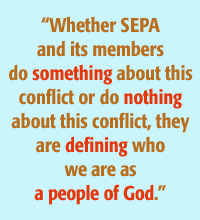
Whether SEPA and its members do something about this conflict or do nothing about this conflict, they are defining who we are as a people of God.
We share this because we fear that many more churches will be treated as Redeemer has been treated. The proposals before the national church are a step in this horrific direction.
Join Bishop Ruby Kinisa as she visits small churches "under cover" to learn what people would never share if they knew they were talking to their bishop.
Undercover Bishop will always be available in PDF form on 2x2virtualchurch.com for FREE.
Print or Kindle copies are available on Amazon.com.
For bulk copies, please contact 2x2: creation@dca.net.
MISSION INSPIRATION OFFER
A visual and biblical guide to help congregations define their missions.
Contact Info
You can reach
Judy Gotwald,
the moderator of 2x2,
at
creation@dca.net
or 215 605 8774
Redeemer’s Prayer
We were all once strangers, the weakest, the outcasts, until someone came to our defense, included us, empowered us, reconciled us (1 Cor. 2; Eph. 2).
Be calm. Wait. Wait. Commit your cause to God. He will make it succeed. Look for Him a little at a time. Wait. Wait. But since this waiting seems long to the flesh and appears like death, the flesh always wavers. But keep faith. Patience will overcome wickedness.
—Martin Luther