4/7InkzHVUEQeEdU9vpc1tikzEhChrKmPfvXI-FSDBrBQ

Redeemer

More Questions for SEPA Synod and Bishop Burkat

“We will travel by listening and praying and discerning, not by resisting, complaining or reminiscing.”

This sentence from Bishop Claire Burkat’s recent letter to professional leaders in the ELCA’s Southeastern Pennsylvania Synod is troubling.

There seems to be a hidden meaning. Listening, praying and discerning are the good things, right? Does that mean resisting, complaining and reminiscing are bad things?

If no one resists when they are mistreated, if no one complains when they see wrong in the world, and if our life experiences mean so little that we cannot share and remember them and build our identities around them, then how is anyone to listen, pray and discern wisely?

Isn’t a devotion to the Bible a form of reminiscing?

There is power in the things Bishop Burkat proposes we avoid. Listening, praying and discernment are fueled by resisting, complaining and reminiscing. No one should want to be a part of a church that does not honor these along with the others.

Bishop Burkat seems to long for easy leadership—one where church leaders and church members do as they are told. This philosophy can be rephrased: We’ll figure out what is best for you; you will comply.

Now that SEPA Synod has decided that your property and money are theirs for the taking, will congregations dare resist, complain or be caught remembering their heritage?

This poor leadership philosophy has been the driving force behind the five-year conflict between Bishop Burkat/SEPA and Redeemer. Does SEPA need more evidence that this is bad for all Lutherans?

By the way, Bishop Burkat’s opening dialog in her one meeting with Redeemer back in 2007 included her complaint, “I sense there is resistance.” Well, she was right about that!

She then set about destroying all memory of Redeemer — locking our doors for nearly three years, tearing down all signage, refusing to allow us even the name of our church. (Doesn’t this sound a bit like the way the U.S. treated the native Americans? If you can control their identity, you can control their land.)

SEPA congregations know what they have to look forward to if they don’t toe the line.
Closing Churches Creates Pariah Parishes

The announcement of church closings is a common scenario in the Roman Catholic Church. Roman Catholic church structure places property ownership in the hands of the bishop.

Not so for Lutherans. Yet in recent years, Lutheran “bishops” are assuming the powers of the Roman Catholic “bishops” and declaring churches closed without the participation of the congregations. As resistance builds, the process becomes uglier and more heavy-handed.

The true measure of a denomination's strength may be how it treats its smallest congregations. Declaring churches closed is asking for trouble. Churches with any life must resist if they are to act on their faith and beliefs — which is what religion is all about.

Once lines are drawn, parishes that resist become pariahs. Gossip starts. No one wants to be involved.

How does a denomination guarantee that determinations of viability are about the parish and not about the denomination?

More congregations will face the mysterious “viability” test. They may not even realize they are being tested.

The signs that this may be happening are

  • no cooperation from the denomination in finding pastoral help
  • pastors sent as caretakers who do nothing to grow the congregation
  • failure to communicate with the congregations (letters unanswered, phone calls not returned)
  • in general, the absence of the denomination until . . . .

Once a congregation is labeled “not viable” word spreads. There is little a congregation can do to change minds. Pastors will disappear and the congregation will find themselves limited to working with lay talents and retired pastors whose careers can no longer be influenced by the denomination.

Any measure of a congregation’s strength made by a denomination, itself in fiscal crisis, must be questioned.

Redeemer is notorious at this point.

One clergy member commented that closing Redeemer doesn’t matter. “There are plenty of churches in that neighborhood.” There were plenty of churches. The Congregational Church on Midvale closed and the building is now the office of a Lutheran Social Service agency. The Methodist Church closed. The Baptist Church closed. The members of St. James the Less were evicted by the diocese. St. Bridget’s is endangered.

The Presbyterian Church faced challenges but has managed to revive their ministry with the support of their denomination. The Episcopal Church, located on a remote street, was assisted by SEPA Synod in creating a ministry plan. Yes, the same synod that determined their own ministry in the heart of East Falls was not viable was assisting the Episcopalian congregation on the fringe of the neighborhood.

At the time Synod declared “synodical administration” on Redeemer, it was the fastest growing church in East Falls.

Decisions are being made about neighborhood ministries by people who know nothing about the neighborhoods.

Money is the issue in East Falls. Redeemer was a small congregation with cash. When Bishop Almquist targeted Redeemer in 1998, we had received a $300,000 endowment a few years prior. We resisted his action successfully, but we became a pariah parish.

In 2007, after nearly a decade of Synod neglect. we still had operating funds and a rented property. The congregation was active and growing. Synod was operating on a recurring six-figure deficit budget. With giving down, the only way out was to look for congregations to close.

Five years after being declared not viable, and more than two years after being physically locked out of their house of worship, Redeemer still meets weekly for worship. Redeemer still develops mission projects which are gaining national interest, if not interest from the denomination. Redeemer remains viable. Imagine what might have been done with the support and respect of church leaders.

One might think that mission and scripture play a role. Love, helping the needy, reconciliation, forgiveness, sacrifice . . . just words when denominations attack their congregations.

Synods must solve their own fiscal problems . . and not on the backs of its small neighborhood churches. The true measure of a denomination’s strength may be how it treats its smallest congregations.  

SEPA member churches, find a voice . . . or you may be next.

What Makes Ministry Viable?

This is a question that is answered differently by clergy than lay people.

Denominations want to measure assets to determine if they can comfortably place a minister there.

Congregations are more interested in ministry results. They look for ideas, passion and action.

Both have a place in the viability equation and both sides should be involved in any viability determination. Money without ideas, and vice versa, is useless.

What is rarely measured is potential and that has a lot to do with the work of the Spirit.  

Redeemer has great experience with the folly of measuring viability without allowance for the Spirit.

Redeemer was declared not viable in 1998. Our elderly but spunky members were viable enough to change Bishop Almquist’s mind — even if they failed to prompt him to work with the congregation.

For eight years we were ignored by synod leadership.

Synod, under new management in 2006, decided to play the viability card again. They assumed those old ladies from 1998 were dead, gone or rasping for breath. Redeemer, under synod’s philosophy of allowing congregations to die, should have been ripe for picking.

The old ladies of 1998 were gone. But they hadn’t gone to their eternal reward without laying the foundation for new mission. In the eight years Redeemer was left to die, Redeemer grew, slowly and steadily at first, and quickly in 2006 and 2007. Most members were now under 40. Children were abundant. Redeemer was five times the size it had been in 1998.

Ample evidence of this was presented to SEPA to no avail.

  • We were debt-free.
  • We had a 25-year day care program renting our educational building.
  • We had an endowment fund — that suffered from Synod’s attempts to take our assets in 1998 but was still more than Synod had!
  • We had ministry initiatives which were reaping good rewards.
  • We had talented lay leadership and good relationships with several pastors.
  • We had worked for several months with clergy, real estate experts, an accountant and lawyer to create a detailed plan for new ministry initiatives.

But Bishop Burkat had made a hasty declaration about Redeemer and wasn’t about to let facts get in the way. SEPA’s recurring six-figure deficit budget was motivation enough. Money had to be found. Redeemer, we learned, was to be the first of six congregations targeted to solve the problem.

If the viability measure were scientific, it should have been easy. Swoop in, act like you care, say a prayer, hold a “celebratory” service, grab everything in sight, and post the “for sale” sign. If members resist, sue; that’ll get ’em.

But Synod’s measure of viability seems to be faulty. Money created a conflict of interest.

Six years later, the oppressed victims of Redeemer have an active and viable ministry even without the property and assets that were found inadequate back in 2006. Legal action, personal attacks, even excommunication failed to dampen its potential.  The Spirit found a crack. Potential.

Synod– the entire body, not just the leadership — turned their responsibility over to the courts, who, as it ends up, don’t want it. The courts never heard the case Synod brought against the congregation. They decided to let the church work out its own problems, citing separation of church and state.

The ball is back in the court of SEPA member churches.

Synod could be proud of Redeemer. They could boast of Redeemer’s pioneering efforts in multi-cultural ministry, social media ministry, and children’s ministries. They might learn from our ministry initiatives.

If you approve of the actions of your synod, beware that your approval means many of you will face the Redeemer treatment. From our visits it looks like about 10% of SEPA congregations are no stronger than Redeemer. A few more years of unchecked decline will add to that number.

If you do not approve, you are obligated under the constitution to speak up and say so. The secular courts are not going to do your work for you.

That’s about the only decision to come out of four years of legal maneuvering. Doing the right thing is up to you! Spend the next four months thinking about it.

Whoville Fun

Yesterday, Redeemer and 2×2 held our first event for the community since we were locked out of our church two years ago. The Whoville Party was fun and profitable.

The idea came from our visit to St. Michael’s, Unionville. The pastor read part of How the Grinch Stole Christmas as the children’s sermon. The Grinch tries to steal what is most precious from the people of Whoville, pretending that his efforts are for their own good. The people of Whoville rally amidst adversity. Perhaps Christmas means a little bit more. The parallels of the Grinch Story and Redeemer Story were remarkable. The Whoville Party was planned on the ride home.

It was good to feel that we were once again working together as a church without the feeling that we had to stay in hiding. We had help from many and were able to create an attractive party ambiance in the donated space of our friends at Old Academy. The Whoville art and decorations, created by a son of Redeemer, were fantastic and transformed the space into Whoville. The food (green eggs and ham soup and roast beast sandwiches) got rave reviews even from the hesitant. The children had lots of fun playing Whoville games and older Whoville visitors sat together, sipping wine and chatting long after the party was supposed to be over.

Whoville visitors heard a story by Dr. Seuss. Even the Grinch (foreground) stopped to listen.

We are grateful to all who helped. It showed the strength of community. Binswanger Realtors donated the Phillies tickets. Old Academy gave us space. Donations helped us cover expenses.

In the process, several people left planning to look up Old Academy on the web. When neighborhood organizations work together there are benefits for all.

It was unfortunate that our event coincided with the devastating news that another East Falls church organization is being managed out of existence by hierarchies that understand dollars more than sense and mission.

Children had fun dressing the Grinch.

Recipe for Green Eggs and Ham Soup (as requested)

Quantities depend on how big your pot is! We made a huge pot, so we are guessing at the quantities for a more normal batch. This was the one and only time we made this, so the only proof of the pudding was in the eating!

In a mixture of olive oil and butter (or just one or the other), saute a large onion, 2 spears of celery, 2 carrots, and 4 diced potatoes. As these ingredients soften, add a quart or so of water and a cup of dried split peas. Simmer on low for an hour as the peas soften. For spices use red pepper, garlic powder, savory and parsley flakes, chicken bouillon, salt and pepper — all to taste. We also added some Goya Ham flavoring. If your Whovillians don’t like chunky soup, blend it with a hand blender. Add milk until it is creamy to your taste. Add 3 to 6 sliced or diced hard boiled eggs. Add ham. We used a pound of Tavern Ham lunch meat and ground it up in the food processor first. This would be delicious served with buttery croutons.

Oops! Wrote Too Soon! Redeemer Is Closed Again

The week before Christmas SEPA Synod announced that Redeemer was reopening and they were holding candlelight vigil of celebration on Wednesday evening. All welcome!

Neighbors report it wasn’t well attended or a particularly happy celebration. They were never clear about what exactly they were celebrating. Lutherans don’t celebrate Christmas in Advent.

It was not open on Christmas Eve.

The latest news is that SEPA will be coming to East Falls Community Council in February to ask the neighborhood how they should use the “former Redeemer” building. Guess Redeemer is closed again!

Just another flip flop from a Synod with no direction. Lock out 82 members (black, white, young and old) for two years. Welcome the neighborhood back. Ask suggestions from the neighborhood at large — where the people they locked out still live. The last thing they would ever do is ask the Lutherans of East Falls what to do with Lutheran property.

Redeemer had plenty of ideas for how to use their building . . . all within the mission of the church as it was intended when the people of East Falls bought the land, built the church, rebuilt it and nurtured it without SEPA’s help. Want ideas for how to use East Falls sacred property? . . . Try asking “former Redeemer.” We’re still alive and well. But SEPA knows that!

  • Redeemer had a 25-year day care with Ken-Crest, which packed up and left when Synod reared its head.
    Redeemer had a day care for 20 years before that.
    Redeemer was within a week of reopening the day care when Synod locked the doors.
  • Redeemer hosted as many as five AA groups.
  • Redeemer was once the “home” of community council meetings.
  • Redeemer held weekly worship services.
  • Redeemer held cultural events.
  • Redeemer held fellowship events weekly.
  • Redeemer held Bible Study weekly.
  • Redeemer had a full-summer Day Care/Bible School.
  • Redeemer had a unique multicultural ministry which Synod claims is one of their goals.
  • Redeemer had multiple ambitious and ground-breaking mission projects underway.
  • Redeemer often hosted ecumenical worship events.
  • Redeemer continues to pioneer mission initiatives. We took our ministry online and have a worldwide following.

Synod, who now claims interest in our neighborhood, attempted to destroy all this with questionable legality. While claiming immunity from the law under separation of church and state (which so far the courts have bought — hook, line and sinker), they used precious resources to attack the members of “former Redeemer” in the courts.

SEPA-ELCA Rethinks Its Attitude Toward East Falls Ministry

  • “Ministry in East Falls is not good use of the Lord’s money.”
  • “A church with no parking lot has no chance of survival.”
  • “Mission outreach? You’re not allowed to do mission outreach.”
  • “White Redeemer must be allowed to die. Black Redeemer . . . we can put them anywhere.”
  • “There are no ministers for you.”

These are quotes from SEPA leadership regarding Redeemer in the last 15 years. Apparently the Southeastern Pennsylvania Synod of the Evangelical Lutheran Church in America is changing its attitudes and platitudes. They have hinted a new ministry is about to begin to the people of East Falls (while they are still pursuing the people who sacrificed for the old ministry in court).

Are they admitting they were wrong all along!? The Lord’s money (provided by the people of East Falls) can be well spent in East Falls?

Are they really planning a new ministry for this neighborhood which they have bullied and abused for nearly two decades? Or . . . is this a pre-election move to satisfy those voting for bishop in 2012 that SEPA’s motives in East Falls were part of a well-planned strategy with God’s Love at its core?

Will SEPA suddenly stop suing East Falls Lutherans and welcome them back into their church? Or will the “new ministry” in East Falls welcome only new and better Christians who have no baggage in life — and therefore little need of a church?

Will this new church in East Falls be the only Lutheran Church that does not own its property and is totally managed by outsiders? Will this new community of Christians be divided from the outset by those “allowed” to serve as leaders and those who, by virtue of being part of Redeemer in the past, will be banned from full participation. This (which has no constitutional foundation in Lutheranism) is precisely what SEPA recommended in court.

Is SEPA a reconciling denomination? Time will tell.

Today’s scheduled “Clean Out” of Redeemer Lutheran Church, announced as a preparation for a new ministry to this neighborhood, did not draw a crowd. We counted three or four adults and a couple of youth. By noon they had mostly carried armfuls of items and placed them in the trunks of their cars. Hmmm. If these items are worth saving, shouldn’t they be saved for the newer and better Lutheran Church planned by the Synod?

We’ve already watched as other things were carried from Redeemer. Ten folding chairs were placed in someone’s hatchback. Four cartons of records went into another car. The neighborhood reports.

The items they were salvaging from the people of Redeemer this morning included boxes and books and kitchen items and such treasures as Christmas stockings. Some hopeful Lutheran children, eyes bright with Christmas excitement, may receive a gift of four-year-old candy courtesy of the people of Redeemer.

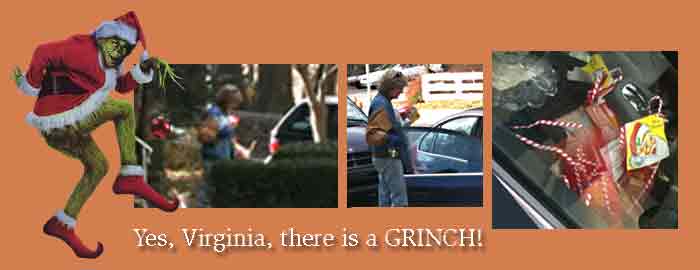
Meanwhile Redeemer, “closed” by a constitutionally questionable edict, plans a Whoville Party to celebrate the third year SEPA has locked the neighborhood out of God’s House on Christmas Eve.

What did the Grinch do? He cleaned out Whoville just before Christmas. Yes, Virginia, there is a Grinch!

Ministries in Decline — The Boat’s Getting Crowded

The year was 1998. A few representatives from SEPA Synod Council were meeting with Redeemer congregation.

They had just made their first attempt to close our church and seize our assets. Working with the congregation council behind the backs of the congregation, they had convinced leaders to resign en masse to create constitutional grounds (where none existed) for SEPA to step in.

On cue, seven council members tossed their resignations (drafted by a synod staff person) onto the table. A synod representative scooped them up and declared “synodical administration.” But three council members refused to be part of the scheme. With the help of two anonymous pastors, they re-established the congregational council — following the constitution — and successfully challenged SEPA’s plot.

SEPA’s interference damaged our church and the network of friendships that characterizes all congregations. The council members who had worked secretly with Synod were disgraced. They left Redeemer with their families. Some had been at Redeemer for decades. We learned that our Synod rarely measures the personal cost of their actions.

There was also damage to our congregation’s reputation. The conflict challenged giving and our ability to attract leadership. Branded.

At this meeting, a synod council member (a pastor from a neighboring church) started to talk to our members about statistics of small churches, patiently explaining that we couldn’t survive.

We pointed out that what congregations in the heart of the city were currently experiencing would become problematic for churches in outer city neighborhoods and suburbs within a decade or so. It was time to find answers.

A decade or more has passed and the churches we visit today on the edges of Philadelphia look remarkably like Redeemer looked in 1998, including the congregation of the pastor who was lecturing us 14 years before. Most congregations are experiencing serious decline, often in double digits.

We are learning through our Ambassador visits, that even suburban churches with fairly healthy worship attendance face financial challenges. Two of the largest congregations we have visited have liquid assets very similar to Redeemer’s and are carrying a similar debt load. A remarkable statistical difference is that Redeemer was growing in membership and attendance while TREND reports show that the larger churches are in decline.

If so many congregations are failing, why are we pointing fingers? Time and resources would be better spent looking for answers.

One thing stands out from our experience. The trustees in 2008 reported to Synod Assembly that we had a vibrant outreach ministry, but it was not run in cooperation with Synod’s Mission Director. In other words, Redeemer was growing without Synod’s help!

There is NO requirement for congregations to run evangelism efforts past the Synod for approval. That goes against Lutheran polity.

The persistent attacks from our denomination have given Redeemer a valuable perspective. We actively seek answers to modern ministry challenges. This IS Lutheran polity.

We recovered from the 1998 damage and were again growing in 2007 when Bishop Burkat, facing serious Synod financial challenges, decided to evict our congregation from our property, effectively excommunicating us. As we approach 2012, without a building or much in the way of money, we continue our ministry and have a glimpse of where churches must go to thrive in a dramatically different world. We continue to grow in ways we did not anticipate as we create a worldwide community, forging invigorating intra- and cross-denominational bonds.

Congregations must be encouraged to find their own answers to ministry challenges. The prescribed way — by every statistical measure — is not working!

Our Once and Future Church

Today’s Alban Institute Weekly Forum builds on the re-release of the books written in the 1990s by its founder and president emeritus, Dr. Loren Mead. The Once and Future Church (1991)Transforming Congregations for the Future (1994), and Five Challenges for the Once and Future Church (1996) tackle the very issues our sponsoring congregation, Redeemer Lutheran Church, has been facing since 1998.

None of our members was a scholar of his work at this time. We were just lay members working at what we believed was our mission. As we review the five challenges Mead poses for the church, we find remarkable similarities to the direction our congregation took — without leadership pointing the way but with dedicated lay people grappling, uncompensated and unrecognized, with issues as big as worldwide church.

Our discipleship has not been without cost. We have suffered both as community and as individuals. Most of the time we found ourselves very much alone. The church as a whole was struggling, its denominational leadership was struggling, its individual congregations — large and small — were counting every penny. Our small church was deemed insignificant.

Mead writes:

For now, here are the five challenges I see we have ahead of us: 

  • To transfer the ownership of the church. 
  • To discover new structures for the church. 
  • To discover a passionate spirituality. 
  • To make the church a new community and source of community. 
  • To become an apostolic people. 

Redeemer deals with each of these issues:

  • We insist that the ownership of our community rests in the congregation. Our constitution and church polity agree with our position. But this has been of no protection. When assets are coveted, governing documents are quickly rewritten in the minds of church leadership. Clergy serving us disappeared with little or no notice or explanation. We were eventually evicted from our property. This was intended to be a final blow. Our denomination even predicted publicly that within six months, our congregational identity would die. 26 months later our congregation still meets weekly and has found new ways to serve which do not rely on property or professional leaders. 
  • Left without a building to support, we began creating a new congregational structure which reached out to other congregations, denominations and the spiritually minded with no church affiliation. How fortunate that the world was never more prepared for this type of outreach!
  • We discovered within ourselves a spirituality we didn’t know we had when we were passive pew-sitters, receptors of our clergy’s sense of spirituality. A foundation was quickly laid for the development of dormant leadership skills.
  • We embraced outreach tools that the church as a whole has been very slow to use to anywhere near full potential. Within months we found that our community potential was worldwide.
  • We work now to create an apostolic presence using modern tools.

Mead goes on to write:

“We need to recognize that a classic conflict of interest is at work here. Clergy-dominated institutions make many decisions in which clergy have a direct stake: salaries and job security, for example—sometimes involving prestige and preference. In our society we generally feel that institutions that nurture “conflict of interest” frequently make bad policy—policy that supports the welfare of those with the conflict of interest not the welfare of the entire institution.”

Mead calls for more dialog between clergy and laity. He cautions that dialog must be entered into with equal respect among participants. This, Redeemer has found, has been impossible. The conflict we have faced has been fought for four years with virtually no dialog and no foundation for mutual respect. Power, not mission, was central to the conflict from the outset.

Mead’s books were rightfully acclaimed when they were published. As they are re-released in a single volume for a new generation of church leaders, we can only ponder why his respected advice has been so strongly resisted by the readers who once found his thinking so ground-breaking.

We hope for a new generation who can not only applaud his wisdom but also apply it!

Head-in-the-Sand Leadership Fosters Bullying in the ELCA

A random click on the computer opened a link to a news story published December 19, 2009, just as the ELCA was beginning to reel over the vote to ordain active homosexuals.

The story was printed in the Washington Times and quotes an ELCA bishop and ELCA Presiding Bishop Mark Hanson, along with several others on both sides of the issue.

The story reported alleged acts of intimidation against dissenting clergy who were contemplating withdrawal. Reading this story two years later is illuminating.

The article reads on the subject of intimidation: “I would deny that completely,” said Bishop Gary Wollersheim of the ELCA’s Northern Illinois Synod. “That’s not happening in northern Illinois. I’m sure that’s not happening anywhere in the country. I have done the exact opposite. I have assured clergy, rostered leaders, that hold different opinions on the decisions that [neither] the synod nor I will discriminate against them in any way. The last thing that I would do as pastor of the synod would [be to] bully somebody or threaten them.”

The story moves on to Presiding Bishop Hanson, the foremost leader in the ELCA. He too denied that intimidation was happening. He went on to question that there was any split in the denomination and deflected responsibility by criticizing the media.

Two years have passed and the split has become obvious. Hundreds of churches have voted to leave the ELCA.

That’s not the only thing Bishop Hanson got wrong!

Bishop Hanson continues to defend the status quo, claiming no authority to deal with parish complaints of misconduct.

Redeemer congregation (sponsors of 2×2) turned to him for help with serious intimidation problems. He responded to our first letter in 2008 by telling us of his high regard for the bishop. He failed to respond to subsequent letters sent monthly over the next ten months. Recently, after a long silence and serious conflict escalation, one of our members wrote again and received the predictable response — the defense of church leadership with no apparent regard for the effects their actions have on laity. 

Perhaps Bishop Hanson and the ELCA bishops do not understand intimidation.

Intimidation is:

  • When a bishop tells a congregation that they must agree to call a recommended pastor or they won’t have a pastor for a very long time. (Redeemer/SEPA 2001)
  • When a bishop insists a congregation vote repeatedly on a call question, hoping the congregation will finally vote the “right” way. (Redeemer/SEPA 2001)
  • When a synod representative visits prospective members and discourages them from joining one congregation in favor of another. (Redeemer/SEPA 1998)
  • When a pastor visits with the bishop’s office and returns to give the congregation 10 days notice by email or never steps foot again in the church. (Redeemer/SEPA 2006 and 2008)
  • When a bishop has a lawyer sitting at her right side (literally) at her first meeting with a congregation. (Redeemer/SEPA 2007)
  • When a bishop calls a meeting without consulting church leaders and arrives with a party of ten others (not announced as coming), including a lawyer and a locksmith positioned out of sight. (Redeemer/SEPA 2008)
  • When a bishop refuses to meet with elected congregational leaders insisting on meeting with the entire congregation. (Redeemer/SEPA, characteristically)
  • When a bishop, with no discussion, has a lawyer inform a congregation by fax that they are officially terminated and have no voice or vote at an upcoming Synod Assembly. (Redeemer/SEPA, 2009)
  • When a bishop goes into court carrying the First Amendment flag of immunity (Separation of Church and State) but proceeds to use the full force of the courts against lay members. (Redeemer/SEPA 2008-present)
  • When a bishop locks faithful members out of the church. (Redeemer/SEPA 2009-present)
  • When a bishop commits the resources of 160 churches to attack lay members of one congregation. (Redeemer/SEPA 2008 to present)
    and furthermore —

When other congregations and pastors share in confidence that they disagree with synod’s actions but no one dares to speak up — they are the bystanders who allow intimidation to reign. 

When a presiding bishop is made aware of such incidents and glibly dismisses them, that’s poor leadership. Most of the items in the above list were shared. 

It is just such apathy that creates the bullying tragedies. We in Pennsylvania are watching the esteemed leaders of our largest state-run school fall because good people failed to pay attention to complaints from the lowly. When will our church get the message? 

It’s time to clean up the Mutual Admiration Society which seems to define the Council of Bishops under Bishop Hanson’s leadership.

Intimidation happens, Bishop Hanson, and it is happening on your watch.

If the ELCA’s recent resolution to fight bullying is to have any teeth, the ELCA must practice what it preaches. 

God’s work; our hands.  

A suggestion: The ELCA should create an ombudsman system which was used in predecessor bodies. If our leaders are not going to listen and respond, the faithful need a forum less cumbersome, less biased and more capable of carefully investigating issues raised by congregations, individual clergy and lay members. Failure to find a way to respond to complaints may lead to the same sort of plight the Roman Catholic Church is experiencing. Let’s learn from that.

Experiencing Multicultural Ministry: Part 1

2×2’s sponsoring church, Redeemer Lutheran Church, has broad experience in multicultural ministry. As we start a new series of posts, we’d like to share our experience. We doubt it is typical or even if there is any typical methodology to multicultural ministry.

(We invite you to share your experiences. This is a fairly new emphasis within many church bodies. We can probably learn more from each other than from books!)

Multicultural Mission Outreach changed our church enormously for the better. It enriched our worship, our sense of mission, our fellowship, our stewardship, our spiritual life and our individual lives.

We did, however, encounter difficulties we never anticipated and which were severe.

We discovered that the greater church does not understand Multicultural Ministry. Its view seems to be “same old church/different people.” While leaders have identified this as a worthy goal (even a necessity), it does not appear to have a plan to achieve the goal or leadership with training to help implement it. In our experience, lay leadership was pivotal to laying the groundwork.

We encountered something very different, exciting and refreshing!

A Little About Redeemer

Redeemer is a small congregation in a well-established Philadelphia neighborhood. East Falls is home to rich and poor. Up until about a decade ago, it was flanked on either end by government high-rise housing projects. These have been destroyed. New single family subsidized housing has been built where they once stood.  The presence of the “projects” in our neighborhood influenced attitudes toward different cultures for many years.

An outsider passing through would see tree-lined streets with well-kept homes. Some of them are sizable estates. Most are modest rowhouses. There are upscale apartments at opposite ends of town.

Redeemer sits at the economic and cultural crossroads of our community. Across the street is the public library and a K-8 public school. Down the hill is old factory worker housing. Behind Redeemer are middle class rowhomes. Above and across the street are the homes of many of Philadelphia’s movers and shakers, including a former U.S. Senator and Pennsylvania’s former governor.

East Falls is a university neighborhood. Philadelphia University, Drexel and Eastern Universities have campuses within our borders. Temple and LaSalle are also nearby. The local public school has struggled with academic achievement. Quaker and Catholic Schools are neighborhood options. Educational opportunities bring many newcomers to our town.

The buildings are of manageable size. A practical church layout, reflects the practical working class people who built it. In addition to a sanctuary/fellowship hall, our members built a seven-room educational building which proved to be an enormous asset to the congregation even after the loss of members following the turbulent 60s.

Redeemer was in a prime position to become a multicultural church, but it didn’t happen overnight.

A decade of poor leadership in the late 80s and 90s, left the congregation divided. We received little help from our regional body as they were having financial problems and any congregational problem was likely to be seen as opportunity to close a church for its assets. We struggled with our denomination for two years in the late 90s.

Eventually, our lay leaders identified a retired pastor who agreed to help. He came into a congregation that no longer trusted pastors. He spent three years with us, slowly restoring our congregation’s confidence with a weekly message of love. He invited many and a good number joined. He laid the groundwork for acceptance as our new members represented many parts of the world.

One family from Tanzania, began inviting their extended family and friends. Over a period of ten years, we developed a small East African community within our congregation.

In 2006, our congregation decided to concentrate our evangelism efforts on growing this segment of our congregation. We asked our part-time pastor to help us find leadership who could relate to Swahili-speaking East Africans. We talked about this for months. The regular report at council meetings: “There is no one.”

When this pastor resigned suddenly, our members within weeks identified two rostered Lutheran pastors from Tanzania. We started working with them.

Our members put every effort behind this outreach. We began by hosting a separate worship service entirely in Swahili. English-speaking members helped with music, putting together a worship bulletin, hosting fellowship and helping with child care. Leadership discussed that attendance at the English service might have to suffer while people, who normally supported it, helped with the Swahili Outreach.

Within a few months 49 members joined through this effort. At the suggestion of our Swahili-speaking members, we united our worship.

We were not prepared for the reaction of our regional body.

To be continued . . .