4/7InkzHVUEQeEdU9vpc1tikzEhChrKmPfvXI-FSDBrBQ

Social Media Ministry

Learning from Our Unique Experience as A Virtual Church

2×2 is the voice of Redeemer, small congregation in the East Falls neighborhood of Philadelphia, Pa. Our denomination decided for us that we could no longer fulfill our mission and seized control of all our property and financial assets for their own use. They locked the Christians of East Falls out of the church, we can only assume, so that they could more easily have their way. Our church building, under SEPA management, has been an empty witness to Christianity for going on three years — a definite failure to fulfill mission!

Redeemer, however, continues as 2×2.

We were not about to abandon our mission under such selfish circumstances. We had spent several years fostering a world view as we had visitors and members from all over the globe. This made it easier for us to take our ministry online, but we had no idea what to expect. Thinking globally and acting locally, we are discovering that our mission can impact the world.

We no longer worry so much about Philadelphia, although we are ready at any moment to reopen our physical church. We think our neighborhood still counts in God’s Kingdom.

Meanwhile, we are beginning to hear from congregations far away. A mission worker in Eastern Europe thanks us for our social media ministry. A pastor in Pakistan sends us regular updates on his congregation’s efforts to reach the poor in remote villages. A church in Africa thanks us for our ministry and describes their need to care for orphans.

Having been ousted from our denomination, we are no longer cloistered within Lutheranism. We are in regular contact with churches and church leaders across the United States. A few have provided both financial and spiritual support. Some have interesting projects and experiences which we incorporate into our ministry. We are more “in full communion” than when we were part of a “full communion” denomination — and this was achieved without decades of dialog!

At home in Philadelphia, we have become friendly with several parishes we knew little about when we were cozy in our own property.

Most congregations, near or far, are looking for little more than attention and prayer, which we are able and happy to provide.

We did not know what we were getting into when we started our virtual ministry, but it has opened the door for new mission and new possibilities. We are no longer just talking about mission but have  never been more actively engaged.

Meanwhile, our own denomination behaves as if we never existed.

Google Insights Can Reveal Ministry Opportunity

As we explore and learn social media, we turned this weekend to a fairly new social media tool, Google Insights. This tool measures internet activity revolving around key words.

We plugged in key words of topics that interest us to see if they interest anyone else.

We searched for interest in “social media ministry.” The graph that pops up with amazing speed reflects our experience. We have long known that our readers are interested in this topic.

Goggle Insights Results for "Social Media Ministry"

We plugged in “children’s ministry” and “family ministry.” The results showed a decline in interest — not dramatic but decidedly so-so. We experienced the same results with our posts on ministry for children. We have also noted that ministry to children is neglected in many of the churches we visit.

Then we plugged in “multicultural ministry.” This is a topic that the our denomination has announced is a priority. The Google Insights graph revealed a flat line with sharp and short-lived spikes occurring about annually. There is only sporadic interest in this topic!

Google Insights Results for "Multicultural Ministry"

What does this tell us? There are a few possibilities.

  1. If multicultural ministry is a goal, groundwork must be laid. The Church is starting from scratch with this concept. Awareness of multicultural ministry challenges and opportunities must be promoted.
  2. Multicultural Ministry will be an uphill effort. Measurable success may be a long way off. Success might be fleeting.
  3. Other things concern congregations more. Any effort at Multicultural Ministry is likely to take a back seat.
  4. Leadership must be developed for this type of ministry.

The data fails to inform in some areas. It measures only interest — not need.

Why are there occasional, sharp spikes? Was there some event at that time that raised momentary interest?

The value of these “insights” is in what the Church does with the data.

  • Opportunities must be identified.
  • Churches and leaders must have some training and leadership.
  • Instant results should not be expected.
  • Since, there is so little interest, there is likely little experience. All ideas and efforts need to be given a chance.

The Art of the Video Interview

Why? and How?: An Interviewer’s Best Friends

Who? What? When? Where? Why? and How?

Six questions every video interviewer needs to know.

There are six well-known questions all journalists employ. They are called the five Ws and an H. Who?, What?, When?, Where?, Why? and How?.

The first four are of less value to video interviewers because the answers to the questions do not encourage complete sentences.

  • Who is leading this ministry? Answer: John and Mary Doe.
  • What are the plans? Answer: To help the homeless.
  • When will your event take place? Answer: Friday morning.
  • Where will this happen? Answer: Central Park

That makes for a boring and ineffective video interview. Would you stay tuned?

The last two staple questions can help you turn the first four Ws into dialog. Why and How questions are open-ended. You can get the information you are seeking in the first four Ws by asking good  Why and How questions.

  • How did your group decide on this ministry? Answer: Every Sunday, John and Mary Doe passed a man pushing a shopping cart with all his possessions down the street. At first they didn’t know how to help but  . . .
  • Why did this man’s plight move John and Mary? Answer: They remembered the stories their parents had told them of hard times in the Depression. They were always taught to appreciate God’s blessings and . . . . .
  • How can the neighborhood support you? Answer: You can come to the rally in Central Park next Friday morning at  9 am and be prepared to . . .

You can see how careful wording of questions will elicit colorful, meaningful answers. It just takes a bit of practice. Ask a friend to rehearse with you or stand in front of a mirror and ask yourself your intended questions. Role play the answers. You will quickly learn how to phrase questions to draw good, colorful, story-telling answers.

Make best friends with Why and How and the other four Ws will tag along.

Adding a Video Interview to Your Blog

Posting an interview is a good first step to exploring video on your blog or web site.

Here are some guidelines for beginners. We’ll build later posts on this foundation.

  • Make your guest comfortable in a well-lit spot. Make sure there is enough light on your guest’s face, but don’t worry too much about lighting for now.
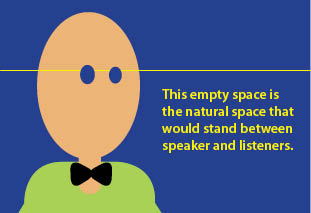
  • Frame your shot. We’ve included a few illustrations to show you how to position your interviewee.
  • A seated interviewee will pose less of a challenge for beginners. If you choose to have your guest standing, be prepared to move!
  • Keep backgrounds simple. You don’t need a set. A corner of a room with drapery, non-intrusive wall art or a bookcase is fine. A side-table with a lamp or potted plant is another possibility. If you are in a person’s office, set up the interview at the person’s desk. The background should not distract from your speaker’s message. 

  • Prepare your guest. Engage in conversation before the interview starts to make him or her more comfortable answering questions. You might review the questions in advance.
  • Test your equipment and sound. If you are using an auxiliary microphone, make sure the sound quality is good. This process can help break the ice with your guest. You can make it a little silly. Have your guest recite The Gettysburg Address or sing Mary Had a Little Lamb. This will do wonders to make your guest speak more informally when the real interview starts.
  • Make sure your guest knows the time constraints. If you plan to run your video without editing, pose just one question and let your guest take it from there. Alert him or her in advance that you will give a nonverbal signal when you need to draw the interview to an end. One technique used by some interviewers is to say, “Tell me in one sentence what you think about . . . . ” Your guest will invariably give you three sentences—enough for a nice, short blog interview!

Why Use Video on Your Church Blog?

There is a great answer to this question: video improves the effectiveness of your blog or web site by nearly 700%! Astounding.

If you have an iphone and a computer you have most of what it takes to create videos for your web site. Of course, if you have a video camera, that is also good.

While there are things you can learn to make your videos better and more effective, there is not a great learning curve. We’re going to start exploring this with 2×2.

The advice for getting started:

  • Before you start, plan topics for 10 videos. This will assure that your efforts have direction and you won’t use initial difficulty as an excuse to stay out of the water.
  • Think short topics. Two minutes is a good goal.
  • Create a youtube account and upload your videos. Then link your web site to your youtube site.

That’s it in a nutshell. We’ll explore it more deeply in later posts.

photo credit: Tonymadrid Photography via photopin cc

23 Advantages for Churches Using Social Media

A business web site (businessesgrow.com) recently published a list of 25 non-financial benefits of business blogging.

The list can be adapted to show the benefits of church blogging. Our list is a little shorter. We combined some things. Here goes:

  1. Create a database of answers.
    Seekers and members ask the same questions over and over. The need to have ready answers for most Frequently Asked Questions inspired Luther’s Small Catechism. Archive your answers to the questions you hear most often.
  2. Showcase your workers.
    Shine the spotlight on your volunteers. It is likely to inspire and encourage others.
  3. Integrate your message.
    Your pastor and church leaders create content regularly when they preach and teach. Give their work broader reach.
  4. Help search engines find your church.
    A lively church blog will rank over those annoying listings by the internet version of the phone book yellow pages.
  5. Tell your community why your congregation is different.
    Make your ministry stand out.
  6. Lay the foundation for other forms of communication.
    If you have an active blog, it will be easy to create a newsletter or congregational report. Cut and paste!
  7. Show your face.
    Your blog will reveal your congregation’s personality. Potential visitors will feel like they know you before they cross the threshold. Be assured — visitors today look at web sites first!
  8. Measure your vitality.
    A church with an active blog is proving they are engaged in the community with relevant and purposeful activity.
  9. Good public relations.
    Churches always have trouble attracting the attention of the press. If your blog has good community content, your local papers will find you.
  10. A quick and easy way to communicate with your current membership.
    If your members subscribe to your blog, they will get an immediate notification of breaking news. No need for the phone chain. Just don’t abuse it if you want to keep your followers.
  11. Engage your congregation.
    This may take some patient nurturing, but your congregation’s blog can become a place for congregational interaction and provide valuable feedback to your leaders.
  12. Ask questions.
    How many vestry or council meetings are spent debating what the congregation wants? With a congregational blog, you can ask them. Pose a question two weeks before a meeting and see what people have to say. If you want to keep this a valuable tool, be prepared to listen to the answers and respond wisely.
  13. Crisis management.
    You do not have to rely on anyone else to supply facts about your ministry. You can tell your OWN story! When a controversial decision is reached, use your blog to help the disgruntled understand. If your denomination is in the news, add your slant to the public issue.
  14. Forum for ideas.
    Again, this will take some nurturing, but foster the sharing of mission ideas. If people know they can make a difference, they will speak up. Be prepared to respond to ideas. No one likes to put their thoughts on the line only to be ignored.
  15. Give your leaders a platform.
    If their ideas are good, they will catch the attention both within and outside your community. That’s giving your church new reach and authority!
  16. Segmentation.
    This is something we don’t think about in the church. We like to think of ourselves as being “one.” There are, however, sub-interests within any united congregation. With the internet you can address these without leaving anyone out. In the business world it’s called “market segmentation.” In the church, it might mean directing some blog posts or creating a separate page or category within your blog for singles, youth, church musicians, daycare parents or Sunday School teachers.
  17. Identify advocates.
    An active blog will create “fans.” It’s nice to have supporters and know who they are!
  18. Inexpensive way to keep connected.
    You can gently remind your audience of upcoming events without the time to make phone calls or incur the cost of sending letters or postcards.
  19. Measure controversial issues.
    Should you change the time of worship this summer? You can debate this in a vacuum OR poll your members on your blog.
  20. Create a volume of work.
    Your blog will create your congregation’s history. Take your posts and create a quarterly or annual report. Your loyal members are likely to purchase an “annual” if you make printed copies available and include lots of photos.
  21. Network.
    Your blog can help you find people with special skills for a variety of needs from programming to building maintenance. Vendors may even be willing to contribute or discount services if you give them a plug and a link on your blog.
  22. Connect with people on an emotional level.
    Most congregational publications are fairly dry. Blogs can come to life with good story-telling, photos and video.
  23. Prove to your community that you understand today’s world. 

The “Not So New” Horizontal Church

Many church leaders are bemoaning that Church isn’t what it used to be. Bishop Claire Burkat wrote to her rank and file lately warning that the road ahead is uncharted and there is no blueprint for moving foreward. The old ways just aren’t working.

Perhaps it is only an illusion that they ever did!

Welcome to the “horizontal” Church.

Church can learn from what’s happening in the rest of the world. Business leaders, too, are noticing that the old ways of doing business are ineffective, inefficient and unprofitable. There is a TV show that brings this “epiphany” to us every Sunday evening — Undercover Boss.

In the old business world, upper management controlled all things. An employee’s future relied on his/her ability to control people, material, budgets, customers. The power in the business world has shifted to the consumer. Smart business people are meeting the challenge by restructuring their businesses to be less vertical (hierarchical) and more horizontal. Create a good product, serve your customers well, and your business will grow by word of mouth or by keystrokes on the internet or cellphone.

The Church lives in the same world. It has relied on hierarchical control for a very long time and so change may come a bit harder and a tad slower, but things are changing. Hierarchies are crumbling under the weight of their own weaknesses. Rank and file spiritual church members are resisting the support of vertical management and for good reason. It’s expensive, unproductive and crippling. Offerings, we can conclude, are better spent on direct service than on supporting hierarchy.

And so, the Church today is mirroring society. The Church is becoming more horizontal. We still have a good “product” and the laborers in the vineyard are committed. The Church will survive by spreading person to person (2×2!).

This is where Bishop Burkat is wrong! There is a blueprint! It’s called The Bible.

photo credit: michaelrighi via photopin cc


Sharing the Gospel in Social Media

One reason many churches shirk away from using the power of social media is an old-fashioned sense of ownership. Their slant on the Gospel becomes a bit proprietary. We carefully hold our cards close to our vests, waiting for the right moment to play.

We forget that the Gospel is for everyone. We start to think about how telling the Gospel benefits us.

Ministry plans sometimes try to fill niches not addressed by other congregations. This can be very altruistic and good. But sometimes it is more like carving out territory, hoping to attract Christians our way to help our parish statistics.

That thinking will not work in the social media age. Sharing the Gospel has never been more possible and churches must adapt our thinking to a world of new possibilities.

Sharing is a good thing. Social Media thrives on it. It is becoming the accepted way of doing things. The internet thrives on linking to other sites.

So stop playing your ministry cards close to your vest. Tilt your hand so everyone can see your cards. Take a look at your neighbors’ hands and TELL IT!

Use your web site or blog to link to other ministries and good works in your neighborhood. It’s OK. Really! You may drive traffic away from your site for a moment, but your site traffic will soon benefit. People will remember that you helped them find that support group or social service agency. Your neighboring church will remember that you promoted their Cantata. They, in turn, might support your spaghetti dinner! You will be demonstrating that you care about your neighbors. That’s a good thing!

The message for today: Look for good things in your neighborhood to write about and link to.

photo credit: oknovokght via photopin cc

Adding the Power of Visuals to Your Blog or Web Site

We live in a visual world. Social Media advocates can take that for granted. They are pleased to get a few hundred thoughtful words together to publish a few times a week. Add a picture? That will take too much time!

A search for "mustard seed" in photopin.com helped find this photo. At the end of the post look for the photo credit, cut and pasted into the html. It took less than two minutes to find the photo and add it to this post.

Fortunately for us, there are media elves who specialize in analyzing our work. Elves like pictures and videos. When they start counting on their little green fingers they report that blogs using images and videos chalk up higher statistics. More people read them. Search engines find them more easily. Listen to the elves!

There are many inexpensive sources of art. istock images can cost as little as $2. But here is a source that is mostly free. All you have to do is add a credit for the image at the end of your post. You don’t even have to type. Just copy and paste the code.

www.photopin.com

Their catalog is vast. The trick for church bloggers is to come up with the right words to find a suitable image. You may have to play around a bit.

For example, a search for “The Good Shepherd” brought up a few religious images but a lot of images that were nowhere near topic. They may have been images of people with the name “Good” or “Shepherd.”

Better results came with different search words. “Stained glass windows” worked well.

Search engines can also help you. Use Google, Yahoo, etc. and click on the IMAGE tab. You’ll have to look at each image that comes up for copyright. It’s a good idea to always credit the source.

You can scan your own images or use your cell phone creatively for images. Objects around the house can add interest. In one of our earlier posts, we used an image of grapes to go with a phrase we had used in the post “sour grapes.” We bought that image from istock for a couple of bucks but we could have taken a cell phone photo of images of grapes from our own refrigerator.

Captions are not always necessary but they do give search engines one more thing to find. If the visual connection to your post is not obvious, write a caption.

Start to think visually. It will help prepare you for the next step . . . video.

photo credit: moominmolly via photopin cc

Looking for the Ideal Christian

In the secular world, businesses have a little trick they rarely discuss except among like-minded professionals.


They create “personas” — model customers. They spend good time and money doing this. They comb through stock art to find an image that looks like the person they want to serve or supply with a product. They may choose two or three ideal customers. The images are given names and a back story. They mount them on foam core and display them in the corporate lobby or board room. They start to talk about “Dakota,” “Trevor” and “Roy” as if they are waiting for them in the next room. They write their blogs and advertising copy with them in mind. Their product development revolves around these imaginary people.


Someone presents a new idea. The corporation asks, “What do Dakota, Trevor and Roy think?”


Can this help the church? Wouldn’t it table the Great Commission — to go out into all the world and preach the Gospel to everyone? Wouldn’t it turn the Church into an exclusive organization?


The fact is congregations subconsciously create personas. “We want families. They’ll help our church grow.” Will they?


To some degree, the congregational persona is as close as the mirror. Churches want more people who are like them.


2×2 recommends the use of personas as a worthwhile congregational exercise. But they are not a magic bullet. The Church is not a business. We do not want members just to support our bottom line, do we?


If our personas are only the people we hope to attract, they can blind us to unseen potential—the wonderful serendipity of mission!


If Redeemer, the sponsor of 2×2, had created a persona for our ideal new member in the mid-90s, we might have followed the same thinking. We might have looked for young professionals for their skills and energy. We might have looked for more established, middle-aged professionals for their ability to contribute. We might have looked for the recently retired for their volunteer hours. In our mind’s eye, we would have seen people who look like us — Americans of European descent, already familiar with our denomination.


The discussion would have become all about who can help us — not about whom we can help.


God had other plans. The people who came to Redeemer and began to make our church grow were immigrants from East Africa — Tanzania, Kenya, Uganda, and Botswana and others. They were looking to create new lives in a new land — finishing school, starting families and purchasing homes. They were looking for a church to be part of their lives. Some were Lutheran. Others were not.


Congregations are not the only people to fall into the “persona” trap. Denominations have their own ideas of what an ideal congregation is. Our denomination was not able to accept Redeemer in our 21st century persona. They had a mental image of our congregation as a throwback to the 1940s. The persona prejudice was impossible to shake. For all its talk about being inclusive and multicultural, church leaders remains unprepared to serve a congregation that does not meet their preconceptions. Pity.


The idea of personas are a good exercise to aid congregations in discussion as they plan ministry. But here is the kicker. The personas we craft should represent the people who actually exist and who need to feel God’s love.


If the concept of “persona” has any value to church it should be for finding people we can serve, without calculating their value to us.

Can you serve children after school? Can you help single parents? Can you care for the neighborhood’s elderly? Can you support military families? Is there a cause that needs someone to take a stand? Keep true community needs in mind as you plan your ministry and write your blogs.


Forget the nonsense. Practice the Great Commission with blinders on. God might have exciting things in store for you.