4/7InkzHVUEQeEdU9vpc1tikzEhChrKmPfvXI-FSDBrBQ

Uncategorized

Adult Object Lesson: Looking Ahead to Advent A-1

peanutSwords Into Plowshares

Anything Can Be a Weapon
Anything Can Be an Instrument of Peace

Advent is a great season for focusing on the Old Testament.
This year, Lectionary Year A, each Advent Sunday focuses on the prophet Isaiah.

This is the first of four object lessons based on the Isaiah Readings for Lectionary Year A.

Isaiah understood that adults understand object lessons!

The first lesson is the well-known “swords into plowshares” text.

Isaiah 2:1-5
The word that Isaiah son of Amoz saw concerning Judah and Jerusalem.  In days to come the mountain of the Lord’s house shall be established as the highest of the mountains, and shall be raised above the hills; all the nations shall stream to it.  Many peoples shall come and say, “Come, let us go up to the mountain of the Lord, to the house of the God of Jacob; that he may teach us his ways and that we may walk in his paths.” For out of Zion shall go forth instruction, and the word of the Lord from Jerusalem.  He shall judge between the nations, and shall arbitrate for many peoples; they shall beat their swords into plowshares, and their spears into pruning hooks; nation shall not lift up sword against nation, neither shall they learn war any more.  O house of Jacob, come, let us walk in the light of the Lord!

Your object can be any or several simple garden tools: a hoe is good. It is used to whack weeds so that good plants can grow.

Or it can be a peanut butter sandwich! (Read on!)

My son went to Quaker school where any reference to weaponry was strongly discouraged. This was a challenge for teachers working with young boys who wanted to dress up as superheroes at Halloween.

What’s a superhero without a weapon?

My son had two kindergarten teachers: a zealous young gal in her first years of teaching and a seasoned teacher in her last year of teaching before retiring. While the young teacher fervently and repeatedly discouraged five-year-old boys from thinking about weapons, the older teacher sighed. “They are boys. They will make weapons out of a peanut butter sandwich!”

Boys, men, adults of any gender . . . . we all have ways of manufacturing weapons.

Talk about how the hoe is tool of peace. Its purpose is to rid the garden of nutrient-sapping weeds so that life-sustaining plants can grow. Still, even the garden hoe can be a weapon. I was chopping away at weeds one summer day when I realized I had chopped a garter snake in two!

The difference between a sword and a plowshare is often in how we look at the world. That’s Isaiah’s mission in today’s passage—to change our point of view.

Words can be weapons. “It takes a thousand ‘attaboys’ to erase one ‘You idiot!’” Doctor Phil regularly tells his audience. Yet the “You idiot” slips out so much more easily.

Money is a favorite weapon. “Do as I say or you will lose my support!” Children learn this early when their parents withhold allowance! Adults often weigh it every day at work and even in church!

You want support? You listen and you listen good!

Rules, meant to keep order, can be used to force will and submission. Words and rules are actually favorite “weapons” of the Church through the ages and even today. You want an upper hand, keep that constitution within reach! (American nuns, get in line or face sanctions!)

Love can be a weapon, too. We are approaching the celebration of love coming from heaven to our doorstep! Yet it, in our hands, it often becomes a weapon.

Just as almost anything can be a weapon, anything can be a plowshare.

The gun in the hands of a hunter can feed the family. The knife can divide fruits and vegetables so that more people can share in God’s bounty.

The challenge of this passage is not so much to address physical tools but to change our mindset— to begin to see our possessions and talents as instruments of peace rather than weapons of war.

A little baby is coming. He will be an instrument of peace even when we are tempted to use Him to fuel our warlike ways!

This Advent: Watch our words. Watch how we use our power and influence. Put love to work. Look at our possessions as tools to spread the goodness of God’s creation.

Turn all those peanut butter sandwich weapons back into sandwiches.

(Why didn’t Isaiah think of that!)

photo credit: boodoo via photopin cc

SlideShare about Blogging

frogFeeding the Blog Monster (57 Ideas for Posts)

One of the most important communications tools of the modern era is the blog. Blogging is easy and inexpensive. Anyone can do it.

The reason more people don’t blog is that it means coming up with new ideas every day. Many would-be bloggers, including pastors, stop after five or six posts. They may think it’s added work to their sermon. If they kept at it, though, they would soon be reaching ten times the number of people as will hear their Sunday sermon! Wouldn’t that add some pep to their step!

Blogging is in the interest of mission.

I gave a talk last night on how to keep the ideas flowing. Last night was theory. Next week is brainstorming editorial calendars.

Here’s the theory!

Clergy Fashions: The Look at Me Factor

clergyfashionHigh fashion in the church is changing!

Above you see a Lutheran bishop and a Lutheran pastor.

Below you see a recent pope. Last you see the man they all emulate.

We at Redeemer were once so cutting edge with our pastor who shaved a cross on the back of his head!

But we are not so far behind the times. One of our own, a tattoo expert, could still provide a valuable service to rising clergy who want to spend less on frocks but keep with modern fashion trends.

As this tattooed pastor shown above said, “You know you want it!”

(She wasn’t talking about salvation.)

Benedict-Jesus

Who Is Important in the Church?

JamesJohnWho Are the Key Players in Church Mission?

The question goes back to brothers James and John as they fought for status by Jesus’ side in heaven.

It’s still a pretty good question.

We may find the answer by asking another question. What are we trying to accomplish?

The standard answer for churches is to spend a few weeks debating the wording of a mission statement (all of which are pretty much the same). Then what?

Mission statements rarely provide a road map. The statement validates us as a community. Often, we don’t have a clue how to achieve our mission. Often, we do little to try. We expect to keep doing things the same way, hoping the age-old mission strategies will miraculously reconnect with new generations and our churches will return to the 1950s with sanctuaries filled with happy offering-givers.

Things are done a bit differently in business. Business cannot afford to live on delusions.

When companies roll out a new product or service they look at every step required to achieve their goal. Usually the goal is to sell widgets or to create a demand for specialized services.

The path towards that goal may be complex. It starts with a concept. The concept must be designed and tested. Patents or licenses may be required. An interest must be created. Public Relations and Marketing go to work. As the plans and ideas take shape the product needs to be manufactured. Distributing channels must be opened. Warehousing must be arranged. Customer service must be available from day one. And then comes the wider advertising blitz (all of which was planned long before).

Some of these processes can happen concurrently. Others are more linear—process B cannot happen until process A is completed. Some very important tasks must be accomplished by people who are fairly low on the corporate ladder. But when their skills are needed, they become the focus of the project.

The process is called the critical path. Someone needs to chart and monitor the critical path. Seth Godin wrote about this in his blog yesterday.

What is the Church’s critical path?

What is the mission goal? Not the lofty pie-in-the-sky goal but the practical, measurable goal—the goal upon which the congregation’s survival depends.

What must happen before that goal can be met? When do we hope to reach our goal?

Who is going to monitor the various entities? Who plays the most critical roles at which times?

This is where the Church may be failing.

Church has an established hierarchy.  The more important—the fancier the robe!

Lutherans went against this thinking 500 years ago. Lutherans believe that all church people, whether clergy or laity, play equally important roles.

Modern Lutherans are forgetting our roots.

Perhaps we should revisit this belief. It could make the difference the modern Church so craves.

Seth’s post makes an interesting point. Some people are more critical to the success of the journey on the critical path at different times. The most important people may not be the ones wearing the robes! Seth writes about his experience monitoring one company’s critical path.

I went out and got some buttons—green and red. The deal was simple: If you were on the critical path, you wore a green button. Everyone else wore red. When a red button meets a green button, the simple question is asked, “How can I help?” The president will get coffee for the illustrator if it saves the illustrator three minutes. In other words, the red button people never (ever) get to pull rank or interrupt a green button person. Not if you care about critical path . . . .

The problem with the general failure of church structure is that age-old structure is assumed to be the proper structure of importance. So even though Lutheranism left this thinking behind, we are tempted to return to the old ways.

A presiding bishop is most important. New World Lutherans had purposely called leaders Presidents—not Bishops. 27 years ago we returned to the old ways. It hasn’t helped.

The presiding bishop may play no practical role whatsoever in the critical path of an individual congregation’s mission. Many who are busy fulfilling a congregation’s mission may not even know the name of the current presiding bishop and are only vaguely aware that they exist. Presiding bishops have visibility, an office, staff and probably the highest salary—but they may not be the most important player in any congregation’s mission strategy.

Then come regional bishops. They, too, may have no role in congregational mission. They, too, used to be called Presidents. Their major constitutional role is overseeing professional leadership. Often this becomes the focus of all mission. Congregations are expected to support at least one minister—whether or not that minister can provide the necessary skills for that congregation’s mission. When they rarely meet with lay leaders they forget to ask, “How can I help?”

Then come clergy. Now we’re getting closer to the work of the church, but they, too, may have far less role in the success of a congregation’s mission than others. Some may! Others may be biding time.

Then come staff. Closer still to the critical path.

So far, everyone on the list is paid.

But none of these people can create successful mission without the next two groups of people—laity and seekers. These are the people who can effectively accomplish mission. Often they get no help—no training, no guidance, no resources, no status, and no consideration of compensation. (Think “disciples.”) This is where James and John found themselves the day they came to Jesus with their question.

Youth leaders may be the people who can reach the families. The communications team may be the ones who can coordinate outreach. The social ministry people may know the problems of the community better than anyone. The young people may be the best evangelists to young people. That church festival is not going to happen without the cooks! All need encouragement and help. But often they are seen as the funders or the foot soldiers who are there to do what the church leaders think needs to be done. If foot soldiers are successful, the paid staff may get a raise!

Frankly, the workers are taken for granted. No wonder the pews are empty!

What if every congregation tracked a plan to achieve its mission? What if it handed out green and red buttons? Note. The colors in no way depict rank. They indicate who, for the moment, is playing the role most critical to the success of the mission. The job of facilitating is equally important.

Lutherans should be good at this! We Lutherans were so modern in our thinking centuries ago!

The green buttons would be worn by the people who have to complete a certain task on the critical path before the next group of people can successfully start the next task. The red button people must facilitate their work if the mission is to be successful. (Think “shepherd.”) The red and green buttons can be swapped as we move down the critical path’s checklist.

Red button church leaders must serve the green button church leaders regardless of either one’s rank or pay grade. It’s all in the interest of expediting Church mission.

Unfortunately, it’s not the way we think.

Instead, we seem to have accepted failure to achieve mission as the norm. This changes the Church’s mission to funding and perpetuating a structure that is ineffective. We keep doling out dollars to support structure until the money runs out.

Most churches work very hard at this. Generally, they are on the fast track to failure.

The laity will pay the fare.

Who will be rewarded in the after life? Next week’s Gospel reports that Jesus didn’t have much tie for such questions! Luke 20:28-37.


Pakistan Revisited

The Pain Doesn’t Go Away
Just Because Christians Have “Moved On”

2×2 was appalled by the church bombings in Pakistan last month and were disappointed that western Christians barely took note of the attack.

This is indicative of the isolation of most Christians. We worry first about ourselves, then about our own congregation, then about our denomination. Our denomination handles the rest of the world by dividing the relatively safe mission areas of the world between its synods. This is effective in that isolated parishes feel like they are making a difference and are connected. And they are. But all the world, we discovered, is not covered by this system which fits so neatly into our “organized” religion.

Christians in the most dangerous places for Christianity are left very much alone as we build relationships with missions that we can control and visit occasionally and see the results of our efforts—perhaps even having a building named after a congregation.

Christians in the more dangerous parts of the world suffer. And yet their efforts help all in the foundational mission of all churches—to preach the gospel to every nation—not just those in our approved fold.

2×2 befriended the church in Pakistan two years ago. We were easily in touch with the people who were so deeply hurt by this horrific and senseless terrorist attack. 2×2 raised some money for Pakistan. It wasn’t easy. We are, ourselves, excluded from our denomination (some nonsense about inability to achieve missional purpose).

We looked for a channel to send our support within our denomination and found none. We worked it out with our bank. Took some doing. We found that Pakistan is one of the most difficult places to work with in banking. But our mission dollars—every one of them—were finally received. 2×2 paid all costs, so every contribution benefited Pakistan.

Our efforts will continue. One of our members is hosting his own fundraising event next month to add to effort.

Here’s a thank you note we received today from Pakistan.

Shalom
I received your blessings /offerings /donation $250 USD (as I already told you). I distributed to the families and to the little kids. I will send you their distribution photograph soon.

God be with you and all your peoples. I send personal thanks for this great and merciful behavior from you and your peoples. We are still in suffering from the accident and from this big and huge bombing attack. Over 50 peoples still injured. Some of these cuts their legs, lost their eyes and arms and hands. Please pray for us.

Please try to do some more help for their foods, clothing and medicines. This is the time to help your Christian brothers and sisters from Pakistan.

God be with you.

Thanks again for your kindness, labor and practical ministries for us. We did not forget your help, and the reward will be multiplied to you from the father God. Your brother in Christ Jesus, (name withheld for protection.)

Adult Object Lesson—Luke 6:20-31

All Saints Sunday: The Rocky Road of Sainthood

At last we have the Reformation and Halloween out of the way. A few days have passed since November 1, the actual All Saints Day. Perhaps we can put aside the Halloween hoopla and stop to remember that all of these traditions were once important to the faithful.

The reason we dwell on ghosts and goblins at Halloween is because we once spent more time thinking about the afterlife. All Saints and All Souls Days were part of our faith. We were honoring the faithful who have gone before—remembering to once again honor them and pray for them and perhaps thinking ahead to our own fate and relationship with God.

In the Lutheran tradition, we believe in the sainthood of each believer–even those who struggle with their faith. That’s most of us at one time or another. Remembering the faithful who have walked their faith journey before us helps to bring us all back into the fold.

teddybearToday’s object is a worn child’s toy—a rag dog or teddy bear that has seen lots of loving.

Have a beloved child’s toy in hand as you address the qualities that Luke writes about today.

Ask your adult congregation to think back to their childhoods and their relationship with a favorite doll or stuffed toy. Reread the scripture. It’s a parallel to Matthew’s Beatitudes.

Look at that rag doll. “Blessed are you who are poor, for yours is the kingdom of God.—But woe to you who are rich, for you have received your consolation.”

Remember those pretend tea parties, “Blessed are you who are hungry now, for you will be filled.—Woe to you who are full now, for you will be hungry.”

Remember the times when you felt scared, excluded, or lonely at night and clutched your toy under the covers. “Blessed are you who weep now, for you will laugh.—Woe to you who are laughing now, for you will mourn and weep.”

Remember when an older sibling might have grabbed your favorite toy and taunted you with a game of keep-away. “Blessed are you when people hate you, and when they exclude you, revile you, and defame you on account of the Son of Man.”

Now remember why you never threw away that dusty toy—the toy that bore your childhood worries—the toy that helped you learn to love.

Since it is All Saints Sunday, ask your people to remember the real people who came to replace our toys as we grew in faith and faced difficult challenges—our parents, teachers, friends and role models. They may have all become tired and tattered from heavy-duty loving. They are the people who brought us close to God and they are worth an annual prayer of remembrance.

Close with the final verses of today’s gospel:

“Love your enemies, do good to those who hate you, bless those who curse you, pray for those who abuse you.  If anyone strikes you on the cheek, offer the other also; and from anyone who takes away your coat do not withhold even your shirt. Give to everyone who begs from you; and if anyone takes away your goods, do not ask for them again. Do to others as you would have them do to you.”

photo credit: PiggBox. via photopin cc

Ambassadors Visit St. Matthew, Chester Springs, PA

StMatthewChesterSpringsA Low-key Reformation Sunday

The bright, blue sky and fall colors of October lured us into the Pennsylvania countryside.

We took the highway to Chester County and then followed Conestoga Road through the rural suburbs of Philadelphia. We saw a sign for St. Matthew’s and pulled into the parking lot but realized it was a UCC Church. We found the Lutheran St. Matthew’s a sparse quarter-mile up the road with only a playing field separating the two St. Matthew’s. The parking lots of all three were full!

St. Matthew must have walked this very land with two namesake churches so close. Of course, we guessed correctly that the two churches have common roots as Union Churches. They separated as friends in 1833.

St. Matthew’s is proud of their agrarian heritage and continue many traditions based on the agrarian calendar with festivals to mark the planting and harvest seasons. Their description of the intermingled social life and church life describes Redeemer’s historic roots, too. Our people were/are mostly small business owners. Regardless, St. Matthew’s homegrown nature of their parish life mirrors ours!

The ELCA Trend Report shows the congregation holding its own since 2005 with 1200 members, give or take 100 or so, year to year. The average attendance is listed at around 250. There was a major increase in membership since the 1990s. Rare!

We were plenty early. We sat for a while in the parking lot and watched people coming and going as our pastor read aloud from Habakkuk. A good number of children were playing in a playground. There had been a 9 am service that featured “faith formation.” The children must have attended the early service as there were none at the 10:30 service. There were about 42 adults at the service we attended.

Their pastor, Rev. Tina Mackie, was installed as senior pastor this month. She had served as associate pastor since 2003. Her husband is the music director. He and a second musician added pleasantly to worship.

Rev. Mackie attended Eastern Baptist Seminary, spending a year with the Lutherans. She preached a barebones Reformation sermon. She referenced each of the four scripture readings and hit the basic high points of Lutheran thinking. Otherwise the service was unremarkable for the festival day that Lutherans so enjoy.

st. Matthew Chester SpringsSt. Matthew’s is looking for a new associate pastor. We found their web account of the call process very interesting. They rejected some names and asked the Synod for more names to consider. What a contrast!

In 2000, we were told we had to accept the one name presented with a very serious “or else” attached. In fact, Bishop Almquist tried to bypass the call committee. He demanded the congregation vote on the candidate, hoping the congregation would vote against the advice of the call committee. Fortunately, we never had to see how such divisive advice would play out. The congregational vote failed, too. Bishop Almquist kept his promise and refused to work with us to fill our pulpit for his entire second term. He told us we would die a natural death in ten years. Instead, we grew five fold by the time his term was over.

We enjoyed the opening Reformation hymn and the closing hymn, “The Church’s One Foundation,” although they left out two favorite verses. When you memorize hymns, you notice!

The credal “Elect from every nation” verse and the great cry of oppressed Christians, among whom we are numbered:

Though with a scornful wonder
we see her sore oppressed,
by schisms rent asunder,
by heresies distressed,
yet saints their watch are keeping;
their cry goes up, “How long?”
And soon the night of weeping
shall be the morn of song.

Redeemer is still crying, “How long?”!

St. Matthew’s use of projected worship aids was the best we’ve seen if a little slow at times. We learned that they were early innovators in this regard, using a stereopticon lantern with a curtain projection for evening worship in 1917, decades before other churches started using projectors.

As is common in larger churches, we came and went without engagement with any members.

St. Matthew’s has active involvement with Tanzanian missions and sent a mission party to Tanzania recently. The blogs of lay members, chronicling this trip, are included on the St. Matthew website.

We wonder if they realize that their synod exiled about 60 Tanzanian members from this very region in 2009 when they voted to take Redeemer’s property and lock Redeemer members out of their church and the whole ELCA. As one of our younger Tanzanian members commented, “The ELCA is great on Tanzanian mission . . . as long as we Tanzanians stay in Tanzania.”

Before the service, Rev. Mackie addressed the congregation about an ongoing discussion — Vision 2020. That’s not so far off!

She correctly outlined how historic church structure is no longer working. We write about this all the time! She noted that the Reformation of 1517 was made possible by the printing press. She noted that modern communication may spark another Reformation. She is correct. We are part of this new reformation—victims with the potential to seriously lead, given the opportunity!

She highlighted two challenges. 1.) Weekly Sunday worship discipline is difficult in a world that offers alternatives on Sunday morning. 2.) People no longer give offerings to churches for centralized disbursement. They tend to give directly to causes. This affects church operating costs.

Members were asked to fill out a questionnaire which focused on shaping the modern worship experience and how it might be reshaped for modern Christians and the survival of the church.

We can give this advice.

Don’t attempt to fund large church deficits and hierarchical mismanagement by taking endowment funds and property from small congregations.

Art: The Pharisee and the Tax Collector

6 Depictions of the Pharisee
and the Publican or Tax Collector

Jesus’ story is a study in contrast. Each of us can probably relate to the story. We may see ourselves as the tax collector even when our actions mimic the Pharisee.

The Pharisee is sure of himself. He is a good man. He has no reason to question his place within the faith. He has followed the law. He does what is expected of him. And he’s thankful for his lot in life. Doesn’t that describe most happy church people?

But the focus is on the little guy—the guy the better people in society look down on. The tax collector is hated. The tax collector is cozy with society’s enemies. The tax collector makes his living at the expense of good Jewish people.

That describes an awful lot of church people, too! It just takes a story from Jesus now and then to set us straight.

And so artists through the ages have visited this story over and over. Let’s start with the iconic portrayal typical of Eastern or Orthodox Christianity.

pharisee5

Icons are painted with meditation in mind. There is enough in this depiction to think about. The relationship of both the Pharisee and the Publican to Judaism is prominent. The artist depicts both men as equal for the purposes of mediation. They are of equal size and position.

Contrast this depiction with another work which is similar in detail but which clearly focuses on the tax collector. Don’t you want to put your hand on his shoulder?

pharisee6

In the next depiction the Pharisee and Publican go head to head. Separate but equal.

pharisee4


Here is another storytelling approach.

pharisee3

The next artist won’t let us forget that this is a story. Jesus is present in the background. His audience is there. The foreground is a stage for his story. The poor tax collector! He even needs a cane to walk!

pharisee2


Last, we show you a modern depiction by artist Bryn Gillette. This contemporary artist painted this rendition in response to a sermon he heard. He tells his story on his website.

The sermon had contrasted the spiritually dead, hypocritical, and self righteous attitude of the pharisee with the persevering faith, obedience, and selfless stewardship of a true disciple of Jesus.

I tried to paint this familiar scene from the more shocking spiritual lens of what was happening within the two figures: the pharisee’s self righteous posture emanating darkness, spiritually dead but covered by a veneer of beautiful color, while the tax collector is contrite in posture, full of life, covered in humble earth tones, and shimmering with God’s anointing. —Bryn Gillette

And so the pharisee is a skeleton and the publican has a halo!

It’s great when the artist is still around to help us understand his work!

Here’s an idea. Paint or draw your response to next week’s sermon!

pharisee1

Adult Object Lesson: Luke 18:9-14

Peacock-MockingbirdA Story of Two Birds

This week’s gospel is Jesus’ story of two men praying before God. It is the parable of the Pharisee and the Tax Collector.

The Pharisee prays loudly, thanking God for his life filled with riches, finery and the prestige of having many important friends. He’s a big shot in the church. God should be proud to hear his prayer.

The tax collector is of low rank in the community. He prays to God in humility.

Today’s lesson is a parallel story. Who doesn’t like a story?

The Story of the Peacock and Mockingbird 

Once upon the time, there was beautiful peacock who lived in a large fenced yard in the center of a very big farm. The peacock did not mind being fenced in. The farmer fed him well and often paused from his work to admire his pet bird’s beauty.

The peacock enjoyed the farmer’s attention. He was proud of his long blue neck and his long feathery tail of splendid gold, green and blue. Whenever he saw the farmer coming his way, he began strutting about the farmyard, dragging his beautiful feathers behind. At just the right moment, he would raise his tail and spread its feathers like a fan. The farmer would always smile with pride.

Nearby, in the branches of a large bush, lived a small gray bird. He often sat on a tiny twig and watched the peacock put on his show. He longed for the farmer’s attention. He’d fly above the farmyard, occasionally swooping low. “Much as I would like the farmer to notice me, I will never be as beautiful as the peacock,” thought the little gray bird. Still, he kept flying, hoping that one day, the farmer would smile at him with the same pride he had for the more handsome bird.

“Hm!” the peacock thought. “Look at that puny little bird. His feathers are so short and they have no color. Of course, the farmer likes me best! Why doesn’t the little gray bird go back to his nest and let the farmer enjoy my show?”

One sunny, spring day the farmer put down his how and leaned against the farmyard fence for a rest.

The peacock took notice and began strutting across the yard. Just as he was about to spread his beautiful tail feathers, the little gray bird began flying above him in wide circles.

“It’s time I put that little gray bird in his place,” the peacock thought. “This is my farmyard. The farmer wants to see me! I am beautiful. He is so very plain.”

The peacock raised his voice to keep the farmer’s attention.

“ACK! ACK! ACK!”

Aha! It was working. The farmer was delighted.

“ACK! ACK! ACK!”

But then the farmer turned his head to follow a different sound. It was very similar to the peacock’s call but so much softer.

“Ack! Ack! Ack!”

The farmer saw the little gray bird flying in circles above the farmyard. He couldn’t help but watch the little gray bird’s graceful flight.

The little gray bird landed on a nearby branch and repeated the peacock’s call ever so softly. “Ack! Ack! Ack!”  The softer the little gray bird called, the more carefully the farmer seemed to listen.

The peacock was jealous. “Is he mocking me?” he wondered. His dark eyes, circled with white, flashed in anger. He strutted toward the bush and spread his beautiful tail, intent on blocking any view of the little gray bird. The farmer moved closer to the bush, straining to see around him.

“ACK! ACK! ACK!” The peacock called as loudly as he could, but the farmer’s eyes were on the little gray bird sitting in the bush.

“Why isn’t he paying attention to me?” the peacock thought. “Is he hard of hearing?”

He stopped to consider whether or not his question made sense. But the little gray bird did not stop. The little gray bird repeated his call. “Ack! Ack! Ack!” The farmer beamed with pleasure at the little gray bird’s delicate echo.

Then the little gray bird changed the pitch. One “Ack” was high. The next “Ack” was low. The third “Ack” was somewhere in between.

“He’s ruining my song,” the peacock thought.

But that was just the beginning. Soon the little gray bird added new sounds to his song. He tweeted and twittered. He rasped and he whirred.

The farmer applauded in delight.

The peacock strutted toward the farmer. He stretched his beautiful blue neck and lifted his tiny head. He tried to echo the little gray bird’s song. But all that came from his mouth was a harsh, ugly “ACK! ACK! ACK!”

The little gray bird stopped singing. He flew a few times around the farmyard. The peacock spun in one direction and then the other as he, too, watched the little gray bird.

Then the little gray bird flew off. The farmer followed the plain gray bird’s soft, delicate call through the wide fields.

The peacock watched from behind the fence. For the first time he wished he could trade his beauty for feathers that could fly. His beautiful tail dragged in the dust as he strutted slowly around the yard with neither the farmer nor the little gray bird interested in his splendor.

Talk to your congregation about what God expects of us when we talk to him.

You can post these links of a strutting peacock and singing mockingbird on your website. The peacock sings at about the 13-second mark. The mockingbird never stops singing. You might even play the recordings for your congregation.

http://www.youtube.com/watch?v=9MhZPqHeEAQ

http://www.youtube.com/watch?v=CMpe34Aign4

You can make stick puppets of a peacock and mockingbird from photos found easily on the web. If you use the story with children (or even with adults) you could divide the group with one singing the harsh peacock ACKs and the other singing more delicate Acks whenever you point to them.

Have fun!


Art: The Persistent Widow or the Unjust Judge

This week’s Gospel lesson (Luke 18:1-8) features only two people engaged in an undefined disagreement. The widow is seeking justice. The judge couldn’t care less about justice but is more interested in clearing his docket.

Story sounds familiar!

Artists have at least four choices: focus your expression of this story on the widow, focus on the judge, focus on the interaction between the two or try to tell the whole story.

Here are examples of each. Unfortunately, I don’t have much background on the artistic sources. But I can provide some links.

Here the persistent widow is shown in humility. She looks troubled, doesn’t she?

widow1So now let’s focus on the judge—the self-centered wielder of power. We all get a little like that when we begin judging others. But when the job goes to someone’s head, as in this story, our meek widow above has little hope. The artist is William J. Webbe, who went by the name W.J. Webb when he illustrated Bible stories. See lower left corner. He lived in 19th century London.

widow3The sketches below are simple but they have a lot of life!

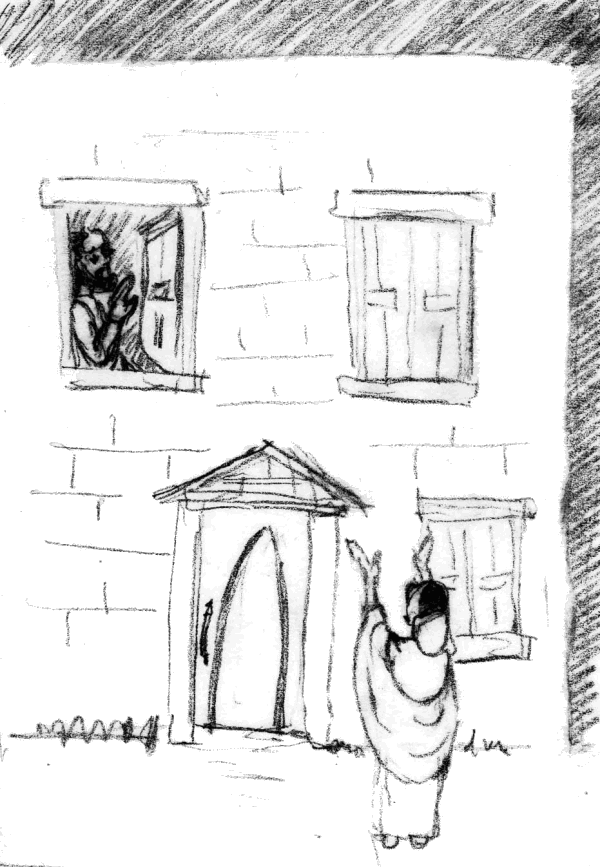
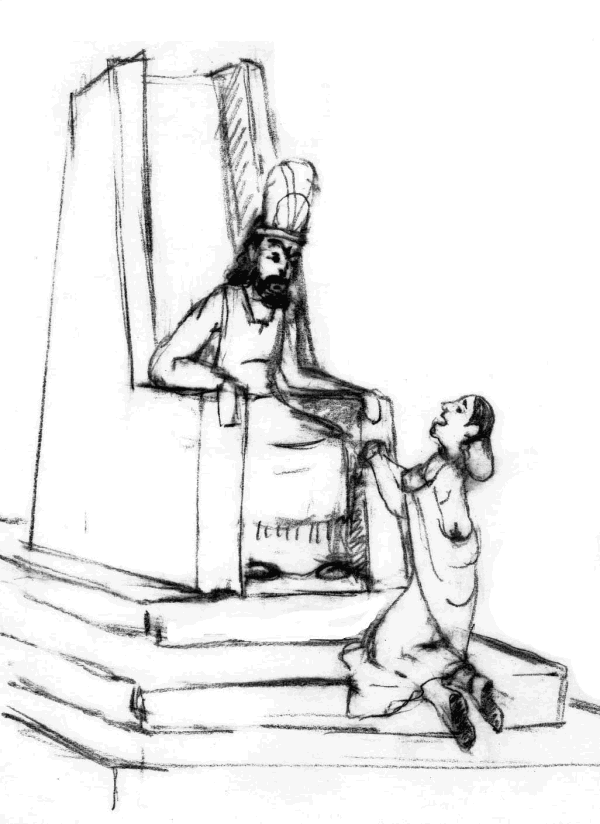
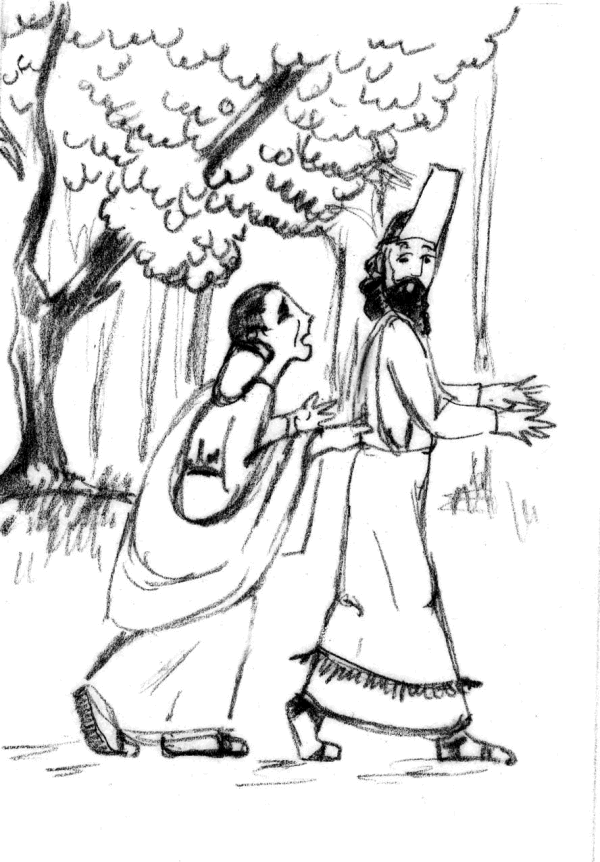
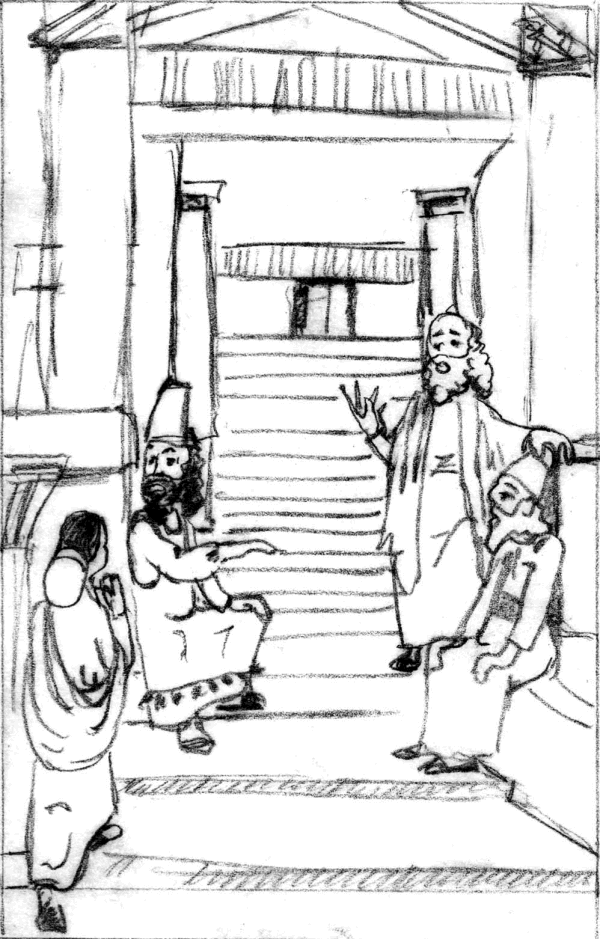
These drawings are by Doris Pritchett. She storyboards the whole story which Jesus told in just a few sentences! They are reproduced from Jesus and Courageous Women: Youth Study by Ann Craig (New York: Women’s Division, General Board of Global Ministries, The United Methodist Church). I found them on this web post, now 12 years old.

widow8

widow1

widow2-2

widow3Our last artistic offering illustrates the end of the parable. We are often tempted to forget the moral of the story!

Jesus wonders if he will find any faithful upon his return!

widow