He makes a good point. We attended worship yesterday and heard not a word about this horrific event that should be rocking all Christianity.
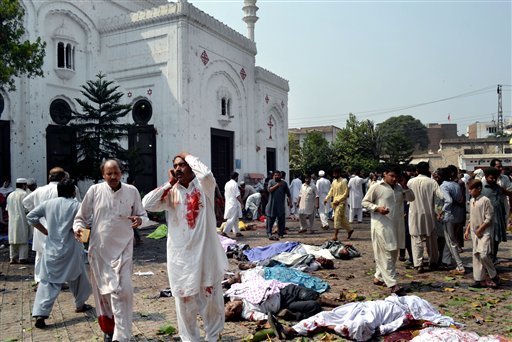
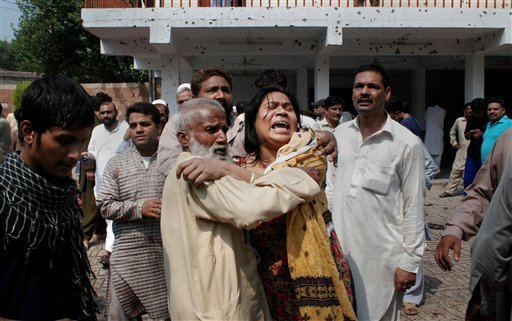
A church with 250 people in worship was blown to smithereens last Sunday. 85 dead, including 17 children. 156 seriously injured. That’s about a tenth the number of people who died on 9/11 at the hands of terrorists and they were people who were simply attending worship.
The terrorists didn’t target Americans this time. Too expensive probably. Instead, the targeted Christians because, silly Taliban, they think Americans are Christians.
As a minority religion in a very protective Muslim state, Pakistani Christians are the bravest of the brave. They face life-threatening persecution every day.
Where is Christian outrage?
Christianity has become a religion of comfort in our free society. Many go to church seeking solace, ease. We are not ready to take on the responsibility of evangelism in a hostile land.
And yet it is our job.
2×2 is collecting money to send to the Pakistani church to help with ongoing medical bills for the seriously injured. They tell us they are not certain they will receive good care in Muslim hospitals.
If you’d like to help here are three ways to contribute. We have been in regular contact with the church leaders in Pakistan for two years. You can see photos of their ministry under our Friends in Ministry tab.
If you would like us to send your contribution for you, mark your check Pakistan and we’ll wire the money. Every cent will be wired to Pakistan.
2×2 Foundation
c/0 Judith Gotwald
591 Hermit Street
Philadelphia, PA 19128
The mulberry tree is a weed tree. Unruly. Persistent. Problematic. Uncommercial.
Mulberry trees are common. I could pull a dozen from garden to use as an object this week. The sooner I pull them the better as they are difficult to get rid of once they take root.
If you have no mulberry trees use this painting by Van Gogh.
Jesus says, “If you had faith the size of mustard seed, you could say to this mulberry tree, ‘Be uprooted and planted in the sea,’ and it would obey you.”
We tend to concentrate on the size of the mustard seed when we tell this story.
Mustard seeds are small. Point made.
Today let’s concentrate on the mulberry tree.
Here’s some information about mulberry trees.
They are widespread. They grow in the Middle East, Europe, Asia and boy! do they grow in North America.
They are a wide, bushy tree. I played under one as a child, imagining each branch dipping to the ground as carving out a separate room in my playhouse, fort or castle.
Most trees have needles or leaves that are very alike. The basic heart-shaped mulberry leaves can develop lobes that create many different shapes.
They bear both male and female flowers.
They can begin to grow again, even years after we think we’ve eradicated them.
They can thrive in the harshest conditions—even next to the sea. Jesus would have their mustard seed-sized faith plant the tree in the sea!
Their fruit is sweet and edible but not commercial. The berries are soft and fragile. Yet dropped by birds, they grow anywhere.
Their fruit stains everything. My back porch is purple in the spring.
This time, when we read this well-known parable, think about how God would put our small faith to work. He would have us moving weed trees, working with a tree that has a mind of its own and diversity in appearance, that can be found almost anywhere, that has potential value if handled with care and which bears a colorful fruit that can leave a lasting impression. If they weren’t so persistent in being what they are, they would be considered beautiful—a subject for painters like Van Gogh.
We just heard that 17 of the dead in the Pakistan church bombing are children. All the dead are not accounted for as officials believe many removed the bodies before responders arrived.
The Pakistani church reports serious suffering among the injured. They are asking mostly for warm clothing. I am happy to report that one Christian read our report and wrote that they were sending a check.
We will send anything that you send to us with Pakistan written on it directly to the pastor of New Life Fellowship.
Send the checks to 2×2 Foundation, c/o Judith Gotwald, 591 Hermit Street, Philadelphia, PA 19128, we will collect the contributions and wire them for you. We will publish a picture of us at the bank with the check to verify that all the contributions — 100% — are going to Pakistan relief.
The ELCA has always been proud of its disaster witness. As for evangelism—the ELCA has divided the world in 65 pieces with each synod adopting a mission region. I looked online at the list of “Companion Synods.” Tanzania has multiple ELCA companions. Pakistan didn’t make the cut. That whole part of the world is missing from our mission efforts.
Here is a country where ministry is very difficult—life threatening. Every day. And we are absent from helping—even from the security of sanctuaries of freedom half a world away.
The Church tends to live in a bubble of bureaucracy. Someone somewhere else will deliver on our prayers and cares. We’ve done our job by repeating “Lord, in your mercy, hear our prayer.”
Of course, there is always the fear that our help will be misused. We want the help to get to the right people. Often, that means we don’t help at all.
We at 2×2, the remnant of Redeemer Lutheran Church in East Falls, know all too well ineffective church assistance. We can’t count the number of pastors who tell us they pray for us. After six years of persecution, we know very well the power of prayer with no action. We’ve had a lot of attacks, many very personal. But at least no one has blown up our whole congregation.
The bombers were angry at the United States. They still equate America with Christianity.
The Pakistani Church is desperate for help in recovering from this attack. One pastor wrote to us this morning in frustration. “Now is the time for practical help. Now is the time to show that ministry is more than words.”
Pakistani Christians are an unwelcome minority in a Muslim culture. They know their lives are dangerous. They are not sure they will get good medical attention because of who they are.
Many are not affiliated with western mainline denominations, although the bombed church was Anglican. They have asked for food, medicine and clothing. They have not asked for money, although money is the most practical way to help them. We don’t know what medicine to send, we don’t wear the same clothes they wear and food is difficult to send. So money is the practical answer.
The ELCA took all Redeemer’s money. But still we will try to help.
If you can help Christians who are actively dedicated to Christian ministry in the hardest part of the world for Christians to serve, please consider sending a gift to the addresses below.
2×2 Foundation
c/0 Judith Gotwald
591 Hermit Street
Philadelphia, PA 19128
2×2 has been in steady contact with the Christian church in Pakistan for nearly two years. Today they sent pictures of the carnage in one of their churches. 85 dead. 150 wounded.
They are asking for practical help: food, clothing, medicine. I asked for specifics of how help could be sent and am waiting for an answer. Look for details in a later post.
(Also, our friends in Kenya are only a couple of miles from the mall siege.)
Here’s a link to the Huffington Post’s artistic slide show of abandoned churches around the world. Pennsylvania has more than it’s fair share within this collection.
The Southeastern Pennsylvania Synod of the Evangelical Lutheran Church in America could create its own slide show of their locked and deteriorating houses of worship.
This parable is one of the most memorable to me from my childhood. I had an old Sunday School paper given to me by an elderly church member that showed poor Lazarus with the dog under the table. The image spoke to me and I thought a lot about this story with its other rich images—the rich man enduring the agony of Hades and the poor man seated comfortably with honor in heaven.
The definition of a parable, taught to us as children, is “an earthly story with a heavenly meaning.”
The parable of the Rich Man and Lazarus is a story about how we value wealth. When weighed against the danger of losing our place in God’s kingdom, how important are our possessions?
That’s a big subject. How do we cover such vast territory with an object lesson?
Let’s consider one of the most valuable things in the world—something we are accustomed to having provided to us for free.
Drinking water.
Our object is the $2 bottle of (name your favorite brand) water.
Bottling individual portions of water for sale changed the way we view and value everyday drinking water.
Water was once provided for free in restaurants. You didn’t have to ask. Water was placed before you. Now you not only have to ask, you ask at the risk of the upsell. “Would you like seltzer water or (name the brand)?” You can sense the disappointment when you say—tap water will be fine.
I once stayed in a hotel where they had in the room’s minibar $6 bottles of water imported from Scandinavia. H2O is H2O, still one of my companions just had to sample it.
Since water is now sold in easy to carry containers, you see them everywhere. Whoever cleans your sanctuary is liking to collect a few bottles from the pews—unheard of 20 years ago.
Professional performers who might have hidden a cup of water to wet their whistle between numbers, position a bottle of water in plain sight. Product placement!
Teachers report that students feel they must have water with them in the classroom. “Stay hydrated” is a popular mantra. “Very important” usually follows the advice.
The offer of water was once an expectation of hospitality. When I was a child, hiking in the country, it was not unusual to be offered water as we passed a farmhouse.
Water fountains were once frequent appointments in public buildings. It was so important to all human beings that even if we didn’t want to share, we provided separate fountains for the people we were looking down upon — the Lazaruses of our day. “Whites only” or “Colored” signs were attached.
We have a new set of nuisances or problems all because of bottled water (including disposing of the used bottles). Because it now has a measurable value to us, we now think about water very differently. The common tin cup hanging by the well is no longer good enough for anyone.
Owning our bottles of water makes us part of our culture. We feel rich and accepted when we are always armed with H2O. As common as water is, we have made it a commercial status symbol.
That immediately affects the way we share. We are tempted to keep our purchased bottles for ourselves. Let everyone buy their own bottles of water.
And yet, water is something none of us can live without.
How important is it for us to have water? How important is it for us to reach heaven?
The rich man is begging for the opportunity to leave Hades for just one day to warn his brothers to share their water.
One Sunday, a year after Redeemer members were locked out of the Lutheran Church, one of our members commented in frustration during our fellowship after house worship.
“I just don’t understand why they want a church without us in it.”
That comment sparked our Ambassador visits. “Let’s go ask them” was the response.
The commenter was Marilyn. That was three years ago.
Marilyn Popp loved being a Redeemer Ambassador. She truly enjoyed the church visits, especially the history of the congregations and the church architecture.
Marilyn was a retired city school teacher. She had intentionally followed a difficult calling. She wanted to work in the city schools from the moment she entered West Chester State College. She taught in Philadelphia’s roughest neighborhoods during the most turbulent years in urban America. She often talked with affection of the children who had passed through her life and was always delighted when she encountered a former student.
Her experience in the toughest schools gave her a commanding presence. Her voice carried. There was no such thing as a whisper. She had a sense of how things ought to be done and insisted that when we enjoyed fellowship after church in a restaurant that she personally place the tip in the waiter’s hands.
Marilyn was frugal, spending as little as possible on herself. We were all surprised when she returned from a trip recently with a new dress. She justified the extravagance. “It was made in America, it was the only one in the store and it happened to be my size.” It was certainly meant to be!
Marilyn came to Redeemer in 1997. She and her husband attended a concert we hosted at holiday time. Her home church, Jonathan Pritchard, had already closed. Unless something changes in the ELCA that’s what city Lutherans have to look forward to — one church closure after another. It’s sad enough when congregations agree to close. It’s tragic when the decision is forced on them. It causes all city Lutherans to weigh just how much they are willing to put into churches that can be seized at any moment.
She immediately felt at home at Redeemer and joined after her husband’s sudden death shortly thereafter.
She brought with her a passion for Victorian hymns. Most hymns are Victorian hymns. She especially admired Blind Fanny Crosby. Blessed Assurance.
She had her own mission project. 2×2 purchases more daily devotional booklets than we need. Marilyn mailed them out quarterly to friends—always with a note. She also had a group of people, many much older than she, whom she visited, took to events and prayed. She was delighted to learn the Lord’s Prayer in German, so she could recite it with one such friend.
Despite being one of our older members, she embraced the use of Swahili in worship and often climbed the stairs into our sanctuary saying Asante sana Jesu.
Every offering she gave to one of the churches we visited included her handwritten note: From Redeemer. As far as we know, all the churches accepted them. We must exist!
Marilyn was a worrier. She worried about things big and small. One of our friends wrote, “I’ll always remember Marilyn as a worrier with a smile.” She still worried that the SEPA Synod might allow our pipes to freeze or that the lights would be left on. She longed to once again enjoy worship in our church home. She was not one of the members of Redeemer targeted personally in SEPA’s lawsuits but she fearlessly attended all the hearings.
Marilyn has no more worries. The mother of the Redeemer Ambassadors died today.
Funny, the lights in the church were left on.
Redeemer, with no official pastor to call, rushed to her home to comfort her daughter. We are still a church, you see.
It’s at times like this that we, the people of Redeemer, are the most angry and that we feel the hurt of our exclusion from our church the most. It’s at times like this that we are most aware that we live in a church without a conscience and a very selective heart.
Marilyn should not have spent the last four years locked out of her church. Our people should be able to rally in our own neighborhood to comfort her family and celebrate her life.
But we have to make do—alone.
Every minute we are not thinking of Marilyn and her family we will be thinking about all the churches that couldn’t care less about the people they are hurting—all the churches that have spent four years waiting for someone else to do something.
Rest in peace, Marilyn. You were a great ambassador.
Too bad—we still don’t know why other Lutherans want a church without us in it.
Wish we had an answer. Meanwhile, put in a good word for us!
Redeemer’s Ambassadors took a Sunday off. We each had personal plans for the day.
Today I was entertaining one of my oldest friends.
She is visiting Philadelphia for only the third time in her life. It was her first visit outside of center city. She came to attend a four-day meeting being held in East Falls.
Having her as a house guest was a little intimidating. Her mother had been my home economics teacher in high school. But my fears that my house-keeping and hospitality would not be up to snuff were groundless.
We met when we were twelve, when my father, a Lutheran pastor, changed parishes. We sang together in church and in school—girl’s trio and choir. We were friends through college. We hadn’t seen each other in more than a couple of passing encounters in nearly 40 years.
We lived in a small town—farming, coal and steel country. We were friends in both church and school. Many of our school teachers were church members, so the lines were always blurry.
We walked a lot of East Falls together during her four-day visit. We walked through the parks, along the Schuylkill River and Wissahickon Creek, the various campuses (college and high school) and I showed her the churches. Her meetings were being held at Good Shepherd Episcopal Church, the church Bishop Burkat helped in ministry at the same time she was trying to take our property. I showed her our locked building. The lights were left on, so it was easy.
As we talked with people we met during her visit, she still identified me as their preacher’s daughter. Some things in life I’ll never be able to shake.
We attended a performance at the playhouse where Redeemer began its ministry in 1891 and where we now hold Sunday morning worship. My friend worked in summer stock theater, so she was interested to see the local theater club. We talked with fellow playgoers. Whenever we encounter anyone from East Falls, the topic of Redeemer comes up. Some things SEPA will never be able to shake!
My friend commented at the sense of community she experienced in East Falls.
We are that. Our people and our history mean something to us. That’s something the Southeastern Pennsylvania Synod of the Evangelical Lutheran Church in America cannot understand.
For them, East Falls is all about how much money they can get from us. Our people—our history—our passion for ministry—are obstacles to them. We are just in the way.
Pity!
Here’s an idea. We can take SEPA representatives on a similar tour. We’ll walk you around our town. We’ll show SEPA where our members live and where we got our start. We’ll share our history and our personal faith journeys and what has happened to our members since we were locked out of the Lutheran Church. We’ll introduce you to the people SEPA has taken advantage of. We’ll share our mission plan—yes, we still have one!
Maybe then, you’ll know something about us. Maybe you’ll see us as people, fellow children of God. Maybe that will prompt some right actions and justice in the Lutheran Church.
My attic got out of hand two decades ago. With the arrival of cool fall weather, I decided the moment had come. It was daunting. 25 years of various stages in the lives of three people stored for a rainy day that might never come. I decided to give it an hour, first thing every morning.
A few months ago, I (and the rest of Redeemer) took on the task of cleaning out the home of a deceased pastor. The home was well-lived in and filled with books and papers, music and recordings. It was easily ten times the amount of stuff in my attic. But the things were not mine. Although, I frequently came across things of interest it was not particularly painful to part with any of them. Still, I think the family of the pastor was glad that we were handling their family’s things with sensitivity.
But now I am sifting through things that were at one time cherished or valued by people that I am close to. Here’s what I learned.
Ephemeral Value:
A lot of things that seem important just don’t matter. A crate of “hamburger” toys. Out!
Value in the forgotten. Last summer I wanted a pair of navy blue slacks. Navy blue is not currently “in.” I found three pairs that I had forgotten I owned. I also learned that I will always like navy blue whether or not it is trendy!
Records. I carefully stored financial records in boxes. They mean nothing today. But I kept photos and things that might be helpful to my our son or step-grandchildren.
Memories. Many things have value in memory only, but still they have value. I bagged lots of little boy shorts and hoodies for giveaway, but I set aside an infant’s snowsuit given to me at the birth of our son by a highschool girlfriend with whom I still talk every week or so. I also kept the last Christmas gift I had given my husband before he died.
Some trends have value; others, not so much: I decided to toss the trendy toys — Power Rangers, etc. and keep the classics. Monopoly, Checkers, Picture Puzzles. There may be grandchildren some day!
New purposes for old things. I have ten bankers boxes of children’s books. I pulled out the favorites long ago—the books about dogs. But what do I do with the rest? I saw a photo on the internet that sparked an idea. It will take some work. But I’ll hang on to them a bit longer.
One of the goals for cleaning the attic was to make room for the new—new uses for the space or new space for new, old stuff? I’m not quite sure. But knowing that the space is available is a big step.
What does this have to do with church?
A lot of churches are one big attic—one big box of bricks and mortar holding the past and memories of the past and perhaps the spark of a future. They need to be cleaned thoroughly every twenty years or so. It’s one way to reevaluate your history and plan your future.
There are things and ideas that live within our boxes of bricks and mortar that will never be used again.
There are things of value that we’ve forgotten about.
History can be valuable but not everything is as important as we think it is at the time.
There are things that are carefully cherished for no other reason than the memories attached to them. Some should be kept — just because. Some can be tossed.
Churches go through trends and fads. You might find unused hymnals, kneelers, or altarware. These might point you to the thinking behind these items. Decide what’s worth keeping and what is taking up space.
There are old things that we might think have no use but are waiting for the spark of creativity to bring them back to life.
It might be a good idea to periodically walk through your church and consider it your attic. What is no longer useful? What was never useful? What can be repurposed? What is classic and will always have potential value? Don’t limit yourself to physical things. Examine the ideas attached to the physical things. What is taking up room that new ideas could occupy? The last lesson I learned:
Join Bishop Ruby Kinisa as she visits small churches "under cover" to learn what people would never share if they knew they were talking to their bishop.
Undercover Bishop will always be available in PDF form on 2x2virtualchurch.com for FREE.
Print or Kindle copies are available on Amazon.com.
For bulk copies, please contact 2x2: creation@dca.net.
MISSION INSPIRATION OFFER
A visual and biblical guide to help congregations define their missions.
Contact Info
You can reach
Judy Gotwald,
the moderator of 2x2,
at
creation@dca.net
or 215 605 8774
Redeemer’s Prayer
We were all once strangers, the weakest, the outcasts, until someone came to our defense, included us, empowered us, reconciled us (1 Cor. 2; Eph. 2).
Be calm. Wait. Wait. Commit your cause to God. He will make it succeed. Look for Him a little at a time. Wait. Wait. But since this waiting seems long to the flesh and appears like death, the flesh always wavers. But keep faith. Patience will overcome wickedness.
—Martin Luther