4/7InkzHVUEQeEdU9vpc1tikzEhChrKmPfvXI-FSDBrBQ

Uncategorized

Learning about Church from Urban Planners

The Value of the Disorganized Church

Maybe it is time to seriously consider the value of the disorganized church.

Change is very, very difficult in the Church.

Why? There is really no desire to change. People rarely go to church to spearhead change and church leaders, as much as they talk about change, are really interested in change for just one reason.

Economics.

The Church wants to maintain the economic advantages it came to enjoy in the affluent Post World War II years. If the money were still flowing, if the Sunday Schools were even half the size they were in 1965, there would be no talk of change. If the building were maintained with salaries paid and if a healthy proportion of offerings were being shared with the regional and national offices (do we remember why?), then everyone would be happy.

There would be celebrations for the status quo.

Somewhere amidst the revelry the mission of the church will be left behind.

The catalyst for change is need—the more personal, the more imperative.

The need is there. The imperative is strong. But there is no strategy. We are all worried about just getting by! There is no money for mission.

Congregations are hurting. When congregations hurt, regional offices lose support. When regional leaders can’t pay tribute to the national office, you have a mess. The battle cry sounds. Change!

Under these conditions, there is a temptation to follow policies designed to mandate change. They don’t work.

Here is a link to a TED talk that addresses the problem of traffic congestion. How does this relate to church life? Watch it and see.

Here is a short vignette. It’s about the temptation to make plans and expecting other people to simply carry them out.

Back in 1989, when the Berlin Wall fell, an urban planner in London got a phone call from a colleague in Moscow saying, “Hi, this is Vladimir. I’d like to know, who’s in charge of London’s bread supply?”

And the urban planner in London says, “What do you mean, who’s in charge — no one is in charge.”

“Oh, but surely someone must be in charge. It’s a very complicated system. Someone must control all of this.”

“No. No one is in charge. I mean, it basically — I haven’t really thought of it. It basically organizes itself.”

It organizes itself. That’s an example of a complex social system which has the ability of self-organizing, and this is a very deep insight. When you try to solve really complex social problems, the right thing to do is most of the time to create the incentives. You don’t plan the details. People will figure out what to do, how to adapt to this new framework.

This is part of church life today. Regional bodies send “transition” experts to congregations and attempt to steer congregations toward newer, accepted, but not really proven, new ways of ministry. They are not recognizing what the people in the local churches know very well. It’s not working — no matter how hard you try, no matter how you veil the statistics.

The Church wants to control the distribution of bread. (No theological metaphor intended!)

What the urban planners dealing with congestion problems discovered is this: Attempts to mandate a change in driving habits had NO impact.

They didn’t achieve success until they found a gentle way to nudge drivers. The nudge was so gentle, no one even noticed that their behaviors had changed. Most people thought the changes were their idea.

The Church needs to learn to nudge. Lead, don’t dictate. We’ve been trying to force congregations to do the things hierarchy wants them to do for a while now. It isn’t working.

A little less organization. A little more incentive for grassroots initiative.

Redeemer Ambassadors Learn More about St. John’s, Mayfair

On the first of the month, Redeemer always looks forward to holding our own worship service at the Old Academy Theater. The Ambassadors arrived still enthusiastic about our visit to St. John’s, Mayfair, last week. One of our Ambassadors enjoys the history and architecture of the churches we visit. She asked about the two cornerstones—one pre-Civil War and one from the mid-20th century. We discovered a connection we didn’t know we had. Our pastor, one of only a couple of SEPA/ELCA pastors not afraid to be seen in public with us, once served St. John’s back in the 1960s.  (Yes, we have a pastor, in fact we have two who worship with us regularly!) He told us a bit of its history, how it used to be downtown and how the new church had been designed to showcase its beautiful German windows. He talked about how the educational wing was once filled with Sunday School students and how it had a friendly competition with St. Paul’s in Olney. Its membership then was more than 2000. Latest Trend reports have them holding their own in the 600s, with a little fluctuation, most recently reported at 695, a third of them worshiping members.

Why Twitter for Churches?

Why Twitter, why not Facebook?

twiFacebook, the king and queen of social media, has some problems as a platform for churches.

  • To be used well, it is a lot of work.
  • It is unabashedly about monetization of cyberspace.
  • The rules change frequently.
  • It can easily become more intimidate than a congregation of unrelated people want to be part of. Facebook rules just changed recently to make posts more public than many users ever intended their Facebook pages to be. We’ll wait with everyone else for the fallout on that.

Facebook has been embraced by business and some nonprofits. They are more likely to have a top-down structure with monetary and hierarchical controls. In other words, Facebook will be part of somebody’s job. It might be their whole job. Few churches can afford that!

Twitter on the other hand comes with some control. You can create a following but you can direct your “tweets.”

The Twitter platform is stripped to the bone. You are limited to 140 characters (practically 120 characters). Who can’t write one sentence a day!?

Let’s look at Twitter. What is it, anyway?

Twitter is a social media platform first designed for people to answer the question, “What are you doing?”

People send simple, short messages. No pictures. No video. No fancy type.

The first reaction from the public, the echoes of which can still be heard, was “I don’t care what you are doing!”

But some people kept reporting their activities to the world anyway.

They soon learned the difference between “This sandwich is delicious.” and “Route 95 is backed up 20 miles. Stay away!”

Slowly with explosive bursts of potential, the world began to realize that there is power in caring about what someone else is doing and how we can influence what happens to them.

Does that not sound mission-oriented?

The power of Twitter is in making connections. Once those connections are made. It is really up to us what we do with them. Twitter is the spark.

There is a good explanation of this power in the book The Tao of Twitter, by Mark Schaefer. There are many good books explaining Twitter. Most of them are written from a marketing point of view. Marketers tend to love numbers and analytics, which if you can bear reading them, are impressive.

(We’ve provided a link to Amazon in our widget column for this inexpensive book.)

Most pastors and church people are not “numbers” people. If they were, they may have already fled the church scene. Church numbers are dismal at first glance and alarming with analysis.

Mark’s book dwells on Twitter’s power, beginning with person to person, one-on-one power. This is something every church needs. It is foundational to mission.

The current and traditional church mission focus is invitational. Build a building, open the doors on Sunday morning, and hope that people are curious enough during those few hours of the week to come to us. We sit in our big churches and wait. For decades we didn’t know how to do mission any other way. The tools to do a better job were out of reach, practically and economically. So we keep doing things the same way, rewarding the congregations that do this the best, despite the nagging realization that even the biggest churches are statistically ineffective.

To use Twitter, requires making an effort to unlearn and change this collective mindset.

How does Twitter differ from Facebook?

Twitter2Twitter is beautifully stripped down. You must tell your story in less than 140 characters. Church people can respond to this limitation in one of two ways.

  1. Protest! We can’t possibly tell our message in 140 characters.
  2. Cheer! How hard can it be to write one sentence a day!

Twitter will be manageable for any pastor or any lay leader. It is possible to put Twitter to work with as little as 15 or 20 minutes of effort per day. That’s good news!

Teach Us to Pray

Why do people go out of their way to ask preachers to pray for them?

Pastor Jon Swanson points to 1 Chronicles where David outlines the duties of the Levites. One of the duties is to stand every morning to thank and praise the Lord.

OK, it’s their job. But it is our job, too.

Each of us can pray. The littlest toddlers find comfort and empowerment in bowing their heads in pray. (Comfort and empowerment are answers to prayer.)

Over the rocky years of life, we tend to lose confidence in God and confidence in our ability to speak to God. The relationship is broken.

Easy way out: assign the duty to those we feel are especially trained to do this.

When you set aside one group of people to perform a function that each person is capable of doing, the result is predictable. The larger group is going to lose its skills.  Prayer is a pretty important skill—one we don’t want anyone to lose!

Another predictable result. The designated pray-ers will accept status and power. Over time, they will get lazy about their responsibilities and the prayers will become corporate in nature. Prayers will be written a year in advance, published, distributed to congregations, and read by the designated pray-ers, who no longer have to know the names and faces of the people they pray for. People will feel further lost and separated from God as their individual needs are grouped with the whole, undefined people of God.

The church must work at restoring people’s relationships — not so much with the Church but with God.

We all feel small before God and in our self-loathing we tend to think that clergy are somehow better. They are not. Clergy are servants just like every other child of God. They are capable of both good and bad. Putting them on a pedestal as the official representative of God results in scandals that grab secular headlines when things get really bad.

Clergy are charged with fostering spirituality. They are not surrogates. That kind of thinking led to the travesties that inspired Martin Luther to risk his life with his 95 Theses. Back then, people were encouraged to pay clergy to pray for them. The more money, the better the prayer. Maybe that’s what we have returned to today without using the word “indulgence.”

The disciples felt inadequate. They came to Jesus. “Teach us to pray.”

The church does not always do a good job of teaching us to pray. The laity is often OK with this. We want to know how to pray, but not if it means practicing. . . in public.

At this point we can learn from musicians. They know that no amount of practice behind closed doors can teach the skills that are easily honed playing in public.

One pastor we heard during our Ambassador visits exhorted her congregation to ration their prayers. Don’t bring your little concerns to God, she admonished. Save God for the big things.

Perhaps she meant to empower the congregation to solve their own problems, but it is definitely short-changing God. God is God. He’s not asking us to save Him time and trouble. God wants us to call upon Him. God can handle little things along with big! Nevertheless, I am sure God smiles with satisfaction when we get up from our knees and help!

There is only one way to change this. Put the responsibility for prayer into the hands of the people. Teach them to pray. Teach by example. Give lots of opportunity for practice.

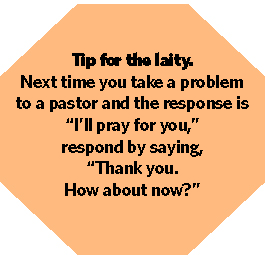
Instead of glibly promising to pray for people who come to you in distress—as a way of dismissing their concerns—stop in your tracks, take their hands, and pray with them, asking them questions in the prayer so that their answers are a voice directed at God.

Then don’t wait for magic. Prayer provides comfort and empowerment! Roll up your sleeves. Lace up your boots. Put on your gloves. Go to work! Love your neighbor!

See if those prayers aren’t answered!

Teach us to pray.

photo credit: Lel4nd via photopin cc

Adult Object Lesson: Signs of Christmas

Jeremiah 33:14-16  •  Psalm 25:1-10  •
1 Thessalonians 3:9-13  •  Luke 21:25-36

Poinsettias are already for sale. What a perfect object lesson to go with the parable of the fig tree!

You know summer is coming when the fig tree sprouts. You know the celebration of Jesus’ birth is coming when you see poinsettias for sale in the grocery store. Talk about the other signs of Christmas—TV and radio ads using Christmas music to grab your attention, charity solicitations in the mail, and your neighbors Christmas lights brightening your lawn in the evening.

Talk about the prophecies in Jeremiah and the sentiments of the psalmist—how the signs bring both hope and anxiety.

photo credit: RedTail_Panther via photopin cc

Please read this post, if able.

There is a fad in the church first noticed ages ago by one of our ambassadors. We dismissed it as his pet peeve, but he has a point. It is getting annoying. Why do all pastors feel compelled to add the phrase “if able” to every worship instruction?

If people are not able, they won’t do it! And if people don’t want to follow instructions, it calls attention and question to either their disability or their orneriness! Why don’t worship leaders just say, “You are invited to stand.” and leave it at that? Most able people will follow instructions. Those with disabilities will not feel singled out…and ornery people…they will always be with us!

Really, we don’t know what we are “able” to do, until we try.

Please stand, if able.

Please sit, if able.

Please read, if able.

Please think, if able.

Confess, if able.

Repent, if able.

Forgive, if able.

Reconcile, if able.

Love, if able.

Did You Survive Black Friday?

It’s Thanksgiving time.

Hurry! Gobble down the dinner some thoughtful matriarch spent days preparing. Break out the camping equipment and claim your spot on the Big Box Store parking lot.

The United States is a blessed nation in that we ever thought to proclaim a national day of Thanksgiving. Proclaimed to be held on a Thursday, at a time in history when the concept of “weekend” meant little, it is one of few holidays that seems safe from the corporate need for Monday holidays.

That Thursday timing is a great opportunity. Many people don’t mind taking Friday, too. Plenty of time to celebrate with all branches of the complex American family. Enough time to join with the neighborhood. A wonderful four-day pause to show appreciation.

It is a time to count our blessings as a people: our survival of hardship, our struggles for freedom, our battles for justice and the blessings that we call prosperity and opportunity.

Oddly, it has become a time when our churches are empty and our malls are filled.

If you don’t believe in God, whom are you thanking on Thanksgiving?

Answer: the great American marketer.

When Thanking God Might Seem Impossible . . .

Write a hymn!

The story of the Rev. Martin Rinckart inspires us each Thanksgiving.

Let me tell it one more time.

Pastor Rinckart was one of four pastors in the walled city of Eilenburg, Germany, in 1637. The city was a refuge from the devastation of the Thirty Years War. Its over-crowded streets became a breeding ground for the Great Plague.

Death was all around. There were four pastors. They were called upon to perform as many as 40 funerals a day. One pastor fled. Rinckart  conducted the funerals of two others and that of his wife. All but three government officials died. Children were hit particularly hard. Rinckart conducted nearly 4,500 funerals before the dead began to be buried without ceremony in trenches.

Famine followed pestilence and Rinckart helped keep the peace when fights broke out over food. He gave away as much as he could without starving his own family.

He mortgaged his future income to help feed the destitute who gathered at his door.

The Swedish occupying forces demanded tribute from the people of Eilenburg in excess to anything that could possibly be paid. Rinckart attempted to negotiate with the occupying forces to no avail.

He gathered his followers and said, “Come, my children, we can find no hearing, no mercy with men, let us take refuge with God.”

His earnest devotion impressed The Swedish general and the tribute demand was greatly reduced.

From this man of God, who knew little but duty amidst profound suffering came the words we sing at Thanksgiving.

Memorize them!

Now thank we all our God, with heart and hands and voices,
Who wondrous things has done, in Whom this world rejoices;
Who from our mothers’ arms has blessed us on our way
With countless gifts of love, and still is ours today.

O may this bounteous God through all our life be near us,
With ever joyful hearts and blessèd peace to cheer us;
And keep us in His grace, and guide us when perplexed;
And free us from all ills, in this world and the next!

All praise and thanks to God the Father now be given;
The Son and Him Who reigns with Them in highest Heaven;
The one eternal God, whom earth and Heaven adore;
For thus it was, is now, and shall be evermore.

Restoring Lutheran Interdependence

Don’t pay the deans

In days long gone by, the deans of a synod served uncompensated. It was their leadership contribution to their Church. In today’s ELCA, at least in the Southeastern Pennsylvania Synod, the deans are paid. Not much—but even a penny is influence.

Deans are supposed to serve a cluster of congregations as liaisons between the regional office and the congregation. Unpaid, they represent the congregations. Paid, they are arms of the synod.

Consequently, the congregations have very little access to the regional office except through the clergy — if they have clergy. The interdependence that defines the Lutheran church structure depends on communication between the congregations and the regional office and national church, which the cluster/conference and dean system is supposed to facilitate. With the leader of the clusters on the synod payroll, the integrity of the system is compromised. Forums for the interchange of interdependent thinking are muzzled.

When a dispute occurs, where can the congregations turn? Nowhere!

And so disputes, which the Church could and should handle themselves, spill into the secular courts.

It is an ethical dilemma that is largely unrecognized. Without an independent intermediary, this is unlikely to be addressed.

Recommendation: Don’t pay the deans. Allow them to be the voice of the congregations — as they are supposed to be. It won’t hurt them to serve the church the way they expect lay people to serve the church. It would help reestablish trust — and interdependence.

Adult Object Lesson: November 18, 2012-Mark 13

Tuesday is object lesson day.Daniel 12:1-3  •  Psalm 16  •  Hebrews 10:11-14 [15-18] 19-25  •  Mark 13:1-8

Hope Springs Eternal

Today’s object is a jack-in-the-box. This remains a popular toy despite its low tech nature. It is a variation of the even less technical peek-a-boo game—the first game parents play with their infants.

Children’s games evolve as we get older. Peek-a-boo becomes hide and seek. Hide and seek becomes Find Waldo. Find Waldo has its online variations.

The games are all about expectations. We are willing to risk some temporary discomfort for the anticipated reward.

That’s what today’s lessons are about—coping with a sense of despair with the hope of something better. Apocalyptic scripture is all about a promised end for those who endure the uncertainties of the day. Hope is a common denominator.

Hope is what makes us work for a better life. Hope is what makes us laugh. An unpredicted turn of phrase or action that goes against what is anticipated is the foundation of humor. Hope is what makes us believe.

Babies play this game, the disciples played this game, and we play this game.

So turn the handle on the jack in the box and experience hope and anticipation with its fulfillment (however silly)—again and again and again. It will strengthen you for bigger dreams.

photo credit: Brother O’Mara via photopin cc