That’s when we find out how well you make decisions.
When you don’t have the resources to do it the usual way, that’s when you show us how resourceful you are.
And when you don’t know if it’s going to work, that’s how we find out whether or not we need you on our team.
Every small church is in this position. Many are finding out that they don’t need to structure their “team” quite the way they have in the past.
The “dead wood” (a term one pastor used in a comment on this site in reference to small churches that the synod wanted to close) may not be the congregations. If you are going to assess interdependent ministries, look for dead wood in all the interdependent branches.
We suspect you’ll find some withering main branches.
Small churches are finding that not only do they not need them on their team but they have been playing without their support for years.
The Church, more than any other organization, save perhaps environmentalist groups, dwells on the concept of stewardship.
Sometimes we use the word interchangeably with offerings and donations, but we know it is more than that.
Stewardship is the conscious and wise use of resources. Too often we view only the property and financial assets in our thinking.
Measuring stewardship is a problem, especially when you don’t know what to measure.
Measuring stewardship leads to harsh judgments — often by people who are, themselves, stewardship-challenged. We are tempted to assume that we somehow have a right to judge who is the best determiner of when, where, and how resources are put to best use.
This can be tricky even for Christians without a horse in the race! Is the same $50,000 better used by a small congregation with 100 members or would it be better used to the Glory of God if a corporate church managed that money—or take the resources entirely out of the hands of the people who donated the resources. Let your regional body make the decisions.
Any organization of any size can use resources wisely or foolishly. Perhaps this is why the founders of the ELCA placed the determination of the use of resources in the hands of the congregations from whom the gifts were collected.
But let’s shift gears.
What if we stopped thinking of stewardship as the use of tangible resources?
What if we started thinking in terms of the intellectual property of the Church?
Let’s call it the Stewardship of Possibilities.
The concept is biblical. Jesus turned the attention of the disciples away from the pursuit of riches or status at every turn. Time after time, he directed them to possibilities. Unheard of possibilities. Away from “safe” investments. There is even a parable about it!
With the Stewardship of Possibilities, lame people could walk again. The blind could see. The hungry could be fed. Tax collectors could be honest. Fishermen could lead. People living in sin could turn their lives around. Children, women, foreigners mattered!
Instead of looking at our small churches with a message of impossibility, help them determine what is possible with the resources they have — all the resources—not just the endowment and offering plate.
Other things to consider:
The location of the property
The talents of the members
The creativity and ingenuity present in the congregation
Special skills in the congregation
The congregation’s spiritual life
The reputation of the congregation in the community. (Business calls it good will and puts a price on it!)
The relationships with civic and service organizations fostered over time
The stamina of the congregation (Can they weather a storm and work together?)
The potential
The faith and belief that all things are possible
These are things you can’t put in the bank. But you can bank on them.
Every now and then a group of people, calling themselves a church, decides that they don’t want to be a church any more. They take a vote and decide to close. It’s sad, but they followed a prescribed procedure. Everyone can move on.
In the Lutheran church, a congregation gets to decide among themselves how to use their remaining assets to the glory of God. Standing on the sideline is the regional body or synod, desperately trying to find ways around their polity to guarantee that the wealth of the congregations goes their way.
To assure this, they have developed a new process. You won’t find it outlined in quite the way it is being implemented in any ELCA governing documents. (But that’s why we hire lawyers.)
It begins with a target painted figuratively in red on the church. This is followed by years of neglect, and knowing nods and glances among clergy when the name of the congregation comes up in Lutheran forums.
The next step is the lock out. They’ll be talk (with no specifics) of the heroic “efforts” that came between these two steps—as if God was at work and failed. Truth be told, the prescribed neglect is just that — neglect, and no effective help was ever intended or offered. This is the written advice of noted church leaders.
By this time, clergy have ceded their influence in the Church to lawyers. The Gospel is out the stained glass window with the law following. Separation of Church and State replaces the laws other people have to live by.
What is likely to follow is a legal battle pitting clergy with their loyalties to the bishop against laity whose loyalties are to their congregation and faith. It’s not supposed to be this way. We are supposed to be interdependent, working together as equals. This is the traditional Lutheran way.
2×2 grew from just such a debacle at Redeemer in East Falls, Philadelphia. We have 15 years of experience on our side.
We’ve heard of similar heavy-handed treatments from bishops in New England, Metropolitan New York and Slovak Zion Synods and there may be more. There are examples in other denominations, including an Episcopal Church in East Falls. (East Falls is a favorite target. It’s a nice, working class neighborhood with soaring property values. The value of our property has outgrown the value of our people.)
So what are the reasons behind these actions.
Some possibilities
The congregation cannot pay its bills.
The congregation cannot afford to pay clergy.
The congregation is heretical in its teachings.
(If the first two are a reality, the congregation is likely to know it and work together to solve the problem or close.)
Here are some other possibilities.
The regional body cannot pay its bills.
The regional body cannot afford its current staff.
The regional body is heretical in its teachings.
In this case, there is the need for a cover story to gain acceptance among church people who might find what is about to take place distasteful — if not sinful. In East Falls, the cover story was that SEPA Synod intended to close the congregation for six months and reopen it with new and improved Lutherans that wouldn’t ask questions.
Well, SEPA has owned the property by court order for going on four years and done nothing with it.
This was not the real plan. The people of East Falls knew it all along!
The primary question that needs to be asked and answered is “What is the goal of forcing churches to close?”
The goal is usually stated as “better stewardship of church resources” or as a synod representative told Redeemer members, “ministry in East Falls is not good use of the Lord’s money.”
If this is the goal, the results point to high-stakes failure.
The results of this mismanagement, from which clergy and congregations shield their eyes, are ungodly. They include:
broken relationships — within the church, among friends, within families—and with God (the definition of sin)
children wrenched from the first support system they encounter outside their families
elderly living their later years under legal attack from the church they served all their lives
disabled or non-drivers, who relied on the local church, totally disenfranchised
an economic pit that gets harder to crawl out of every day for both the regional body, haughtily asserting its power, and the remnants of the congregation they set out to destroy
a Gospel message, preached weekly, but acted upon rarely
The stated goal—better use of church resources—is no longer even mentioned. The goal has failed.
The evidence is that if stewardship of resources is the goal, it is a far better to work with congregations interdependently — as our constitutions state.
Redeemer Ambassadors have now visited 50 churches. We’ve seen 50 versions of the weekly bulletin.
They are all pretty much the same and most are a mountain of paper to be left in the hymnal rack or tossed at the first opportunity.
The primary purpose of a worship bulletin is to direct people through the service. This is also the primary purpose of the expensive Worship Books/Hymnals sitting in the pew racks.
A secondary purpose is advertising — which these days is better done by email or Facebook. (It’s not the people who are in church that need all the reminders!)
Bulletins can be a creative outlet that provides enriching content—much more than those black and white line drawings that every church uses—the ones with short, big-eyed characters in flowing robes, acting out the Gospel for the day.
If a church is to go to the trouble of reprinting the worship book each week, it should add something to the worship experience.
We have yet to encounter bulletins as helpful as Redeemer’s—one piece of paper (11 x 17) with the entire service printed inside, including words to all hymns and prayers. Full color art from many different genres and religious poetry graced the covers. News, contact info, credits, calendar and even a Bible study or puzzle for the children appeared on the back.
There was no need to reference hymnals, which freed us to use worship elements from many sources.
Since we printed only words, we could easily substitute parts of the liturgy with an appropriate praise song or hymn.
But what about the music? The congregation developed a pretty good ear. The organist played hymns through in their entirety once. Hymnals were in each pew. Hymnal references were provided for those who wanted the music—and that was rarely more than one person.
A Redeemer bulletin was easy to follow for the presiding minister, visitors and even the children. Most important—there was a reason to take a Redeemer bulletin home to enjoy and share during the week.
Recently, a former member who now lives out of state wrote to one of our members and asked for a copy of our bulletins. She wanted to share them with her new pastor. A current member spoke up and said, “I’ll send her a few, I have them all on file.”
Others had often shared that they clipped a poem or image from the bulletin and stuck it to the refrigerator. That anyone kept them on file was a surprise!
It’s been more than three years since our last worship service in our own sanctuary, but when I cleaned my son’s room last week (who is now of age to be moving out). There, neatly folded on his dresser was the bulletin from the last Redeemer worship service —September 20, 2009.
Redeemer bulletins had mileage—even three years after we published our last one!
In this age of “going green,” it is peculiar that we publish hymnals with liturgies printed in them and place them in every pew. We brag that we have the latest and greatest worship book. Then the worship books sit unused in the racks. We reprint the liturgy in bulletins that eat up a ream or two of paper each week, a ton of toner, and wear and tear on office equipment. Preparing these bulletins takes a half day of a pastor’s time and probably a full day of office time.
Church bulletins are a huge investment with little return.
The reason we do this is probably that the hymnals are heavy and require flipping from the liturgy section to the hymn section frequently. They are awkward.
It’s also the way every church seems to do it.
But bulletins with 16-24 pages and fliers spilling out are equally awkward. Some of them were daunting to us as visitors — even with our strong church backgrounds.
Here’s an idea. Fill the hymnals with hymns—nothing else. You may end up needing to invest in fewer copies.
Print each liturgy in a small booklet that is easy to manage and won’t cost more than a dollar or two per copy. Let congregations choose which liturgy booklets they want. They can even create them themselves if they pay the licensing fee. Most churches don’t use more than one or two versions of a liturgy, regardless of how many choices are offered in the heavy worship books. An advantage of this is that new liturgies can be added at any time without waiting 20 years for the next hymnal to be published.
Now your bulletin can be one sheet of paper. Or maybe you won’t need one at all!
Save a forest. Save the church budget.
The bulletin will be easier to follow and allow for the inclusion of more art, poetry and teaching in your worship experience.
PS: We were able to forge the way in developing this because we didn’t have a pastor controlling the process.
If they haven’t started already, they will soon! Christmas Carols will be on every retail store Muzak, the radio, and TV commercials.
There is something about the “sound” of a Christmas Carol that touches emotions immediately. It has nothing to do with being “pop.” Most popular Christmas Carols were written hundreds of years ago.
Part of the thing that distinguishes a “carol” is its seasonal nature. We don’t talk about them much but there are Advent carols and even Easter carols.
Many of them grew from folk music.
But a key distinguishing element of a carol is this. From the very beginning, carols—as differentiated from hymns—were meant to inspire DANCE!
Has your congregations danced to its Christmas music lately?
I had an uncle who was a Methodist preacher. He often said, only partially jokingly, “Jesus is the answer. Now what is your question?”
There seems to be a similar “go to” response in the Church today. When you don’t know what to do—or when you do know what to do but don’t have the courage to do it, there is an easy answer. Promise to pray.
It’s been tough going for our congregation as members of the Evangelical Lutheran Church in America. Bishop Claire Burkat of the Southeastern Pennsylvania Synod went on the warpath against Redeemer Lutheran in East Falls, Philadelphia, including personal attacks on lay members. Acquiring the assets of Redeemer seems to have been part of the plan to fund massive budget deficits from the very beginning of her first term in 2006.
Large deficits have been routine since the beginning of SEPA back in the late 1980s. Giving and attendance were (and still are) in serious decline. There was no plan for reviving small church ministry beyond neglect and waiting for failure. Several congregations folded rather than swim upstream without the cooperation of SEPA leadership.
The assumption of SEPA leadership is that if they neglect ministry for a decade, ministry will fail to the benefit of Synod coffers. Under Lutheran polity this isn’t a given. Congregations can determine where to donate their assets. But Synods are finding a work-around that guarantees they will benefit. Simply declare the congregations “terminated” before they can have any say. This means that the congregations have NO rights within the Church they have served for decades or centuries. They need not even be consulted! Constitutional checks and balances are ignored.
Redeemer was getting the “10 years of neglect” treatment. But it wasn’t going as Synod planned. Lay leadership grew. Alliances were made with several dedicated pastors. Redeemer was in a promising position, with a five-year commitment of a qualified Lutheran pastor, working under a detailed plan that the congregation had spent six months drafting. In fact, our ministry continues to grow, despite the abuse.
But the efforts of lay people are not valued.
And there was that $275,000 deficit budget approved by Synod Assembly at the same time they voted (against Lutheran rules) to take our property.
And all of this has gone on while the clergy of SEPA Synod have watched.
Our members have approached people who should be in a position to at least open dialog on the issues.
There are fairly specific guidelines for resolution of disputes in the Bible and there are governing documents that could be followed within the Church. But ELCA leaders do not bother. They rely on “wisdom.”
We’ve heard all kinds of excuses.
From Bishop Hanson: Just talk it out. I have great regard for Bishop Burkat.
From a Synod Council member: We have no intention of negotiating with you. (Synod Council is supposed to represent the congregations.)
From deans: Silence
From pastors in a position to help: We have to trust the wisdom of the bishop.
From pastors who visited Redeemer 30 or 40 years ago: We know your history (as if Redeemer was stuck in a time warp).
From pastors who don’t know anything about Redeemer — but voted with the crowd anyway: Sorry! We didn’t know.
Whatever the excuse, it is always accompanied with a sanctimonious, conscience-assuaging promise to pray.
We wonder what these learned church leaders expect to come of prayer.
That someone else—anyone else—will play peacemaker.
That God will suddenly fix everything without any work.
That whatever happens won’t affect them.
That miracles will replace gumption.
That whatever happens, their jobs will be secure.
That they will never be the victims of the type of leadership abuses that have characterized this sad episode (and perhaps others before us).
That life in SEPA will go on as if Redeemer, and Epiphany, and Grace and others never existed—and the list will probably continue to grow.
Lutherans pride themselves on an interdependent structure. That means we are supposed to work together.
Here’s a suggestion:
By all means, keep praying, but recognize that the answer to prayer is probably in getting off your backsides and doing something.
‘Truly I tell you, whatever you did not do
for one of the least of these, you did not do for me.’
At the core of democracy is the freedom to say “no.” This freedom is also at the core of Christianity, without which democracy the way we know it today would not exist.
Jesus taught His followers to sort out the demands of the various authorities in everyday ancient Mediterranean life—and they were many—local, religious, tribal, class, Roman. Jesus gave his followers license to say “no.” Yes, it got some of them in trouble. Saying “no” calls for some bravery, some chance-taking.
Every now and then, the Church forgets that “no” is an option, even in Church life. The Church is then taking itself more seriously than its mission.
There is always a temptation to worship the leaders whom we can see and hear rather than the nebulous God they serve but come to represent in people’s minds. The temptation of leaders is to first accept the attention and then to expect the attention. Obedience to man is substituted for obedience to God.
Things can go badly for many for a very long time until one or a few brave souls put their tongues to the roof of their mouths and say “NO.”
Many of these are remembered today as saints. Others are featured in history books. Two of them have similar names — Martin Luther and Martin Luther King, Jr.
Still we easily forget the power of the simplest and most necessary word in almost any language. Wrong will prevail without the ability to say “no.”
We are in one of these unfortunate eras. We have church leaders who look at any controversy in the Church and say. “I’d better not comment.” No response appears to be safe, a ticket to popularity (and reelection and a continuing paycheck).
No response is a devil’s playground.
We have clergy who protect their status in the Church by saying nothing to abuses of power.
We have church members who follow suit and attempt to create an easy-going congregational life where everyone just gets along and never considers taking a stand on anything that might disrupt the good life.
Shun the naysayer.
Substituting for the simple word “no” are laborious Social Statements that committees slave over until everyone can agree . . . and that collect cyberdust on the national bodies’ websites.
The Church then stands for nothing and people of conviction rightly conclude that passions are of more value outside the Church.
The Church, without the word “no” in its vocabulary, will continue to decline.
Do something about this? It’s our choice: Yes or No.
1600 years ago two fellows from different walks of life met in Milan, Italy.
Ambrosius had the odd distinction of being elected bishop before he was baptized. He was awarded the position on the basis of character. He was likable! He was not ordained. He had not studied theology. He underwent an early “on the job” training program! Fortunately, he excelled!
Augustine found his way into the Church through a back door, coming from a life of debauchery. His mother, Monica, was devoted to her wayward son. Her prayers were answered but not before he had fathered a child out of wedlock. He was attracted to the church by Ambrose’s sermons.
Both became great teachers and writers in the Church. Both tried their hand at poetry.
One of the problems with Advent is that the hymn traditions of Advent rely on understanding both poetry and scripture. Rare today.
Poetry doesn’t fit our modern attention spans. Modern hymns rarely have more than one verse. Hymn writers have run out of things to say! Our mind’s eye, bombarded with visual images, is losing its imaginative vision.
Nevertheless, there is a teaching opportunity in the wealth of poetry that has been set to music. Advent is so short that we flit from one great poem/hymn to another. Unless we sing in the choir, we never really learn them. They remain foreign to our ears.
Add to that, they tend to be melodically different, clearly belonging to other centuries. It is easy to put them aside to try to understand them next year.
Advent hymns cover a breadth of scripture — not just a Bible story or two. They span the Old Testament right through to Revelation. So while the purpose of Advent is to slow down and meditate, we end up rushing through it.
In an attempt to introduce the theologically deep hymnody of Advent, concentrate on the poetry of these two old friends — known today as St. Ambrose and St. Augustine.
Ambrose wrote “Come, thou Redeemer of the Earth.”
Augustine wrote “Christmas.”
Ambrose’s poem can be studied verse by verse.
Augustine’s poem breaks nicely into couplets (each of which would make nice “Tweets” to your congregation).
Augustine’s poem evokes imagery which is likely to appeal to the modern reader of poetry. It relies on an understanding of theology and is therefore a good chance to explain the Bible’s many and diverse Advent scriptures.
Start with the simpler poem!
You might repeat this poem together responsively before each Advent service, so that it becomes familiar.
Christmas
Maker of the sun,
He is made under the sun. In the Father he remains, From his mother he goes forth.
Creator of heaven and earth,
He was born on earth under heaven. Unspeakably wise, He is wisely speechless.
Filling the world,
He lies in a manger. Ruler of the stars, He nurses at his mother’s bosom.
He is both great in the nature of God,
And small in the form of a servant.
Come, Thou Redeemer of the earth
Come, Thou Redeemer of the earth,
And manifest Thy virgin birth:
Let every age adoring fall;
Such birth befits the God of all.
Advent means come. But no one expected the Messiah to come this way!
Begotten of no human will,
But of the Spirit, Thou art still
The Word of God in flesh arrayed,
The promised One to man displayed.
Here we have the imagery of John—The Word became flesh.
The virgin womb that burden gained
With virgin honor all unstained;
The banners there of virtue glow;
God in His temple dwells below.
Forth from His chamber goeth He,
That royal home of purity,
A giant in twofold substance one,
Rejoicing now His course to run.
The verse about the Virgin is often cut from Protestant hymnals but without it we don’t really know from what “chamber” Christ is going. It takes two verses to grapple with the idea that Jesus is both God and Man — the twofold substance.
From God the Father He proceeds,
To God the Father back He speeds;
His course He runs to death and hell,
Returning on God’s throne to dwell.
O equal to the Father, Thou!
Gird on Thy fleshly mantle now;
The weakness of our mortal state
With deathless might invigorate.
And then God/Man goes to work to redeem the world.
Thy cradle here shall glitter bright,
And darkness breathe a newer light,
Where endless faith shall shine serene,
And twilight never intervene.
Light and candles are symbols of Advent. Christ brought new light into the world.
All laud to God the Father be,
All praise, eternal Son, to Thee;
All glory, as is ever meet,
To God the Holy Paraclete.
Many hymns end with the invocation of the Trinity. This is no different. Paraclete means advocate. The Holy Paraclete is the Holy Spirit.
The tune used for this hymn is also an Easter hymn—That Easter Day with joy was bright. It remains an easy tune to the modern ear.
There is a lot of power in these two poems. Take the time with your congregation to dig into their meaning. In other words, use them more than once!
Statistics show that Twitter is one of the most powerful tools of Social Media, out-ranking even Facebook for the purpose of drawing traffic. Yet there is a huge barrier keeping people from using it.
We just don’t think that way . . . (2×2 included).
But Advent might be a good time to start using Twitter. Advent includes a tradition of daily reminders anticipating the coming of the Messiah. There are tons of methods used, including special devotions, colorful calendars with a door to open for each day as we wait for Christmas, and numbered decorations to add to a tree.
If you are at all dedicated to fully using Social Media, consider an Advent Twitter campaign. But start now. Encourage your members to sign up for Twitter accounts and start collecting followers among their friends.
We are going to try this experiment, so we hope you join us. Take some time in the next couple of weeks to become familiar with Twitter, so that you are ready to go with your Advent Twitter campaign come December.
Remember: it is every church member’s responsibility to spread the Word. Twitter is one way to do this.
The power of Twitter is in retweeting — the people you send a message (or Tweet) should then broadcast it to their friends (retweet). If your Advent campaign is successful, you’ll attract more followers from the followers of your network.
It will be an interesting experiment to measure the mission power of your congregation might have as you encourage members to retweet.
Twitter is totally opt in, so you do not have to feel intrusive. Anyone can stop following at any time.
Here’s our contribution to help make this experiment easy. Here are messages, already measured to fit Twitter’s 144-character limitation. You can Tweet these manually once a day, or if you are already using Twitter, you may have discovered services that allow you to schedule tweets. (Google “schedule tweets”)
Our list of tweets.
Feel free to use our tweets, add to them or reorganize them. Try to include local references from time to time. There are more than enough and more can be added. Most are short enough that you can create a “short link” to your church web site. (bitly.com or tinyurl.com)
NOTE: In some cases, the Bible verses were shortened to fit Twitter’s 144-character platform.
ADVENT WREATH: symbol of victory, an unending circle symbolizes God. 4 candles for 4 weeks.
ADVENT CANDLE 1: HOPE—God will keep his promises.
In the beginning was the Word, and the Word was with God, and the Word was God.—John 1:1
Gabriel tells Zechariah that he and Elizabeth will have a baby boy named John. They were old and had lost hope.
Gabriel visits Mary and tells her she will have a baby boy. Mary had not yet married!
CANDLE 2: PREPARATION—Are you ready for the big day? God gives you time to get ready!
And so John the Baptist appeared in the wilderness, preaching a baptism of repentance for the forgiveness of sins.—Mark 1:4
Advent means coming. God’s Son is coming? Are you ready? How will you get ready?
God loves us and is sending us his Son. How can you show your love?
All the ways of the Lord are loving and faithful toward those who keep the demands of his covenant.—Psalm 25:10
Jesus answered, “I am the way and the truth and the life. No one comes to the Father except through me.—John 14:6
CANDLE 3: JOY—But the angel said to them, “Do not be afraid. I bring you good news that will cause great joy for all the people.
Elizabeth says to Mary: Blessed are you among women, and blessed is the child you will bear!
Mary said: “My soul glorifies the Lord and my spirit rejoices… for the Mighty One has done great things for me—holy is his name.—Luke 1:46-49
He came and preached peace to you who were far away and peace to those who were near.—Ephesians 2:17
CANDLE 4: LOVE—God is sending Jesus to earth because He loves us.
Imagine this: The wolf will live with the lamb . . . and a little child will lead them. (and there’s more read Isaiah 11:6-9)
Joseph son of David, do not be afraid to take Mary home as your wife—Matthew 1:20b
To Joseph: Name the baby Jesus, because he will save his people from their sins.
Jesus is the Greek form of Joshua, which means the Lord saves.
He came and preached peace to you who were far away and peace to those who were near.—Ephesians 2:17
Jesus answered, “I am the way and the truth and the life. No one comes to the Father except through me.—John 14:6
The Word became flesh and made his dwelling among us. We have seen his glory, the glory of the Father’s only Son.—John 1:14
To you, O Lord, I lift my soul. Show me your paths and teach me to follow; guide me by your truth and instruct me.—Psalm 25
Herod sent the Magi to Bethlehem and said, “Report to me, so that I too may go and worship him.”—Matthew 2:8
But when the time had fully come, God sent his Son, born of a woman.—Galatians 4:4
For the wages of sin is death, but the gift of God is eternal life in Christ Jesus our Lord.—Romans 6:23
Shout for joy to the Lord, all the earth. Worship the Lord with gladness; come before him with joyful songs.—Psalm 100:1,2
(A favorite summary of Advent from St. Augustine): You have made us for yourself, and our heart is restless until it finds its rest in You.
Today’s scriptures have a common theme. They are about listening and obeying. In fact, in today’s gospel, Jesus takes and passes a test!
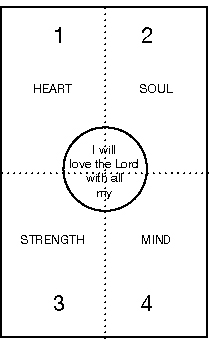
Today’s object lesson is about following directions. Your congregation will take a test.
“Hear, O Israel! The LORD our God, the LORD is one! You shall love the LORD your God with all your heart, and with all your soul, and with all your might” (Deuteronomy 6:4-5).
The Old Testament Lesson is called The Shema, the Hebrew word for Hear. It is the key Bible text in the Christian/Judaic scriptures.
The Psalm reassures us that there is happiness in following God’s ordinances.
The Epistle and the Gospel dance around the established authorities of scripture—the priests, scribes and Jesus.
Today’s Gospel follows a number of exchanges between various religious leaders who challenge Jesus. There seems to be some confusion among Jesus’ followers. In comes a scribe, a fellow who is used to being the “go to” guy when such questions arise.
Scribes were respected teachers, entrusted to copy and interpret scripture.
So, in this exchange, we have “dueling teachers.”
As we read today, we might be waiting for this scribe to get his comeuppance from Jesus, the great teacher.
That’s not what happens!
The tables are turned. This time Jesus is quizzed.
The question: What is the most important commandment?
We can be amused that Jesus passes the scribe’s test, but Jesus took him seriously. He could have answered, “How dare YOU question ME!” But Jesus embraced the moment. He enjoyed the exchange just as any good teacher might enjoy debating a worthy colleague.
Jesus’ answer assures the scribe that He has not departed from the traditional Jewish teachings. And so the scribe, who clearly knows his stuff, is neither embarrassed nor intimidated.
The following exercise is adapted from a “listening” exercise used with school children. There is no trick. It’s just seeing if you can follow directions. Educators claim that despite the simplicity, it is, in fact, a challenge. The only suggestion from teachers is to tell them you will not repeat a direction more than once. They have to LISTEN if they are to OBEY!
You might interweave this with your actual sermon.
Make sure there is a blank piece of paper and a pencil handed out to each worshiper before the sermon or with the bulletin.
Before the sermon. Instruct the congregation to fold their piece of paper in half lengthwise. Then ask them to open the folded piece of paper and fold it a second time crosswise. Again, have them unfold the paper. They should have a piece of paper that is neatly divided into four sections. Have them number the sections. 1, 2, 3, and 4.
Have them draw a roughly two-inch circle in the center where the folds cross.
Have them write inside the circle, ” I will love the Lord with all my”
Tell them to listen carefully in the sermon for further directions.
Interspersed in your sermon give the following directions.
In section 1, write HEART
In section 2, write SOUL
In section 3, write STRENGTH
In section 4, write MIND
Congratulate them for following your directions. Challenge them to follow the directions of the commandment.
Bonus question: What is the second most important commandment. (See if they were really listening!)
Join Bishop Ruby Kinisa as she visits small churches "under cover" to learn what people would never share if they knew they were talking to their bishop.
Undercover Bishop will always be available in PDF form on 2x2virtualchurch.com for FREE.
Print or Kindle copies are available on Amazon.com.
For bulk copies, please contact 2x2: creation@dca.net.
MISSION INSPIRATION OFFER
A visual and biblical guide to help congregations define their missions.
Contact Info
You can reach
Judy Gotwald,
the moderator of 2x2,
at
creation@dca.net
or 215 605 8774
Redeemer’s Prayer
We were all once strangers, the weakest, the outcasts, until someone came to our defense, included us, empowered us, reconciled us (1 Cor. 2; Eph. 2).
Be calm. Wait. Wait. Commit your cause to God. He will make it succeed. Look for Him a little at a time. Wait. Wait. But since this waiting seems long to the flesh and appears like death, the flesh always wavers. But keep faith. Patience will overcome wickedness.
—Martin Luther



 Every small church is in this position. Many are finding out that they don’t need to structure their “team” quite the way they have in the past.