4/7InkzHVUEQeEdU9vpc1tikzEhChrKmPfvXI-FSDBrBQ

Uncategorized

Using the Internet to Reach the Person Next Door

Anyone with adolescents in the house has witnessed the scene where two or three young people are huddled in the rec room, each with his or her own cellphone or laptop, intently texting or instant messaging each other. Their eyes never meet unless something strikes them as funny and then heads fly back with youthful, exuberant laughter. Hearing that volcanic laughter rise out of silence will take adults by surprise. It is representative of just how engrained social media has become in the lives of more and more people.

Now Social Media is being used in this way by the church.

Pastors can use social media to reach their members and some may enjoy it. Be careful though. Social media such as Facebook are very public and people are still very private on matters of personal faith. A scan of some congregational Facebook pages can reveal all kinds of unsettling personal information.

Nevertheless, Social Media is a tool and according to this article, some pastors are starting to use it. As interesting as this article is, the comments that follow add more dimension, noting that it is not unusual for congregational social media to attract worldwide attention. That realization must be kept in mind at all times!

2×2 uses blogging as the hub of its social media outreach. We “meet” on the blog and correspond by email. We have befriended congregations in Pakistan and Kenya with weekly exchanges of news and mission. We ask permission before publishing anything about our friendship on our web site. We also have regular exchanges with churches across the United States and Australia. Few of them are of our own denomination, but that hasn’t mattered.

We don’t do this on Facebook. It’s too public and freedom of religion hasn’t reached every corner of the world.

It’s still a bit odd. There is a feeling of privacy when there really is none. An innocent exchange could cause trouble.

Worldwide dynamics are going to change the church. Congregations no longer need to wait a year or two to hear a Temple Talk from a sponsored missionary home on furlough. They can follow the work and ministry daily online. This will be a strength of the emerging church. Ironically, it will weaken the structure of the church while it makes the church stronger.

photo credit: Mike Licht, NotionsCapital.com via photopin cc

Join the Crazy Ones! It’s never boring!

Our little church has been called a lot of names over the last decade and put through our own share of hell — by the people who are supposed to support us.

Despite the years of degrading name-calling we are really just a community of believers who wants to worship in our own church, in our own neighborhood, fashion our own ministry with our own “discernment,” paid for with our own resources — the very things promised to us by the ELCA. As we approach our third Easter locked out of our house of worship, we revisit a 1990s quote from Apple. We don’t think we are crazy or geniuses. We just believe in our mission — what all church members are asked to do.

Enjoy! We also made a Wordle out of the words — just for fun.

Here’s to the crazy ones. The misfits. The rebels. The troublemakers. The round pegs in the square holes. The ones who see things differently. They’re not fond of rules. And they have no respect for the status quo. You can quote them, disagree with them, glorify or vilify them. About the only thing you can’t do is ignore them. Because they change things. They push the human race forward. While some may see them as the crazy ones, we see genius. Because the people who are crazy enough to think they can change the world, are the ones who do.  

Make Way for the Non-geographic Future Church

We are polishing our crystal ball again. This is what we see . . .

The Church of tomorrow will have only two sociological geographies — the local church and the worldwide church. Intermediary layers will be defined by local congregations as needed — not by hierarchies.

Denominations and regional authorities will become expensive drains on local churches with waning benefits.

They and national church offices — at least as we know them today — will become archaic, outliving their purpose and mission. Once the hub of thought leadership, educational/resource publishing, and social ministry implementation, they are already being phased out by economic realities. Any congregation can form alliances with a multitude of social causes locally, nationally and internationally. Any congregant can publish.

Congregations will become identified by their works which will make them more relevant and help them grow. If they are to survive they will find vitality — quickly!

Congregations will soon realize that the dollars they are sending to regional bodies are better spent in ways they can monitor and become involved with directly. Giving will improve when results are more visible.

This is all the result of the internet.

Every congregation has the same power at its fingertips. Soon churches will realize they will get more help and better advice if they bypass the systems of the past.

Part of this is driven by economics of scale. Business has a saying: “Go big or go home.”

The church will discover this, too.

In the past, each individual judicatory duplicated similar services supported by its own 100-200 congregations. Better services will be supplied by pooling resources of more churches than one regional body can support. Local churches will bypass judicatories and go directly to enterprising thought leaders who no longer need denominational affiliation to gain an ear.

The economic failure of judicatories will return talent now stagnating in management to work in congregations.

The best ideas will be too expensive for regional bodies to implement. They will, for a while, keep trying to do things the same way . . . and fail. Frustration will turn the tide.

Denominational lines will blur as the internet helps ideas cross traditional lines. Congregations will find their own sister congregations . . . and they could be anywhere.

In the past, denominations might have worried that doctrines and traditions would be compromised without layers of oversight. No longer! Everyone has access to the same technology. This will create its own checks and balances.

Turf wars are likely at first. They could be ugly. But the realization that hierarchies are no longer needed will begin to set in.

For a while, middle management judicatories will flex muscles, trying to rein in congregations as their power weakens. There will be casualties that will be an enduring shame…but a new church will emerge.

The local congregation will become more important than ever. It will be the local hands-on expression. They will display renewed vitality as they tap resources beyond the offering plate. They will identify mission and form alliances with like-minded organizations.

We’ve spent decades in interdenominational dialogue to achieve what the internet will achieve in just a few years!

The coming Church is going to be exciting!

photo credit: frompandora via photopin cc

Laity Need to Learn to Speak the Clergy’s Language

Talking with clergy lately, we heard some terms we doubt many lay people have ever used or heard.

Some terms universally understood among clergy describe congregational health. These terms include “hospice,” “caretaker ministries,” and even “undertaker ministries.”

Ask a lay person, “Is your church on hospice?” and they will probably look puzzled. As it dawns on them that hospice is a service provided to dying people, they will start to realize that the clergy person is asking if their church is dying and unlikely to receive meaningful support from their denomination.

They will keep listening as they recover from shock and anger sets in.

“Who’s your pastor?” might be the next question. “Is he/she part time?”

If the answer is “Yes, that’s all we can afford right now,” the clergy might nod and mutter, “Ah, —sounds like you have a caretaker ministry.”

The lay person has probably never heard this term either. When it is explained that “caretaker ministers” are assigned to churches to hold members’ hands as their congregations die, the sense of shock and anger is rekindled.

With any sensitivity, the clergy person does not use another term used among clergy — “undertaker ministers.” This type of minister has NO intention of growing a congregation’s mission and the assignment, in all probability unknown to the congregation, is that this minister is there with the denomination’s understanding that the congregation’s ministry be brought to a close with as little muss and fuss possible.

This is a prescription for church conflict.

Laity NEVER consider their congregations as dying. They are usually aware that they face challenges, but when they call a pastor they are ALWAYS looking for help with their ministry. Lay people understand that the mission is to serve. They think every clergy person they talk to or call — even on a part-time basis — has congregational health and outreach as their goal.

Laity need to use a bit of “clergy talk” when calling their ministers. If they sense the candidate understands that the mission under consideration is to close the church—not grow the church—the congregation needs to move on and make sure their denomination understands that the congregation considers mission and ministry the goal.

It might help if we all spoke the same language!

photo credit: aldenjewell via photopin cc

A Return to the Days of Muhlenberg

The Lutheran Church recently celebrated the 300th anniversary of its American patriarch, Henry Melchior Muhlenberg.

Muhlenberg was a German pastor who came to America’s East Coast at a time when its forests were first being cleared for farms. There were pockets of German settlers longing for pastoral help in establishing congregations that worshiped in their traditions.

Muhlenberg came to Pennsylvania and began founding churches. But he didn’t sit still. He planted churches all along the East Coast. Most congregations had only an itinerant pastoral presence, perhaps as little as once or twice a year. And they grew.

Ironically, after 300 years, we are at a similar time in history. The Lutheran Church is well-planted but its foundations are shaking. After a century of working to unite, we are subdividing. There is no unifying voice, no forum to bring us together.

Corporate thinking of previous decades may be responsible for the current crisis. As populations shifted to the suburbs, consolidation for economic benefit was favored. We began to measure our churches’ value by their ability to park cars.

We are learning today that the neighborhood church is vital. People want to worship close to home where the sense of community truly impacts lives and where they can make a hands-on difference.

But damage has already occurred. During the affluence of the 1980s, congregations that thrived through the hardships of the Great Depression, began to struggle. Part of the struggle was the need to fund a full-time pastor at higher levels of compensation than they had ever known. That in itself became the focus of church life . . . and it’s no wonder people became less attracted to church.

Small churches can survive this, but it will require fresh thinking.

Worship and mission must return as priorities. We have to think as creatively as our colonial foreparents thought.

It is time, once again, for the structure of the local parish church to change.

We must concentrate on the work that needs to be done, not the positions that must be compensated.

Clergy, it must be recognized, have a vested interest in the solutions they propose. Pastors deserve compensation, but looking for larger salaries from one congregation may no longer be possible as the norm. Churches that admit they cannot do this need alternatives. Locking church doors is NOT the answer.

Lay leaders must speak and be heard. Their forums are few.

Recognizing Jesus

Too bad none of the disciples were artists! They could have helped us all with one of the biggest questions of our faith. What did Jesus look like?

Biblical evidence is that Jesus looked like most people in Galilee and Judea. It took the kiss of Judas to help soldiers distinguish him from the others in the Garden of Gethsemane.

Artists over the centuries put their imaginations to work depicting Christ until the images began to look startlingly similar — however unlikely.

The earliest Christians didn’t seem to care about appearances. They had first-hand accounts of the disciples and apostles. The first depictions surviving today are from the 200s and 400s and are not very detailed. In fact, the depictions show Christ in action. His physical appearance is secondary to his works. They are like cartoons in simplicity.

The Eastern Church and its emphasis on icons in worship began to concentrate on the details of Christ’s appearance. Although they are stiff and representative, they are also beautiful, designed to be contemplated.

The Western church developed a genre of story-telling and teaching in church adornment and architecture that took the Eastern representations and made them breathe with realistic features in familiar biblical settings. The depictions were stereotypical and stiff in the Middle Ages but became more realistic with the rise of humanism. Jesus became easily recognized with features recognized to us today.

Modern people still want to know what Jesus looked like. We are accustomed to treasuring photographs, which is a very new historical phenomenon — not even 200 years old.

Our curiosity is insatiable. Recently anthropologists decided to answer this question once and for all. They used forensic methods to analyze excavated skulls to rebuild the face of the typical Jewish male who lived in Israel in the era that was unknowingly passing from BC to AD.

Now we know!

Jesus looked like the typical Jewish male of 2000 years ago.

Jesus looks like us today.

Jesus will look like our descendants to the thousandth generation.

But does it matter? Jesus asks us to see him in each other. Treat others well and you will be honoring me, he tells us.

No matter who takes the brush or chisel in hand, we don’t have trouble recognizing Jesus in art. It’s harder to see him in each other!

Children in Worship; Adults in Sunday School

Today’s Alban Institute Roundtable discussion again references the book, Scattering Seeds, by Stephen Chapin Garner, pastor, and Jerry Thornell, layman, of  UCC, Norwell, near Boston. It is interesting that the Alban article lists only the pastor as author, leaving off the name of the lay co-author.

That’s what this book is all about, the changing roles of pastors and lay members. 2×2 will be reviewing it later this week.

Meanwhile, today’s discussion focuses on a favorite topic of 2×2’s: children in worship. This was the biggest surprise as our Ambassadors visited 41 churches in the last 18 months. We thought the Lutheran tradition was to have children worshiping side by side with their parents, deeply involved in the communal worship experience. We found that the overwhelming number of Lutheran churches dismiss children from worship before the Scriptures are read. In one church we visited, the fairly healthy attendance at worship dropped almost in half as a surprising number of adults accompanied the children out of the sanctuary.

The findings of this book support our concern. The Norwell experience found that the inclusion of children in worship created a more vibrant youth presence. There was more continuity between childhood, teen years and adulthood. We thought this was always understood among Lutherans!

Children in worship are important to the life of the congregation and continuity of Christian family. You do not exclude children from the family dinner table because the conversation is “over their heads” or not of interest to children. Children become interested in the concerns of the adults in their lives by listening. They learn the rules of social interaction by watching the give and take. The day will come all too quickly when the young child adds his or her two cents to a topic no one realized was noticed by the youngest. All heads may turn for a moment, but the conversation will go on . . . and grow.

Adults benefit. They have a chance to connect with their children and learn about their concerns. They begin to see the world through the eyes of a new generation.

Similarly, this book advocates for a stronger educational experience for adults. 2×2 suspects this is vital to healthy congregational life.

Redeemer, our parent church, followed this advice. Children were very active in worship and often volunteered when they thought they were ready for a new role. Children led prayer. Middle schoolers often told the children’s sermon story. They shared church leadership. They sang and accompanied music. When they came back from church camp, they insisted on teaching the songs they had learned to the congregation. They acolyted, they took the offering and read lessons. Our church, like Norwell, was experiencing significant growth.

Sadly, they have been locked out of their church for a significant part of their childhood.

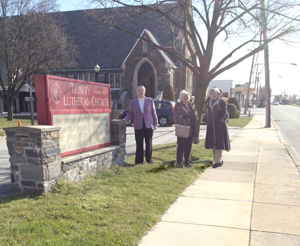
Ambassadors Visit Trinity, Manoa/Havertown

Three Redeemer Ambassadors visited this active church on West Chester Pike near City Line Avenue this morning. The congregation has been of interest to us for some time since one of our members, a retired Lutheran minister, remembers serving his internship year with this congregation 60 years ago. Unfortunately, he wasn’t with us this morning, but we took photos to share with him!

The 10:45 service had about 60 in attendance, including a nine-member choir and piano accompanist for all worship. A lovely solo, Panis Angelicus, began the service. The sermon was about keeping the first commandment — giving your all for Lord. The message rang clear to our Ambassadors as our people have sacrificed greatly for our church, laying much on the line as individuals. Our devotion has been ridiculed and taken advantage of by denominational leaders. But the pastor, Dr. Dolores Littleton, admitted in her sermon that it is a difficult commandment to honor.

Members were quite friendly. Several went out of their way to talk with us and we had several good conversations.

The congregation seemed to be pulling together on many projects including an upcoming mission trip to West Virginia. It was older adults bragging to us about their youth’s activities. Their youth had just participated in a youth retreat in New Jersey and slides from that event were on display in the fellowship room.

One member talked to us about a ministry meeting in their building called Oromo. We had seen this listed in directories but could learn nothing about it. He described it as a ministry exclusive to those from an area of Ethiopia. We discussed our East African outreach with him and how we had grown into a multicultural congregation.

The pastor expressed a sentiment that she wished Redeemer members could move on and forget all the anger. Anger is a rightful byproduct of injustice.

No one suggesting we should move on — including our bishop — ever presents any realistic options. Law suits filed against our church and individual church members left no choice but to defend.

Which church near us (all which voted to take our property) would be willing to welcome us? We’ve visited almost all of them. They are very much like Redeemer in size and joining one of them is likely to find us being treated the same way all over again in a few years, just as our nearest neighbors — Grace and Epiphany, Roxborough, were before us. We care about our church and neighborhoods and are bound by faith to minister in our own community.

Redeemer is dedicated to finding answers to urban ministry challenges — not shuffling people, their faith and properties like playing cards.

Creating A Congregational Culture that Welcomes Growth

A favorite moment in the popular game show, Wheel of Fortune, is the moment when the leading contestant realizes he or she has won the bonus round and a huge jackpot. Family and friends instantly surround the winner and the perennial host, Pat Sajak, walks away and allows the family to enjoy their moment on national TV with no attempt to share the spotlight.

Pat Sajak is a gentle and unpretentious host. He seems to truly enjoy the contestants and their quirky hobbies or unabashedly mundane lives. Each contestant is welcomed and accepted.

His personality has helped to create a game show culture that encourages success and gently helps players recover from misfortune or nervous blunders.

It is no wonder that this game show is a favorite. Every contestant knows he or she is safe from potential nationwide embarrassment and has a good chance at success. Viewers at home feel comfortable as well, rooting for the success of each player.

Congregations have cultures too. Some are centered on the personality of the pastor. Others are centered on long-standing traditions or family or lay leadership.

Developing a congregation’s culture may be an overlooked key to achieving church growth.

Culture is what visitors first encounter. Culture is the impression they take with them.

The challenge to each visitor is to measure whether or not they will be able to fit and flourish in the culture they encounter.

Culture can be cultivated. It can be nourished and encouraged. It can change!

While each culture embraces the same Scriptures, the group of people representing your congregation to the community has its own personality, its own priorities, and its own system of values and rewards.

Visitors will pick up on your culture immediately. Whether or not they return depends a great deal on what they see and feel, more than the quality of worship or the sermon.

Congregational culture can take cues from its denomination. The attitudes of top church leaders cannot help but trickle down. When, for example, there is a change in the papacy, it isn’t long before the rank and file adapt to the priorities of new leadership.

The opposite may also be true. Congregational culture can also affect leadership and guide the attitudes and values represented by the denomination.

Here are some questions to help you examine and shape your congregational culture.

Does your congregation value life-long education?

Does your congregation draw all members into leadership?

Does your congregation know its priorities, needs and goals?

Does your congregation have established cliques?
Is there an attempt to involve different groups of workers on various projects? 

Does your congregation enjoy being together? Do you have fun?

How do you achieve this?

Share the work.
Give everyone a chance to play a leadership role. That means giving people room to make mistakes and learn. Create a culture that is nurturing and forgiving. If your congregation has long-standing lay roles, it may mean creating some new responsibilities for new members to become involved. Encouraging the new does not necessitate discouraging the old!

Praise your members.
If you are the pastor, take a cue from Pat Sajak, walk away and let the attention fall on the members. Let their lights shine. Avoid the spotlight entirely. Let members praise and encourage one another.

Educate gently and often.
Education is an ongoing process. Talk about your mission and goals. Tie your work to scripture. The lecture hall is dead. Sermons, like lectures, have limited impact. Spread your message out in bytes and teach by example.

photo credit: Thomas Hawk via photopin cc

2×2 Has 4000 First Time Visits and Counting

Today 2×2 registered its 4000 first-time visitor just as we began our second year of posting.

We created our virtual church after our denomination locked us out of our property nearly three years ago. It’s been a grand experiment and we’ve learned a lot, all of which we are glad to share.

We’ve been watching the statistics and they reveal a great deal about the reality and challenges of ministry today.

Here’s a short rundown:

  • In the first two months of 2012 we matched the traffic for all of 2011 with more than 2000 visitors. If traffic continues to grow we may have 20,000 visitors by this time in 2013.
  • Someone from every state has visited 2×2 with the most visitors from Pennsylvania, California, Georgia, Iowa, Texas, Ohio, New Jersey, Minnesota and Illinois.
  • 68 countries have visited 2×2 with regular readership in France, Great Britain, Canada, Australia, Pakistan and the Netherlands. Traffic in Africa and South America is beginning to pick up.
  • Traffic comes in peaks and valleys but the peaks are growing taller and the valleys less deep.
  • We have about 80 readers subscribing to our daily blog feed and an average of 37 miscellaneous visitors every day. Together that’s more than 100 readers every day.
  • We’ve had more than 200 new weekly visitors for the last four weeks (not counting subscribers).
  • Most readers come looking for advice on using social media or for the worship resources we’ve made available.
  • Our multicultural series was reposted in Texas.
  • Two seminaries have shown an interest in 2×2’s thought leadership. Our posts have been circulated for discussion among students.
  • We are starting to form friendships with churches all over the world as we make it a point to write to anyone who comments. Some are becoming pen pals, praying and fasting for our church. We pray for them regularly as well.
  • We’ve created links for special projects of others and are helping their ministries grow.
  • Our most popular post continues to be a review of our visit to Trinity, Fort Washington, and their pastor’s object lessons for adults.
  • Just in the last month, dialog started to pick up on the topics we’ve introduced, drawing comments from leaders of some sizable churches.

2×2 is a small church fulfilling a big mission. We’ve just begun!