4/7InkzHVUEQeEdU9vpc1tikzEhChrKmPfvXI-FSDBrBQ

Uncategorized

10 Reasons to Question the Wisdom of Interim Ministry

Interim Ministry is a fairly modern trend of assigning a short-term minister to a parish that has recently ended a relationship with one pastor and intends to call a new pastor. The process is described in a similar manner by various denominations as a time to minister to the people and help them identify ministry objectives.

One denomination described the interim period as a buffer between a congregation and its relationship with a former pastor and expectations of a new minister. One said, “The interim minister makes the necessary changes in a congregation. No reason to have the congregation get mad at the new minister. Let the interim take the heat.”

The days of a congregation enjoying the leadership of a single pastor for decades may be numbered.

This sounds like a good idea on the surface, but there is a danger that the practice could serve less noble purposes. Our recent visits to 34 congregations found a surprising percentage engaged in some stage of interim ministry. Some were just beginning the process. Some had been in interim status for more than a year. One had a new interim at our first visit and we learned a few weeks later that another interim was stepping in. “It didn’t work out,” the newer pastor explained.

Both the number of interim ministries we encountered and their length raised questions. We do not claim to have the answers but the questions could be important.

  1. What other aspects of our lives have such long fallow periods? We change presidents and mayors, jobs (and even spouses) without months of interim work. An argument might be that presidents and mayors have long campaigns before they are chosen for their jobs. That leads us to consider the call process.
  2. Perhaps it is the call process that needs changing? With the average length of pastorates fairly short — less than seven years — an interim ministry can be a frequent occurrence, adding to instability. The scenario could be 12-18 months of interim ministry, 12 months of honeymoon, three years of ministry, 12-18 months of interim ministry, etc. (Revolving door). While pastors may feel that the interim has eased the transition process, the lay point of view is that the process starts all over again every time the face in the pulpit changes — interim or not. The call process, at least in our denomination, can be unsettling. Candidates are given every opportunity to learn about the congregation, while the names of candidates are withheld from the congregation until a sample sermon is delivered. The approval process is often based on little more — yet congregations expect so much more!
  3. Shouldn’t congregations undergo a constant process of self-examination? If ministry is to be effective, congregations will change constantly. Communities also change quickly.
  4. Shouldn’t all pastors have skills to help congregations assess goals and strategize?
  5. Does the interim process change the role of lay representatives? Who does the interim pastor report to and work for — the congregation or the regional body? In several of the churches we visited, the interim pastor announced that he or she would be making a report to the bishop that week. There was no mention of any lay involvement.
  6. Wouldn’t it be easier to train one leader to handle change than to try to work with dozens of congregation members?
  7. Is the interim process good use of congregational resources? Congregations pay good money to the interim for a very short-term investment. If this is a period where ministry concentrates on self-analysis, that translates to a long period of time when resources are spent on activity that is not, at least for the time being, outreach-oriented. Are visitors during the interim going to be attracted to a congregation in long-term transition?
  8. Do interim ministries meet the career needs of pastors and administrative needs of regional bodies more than the ministry needs of congregations? Interim pastors are making short-term commitments. Short-term commitments are safer entry points for the many seminary candidates entering ministry as a second career. Interim pastors don’t have to consider the hassles of moving and relocating families. It’s an attractive opportunity for pastors who don’t want to make changes in their lives that may not match the career objectives of their spouses. But the congregations are expected to change!
  9. Do interim pastorates change the political balance? An overlooked consequence of the over-dependence on interim pastors is the shift of power away from the congregation. Interim pastors have close ties and loyalty to the denominational body and its current leadership. When a high percentage of congregations have interim ministries, that has the potential to skew the decisions of representative governing bodies.
  10. Why should the interim process, led by experts in interim ministry, take more than three months?

Ministries in Decline — The Boat’s Getting Crowded

The year was 1998. A few representatives from SEPA Synod Council were meeting with Redeemer congregation.

They had just made their first attempt to close our church and seize our assets. Working with the congregation council behind the backs of the congregation, they had convinced leaders to resign en masse to create constitutional grounds (where none existed) for SEPA to step in.

On cue, seven council members tossed their resignations (drafted by a synod staff person) onto the table. A synod representative scooped them up and declared “synodical administration.” But three council members refused to be part of the scheme. With the help of two anonymous pastors, they re-established the congregational council — following the constitution — and successfully challenged SEPA’s plot.

SEPA’s interference damaged our church and the network of friendships that characterizes all congregations. The council members who had worked secretly with Synod were disgraced. They left Redeemer with their families. Some had been at Redeemer for decades. We learned that our Synod rarely measures the personal cost of their actions.

There was also damage to our congregation’s reputation. The conflict challenged giving and our ability to attract leadership. Branded.

At this meeting, a synod council member (a pastor from a neighboring church) started to talk to our members about statistics of small churches, patiently explaining that we couldn’t survive.

We pointed out that what congregations in the heart of the city were currently experiencing would become problematic for churches in outer city neighborhoods and suburbs within a decade or so. It was time to find answers.

A decade or more has passed and the churches we visit today on the edges of Philadelphia look remarkably like Redeemer looked in 1998, including the congregation of the pastor who was lecturing us 14 years before. Most congregations are experiencing serious decline, often in double digits.

We are learning through our Ambassador visits, that even suburban churches with fairly healthy worship attendance face financial challenges. Two of the largest congregations we have visited have liquid assets very similar to Redeemer’s and are carrying a similar debt load. A remarkable statistical difference is that Redeemer was growing in membership and attendance while TREND reports show that the larger churches are in decline.

If so many congregations are failing, why are we pointing fingers? Time and resources would be better spent looking for answers.

One thing stands out from our experience. The trustees in 2008 reported to Synod Assembly that we had a vibrant outreach ministry, but it was not run in cooperation with Synod’s Mission Director. In other words, Redeemer was growing without Synod’s help!

There is NO requirement for congregations to run evangelism efforts past the Synod for approval. That goes against Lutheran polity.

The persistent attacks from our denomination have given Redeemer a valuable perspective. We actively seek answers to modern ministry challenges. This IS Lutheran polity.

We recovered from the 1998 damage and were again growing in 2007 when Bishop Burkat, facing serious Synod financial challenges, decided to evict our congregation from our property, effectively excommunicating us. As we approach 2012, without a building or much in the way of money, we continue our ministry and have a glimpse of where churches must go to thrive in a dramatically different world. We continue to grow in ways we did not anticipate as we create a worldwide community, forging invigorating intra- and cross-denominational bonds.

Congregations must be encouraged to find their own answers to ministry challenges. The prescribed way — by every statistical measure — is not working!

14 Reasons Congregations Should Avoid Social Media Ministry

Maybe Social Media Ministry isn’t right for you. There are plenty of good reasons to avoid it. 🙂

  1. Religion is a mystery. Let’s keep it that way!
  2. Let people form their opinions about our religion from the popular media. They do a pretty good job!
  3. Social media allows for too much interaction between clergy and laity. It’s best to maintain boundaries.
  4. We do not want to be known by our works. It’s a theological thing.
  5. Why monitor our image? We have a great reputation. No one could possibly have a beef with us.
  6. What if people who don’t know anything about us take cheap shots online? So what! Everybody knows the truth. No one will pay any attention to them.
  7. We want the people who join our church to know as little as possible when they join. That way we can tell them what’s what! We don’t want their ideas to mess up something good.
  8. Our congregation is a close-knit family. We are busy helping each other and don’t have time for other people’s problems.
  9. Pen and ink were good enough for St. Paul. No need to make any changes there.
  10. We think it is a bad idea to reach more people with the message of God’s love. What’s in it for us?
  11. If we start writing with other people in mind, they may get the idea that we care more than we really do.
  12. We can’t afford to serve any more people than we already serve. It’s just not in the budget!
  13. Who has time for this Social Media nonsense? Our current members keep us plenty busy as it is.
  14. Everything is great just the way it is.

Preparing Pastors to Embrace Social Media Ministry

We’ve written about this subject before, but it is important enough to tackle from a different angle. Pastors must start to learn and use Social Media if they are to minister effectively in today’s world.

If your congregation is lucky, you have a pastor who understands the power of social media ministry. It seems like a no-brainer for anyone with the objective of reaching more people with the Good News.

The reality is that many pastors were called and trained for the ministry long before social media was available. Even fewer have been ordained in the last five years or so when social media began to spread its roots all over the world.

Congregations must realize as they develop Social Media Ministry that it requires work — daily work. It is a discipline just like answering snail mail used to be. Your Social Media Ministry Committee (Evangelism Committee) will want very much to work with your pastor, but may encounter resistance. It’s not what pastors do!

Here are some tips.

  1. You must convince your pastor that your Web Site, Blog and Facebook or Google+ presence is not for vanity. Communicating with and cheerleading your current membership is only the tip of the iceberg for your Social Media Ministry potential. Examples of going beyond this are few but growing. 2×2 is an example. We are a very small church reaching more than 100 new readers each week within only a few months of launching our site. We are finding our way, but we are a step or two in front of most and will readily share what we learn.
  2. On the other hand, appealing to vanity might work! Pastors might enjoy knowing they can put a video or slide show on the web and be found in the search engines by thousands.
  3. Convince your pastor that the Social Media is a powerful evangelism tool.  It is not just a place to post sermons. It is about communicating with the neighborhood in ways that show the church cares about them. Ironically, the web allows you to reach the whole world while you talk to the guy next door!
  4. Take the teamwork approach. While professional leadership input is helpful, it is not a one-person enterprise. Clergy and laity must work together.
  5. Statistics can be helpful. Point out that your pastor can continue to prepare sermons that are delivered on Sunday morning to the same 50 people — or their insights can be condensed and delivered to 100s or 1000s every hour of every day.
  6.  Don’t overwhelm. This is where pre-planning and the editorial calendar become invaluable. If your leader can see what is expected during the week, it will help him or her to begin adjusting schedules and routines. Point out that people in all fields are rearranging their work habits to make room for the potential of Social Media. If  CEOs of Fortune500 companies can do it, so can clergy!
  7. Don’t let it go. If your church is like most churches, time is an imperative. This is a tool which can help churches move from where they are to where they need to be. You don’t want to wait years in hopes of someday finding a pastor well-versed in Social Media to take your church in a new direction. You need current leaders to embrace technology now.
  8. Find the help you need to educate and train your whole team, including your pastor. This is more of a time commitment than a cost commitment. There are many resources on line which are free. socialmediaexaminer.com, hubspot.com, hubze.com, copyblogger.com, interactmedia.com are good starting places. Workingpreacher.org is a seminary blog that uses Social Media techniques.
  9. Make education a regular feature of your Social Media Committee Meetings. Assign someone each month to research a topic of interest and present ideas and a list of resources found. Business support groups do this routinely. They hold weekly meetings and one member is given 10 minutes to speak on a business topic.

If you’ve found helpful sources online, please share them! We’re in this world together!

Calls to Action Are Nothing New to Christianity

A Call to Action helps your reader take the next step.

As you get comfortable with blogging you will want to start creating more interactivity with your readers. If you want interaction, you’ll have to ask for it. That’s where the Call to Action comes in.

Calls to Action are so important to the business world that they have their own acronym (CTAs).

You see them every day in advertising: “Call 1-800 . .,” “Send $24.95 to  . . . .” 

Typically, advertisers try to create a sense of urgency — a reason for people to take action NOW! They know that people need incentive to get off their backsides and do something. And so you see the warnings! “Act now. Offer ends July 4.” “Supply is limited.” 

This is not new thinking to Christians. Our whole faith is built on Calls to Action: “Follow me,” “Come and see,” “Do Unto Others . . . ,” “Love one another.” The challenge to the modern church is to translate biblical Calls to Action to reach modern Christians or seekers.

How do you create Calls to Action on your web site or blog?

Again, you see CTAs on web sites every day. “Click here,” “Download,” “Submit,” or “Enter.”

Churches can use the same tools. The goal is engagement with others and growth in Christian community.

Pace yourself as you build your community’s engagement and trust. 

Your CTAs should be stepping stones to involvement in your community. Help people move from the anonymity of cyberspace to “what’s in it for me?” participation to “how can I help?” commitment. In other words, watch your interactions with your readers grow from anonymous participation to sharing an email, to providing a name and eventually a physical presence.

Here’s a plan described in tiers or levels of engagement:

Your first-tier or introductory Call to Action might simply be to pose a question at the end of your blog article.

  • “What do you think?”
  • “Can you recommend a resource?”
  • “Share your experience.”
  • “Do you know anyone who can benefit from this idea?”
At this level of engagement, your only goal is to get people thinking about their involvement.

A second-tier Call to Action might be to provide a way for people to answer those questions on line with a comment box. Another possibility is to engage readers in a simple poll. Blogging software makes this easy. Limit your poll to one question and suggest just a few possible answers. It allows your readers to test the water. There is no risk. They are not sharing any personal information with you. Keep it fun. Everyone wants to know how their ideas stack up to others. Report the results of the poll in an entertaining way.

A third-tier Call to Action might be to offer something for download. 2×2 offers the Editorial Calendar for example. You can have this information offered freely (as 2×2 does) or you can ask for information when they download and begin to create an opt-in email relationship.

A fourth-tier Call to Action might be to interest readers in some action that requires a bit more initiative from your readers. Tele-evangelists, for example, often ask for prayer requests.

  • Sign up for our Walk for Hunger.
  • Volunteer to work in the Food Pantry or Thrift Shop.
  • Join our Prayer Chain.
  • Join our youth on their Mission Trip to New Orleans.
  • Attend our workshop on Autism.

A fifth-tier Call to Action asks for information and offers something of value in return for the information (an incentive). Do not ask for more information than you need. An email address may be enough. A physical address might be desirable. Keep in mind that the less information you require, the more comfortable it is for readers to participate and the higher the response. If all you need is a name and email address — that’s all you should ask for.

  • RSVP for Our Community Thanksgiving Dinner by November 1 and receive a beautiful Advent Calendar. (Blogging software will allow you to create the form.)
  • Sign up for Hunger Walk by October 15 and receive a free T-Shirt at the starting line.
We’ll explore the nuts and bolts of how to create and use CTAs in a future post.

Learning from Ministry Mistakes

A huge obstacle to transforming ministries is the fear of failure. Some failure is to be expected on the way to success. A congregation’s failures in ministry initiatives should not be a death sentence.

Our most eminent inventors will attest that their greatest contributions came after repeated failures.

Multicultural Ministry is particularly risky. Bonding can be difficult within families! Across cultures there are bound to be problems. Prepare to use failure to improve your ministry. People need to know that it is better to try new ideas and fail then to do nothing. Create an environment that embraces the risk of failure.

Unfortunately, in ministry, critics line the sidelines waiting for signs of failure. Some want to justify inaction with a ready “I told you so.” Although it is a harsh view, the reality is that some are waiting for small churches to fail to boost the assets of survivors. Congregations have significant incentive to avoid risking failure that may attract negative attention. Catch 22. Do nothing and wither. Do something and risk catastrophic resistance.

We’ve written in previous posts about the importance of preparing a congregation for Multicultural Ministry.

No matter how well prepared your people are, someone someday is going to say or do something that could be offensive to someone else — probably without realizing it. It may be a simple faux pas. It may come from a member who rarely attends. It may come from a visitor or a child.

No matter how thoroughly you plan, you are still likely to learn at the last minute that your best ideas won’t work for one reason or another for a cultural reason you never envisioned. That’s the nature of Multicultural Ministry. Be prepared for these moments.

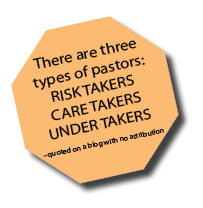
There are three types of pastors: Risk Takers, Care Takers, and Under TakersLearn to manage failure. It can be a stepping stone to success.

Regular evaluation of your ministry is the key to avoiding problems and overcoming the glitches which will occur. Weekly evaluation is not too much and the evaluation session should be as soon after an event as possible. You want to build on your strengths and minimize your weaknesses. You also want to be prepared to identify opportunities that sometimes arise from the most unlikely places.

Acknowledge: Don’t sugar coat failure. Call it what it is.
Analyze: Figure out what went wrong.
Adjust: Shift gears, dramatically if necessary.

The first two are fairly easy steps — uncomfortable perhaps, but easy. Just don’t dwell on blame. Be as honest as possible without discouraging those who have worked hard. Honesty means that all involved in the ministry are subject to review. If you are to find answers to your ministry challenges, you must deal with the good information. Include as many as possible in your analysis. Don’t allow a few with vested interests to define problems. That is likely to result in hurtful finger-pointing.

The adjustments you make must match the analysis. If your best information indicates that your visitors and new members aren’t relating well to an individual involved (including the pastor), your adjustments must fix that problem. Mission is the goal. Personal pride must be put aside.

From Our Experience

Redeemer’s success with our East African Outreach failed at first. We hosted a few successful services. Soon interest began to wane and after about a year we discontinued the effort while we worked on another initiative.

The idea never died. Our East African members wanted to resurrect the effort. First we spent a couple of council meetings analyzing why things weren’t working. Brutal honesty was necessary.

We identified three major problems.

  1. The Swahili service was entirely separate from the English. Only a few existing members were aware of the outreach and the new people coming and going remained strangers. The entire church was not invested in the project.
  2. Our first attempt to reach the growing East African community involved working with a pastor who traveled 90 miles to lead worship once a month. Bad weather, illness, scheduling conflicts made consistency difficult.
  3. The project was adopted by one person in the congregation who was not East African and who worked independently. Neither the existing congregation nor the visitors knew how to contribute. Help was soon hard to come by.

The remedies were simple once we all agreed on what the problems were. We enlisted more members to help with the service in peripheral ways — fellowship, etc. We found two rostered, ordained pastors from Tanzania who lived nearby. We assigned leadership for the project to our East African members who enlisted help from others in the East African community. Within a few months the newcomers felt welcome and part of our community. A membership drive initiated by the first new members resulted in 49 joining our congregation. Within a few months, Swahili members suggested uniting the English and Swahili services.

Sadly, our denomination remembered the failure long after we had begun measuring success. This is something the church as a whole needs to address if they are going to ask congregations to invest in new initiatives. Make room for failure.

Report of Redeemer’s Kiswahili Ministry

Ambassadors Visit St. Peter’s, North Wales

Redeemer Ambassadors took our farthest Sunday visit to date to the suburban town of North Wales and the congregation of St. Peter’s. We noticed on their web site that their traditional service times were changed for a united worship on Consecration Sunday. We did not know what a Consecration Sunday entailed but learned that it was Stewardship Sunday with a Dedication of Sunday School teachers ceremony. This is the second Stewardship Sunday we encountered. St. Peter’s made the day very hands-on and participatory.

The sanctuary was packed. All the church choirs were robed and singing, including a young children’s choir, a girl’s vocal group and an adult choir. The groups sang separately and in a combined anthem featuring a song Redeemer sings each week as our offertory — Asante Sane Jesu or I Am Thanking Jesus. We noticed that their women and girl voices outnumbered males by a huge margin — something like 10 to 1 and that made us appreciate the work of our East Falls Community Choir, hosted by Redeemer, and the influence of the Keystone State Boychoir on our boy singers.

A guest speaker, Rev. Karl Krueger of the Philadelphia Seminary, spoke on stewardship. Pastor Wagner led the worship and we couldn’t help but notice that although the sanctuary held at least 100 people, he seemed to have a personal connection with each worshiper. He welcomed us to their fellowship dinner, which was a feast of ethnic foods. We were fortunate to sit with another guest, the Rev. Jonathan Shin and his wife. He is new to the Synod and will be working with the Synod Mission Developer, something Redeemer was once promised by SEPA Synod but was never allowed.

The youth led a quiz on the life of Muhlenberg. Our Ambassadors were well prepared with the answers as we had visited Muhlenberg’s home church two weeks before and had taken a field trip to the Muhlenberg exhibit at Ursinus College.

The most meaningful part of the service to us was the dedication of the Sunday School teachers. Pastor Wagner had a student offer a blessing for each teacher which was very moving. Our Ambassadors often talk about the influence of the Sunday School teachers in our lives. Their names are offered in remembrance at each All Saints Sunday. As the ceremony progressed, youngest child to oldest child, we were able to replace the faces of the strangers before us with the memory of our own teachers.

Our 34th Ambassadors visit was truly memorable.

Letter to St. Peter’s

Ambassadors Report

Timeline

Our Once and Future Church

Today’s Alban Institute Weekly Forum builds on the re-release of the books written in the 1990s by its founder and president emeritus, Dr. Loren Mead. The Once and Future Church (1991)Transforming Congregations for the Future (1994), and Five Challenges for the Once and Future Church (1996) tackle the very issues our sponsoring congregation, Redeemer Lutheran Church, has been facing since 1998.

None of our members was a scholar of his work at this time. We were just lay members working at what we believed was our mission. As we review the five challenges Mead poses for the church, we find remarkable similarities to the direction our congregation took — without leadership pointing the way but with dedicated lay people grappling, uncompensated and unrecognized, with issues as big as worldwide church.

Our discipleship has not been without cost. We have suffered both as community and as individuals. Most of the time we found ourselves very much alone. The church as a whole was struggling, its denominational leadership was struggling, its individual congregations — large and small — were counting every penny. Our small church was deemed insignificant.

Mead writes:

For now, here are the five challenges I see we have ahead of us: 

  • To transfer the ownership of the church. 
  • To discover new structures for the church. 
  • To discover a passionate spirituality. 
  • To make the church a new community and source of community. 
  • To become an apostolic people. 

Redeemer deals with each of these issues:

  • We insist that the ownership of our community rests in the congregation. Our constitution and church polity agree with our position. But this has been of no protection. When assets are coveted, governing documents are quickly rewritten in the minds of church leadership. Clergy serving us disappeared with little or no notice or explanation. We were eventually evicted from our property. This was intended to be a final blow. Our denomination even predicted publicly that within six months, our congregational identity would die. 26 months later our congregation still meets weekly and has found new ways to serve which do not rely on property or professional leaders. 
  • Left without a building to support, we began creating a new congregational structure which reached out to other congregations, denominations and the spiritually minded with no church affiliation. How fortunate that the world was never more prepared for this type of outreach!
  • We discovered within ourselves a spirituality we didn’t know we had when we were passive pew-sitters, receptors of our clergy’s sense of spirituality. A foundation was quickly laid for the development of dormant leadership skills.
  • We embraced outreach tools that the church as a whole has been very slow to use to anywhere near full potential. Within months we found that our community potential was worldwide.
  • We work now to create an apostolic presence using modern tools.

Mead goes on to write:

“We need to recognize that a classic conflict of interest is at work here. Clergy-dominated institutions make many decisions in which clergy have a direct stake: salaries and job security, for example—sometimes involving prestige and preference. In our society we generally feel that institutions that nurture “conflict of interest” frequently make bad policy—policy that supports the welfare of those with the conflict of interest not the welfare of the entire institution.”

Mead calls for more dialog between clergy and laity. He cautions that dialog must be entered into with equal respect among participants. This, Redeemer has found, has been impossible. The conflict we have faced has been fought for four years with virtually no dialog and no foundation for mutual respect. Power, not mission, was central to the conflict from the outset.

Mead’s books were rightfully acclaimed when they were published. As they are re-released in a single volume for a new generation of church leaders, we can only ponder why his respected advice has been so strongly resisted by the readers who once found his thinking so ground-breaking.

We hope for a new generation who can not only applaud his wisdom but also apply it!

How to Monitor Your Congregation’s Social Media

It will take a while to create online dialog, but start preparing.

If you want to encourage engagement on your site, remember to ask. Businesses use Calls to Action or CTAs. Every good ad has one. It could be a phone number to call or a web site to visit. The interactivity of the web allows you to get fancier. Ask questions at the end of your post. Include a simple poll on the topic you are covering. Direct readers to something you’d like them to download. Link to another page. We’ll talk more about this later.

There are three major forums for interaction in Social Media. Facebook, Twitter and your Blog. Focus for now on your blog. Blogs encourage thoughtful interaction. Facebook is more of a free-for-all. Twitter plays an important role, too. All need to be monitored. If help is short, start with the blog. Blog platforms send the administrator an email when a comment is posted. You can review the email before it goes public. (We’ll address Facebook and Twitter in future posts.)

There are tools to help you monitor your Social Media, but the focus of our series is helping churches use this media. The reality is that church experience with social media probably relies on volunteers. Much of the advice you find online will not help you get started with the resources you have.

Begin by Drafting Community Rules

Draft a short statement to readers about the type of content you will accept.

Post Community Rules prominently in a sidebar on your blog and Facebook or on its own tab. Rules should be very short and should encourage participation and give readers a sense of comfort in joining your community. They’ll know someone is watching out for them.

Suggestion for Community Rules:
We welcome you to participate in discussion on our parish blog with opinions or questions that are presented thoughtfully, responsibly and with respect to our readers. We will not publish profanity of any sort and reserve the right to exclude comments that bully, harass, threaten, are libelous, hate-oriented, racist, or illegal. You may post anonymously but do not impersonate someone else. If you read content on our page that you think is inappropriate, please report it. We want this forum to make the world a better place. We know that includes criticism. Following the Community Rules will make this a safe place for everyone to have a say.

It is important to be open in your approach to monitoring. Negative comments should be deleted only if they violate the Community Rules.

Negative comments are an opportunity to address issues which may concern many people. It is a chance to witness! Do so thoughtfully.

  • Answer all comments. It creates relationships.
  • Accept positive comments graciously.
  • Address negative concerns openly. You may want to ask the pastor to respond, depending on the nature of the complaint.
  • If you encounter a “troll,” someone who is out to make trouble on your blog, here are a few steps to take.
    Respond publicly to the first comment or two. Address concerns in a forthright manor. If the complaint is legitimate the negative comments will stop. If negative comments persist, respond publicly one more time, saying that you are going to address future concerns offline. Then do it. Your readers know that you are responding but any nastiness is no longer public.

You are likely to receive more positive comments than negative, but both are important. Personal attacks should not be allowed. Give more leeway for criticism of public figures or elected representatives. By virtue of their office, they are open to criticism.

Monitoring Social Media is work. We recommend that you designate a few people to monitor comments. Have a talk about how you will respond and what to do if you don’t know the answer to a question. Divide the responsibility, assigning committee members certain days.

People expect replies within 48 hours. The value of the discussion decreases dramatically after that.

Over the course of a few months, you will see patterns to participation and can prepare for busy days. But make sure someone checks daily so that questionable comments are not hanging in cyberspace without your attention and those in need know you are listening.

Why Small Churches Are Ideal for Multicultural Outreach

2×2 is polishing the crystal ball. Looking into the future, we see the small urban church as having the best potential to implement multicultural ministry.

Here are the reasons why:

  • Location, location, location 
    Small churches sit in the middle of changing neighborhoods. If multicultural ministry is the goal, the church needs to be where the cultures are!
  • Heritage
    Small churches remain close to their heritage which often had their roots in immigrant ministry. Suburban churches are likely to have had a later historic start and missed that experience.
  • Size
    Smaller groups of people make it easier for newcomers to become involved in influential ways more quickly. They will not be lost in a crowd.
  • Ability to Adapt
    Small groups can change more easily and quickly with the right leadership. There are fewer minds to change. Leaders are easy to identify and motivate.
  • Personal Touch
    Guests stand out in a small church. Visitors readily greet them. This has been very pronounced in our Ambassador visits. Smaller churches meet and greet — before church, sometimes during church, and after church. Medium-sized churches often assume somebody else knows you and may say hello. Larger churches have an invitation to sign the guest book printed in the bulletin.

Small Churches Have the Best Shot of Leading the Way — Except

  • Many small urban churches are targeted for closure.
  • Their ministries have often been neglected with minimal professional leadership provided. Leaders are often assigned as “caretakers,” waiting for congregations to get discouraged and close. While they are providing “palliative care” the neighborhoods around them are changing with no outreach efforts attempted.
  • Interim ministries (the new normal) slow the process of change. While congregations are in a year or more of evaluation/assessment limbo, neighborhoods keep changing. When the congregation finally calls a pastor, they are starting over once again with probably another year before outreach can be attempted. That’s two years of a congregation’s history and resources spent focusing on relationship with a pastor — not outreach. With an average length of pastorate being just a few years, that’s a high percentage of a congregation’s time and resources focused on self.
  • Often, resources are depleted during years of maintaining a status quo and doing NO outreach. People are afraid to spend money, attempting to preserve assets for their current ministry as long as possible.
  • Assets of small neighborhood churches are sometimes eyed by the denomination.
  • Attitudes toward small churches, fostered by hierarchy, make them unpopular places for clergy to seek calls. What energetic pastors want to hold the hands of a congregation that has been labeled caretaker ministries with closure in the near future?

If denominations want to advance multicultural ministry, they must take a fresh look at the neighborhoods where multicultural ministry is most needed and find ways to make ministry possible.

The first challenge to the Church is to reverse the negative attitudes towards small churches as not worth the attention of church leaders. These attitudes squander the resources available for multicultural ministry.

This type of ministry requires special training. Seminaries must stress evangelism skills. The current scenario many small churches face is pastors who charge the laity to do this outreach. The laity have even less training than pastors! This is not working!

New ideas for teaming ministry talent (both lay and clergy), church agencies and resources must be explored.

Failure to address these conditions over the course of many years has created distrust between congregations and regional bodies. Reports from church consultants and online polls are consistently close in numbers. According to them, two thirds of church members have lost confidence in their denominational leaders with an additional 10% or more not sure. This should set off the sirens among leadership circles, but they have been slow to recognize the problems.

Rebuilding trust is a good place to start.