4/7InkzHVUEQeEdU9vpc1tikzEhChrKmPfvXI-FSDBrBQ

Uncategorized

Adult Object Lesson: Thomas the Doubter

shell gameJohn 20:19-31

The power of doubt

Poor Thomas. What a scapegoat he has been for all of us these last 2000 years!

Thomas’s mistake was not so much his unbelief—he wasn’t alone in that—then or now.

Thomas made his mistake in boasting about his superior intellect. He was no fool to be caught up in fantastic rumors.

You guys can talk all you want about the risen Lord. I’ll believe it when I see it. Strike that! I’ll believe it when I can touch his wounds.

What might have happened at this point? Jesus might never have appeared to Thomas. Thomas might have lived the rest of his days as the obscure apostle who doubted something only a few people were taken in by. In his superiority, he might have spent his remaining life retelling his “I told you so” story.
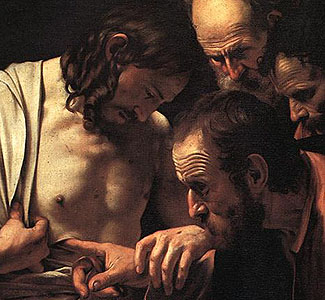
ThomasArtists in depicting Thomas’s encounter with the risen Lord have done him a great disservice. They like to show Thomas reaching out to touch the wounds of Christ, still open and bleeding. It’s more dramatic than depicting a dumbfounded Thomas.

In fact, this Gospel telling of the story reveals a proud man caught in a self-made trap.

John, the Gospel writer, does not tell us

…and then Thomas placed his hands in Jesus’ side and he believed.

Instead, John tells us that Thomas backs away from his boast. He immediately is humbled. He confesses his faith, “My Lord and my God.”

Your object lesson today is a shell game. Have three paper cups (or walnut shells) and three peas/beans or a similar small object. Set up the game in advance placing a bean under two cups ahead of time. A real shell game operator will make a great show of each cup being empty before the game starts. But your people trust you, don’t they?

As you begin your talk about Thomas, place the third bean under the third cup. Have your congregations watch as you shift the cups around as you talk.

Talk about how our fear of being proven wrong is the root of our resistance to God’s message. At the end, have someone choose a cup and reveal that there is indeed a bean to be discovered. You can reveal the other beans if you like. The point is that God made sure Thomas believed so that we might one day believe too.

God is in control of the outcome of the game.

Oh and by the way . . .

What actually became of Thomas?

Thomas is believed to have carried the gospel story as far as India. He wrote his own account of Jesus’ childhood and his own “revelation” that did not make it into the Bible.

We tend to forget the result of Thomas’s doubt.

Thomas’s doubt caused millions to believe.

photo credit: Mike Licht, NotionsCapital.com via photopincc

The Resilience of Small Congregations

shepherdlrSmall Church Resilience: A Squandered Asset

Today’s Alban Institute blog post addresses church resilience. It includes the thoughts of Judith Jordan who describes resilience as not so much an “intrinsic toughness” but more as an ongoing process of nurturing and fostering of relationships. 

All churches can be resilient. We notice resilience more when the stakes are higher—but both large and small churches can rebound. They can redefine their missions. They can survive.

Resilience grows from love.

That’s what the Church is supposed to be good at. Wealth gets in the way.

The Church at every level is challenged today. Almost all church activity is funded by the contributions of individuals. That quarter that clinks in the offering tray must fund the local church, a regional body, the national church and all church agencies.

It is getting harder for church entities more distant from the members’ pockets to survive. Power is their only tool.

In the Lutheran Church with its interdependent structure, there is very little power assigned to church hierarchy. They are supposed to exist as servants of the congregations. But the economy has hit them hard. They crave more direct access to the wealth of congregations.

They start to stretch their powers, tweaking their constitutions a little here, a little there, until they are wielding powers that were never bestowed upon them in their founding documents.

The sense of mission begins to fade. It becomes replaced with pageantry. Pageantry makes things look better—for a while.

The mission of most churches today is funding their budget.

In this atmosphere it is harder to see resilience. The message of love is lost.

Love breaks down barriers. It opens hearts.

Resilience is hindered in a culture of criticism and judgment. That’s what many congregations experience within the structured church. The list of judgments against small congregations can be long and fabricated. The claims are difficult to prove, but few care as long as they are not personally affected.

  • Lay leaders are too strong.
  • People are resistant to change.
  • People are living in the past.
  • People are unwelcoming.
  • People can’t support clergy.
  • People can’t accept new ideas.

Says who? The people who want to claim church assets.

Funny, the faulty lay people who are “destroying their churches” with their backward thinking are thriving in the secular world which changes more frequently and at a faster rate.

Much of the criticism of congregations reflects denominational needs.

Running a denomination is expensive.  Offices are expensive. Staffing an office is expensive. Keeping up illusions is expensive. The ONLY source of income for denominations is congregational members.

The poor, the needy, the sick, the young and old dependents, the infirm or visionaries need not apply.

Constitutionally, in the ELCA, no congregation is required to give to the denomination. Withholding support for a denomination may be the only voice a congregation has.

But denominations can ignore the voice and interpret the lack of support as the congregation’s failure—never its own.

It should be a huge red flag within a denomination when criticism focuses on lay people to the point of naming them and suing them. Any denomination that puts limitations on the laity’s ability to serve denies the example of Christ, who nurtured a ragtag group of peasants and spent most of his time with the needy.

You don’t hear limiting words from lips of Christ. All that comes later. It echoes through the centuries and may be the undoing of the mainline church.

Both clergy and lay leaders are all capable of leading congregations in renewal. But if their view of a congregation is only a measure of dollar signs for the denomination, then there is real trouble.

Any denomination that seeks to limit any individual’s talents is doing a disservice to their message.

God is love.

Easter 2013: Four Years Locked Out of Our Church

RedeemerEaster2013lrCan No One Roll the Stone Away?

Redeemer members gathered this Easter on the sidewalks of our forbidden house of worship. Our pastor led us in a song. We took turns singing verses of I Know That My Redeemer Lives. Redeemer still is a church full of soloists.

We then went to a member’s home for Easter Fellowship. Ham and kielbasa. Delicious.

We had changed our Easter time to accommodate the plans of our members. So when two carloads passed by the church at the normal time for Redeemer worship (10 am) they found an empty church (as opposed to an empty tomb).

We caught up with them later and took a second photo.

Fortunately, we can resurrect our sign which our bishop was so intent on destroying. It’s looking better than the church!

Take away the name. Take away the heritage. Destroy the church. Control the wealth.

SEPA, let the people who love a church, care for it. That’s the Lutheran way.

RedeemerEasterBaptism

Lutheran Fraternal Insurer Seeks to Serve Non-Lutherans

kangaroo2Is there something to be learned from this?

Thrivent, once known as Lutheran Brotherhood, is a financial fraternal association serving the members of all Lutheran denominations.

Redeemer’s Thrivent members recently received a ballot to vote on a proposal to expand their service offerings to other Christian groups.  (They must not have heard that we’ve been kicked out of the Lutheran Church.)

It was inevitable as the Lutheran population dwindles that the financial fraternity would have to expand its economic base and welcome more people into the brotherhood.

This raises some questions about church voting. If an insurance company can open a vote to every member, why do we still rely on representative assemblies voting for us at the Synod level? Might the Digital Age afford us a better way?

Representative voting relies on voters having the knowledge and experience to do a conscientious job. In this regard, the voting procedure within the ELCA is seriously flawed.

The Evangelical Lutheran Church in America adopted a quota system at the time it was formed 25 years ago—before the power of the internet was unsheathed. The original system (faulty as it was) has been tinkered with ever since. Votes are assigned by size of church, gender, language, and age. There is no good way to prove some of these characteristics. Redeemer was a church with a majority membership of color, a strong youth population and multi-lingual. Not only were we never allotted extra representation for any of these demographics, as the bylaws allow, but the bishop (at the last minute) declared us ineligible to send any voting representatives to the 2009 Synod Assembly—which the bylaws do not allow.

None of the voters at that Assembly raised any questions. We’ve been excluded ever since.

Under the quota system, credentials for representatives create a false demographic—an illusion of inclusion. A scan of the floor of a Synod Assembly might make it seem like SEPA Synod is highly diverse. We’ve visited 57 congregations. Diversity is the exception.

Twenty years of liturgical gerrymandering may have resulted in a voting pool that meets inclusion criteria but fails to be representative—or effective.

For example, many congregations have a majority female membership. They must come up with a male if they are to have the proper number of votes at Assembly. The males in the congregation may have no interest and are borderline involved in church government  but genitalia is valued above knowledge and commitment. 

An inexperienced voting assembly is putty in the hands of church leaders. How else can our Synod explain adopting six-figure deficits at a time when giving was down across the board and never stopping to think how those deficits would be overcome and at whose expense?

Voters who don’t understand the issues or consequences of their decisions follow the pack.

There are important documents and procedures which control the powers of the Assemblies and provide safeguards to the congregatons. It’s not just the constitution, with which some people have at least vague familiarity. It includes the Articles of Incorporation, which define the powers of the Assembly and control the extent to which the constitution can be changed. Practically no one is familiar with this document. For one thing it forbids the seizure of congregational property without the consent of the congregation and puts this matter outside the authority of the Synod Assembly.

Without knowledge of church government, Synod Assembly has become a venue to present a synod’s wish list for rubberstamp approval—not a venue for dialog or debate. 

All of this can be revamped for greater participation in an age where this is expected.

It is now entirely possible to allow all members a vote, but failing that they can at least be afforded a voice. It would take some thinking to make it work but it could bring benefits, fresh air, and true representation into the world of Church.

  • Regional offices will be forced to really engage with their constituency.
  • Congregations will have to be realistic about their memberships.
  • They, too, would have reason to engage members on issues that matter.
  • Members would have a sense that their involvement can make a difference.
  • Vested members may increase participation and giving.

Today issues can be presented to all church members online well in advance of the Assembly date. 

During this time, the regional office is free to communicate with all members of the church. Congregations have equal freedom to debate issues. Even individuals can take discussions online. People might actually become involved.

If it is too unwieldy to count each person, a congregation’s representatives can gather after the issues for debate have been aired for a few weeks. A one-day assembly is all that would be needed.

It’s something to think about.

It could be truly transforming!

If insurance companies can count every vote, so can churches.

Voting kangaroos have done enough damage!

The Economic Potential of the Small Church

squanderBigger Is Not Always Better

An earlier post included a bold and interesting claim.

There is more economic potential in an open church than in a closed church.

Fact: The mainline church, which includes the Evangelical Lutheran Church in America, is economically challenged. Decline is the norm whether a congregation is large or small.

The most fragile element in the mainline church is the upper rung—the hierarchy. (Lutherans don’t believe in hierarchy, but sometimes we forget what we believe.)

Hierarchy is totally dependent on congregations. Congregations constitutionally control the land and monetary assets. They also drive mission.

This isn’t sitting well with leaders who like the idea that they are in control.

Nevertheless, this is is the way Lutherans like it. Predecessor constitutions actually forbade the synod level from owning property. Our ancestors sensed the temptation!

The ELCA’s founding documents and constitutions were originally presented to congregations protecting the congregations and empowering them with the control of their own ministry. As long as congregations are not violating the tenets of the faith, how they minister is their business. Lutheran congregations are not even required to support the hierarchy!

Today, the endangered hierarchy is making a big mistake. Their solution to riding out the economic crisis faced by every level of the church is to gain control of land and property for their own preservation. Their founding documents forbid this but most people—clergy and laity are unaware.

Hierarchies designed to shepherd and serve suddenly seek control. Power is discussed at the water cooler — not mission.

Attention and services become directed to churches of larger size with bigger offering plates. Smaller churches are neglected or ignored.

There is always a temptation of management-oriented leadership to assume that they know best. The ELCA founding documents protect congregations from this thinking by assuring congregations that their consent is required  when it comes to managing their property and ministry.

Well-intended constitutions have been ignored or amended to remove these safeguards. If a congregation does not cooperate with synod’s wishes or even if it is suspected that they might not cooperate —well, just get rid of the congregation. 

These policies, arguably illegal under Lutheran polity, squander the denomination’s strength—the community church—which sometimes is large but most often is small.

We will examine the economic potential of the small church from at least eleven vantage points:

  1. Legacy
  2. Voice
  3. Reputation
  4. Motivation
  5. Integrity
  6. Opportunity
  7. Immediacy
  8. Intimacy
  9. Mission
  10. Assets
  11. Promise
photo credit: outtacontext via photopin cc

Where Has Palm Sunday Gone?

palm2Ambassadors Weigh Palm Sunday Options

Palm Sunday was always a big day for Redeemer. In some ways, we looked forward to it more than Easter. Our congregation had many young families who traveled on holidays to visit the grandparents.

Palm Sunday was always a joyous celebration complete with a congregational ham dinner. We collected food to deliver to needy families for Easter at this event.

We celebrated Palm Sunday—purely Palm Sunday. We were joyful as were the people gathered in the streets of Jerusalem. Our new East African members added to our tradition, teaching us Swahili chants.

We could concentrate on Palm Sunday readings and sing several Palm Sunday hymns—not just one. We entered Holy Week the way Christians are supposed to enter Holy Week.

In recent years, the Church revisited Palm Sunday. Theologians despaired that Holy Week services were not attended as they once were. So they decided to combine all of Holy Week into Palm Sunday. “Captive audience” was the thinking. Consequently, there is now 10-minute nod to the celebration of Christ’s entry into Jerusalem before the Old Testament, Psalm and Epistle lessons are glossed over or skipped so we can read 114 verses of Luke. It’s long no matter how you try to break it up—way past the modern attention span.

The faithful, who observe Holy Week, are cheated out of their observance.

The Ambassadors are looking for a church where we can celebrate—truly celebrate—Palm Sunday. We may end up staying home tomorrow.

photo credit: kreg.steppe via photopin cc

Transforming the Role of Clergy in the Future Church

Transformational Ministry Requires Structural Change

Part of the challenge facing today’s Church is that the role of clergy and how they relate to congregations must change. Changes have already occurred in the numerous short-term and part-time pastorates. This is likely to continue while our expectations remain in the past.

The monetary demands on congregations have grown while the source of funding has been steadily dwindling.

Clergy spent decades griping about being highly educated but poorly paid. They had a point, but the resolution of their complaints has put their services out of reach for many congregations.

“Too bad!” might be a quick response.

The fact is that every church that fails diminishes the mission of the whole Church. Small churches reach more people. The economics of fewer larger churches make economic sense but don’t really work.

Fewer recent college graduates are entering the ministry. Today, candidates for ministry are often mature adults. Some are nearing the end of their careers—drifting from a professional calling. As older servants of God, with established families, lifestyles, and debts, they are looking for economic security and as little disruption to their settled lives as possible. Since clergy often view themselves as CEOs, the pay expectations are the pay expectations of older professionals.

The talent pool in which all congregations fish for leaders is crowded with candidates who can make only part-time commitments within tight geographic parameters. The pool of available talent may not fit congregational needs. Yet it is the role of regional bodies to place their rostered leaders in their rostered churches. Lots of square pegs in fewer round holes. That translates to unhappy clergy and congregations. Conflict often results.

That’s one side of the equation.

On the other side of the equation—the congregational side—an ongoing revolution has been underway. People have stopped attending church. The Sunday morning worship demographic is upwards of 50+.

The younger demographic—the demographic absent from church—represents well-educated career people, whose varied expertise is hard for professional church leaders to recognize if it competes with their own.

This is only part of the picture.

The needs of congregations change so dramatically that they are difficult to define and fill when the need is greatest. Community demographics, once stable for generations, now shift every few years. Congregations using the “settled pastor” model can easily be left with beloved leadership that is unable to serve the changing neighborhood. Decline sets in and everyone is afraid to make changes. We are church people. Nobody likes to complain—even those charged with the welfare of the congregation.

It is fairly clear that most congregations can no longer afford a full-time theologian in residence. Even if they could, it might not be to their mission advantage. The skills of theologians are no longer a congregation’s most urgent imperative.

Theologians are trained in the art of preaching — pulpit to pew communication. Modern church leadership must concentrate on communication beyond pulpit to pew. The pews are nearly empty.

Communication in today’s world is person to person. Very pastoral.

Money spent on making sure a good sermon is provided to a dwindling number of listeners is money that cannot be spent on reaching the people who are not in church—a key mission.

Yet the pastor’s salary is the foundation of every church budget.

The power in the world has shifted to the individual. This changes the way individuals think. We are no longer wired to understand the need to gather on Sunday morning—especially if our presence in Church does not recognize our abilities.

This trend is not likely to reverse. The Church is going to have to adapt.

In the Church, we see a structure that cannot budge. It continues to make unrealistic demands on the few people who remain loyal.

It is disheartening to be a lay person in today’s Church.

The typical congregation of the future, large or small, needs communications experts, education experts and service providers. We need business and entrepreneurial skills. It will be the rare pastor who can fill every need. It is unlikely that the growing pool of second career clergy perceive these skills as part of the role they are adopting late in life. (It may very well be the demands for change in their first careers that inspired them to turn to the Church.)

The day is coming when clergy will not be called to one congregation long-term but to multiple calls defined by skill sets which they will provide to congregations only for as long as they are needed.. They may join teams of clergy with complementary skills. Congregational budgets will detail mission tasks and will no longer allocate a large sum to one pastor.

This is an economic necessity and it will further empower the laity.

And then the Church might be transformed.

Adult Object Lesson: Philippians 2:5-11

Paul Teaches New Christians How to Think

This Sunday is Palm Sunday, a busy Sunday unto itself. In recent years the Church has combined Passion Sunday with Palm Sunday. The result is a marathon of emotions that is too broad for people to absorb. It doesn’t really work very well. We can neither enjoy Palm Sunday or take in the depth of the entire Passion Story.

There is probably little time in this liturgical panorama for an object lesson. The concentration will be on reading 114 verses from Luke. But let’s look at the lesson from Philippians and a bit of Isaiah 50:4-9a and Psalm 31:9-16, too. They are there for a reason.

Paul is teaching his new followers a new way of thinking.

Your object today is a pitcher of some sort and a bowl. You might even use the congregational chalice filled with water and be prepared as you end your talk to refill it with the wine that will be used for Communion—the blood of Christ shed for us.

Your pitcher is filled with water. Empty it slowly into a bowl.

Talk about how Christ emptied himself. The Passion Story is all about wearing down the Son of Man. Jesus took everything they threw at him. He turned his cheek to those who would pluck his beard—a wonderful image from Isaiah, today’s Old Testament lesson.

You might call attention to today’s Psalm in which the psalmist cries out that he is like a broken vessel. Totally empty.

But Christ’s empty vessel is not broken. It will be refilled. Christ empties himself and refills the void with something fresh, something no one expects of the Son of God.

He fills the empty space with the attributes of a slave. He becomes humble and accepting of God’s plan for him. He is obedient unto death — even a terrible death.

In his obedience, he becomes a servant.

It is hard enough for us to empty ourselves. It is painful. We would refill the void with our wants, our own sense of importance.

Christ fills the void with humility. It is a choice.

We, too, have the power to shape our thinking and passions—to fill the void in our hearts with things that are godly. That we would learn this lesson was one reason for Christ’s sacrifice. We should not ignore it.

How will we fill our hearts?

A Lesson in Branding Gone Terribly Wrong

Saint Patrick’s Day

Today is the feast day of a saint.

Everyone knows St. Patrick—the patron saint of Ireland, who lived 1600 years ago.

On a typical day Bishop Patrick donned a green robe and frolicked in the meadows of pagan Ireland, encouraging snakes to slither toward the sea and picking shamrocks.

At sunset, he would gather all his friends, neighbors, parishioners and merest acquaintances to join him in downing fermented beverages. As the night wore on, his inebriated following would begin asking theological questions—the answers to which Patrick excelled. He would pull a shamrock from the green nosegays he had collected earlier in the day and begin to explain the Trinity. His followers understood his teachings with amazing clarity.

The next morning, Patrick would pour himself a green milkshake. It helped the pounding in his head that came from thinking too hard about the Trinity.

And then he would sit down and write a hymn. It’s been a very long time since he wrote his most famous hymn. The tune is a rather awkward sequence of notes but the words reveal Patrick’s inner heart.

It reveals a man of piety that his festival day no longer honors.

I bind unto myself today
the strong Name of the Trinity,
by invocation of the same,
the Three in One, and One in Three.

I bind this day to me for ever,
by power of faith, Christ’s Incarnation;
his baptism in Jordan river;
his death on cross for my salvation;
his bursting from the spicèd tomb;
his riding up the heavenly way;
his coming at the day of doom:
I bind unto myself today.

I bind unto myself the power
of the great love of cherubim;
the sweet “Well done” in judgment hour;
the service of the seraphim;
confessors’ faith, apostles’ word,
the patriarchs’ prayers, the prophets’ scrolls;
all good deeds done unto the Lord,
and purity of virgin souls.

I bind unto myself today
the virtues of the starlit heaven
the glorious sun’s life-giving ray,
the whiteness of the moon at even,
the flashing of the lightning free,
the whirling wind’s tempestuous shocks,
the stable earth, the deep salt sea,
around the old eternal rocks.

I bind unto myself today
the power of God to hold and lead,
his eye to watch, his might to stay,
his ear to hearken, to my need;
the wisdom of my God to teach,
his hand to guide, his shield to ward;
the word of God to give me speech,
his heavenly host to be my guard.

Christ be with me,
Christ within me,
Christ behind me,
Christ before me,
Christ beside me,
Christ to win me,
Christ to comfort
and restore me.
Christ beneath me,
Christ above me,
Christ in quiet,
Christ in danger,
Christ in hearts of
all that love me,
Christ in mouth of
friend and stranger.

I bind unto myself today
the strong Name of the Trinity,
by invocation of the same,
the Three in One, and One in Three.
Of whom all nature hath creation,
eternal Father, Spirit, Word:
praise to the Lord of my salvation,
salvation is of Christ the Lord.

Who is the real St. Patrick?

The real St. Patrick was captured as a teen and taken as a slave to Ireland where he herded sheep—good training for a bishop. He describes his six years as a slave as prayer-filled. A vision put the idea of escape in his head. He ran 200 miles to the shore and hopped a ship. He reconnected with his family in Britain and studied for the priesthood. He returned to Ireland as bishop. It is unclear whether his assignment was to convert the pagans to Christianity or to protect the existing Christians as a minority religion. Either way, St. Patrick was a man of piety and prayer. His earliest followers and admirers depicted him wearing blue.

He was not always revered. Contemporary Irish wrote this mocking ditty:

Across the sea will come Adze-head crazed in the head,
his cloak with hole for the head, his stick bent in the head.
He will chant impieties from a table in the front of his house;
all his people will answer: “so be it, so be it.” 

That his festival day, which commemorates his death, has become a day of debauchery is a fairly recent historical phenomenon. The Republic of Ireland began highlighting the day in mid-1990s as a sort of branding. The intent was to unite Irish worldwide, projecting a culture rich in the arts. It was done in the name of national pride, tourism and economic development.

It has become a showcase for branding gone wrong. The intent failed to communicate the desired message. The imagery and reputation fell into the hands of the Irish themselves and Irish wannabes—consumers, so to speak. It immediately became associated with revelry — not artistry. It got out of control bigtime and became the advertising vehicle for big box stores, merchants of almost anything and every corner pub in the Anglo-influenced world.

Only some 20 years after setting out to create a cultural asset—even the Irish are trying to find ways to rein it in.

Too late. St. Patrick will be forever rolling in his grave.

Why Small Churches May Solve Mainline Problems

The Church’s Food Chain

FishChain2

Here is an interesting analysis of problem-solving potential.

On a scale of 1 to 10, 1 being the lowest, imagine you are a person with a level 2 strength of character and attitude looking at a level 5 problem. Would this problem appear to be big or little? From a level 2 perspective, a level 5 problem would seem like a big problem.

Now imagine you’ve grown yourself and become a level 8 person. Would the same level 5 problem be a big problem or a little problem? Magically, the identical problem is now a little problem.

Finally, imagine that you’ve really worked hard on yourself and become a level 10 person. Now, is this same level 5 problem a big problem or a little problem? The answer is that it’s no problem. It doesn’t even register in your brain as a problem. There’s no negative energy around it. It’s just a normal occurrence to handle, like brushing your teeth or getting dressed.

~ T. Harv Eker Quotes from Secrets of the Millionaire Mind

Let’s look at how this might relate to churches—most of which face similar multiple problems with varying degrees of urgency. Let’s say Big Church A and Little Church B both face thm same Level 5 Problem. Because we live in a society that considers bigger as better, smarter and more desirable, we are tempted to think Big Church A won’t find a Level 5 Problem to be any challenge. Similarly those who represent the big churches assume that Little Church B will find the Level 5 Problem to be insurmountable. The Management-minded Solution: Close Little Church B down and reallocate their resources to Big Church A who faces the same challenge. In reality Big Church A will have a more difficult time solving the problem.

  • It can avoid facing foundational problems longer. (The largest congregations in our denomination and region are showing large statistical losses, but are still viewed as more viable than small congregations that are holding their own.)
  • They have a process they must follow to solve any problem. Creativity is less likely to enter the picture.
  • Staff may be more bountiful, but problem-solving isn’t on any of the job descriptions.
  • Lay talents are viewed with suspicion.
  • New talents take longer to gain notice and acceptance.

The Level 5 Problem is likely to continue unrecognized for years. Taking on problems that few people recognize is asking for trouble.

On the other hand Little Church B is truly threatened by the Level 5 Problem. Their very existence depends on finding solutions. They start looking for answers. They evaluate the few resources and people they have and go to work.

And here is the magical nature of Little Church B. Every new person who walks through the door is a resource that can immediately be put to work. Leadership is cultivated. The roles of laity can change as problems force them to develop new skills.

The status of Little Church B, therefore, can change dramatically in months. Resilience.

Understand this. There are many more Little Church Bs than there are Big Church As. They are a valuable resource in themselves that is being squandered as we worship church size.

Management-minded regional bodies easily get stuck with prejudices — often fostered by years of disgruntled pastors who failed in leadership roles. They have rare interaction with smaller churches and view them as stagnating—lying in wait for the regional body to save them.

In reality, they haven’t given this notion a moment’s thought.

There is a prejudice that Little Church B cannot support professional services and therefore must be controlled or closed. No small churches have as their mission statement—We exit to support the clergy and contribute to the regional and national church. Yet this is the priority when evaluating viability.

This threat is felt at all levels of church leadership. They just don’t know what to do with Little Church B. Clergy hear God calling them only to congregations that ensure a comfortable living. The result is a form of cannibalism.

Regional bodies, strapped with their own survival problems, are tempted to manage small congregations. They usually manage them out of existence. Even so, small churches vastly outnumber large churches. They always will.

If the cannibalism (closing small churches and assuming their assets as their own) continues, the entire denomination will become a relic. There will be a few larger congregations sitting in suburban outposts with no real ability to serve the neighborhoods they stripped of their assets.

Fewer churches means there will be fewer traditional jobs for church professionals which will result in fewer seminaries, fewer service initiatives and much less need for the regional body.

Pretty soon, the larger churches who were content to watch as neighboring congregations were managed out of existence will feel something nibbling at their own toes.

Let’s end with another quote from a 20th century genius.

The significant problems we face cannot be solved at the same level of thinking we were at when we created them.—Albert Einstein