Another Favorite Story for Artists Through the Ages
There are many depictions of the story of Jesus’ visit to the home of Mary and Martha.
Here are a few, beginning with a straightforward representation of an icon. Icons are for contemplation. Icons present the basic story but leave the interepretation to the viewer.
Seventeenth century Dutch artist Johannes Vermeer’s rendition concentrates on the three key figures—Mary, Martha and Jesus. Jesus is being so patient as he explains his view of the situation to Martha. Focusing on the three main characters is a common approach. The biblical account suggests there were many more people present, including Lazarus and the Disciples.
Most artists tell the story in the setting and garb of their own era.
During the age of the still life, many artists put brush to this topic. Here is one by Italian artist Vincenzo Campi. Martha in the kitchen, surrounded by all the wonderful textures of a still life, is the foreground. Are you looking for Mary and Jesus? Pull out your magniying glass and look in the upper left background—behind the dead poultry. Martha sure has her work cut out for her.
Then turn to this modern depiction by Maud Sumner, a 20th century South African artist. Mary is lost in her thoughts. Martha is thinking about the work that needs to be done. Where’s Jesus? That might be him, reflected in the mirror on table. He looks a bit exasperated with both the ladies.
The last image is a touching detail from the story. Jesus’ gesture of love and acceptance comforts the criticized, adoring Mary. Martha is out of the picture.
What is going on in Rome right now might be of interest only to our Roman Catholic neighbors. But when one denomination boldly claims to be the one and only true church, they invite the attention of the rest of us neo-Gentiles.
Protestant leaders tend to emulate the Roman Catholics, often forgetting the reasons we separated 500 years ago. Some of the reasons have disappeared. Other have not. It’s probably envy for the attention the media gives to the pope.
Truth be told, Protestants have their own messes to clean up today—lots of them, in fact. We don’t really need to be watching so closely.
Nevertheless, beginning this week, all eyes will be on Rome. The process promises to take us close to Holy Week. Guess how much attention Protestant churches will get from the media this Easter season.
We don’t know how things will turn out. One learned church authority described the process and closed his statement saying, “In the end, it’s God’s choice.”
Really? God needs the help of 115 old men, each with considerable self-interest, to name his new Saul or Peter?
Why is the process so secret? Tradition is not a good enough reason anymore. Tradition has led to horrific abuses. Furthermore, tradition has condoned the abuses and made a habit of victimizing any voice of dissent. Again, Protestants share in these atrocities. For once, they can be glad the media concentrates on the Roman church.
Can we, perhaps, learn and adapt traditions so they make sense?
Secrecy in choosing leaders reveals distrust in any human ability beyond the chosen elite. It leads the Church down the road of management not leadership. Managers tend to preserve what they have as they seek to maintain and expand the same power structure. The privileged will remain privileged. Outsiders will fight for a voice.
Leaders, on the other hand, assess the existing resources and add dreams—their own and those of others. This is what the Church today — Roman and Protestant — needs badly.
Leadership has been with us always. In recent years, sparked by the Renaissance, the Reformation and the rise of Democracy, the concepts of leadership have been studied. Much of this research and analysis emerged during the last century but it continues as the world is redefined by digital communication. Old principles will be applied in new ways.
We know now that heredity does not ensure good leadership.
We know that occasionally the best leaders come from outside a given structure.
We know that genitalia is not a predictor of effective leadership.
We know that there is no chosen race that excels in leading.
We know that the most effective leaders are often unarmed.
We know that input from all leads to better decisions.
We know that any voting process is not foolproof.
We know that any power, however and once bestowed, needs to be watched.
We know that future power might be sitting today in a jail cell.
We know that power need not be a life-long mandate. Power can be passed on to successors peacefully and former leaders can return to “civilian” life.
And with all this new knowledge about leadership, we know mistakes can still be made and power can be abused.
Yes, we know more than we did some 2000 years ago, when someone had to figure out what to do upon the demise of Christ’s hand-picked favorite — the mercurial and passionate Simon Peter. They got it wrong a few times, terribly wrong for a while, which brings to question the conclusion that this is God’s process.
We have ample experience these days with dictators and despots—some benevolent, some ruthless.
We have learned that secrecy and exclusion is a predictor of problems.
Good leaders operate in open ways, building trust with honesty and accountability.
The Church has been very bad at this.
Protestants fall into the same trap. In our denomination there seems to be a behind closed doors vetting process. You have to play to have a say.
The archaic processes are designed to evoke mystery and keep the sheep at the far end of the fold with a few barking dogs between them and the emerging leaders.
Just look at the customs that are revealed on the evening news.
The papal apartment is sealed. Against what?
The stoves and chimneys are installed so that smoke can signal the cardinals’ progress. Come on! Even Pope Benedict used Twitter.
The mind games, always part of the process, become tiresome in the media. They would have us believe none of the cardinals aspire to stand on the balcony with the world watching. They are all so engaging as they describe their reluctance. One candidate is out of socks. Another just wants us to know he bought a roundtrip ticket. Coach or first class?
But again. This is all the business of the Roman Catholic church. It doesn’t involve the various branches of Christianity, including the Orthodox who were the first to leave the self-proclaimed one true Church. (Or did the Roman Church leave the Eastern Church?)
The difficult thing to understand is why Protestant leaders, excluded from the club, travel to Rome for photo ops with the pope. There is zero benefit to their denominations, which are surely footing the bill.
The reality is this: the papacy and all church leadership face a new age in which hierarchies as we know them will topple.
It could come hard. It could come easily. It’s going to come. Whomever God or the conclave chooses will be managing or leading God’s people into a new religious era.
Comparing SEPA’s Largest Congregation with the Church SEPA Says Doesn’t Exist
What do Trinity, Lansdale, and Redeemer, East Falls, have in common?
We both engage with more than 700 followers each week.
According to Evangelical Lutheran Church in America Trend reports, Trinity, Lansdale, stands alone among Southeastern Pennsylvania churches in numbers. It has nearly 5000 members and an average worship attendance of 725. Most other large churches in SEPA — and there are only a few — average around 400.
Most SEPA churches are much smaller with about 100 or fewer at worship (many much fewer). ELCA Trend measures only membership, attendance, income and expenses (in various configurations).
There are new statistics that will mean more in the emerging church. Churches don’t have to worry about collecting the data. The internet tracks results for you. This is where Redeemer is breaking ground no other SEPA church seems to be seriously exploring.
Redeemer is no longer listed in the Evangelical Lutheran Church in America Trend reports, although the congregation never voted to close. We’ll take that up with the ELCA later.
Redeemer was growing quickly although we were still among the SEPA churches with fewer than 50 in average weekly worship attendance—the only engagement most churches measure. The Southeastern Pennsylvania Synod seized Redeemer’s property and locked our doors in 2009—something about inability to fulfill mission. (They approved a $275,000 budget deficit at the same time they claimed our property.)
There was plenty to question at the time, but no one did. There is more to question now!
Redeemer has continued its ministry without our property. There is no rule that a congregation must own property.
Locked out of God’s House in East Falls, we took our ministry online with our blog, 2x2virtualchurch.com. We now have an average weekly following approaching 800 in new traffic and about 150 who subscribe to our site daily. We engage between 1000 and 2000 readers each week.
Redeemer may have the largest engagement of any SEPA congregation! The potential for effective mission is huge.
While the Southeastern Pennsylvania Synod of the ELCA has tenaciously tried to destroy our ministry, we adapted — and grew!
2×2 is written with lay leaders in mind. Our experience as a small church is that lay leaders are the innovators in ministry. Most have part-time pastors. Growing churches is not part-time work. The passion of lay people (an undervalued resource) is keeping many churches going.
Small churches need resources that don’t rely on paid skills.
We had an additional challenge. Redeemer is multicultural and multilingual. No single age group dominates. That means we can’t just turn to a choir or a youth group or a Sunday School class to create interesting activities. We developed materials that could be adapted to any eclectic grouping.
When we still had our building we posted these resources on generic ministry websites.
Two years ago we began posting them on 2×2.
We posted an Easter play Redeemer performed for all East Falls churches in 2009. It was downloaded 300 times last year and 3000 times this year.
This tells us how we can further serve the large audience of small churches. Search engine analysis shows us that people are beginning to find our content by specifically plugging in terms specific to our site (“2×2 Easter play” — not just “Easter play).” Our content is gaining a following.
We post at least two features a week which congregations can adapt. Early in the week we post an object lesson intended for adults based on the week’s lectionary. Mid-week we post an analysis of art that complements the week’s theme. These can be adapted to multimedia presentations that some churches now show before worship (just as Redeemer did). We will continue to build on this foundation.
In addition, we offer our experience in using social media with dozens of how-to posts.
One large church recently wrote to us: “A lot is written about social media and the church, but you are the only church actually doing it.”
In all likelihood, Redeemer has the widest reach of any church in SEPA Synod with followers all over the world. We engage with them one-on-one. We share ministry problems and successes and rely on one another for prayer.
What does this mean for ministry in East Falls? It means our worldwide reach can now benefit our local ministry. We have a new potential source of funding for ministry.
Redeemer always was viable despite SEPA’s self-interested reports. Our day school, locked since SEPA interfered, would be generating upwards of $6000 per month. (That’s nearly $300,000 of squandered potential over the last four years.) The web site could begin to generate several thousand a month within a year of nurturing—plenty of resources to fund a neighborhood ministry without a single coin in an offering plate.
Redeemer has never had more potential.
If mission is the goal in East Falls (and it is definitely our goal) the best potential for ministry is to make peace with the Lutherans who have steadfastly maintained and grown mission during the last six years of conflict. The property should be returned to Redeemer. This would be in keeping with Lutheran polity.
Our journey has been a leap into the future of the church. We could still be a small neighborhood church serving a few, focused on survival and paying a pastor—as is the case of so many small churches.
We’ve learned that it is possible for a small church to grow. We are very aware that 2×2 can grow beyond our own vision.
Meanwhile, the largest church in SEPA and Redeemer, the largest online church, are both fulfilling their mission with impressive results.
God is doing something new at Redeemer, East Falls.
The Story of the Prodigal Son is visually rich. Artists through the ages have loved it.
Artist Giovanni Barbieri focuses on the three key characters in the story. (early 17th century)
Part of the fascination with the story is the multiple points of view. It is easy to focus on the Father and Son and occasionally the second son.
This artist, Giovanni Barbieri, does this beautifully. We have little to notice except the gestures of the three key figures.
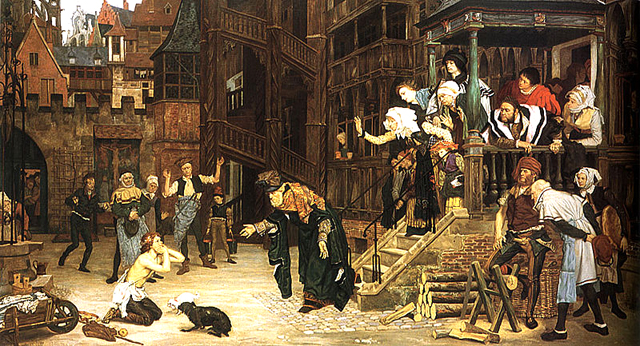
But many artists recognize that there are more players in the story. The Prodigal Son is worn down by many bad relationships. Some artists focus on this broader interpretation as seen in two paintings below by James Tissot (c. 1880).
One concentrates on the Return, the other on the Leaving.
In this retelling of the story, there is a mother or sister!
James Tissot tells the story with the involvement of the whole community.
Artists enjoy taking us to the depths of the son’s despair. Look at this painting which shows the son’s rejection by the society he so longed to own.
And then there is the scene with the hogs. What an image of despair!
There is plenty of emotion to explore whether it is in the selfish leaving, the desperate squandering, or the pathetic, yet joyful return.
Look below at the treatment by Rembrandt. Focus on the story told just in the depiction of the son’s feet.
It is easy to re-interpret the story through contemporary eyes. Each depiction above shows the culture and times of the artist. This painting by an African artist is no different.
Finally, a simple line drawing can be as moving as a full-color mural.
How would you draw or sculpt the Parable of the Prodigal Son?
March 4 is the date that commemorates my coming of age at Redeemer. It is the date of the funeral of a senior member of our congregation. It’s easy to remember. March Fourth — the answer to an old riddle—the calendar date that is an order.
I was happy being a peripheral member of Redeemer back in 1985. I was 31 years old and was just becoming active. I taught the adult Sunday School class. The members of the class were all senior women. They were part of the capable old guard in this neighborhood church. Redeemer had accepted women as leaders well ahead of the national church.
I had just been elected to the congregation council. I joined in the congregation’s shock when one of the long-time leaders announced he would no longer continue. Our pastor recommended they nominate me as president. I felt unqualified. It wasn’t that I didn’t know church. I was a seasoned preacher’s kid from a long line of Lutheran preacher’s kids. Families of clergy are accustomed to viewing church from the outside. Ministry is the family job. Add to that the fact that I was a country gal in an urban church. A guppy out of water.
I accepted the role of president on one condition—that Elmer Hirsh, one of the seasoned leaders, serve as co-president and teach me the ropes. Deal! The annual meeting at which I was elected was the last Sunday in February.
Elmer died on March 1. From that moment, it was trial by fire.
I took the job seriously and tried with success to lead the family church in facing the changing demographics of the neighborhood.
I convinced the congregation to stay open in the summer instead of ceasing all activity in East Falls and merging worship with Grace in Roxborough. Summer is when people re-organize their lives and the church should be open, I argued.
I was president when Redeemer received its fateful endowment in 1987. This large infusion of cash made it possible to call a full-time pastor once again. I saw the shift in attitudes among clergy that occurs when it is known that a small congregation suddenly has means.
I helped the congregation transition from running their own parish school to working with the Lutheran agency, Ken-Crest, to operate a school that could help even more children. This worked well for 25 years — until SEPA interfered behind the backs of the congregation.
I married into an old Redeemer family in 1988. I left for five years when the endowment began to cause tension with clergy. I didn’t want to be part of what was happening. My old guard husband stayed on — ever loyal, but growing disillusioned. We had just reunited at Redeemer in 1997 with a change in pastors when my husband suffered a catastrophic stroke. He was to live the last nine months of his life totally dependent.
His death coincided with Bishop Almquist’s first attempt to seize Redeemer’s assets. Had Bishop Almquist made his move a couple of months earlier, he might have prevailed.
I had been absent from Redeemer for nearly a year, caring for my husband—a 24/7 job, and for five years before that. Only a few weeks after my husband’s funeral, a Redeemer member called — a woman I barely knew—asking for my help with a situation that was brewing with the Synod.
I was recovering from a horrific year. I hadn’t been working. Newly widowed, I was the sole family bread-winner and raising an 8-year-old boy solo. Even so, I agreed to help the church that had become my family church. We reorganized to face Synod’s threats.
Thus began two years of needless fighting (1998-2000).
Redeemer had already taught me a lot about what makes people work well together. I learned from Redeemer that it is OK to fight. One older member explained to me: an occasional verbal bench-clearing is good for the team. I learned that these people knew each other well enough to fight and reconcile at the same meeting. There was no shame in insisting on what you thought was right.
One Sunday, there was a momentous argument. (I DO remember what it was about!) As is typical at Redeemer, the air soon cleared and everyone sat down at the same table to work together as if nothing had happened. I noticed our pastor’s wife standing off to the side, observing and grinning. I asked her why she was smiling. “That kind of reconciliation doesn’t happen in every church,” she commented.
It was the norm at Redeemer. What comes as a surprise to us is that others are incapable of arguing, standing ground, and reconciling. We still don’t understand why this is impossible with SEPA.
Bishop Almquist gave up the always unnecessary “synodical administration” and a year later returned most of the assets the synod had seized. But his actions did lasting damage.
The current feud was made possible by his precedent. It fueled gossip within the insulated environment of church hierarchy. Redeemer became fair game. It was OK to abuse and ignore us. They’d done it before!
Today’s six-year feud could have been resolved before it started with a good, bench-clearing debate, followed by reconciliation. We are all on the same side, really. The control of property and assets — which is clearly defined in our founding documents — stands in the way of reason and ministry.
Redeemer members are trying to uphold historic Lutheran polity. Lutherans are interdependent, not hierarchical. More and more Lutherans (including clergy) don’t know that!
Fueled by clergy gossip, the Synod views Redeemer’s fortitude as a threat to their power. We see our position as doing the job of lay people.
Lutherans believe in equality of and cooperation between laity and clergy. I learned this in Confirmation Class and from the examples set by Elmer Hirsh, my husband, my adult Sunday School class, and both the old and new leadership of Redeemer. They are all saints in my book.
Somewhere in the last 25 years of the new ELCA, this strength of Lutheranism has waned and may be totally lost as we seek to emulate the structures of other denominations. Logically, other denominations should be emulating us—we have the tradition of reformation. But the concept of hierarchy is once again attractive to those who crave power.
Congregations are expected to comply with whatever the regional body sees as best. The regional body’s vision is muddied with self-interest and waning support across the board. Its information, especially from under-served smaller congregations, is often dated. Still, it’s comply or die.
And so, at least in my mind, this week commemorates the death of old Redeemer and my inauguration as one of many leaders of a new Redeemer. We went in directions none of us foresaw (and SEPA wasn’t looking). We constantly reassessed our neighborhood, our resources and our pool of talent. We were on a solid course, which still shows more promise than anything SEPA has in mind.
We remain ready to work together toward reconciliation however unlikely it seems.
He describes ten reasons businesses die. They apply to churches, too.
1. As Yoda said, you just don’t believe it.
Luke Skywalker says, “I just don’t believe it.” Yoda answers, “That is why you fail.”
For all the talk about faith and belief, the Church often acts as if we do not believe our own message. We don’t believe small churches can survive, so we do nothing to help. Our leaders see no economic incentive in helping small churches. Regional bodies see themselves as better managers of money. They often are not. When the assets of one closed church dry up, they look for another small church to loot. The altruistic promises made to justify the seizures, are quickly forgotten. No one really analyzes where the money goes.
Bishop Almquist told us our assets were being put into a Mission Fund. It was later revealed that the Mission Fund fills the synod’s own spending deficits (which were frequently in the healthy six-figures). A few weeks ago we learned that Holy Spirit’s assets would go to The Bishop’s Emergency Fund. Does anyone know what that means?
Belief in the purposes of church—as in life—is foundational to success. More, when we believe in an all-powerful, merciful and gracious God. If we in the pew don’t believe and the regional body has self-interest in our failure — we have a problem.
2. Other people have convinced you of your “station.”
This brings to mind the school principal who fired a teacher when she learned that the teacher had told students from poor urban neighborhoods that they would never amount to anything.
We need this principal’s kind of leadership in the Church.
Any church leader who goes to a small congregation, accepting a salary, with the message that the congregation will never amount to much should be history.
Redeemer was lucky. Bishop Almquist had left us to die. “You’ll die a natural death in ten years,” he told us. He refused to provide even a caretaker pastor. But we found a part-time pastor who served us for three years. He told us we could be a flagship church. We believed. While SEPA was waiting out the ten years, we began to grow.
DiSalvo quotes Tennessee Williams. “A high station in life is earned by the gallantry with which appalling experiences are survived with grace.”
Disruption means that consistency, stability and certainty might get jettisoned for a time, and that puts our hard-wired internal defense system on high alert. Sometimes, though, you have to override the alarms and move ahead anyway. If you never do, you’ll never know what could happen.
Redeemer had put aside old expectations as we forged new ministry and began to experience success. SEPA allowed alarms to go off without ever sharing our successes.
We all want to leave a legacy. The Church feeds into this idea, too.
Our pastor in 2008 met with the bishop and never returned to our church. He sent word that rumors were being spread that he was leading a rebellion and he feared his reputation being ruined. A rebellion? A church defends its ministry and it is seen as rebellion! Bishop Burkat shamelessly used the fear of tarnished legacy to fuel her cause. She wrote in a letter to all pastors.
In the case of Redeemer, leaders did not cooperate with us and instead resisted tenaciously in an adversarial manner that publicly tarnishes the wonderful memory of ministry that has taken place in the East Falls community since 1891.
Small churches must learn to live in today’s world and guard against any appearance that protecting the past is mission.
6. You think there must be a pre-established role for your life.
This is part of the church model. We are who others tell us we are. Don’t dare step beyond your role — even if the role you played historically no longer has a need in today’s world. Instead of using our assets to explore new ways of meeting needs, the Church attempts to find new places where the old ways might still work. They call this mission and celebrate it as innovative. It is not; it is replication. Chances are such replicated ministries will fail soon after the publicity value wears off.
SEPA’s vision of Redeemer was that of a small family church. Redeemer started to transform from a small white congregation in a working class neighborhood to an international church in a growing collegiate neighborhood. SEPA was unprepared to serve us. They had been counting on our failure for 10 years!
DiSalvo writes that these pre-defined roles (agency) “is a figment our brains rely on to manage difficulty with as little trauma as possible. The first thing to do is recognize that….”
7. Your career appears to be well-established and that’s good, right?
We all know the role of the small church. Serve the immediate neighborhood with the message of God’s love. Support a pastor to the best of our ability. Maintain the property. (Not necessarily in that order.) But what if you stepped out of that role and began to serve in new and innovative ways? How would the church react? (It isn’t always pretty.)
8. You are afraid of losing what you have built.
DiSalvo ponts out that this is beyond our control. There is always a danger of losing what we have built. It should not determine your ministry. Unfortunately, in the Church, there are people ready to help us lose what we have built. This fear of being a victim of hierarchical greed is actually crippling the potential of the church. Lutheran congregations used to be fairly independent. It’s written into our founding documents as “interdependent.” But lately, congregations are looking to the bishop’s office for approval of decisions that are constitutionally theirs to make independently. This is what happens when you start forcing church closures. Congregations start to live in fear.
9. You think “maybe I’ve hit my ceiling.”
Many small churches stop trying. Pastors often stop trying. Synods encourage this when they use terms like caretaker and hospice ministries. Small churches must fight this mindset. But that, we learned, can be dangerous!
10. Confusion about where to go.
This is a huge problem in the church because the Church really has no vision for where it is going. Frequently, the people we look to in the Church as visionaries are people who have found a way to preserve the concept of Church as we understood it in the past. They are few. These pastors write books about their successes, hoping they will help others. Some of them are pretty good books! These successes are, however, often the result of a serendipitous combination of personalities and circumstances that is hard to replicate.
The Church, I suspect, is headed someplace very different than what we have known. At 2×2, we are excited to be part of it—even as we have been made to feel so very unwelcome in it.
The Number 1 challenge for churches who want to use social media but do not know how to get started is finding content.
This is new territory. In the past, church members had to seek permission to have a voice in the Church—earning the right with years of faithful obedience—best achieved in silence.
In the past, “content” came to us from the national church. Congregations subscribed to a service which provided bulletin shells with four-color art on the cover and a national church pitch on the back. We’ve visited 56 churches. Not one is using them.
The national church also published all curriculum and worship materials. Our visits reveal that worship books sitting in the pew racks are rarely—almost never—used. Instead churches are drawing from many sources — including the web.
2×2 uses seven types of content. When the well is dry in one, we move on to another. Generally, we rotate fairly evenly between them.
First of all, recognize this. If you don’t have a message, it will show. Blogging and social media is not for the timid. So take a look at each of these types of content and determine how each can “tell the story.” You don’t have to use them all. You can use just one of them consistently. But they are all available.
We’ll point out how 2×2 uses each.
1. Articulate A Dream
Think back to Martin Luther King, Jr. He had a dream and his actions and his sermons/speeches articulated that dream. Without the power of the internet, he rallied people around his vision. He sparked action. He dusted the cobwebs of bigoted thinking. He changed society. Just think of what he might have accomplished today! Find the dreamers in your congregation. Ask them to write. Otherwise that vision statement you worked on so hard might be wasted!
2×2’s dream is to restore neighborhood ministry in East Falls. We write about this often. In that quest we have discovered that other churches face similar threats. We try to help.
2. Teach
Social Media is changing the American classroom. It is turning the education process inside out. Old way: Students listened to lectures in school and went home to complete assignments. New way:Students listen to lectures at home and come to school ready to work out problems both individually and collectively. How this will apply to congregational education has yet to be explored. Explore it.
2×2 posts two about twice a week with teaching content — an object lesson suitable for adults and a religious art feature. They draw good traffic!
3. Persuade
Jesus and Paul were great persuaders. Jesus tirelessly told persuasive parables. Paul was less of a storyteller — at least in his preserved letters. A letter from Paul was a carefully drafted persuasive treatise. Each one articulated — often to disgruntled or confused people — the reasoning behind the Christian movement. The Church still has this need. Fill it.
2×2 tries to persuade our denomination to view small churches as powerful mission resources and not just assets-in-waiting for the larger church.
4. Analyze
The Church is accustomed to people of higher authority analyzing the world for them. This will change as it becomes easier to tap the wealth of experience and education sitting in the pew that never attended seminary. Choose a topic of current interest—or introduce a topic that needs attention. Look at it from every point of view you can think of. Then invite others to look at it from more points of view. The Church is a cornucopia of topics that call for this need. Theology. Mission. Ethics. Morality. Modern Life. There is no end of material. Much of it begs for attention.
2×2 analyzes the direction of the modern church from the small church viewpoint.
5. Review
People love to know what other people think. Review the popular movie or book. Introduce readers to less popular art, writing, music and cinema. Is a noted artist or choir coming to town? Give a preview to promote it and a review after the fact. Attend local school performances and write reviews. Be part of your neighborhoods!
2×2 posts occasional reviews and moves them to a review page. We have started to make a conscious attempt to attend local events and write about them.
6. Tell Stories
The foundation of all good communication: Tell THE story. Tell YOUR story. Tell the stories of members and mission.
2×2’s Ambassador Reports tell our story about once a week.
7. Curate
The web is full of information. When you come across something of interest to church members, SHARE. You can also link readers to interesting posts. Tell them why you found the post or video worthwhile.
Bishop Roy Almquist told Redeemer this at the turn of this century as a prelude for doing nothing to serve our congregation in his second six-year term.
He may have been very right.
It is no accident that small churches vastly outnumber large congregations. People are attracted to small congregations. Sociologically, an ideal congregation has about 150 members.
The model congregation must have 300 members to support the financial expectations of clergy and the regional body—and that’s before they do a lick of ministry or mission. When a congregation gets that big, it loses some of the qualities that attract many people to church.
A broader geographic area is needed to support this model which makes it more difficult for the congregation to stay in touch with the local needs.
The model is presented as economically desirable — fewer churches serving more people. But statistics show that fewer churches are serving fewer people. Statistics overall are down.
This model relies on the concept of a “settled pastor”— a pastor who serves a congregation for some seven years or ideally for decades. This is unrealistic today and is not likely to lead to church growth.
The epidemic of church closures is a result of a failure to adapt—hanging on to a dying model until it is too much work to turn things around—although it is probably still possible.
To survive in a diverse, quickly changing community culture, congregations need flexibility. They need to draw on professional skills that one person is unlikely to have. They may need these services for only six months, but they can’t get them because their money and fealty is tied up in one “settled pastor.”
Perhaps the growing number of clergy taking interim pastor training is a sign that they recognize that the “settled pastor” model will no longer advance the church from either the clergy or lay point of view.
The interim approach — a short-term plug for a hole which will eventually be filled more permanently — may need adjusting. It puts the management of congregations in the hands of the regional bodies—with which the congregations don’t have any day-to-day knowledge or relations. Similarly, regional bodies know only what they are told about the congregations by people with a vested interest. The odds for misinterpretation are good.
Congregational control of their own ministry — the Lutheran way — is slipping away. Attitudes are changing as the regional bodies rely more and more on their power and less on their sense of service. Congregations begin to defer decisions and rights that are constitutionally theirs. It doesn’t take long for this to become “the norm.” Congregations that insist on their rights are ridiculed and shunned—the Redeemer experience.
We will talk about this more in a later post, but this abandonment put us in an ideal position to experiment. And we were experiencing success.
The only answer many congregations hear is that they should continue to pour money down a non-producing hole until they are drained both financially and spiritually. Then, unable to meet the future, there is a grand celebration of the past as the regional body shutters the church and walks off with the spoils. Such a celebration is scheduled this week at Holy Spirit in NE Philadelphia.
What does the Devil look like? The answer is probably “more like us than we want to believe.”
We like the idea that we can recognize the Devil. We create a visual vocabulary so that we know the devil when we see him (or her). Isaac Louis in the 1600s shows a female devil tempting Christ.
There are centuries of art depicting the devil that engages Christ in the desert with horns, wings (the fallen angel) and a tail. The devil is wicked; anyone can tell just by looking.
The art above the headline shows the three scenes of temptation as depicted in St. Mark’s Basilica. It is straightforward in telling the three encounters with the Devil.
Most religious art becomes sparser in detail in the modern era as is evident in last month’s religious art post about the Transfiguration. Nevertheless, here are two very complex and contemporary depictions that are fascinating in detail. The triptych at the end of this post was found on the web about five years ago. I believe it was by an Episcopalian artist. Details could not be found now.
The second is by James B. Janknegt, a contemporary religious artist from Texas. The complexity of this depiction is fascinating. Study it. It was painted in 1990.
The devil is not as easily recognized and the desert is the world we know so well.
Join Bishop Ruby Kinisa as she visits small churches "under cover" to learn what people would never share if they knew they were talking to their bishop.
Undercover Bishop will always be available in PDF form on 2x2virtualchurch.com for FREE.
Print or Kindle copies are available on Amazon.com.
For bulk copies, please contact 2x2: creation@dca.net.
MISSION INSPIRATION OFFER
A visual and biblical guide to help congregations define their missions.
Contact Info
You can reach
Judy Gotwald,
the moderator of 2x2,
at
creation@dca.net
or 215 605 8774
Redeemer’s Prayer
We were all once strangers, the weakest, the outcasts, until someone came to our defense, included us, empowered us, reconciled us (1 Cor. 2; Eph. 2).
Be calm. Wait. Wait. Commit your cause to God. He will make it succeed. Look for Him a little at a time. Wait. Wait. But since this waiting seems long to the flesh and appears like death, the flesh always wavers. But keep faith. Patience will overcome wickedness.
—Martin Luther



 Here are a few, beginning with a straightforward representation of an icon. Icons are for contemplation. Icons present the basic story but leave the interepretation to the viewer.
 Most artists tell the story in the setting and garb of their own era.